The best headphone amplifier can add useful power, cleaner control, and more flexible connections to headphones that sound quiet or underpowered from a computer, console, or phone.
We compare 10 options for desktop listening, gaming, recording, guitar practice, portable use, and sharing one source with multiple listeners.
Best 10 Headphone Amplifier Picks for 2026
Best All-Around Desktop Pick

- Up to 2100mW output power
- USB-C, optical, coaxial, and Bluetooth inputs
- 4.4mm, 3.5mm, and RCA outputs
Best For: Desktop audio systems and gaming setups
Best for Shared Listening

- Four independent headphone outputs
- Separate volume control per listener
- Compact plug-and-play metal design
Best For: Tracking sessions and rehearsals
Best Audiophile Feature Set

- Fully differential 24-bit R2R DAC
- 2400mW output and balanced connectivity
- 10-band PEQ and LDAC Bluetooth
Best For: Enthusiast desktop headphone systems
Best Portable Budget Option
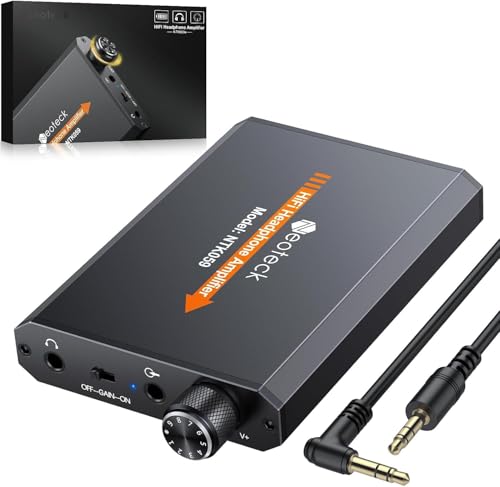
- Supports 16-300 ohm headphones
- Two-stage gain switch
- Over 12 hours of battery use
Best For: Portable listening with phones and laptops
Best Multi-Listener Pick
FIFINE N6 4-Channel Headphone Amplifier
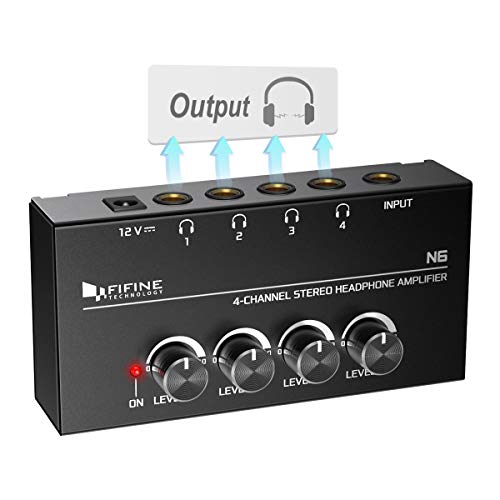
- Four separate headphone outputs
- Individual volume controls
- Compact metal build
Best For: Shared monitoring in studios, rehearsals, and home setups
Best for Guitar Practice
Fender Mustang Micro Plus Headphone Amplifier

- 25 amp and 25 effect models
- Bluetooth audio streaming
- USB recording and rechargeable battery
Best For: Silent guitar practice, mobile jamming, and recording
Best Desktop Hi-Fi Option
Douk Audio U3 Class A Headphone Amplifier
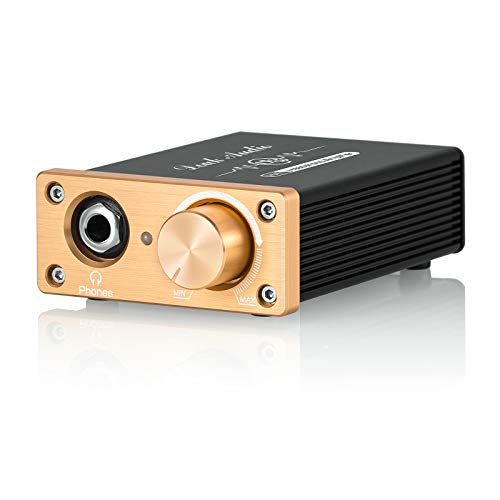
- Class A amplification
- Supports 3.5mm and 6.35mm headphones
- Op-amp socket for upgrades
Best For: Desktop listening with standard or high-impedance headphones
Gaming DAC Pick
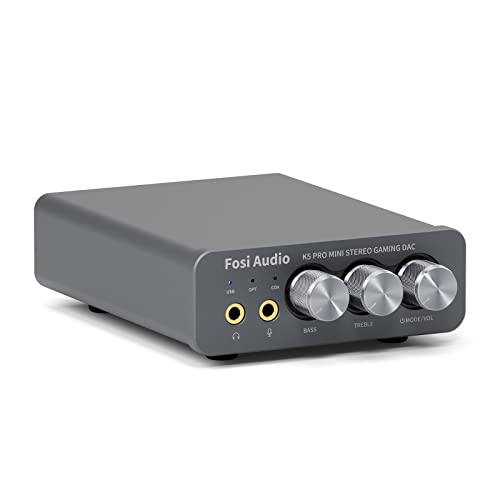
- Up to 1000 mW output at 16 ohms
- USB-C, optical, and coaxial inputs
- Mic input plus bass and treble controls
Best For: Gaming and desktop audio setups needing flexible connectivity
Best Heavy-Duty Pick

- Powers up to four headphones
- Separate volume controls for each listener
- Compact 1/4-inch TRS design
Best For: Recording, rehearsal, and shared monitoring
Entry-Level DAC Pick
Fosi Audio Q4 DAC Headphone Amp

- USB, optical, and coaxial inputs
- Supports headphones from 16 to 200 ohms
- Bass and treble controls with RCA output
Best For: Compact desktop and TV audio setups
Best All-Around Desktop Pick – Fosi Audio K7
The Fosi Audio K7 is a versatile headphone amplifier for desktop listeners who want one hub for music, gaming, and multiple audio sources. It combines a high-resolution DAC, up to 2100mW of output power, wired and Bluetooth connectivity, and several headphone and line-output options.
Best For: Desktop audio systems, gaming setups, and users who need broad connectivity.
Pros:
- Supports PCM up to 384kHz/32bit and DSD256 through its AK4493S DAC and XMOS processor.
- Offers USB-C, optical, coaxial, Bluetooth aptX HD/LL, and a 3.5mm microphone input.
- Includes 4.4mm balanced, 3.5mm single-ended, and RCA outputs.
- Solid aluminum chassis with an angled design, large controls, shortcut buttons, and status display.
Cons:
- Its extensive controls and connections may be more than a simple headphone setup requires.
- It requires the included 12V power supply for desktop use.
The K7 stands out as a flexible headphone amplifier for buyers building a feature-rich desktop system. Its strong output, microphone input, and gaming-friendly source options make it especially adaptable.
Best for Shared Listening – Mackie HM-4
The Mackie HM-4 is a compact four-channel headphone amplifier designed to distribute one audio source to multiple listeners. Each of its four outputs has an independent volume control, making it a practical choice for tracking sessions, rehearsals, and collaborative listening.
Best For: Recording sessions, rehearsals, and setups where four people need separate volume control.
Pros:
- Drives four headphones from a source with a 1/4-inch or 1/8-inch output.
- Provides independent level control for every listener.
- Compact metal enclosure can be attached to a desk, rack, or stand.
- Plug-and-play operation does not require a separate power supply.
Cons:
- It is a splitter-style headphone amplifier rather than a DAC or wireless audio hub.
- Its four outputs use headphone connections suited to shared monitoring, not extensive system integration.
If your main goal is letting several people monitor the same source, the HM-4 keeps the setup simple and affordable. Its individual volume controls are the key advantage over a basic headphone splitter.
Best Audiophile Feature Set – FiiO K13 R2R
The FiiO K13 R2R is a desktop headphone amplifier and DAC for listeners who want an enthusiast-focused digital front end. Its fully differential 24-bit R2R design, NOS and oversampling modes, high output, Bluetooth LDAC support, and extensive balanced connections give it a broad feature set.
Best For: Audiophile desktop systems, headphone enthusiasts, and users who want EQ and balanced outputs.
Pros:
- Uses a proprietary fully differential 24-bit R2R DAC built with 192 precision resistors.
- Offers NOS and oversampling modes, with oversampling available up to 384kHz.
- Provides 4.4mm balanced and 6.35mm single-ended headphone outputs plus XLR and RCA line outputs.
- Includes 10-band PEQ with app and web control, along with Bluetooth 5.4 LDAC support.
Cons:
- Its advanced features may be unnecessary for buyers seeking a basic headphone amplifier.
- Balanced connections require compatible headphones or other equipment.
The K13 R2R is aimed at listeners who want control over both signal path and sound customization. It is a strong fit for a dedicated desktop system where balanced connectivity, wireless high-resolution streaming, and EQ flexibility matter.
Best Portable Budget Option – Neoteck 16-300 Ohm
The Neoteck portable headphone amplifier is built for listeners who want extra drive and volume control away from a desktop. It supports headphones rated from 16 to 300 ohms, includes a two-stage gain switch, and uses a rechargeable battery for up to 12 hours of continuous use.
Best For: Mobile listening with smartphones, laptops, MP3 players, and portable CD players.
Pros:
- Supports a wide 16-300 ohm headphone impedance range.
- Two-stage gain switch helps accommodate different headphone requirements.
- Compact aluminum design weighs about 102g according to the supplied product notes.
- Rechargeable 1500mAh battery provides over 12 hours of use.
Cons:
- Connectivity is limited to 3.5mm audio rather than USB, optical, or balanced inputs.
- It is intended for portable headphone use, not as a full desktop DAC and preamp.
Choose the Neoteck when portability and straightforward amplification matter more than extensive connectivity. Its gain switch, broad impedance support, and rechargeable battery make it a practical companion for compatible mobile sources.
Best Multi-Listener Pick – FIFINE N6 4-Channel Headphone Amplifier
The FIFINE N6 is a practical headphone amplifier for sending one stereo source to as many as four listeners. Each output has its own volume control, making it useful for recording sessions, live monitoring, shared computer audio, or watching TV with headphones.
Best For: Studios, rehearsals, and other setups where up to four people need to monitor the same source.
Pros:
- Four independently controlled 1/4-inch headphone outputs.
- Metal construction with a compact, portable design.
- Includes a 12V DC power adapter and power indicator.
- Designed for low noise and minimal distortion at high volume.
Cons:
- Uses 6.35mm input and output ports rather than 3.5mm connections.
- TRS/TS cables are not included.
- It has one input and four outputs, so it is not a mixer.
The N6 is a straightforward distribution solution when multiple listeners need separate volume adjustments. Confirm that your source and headphones support the required quarter-inch connections before buying.
Best for Guitar Practice – Fender Mustang Micro Plus Headphone Amplifier
The Fender Mustang Micro Plus is a guitar-focused headphone amplifier with amp and effects modeling for silent practice, recording, and mobile jamming. Bluetooth streaming lets you play along with audio, while the rechargeable design supports portable use.
Best For: Guitarists who want a compact personal amplifier for headphone practice, tone experimentation, and recording.
Pros:
- Offers 25 amp models, 25 effect models, and 100 editable preset slots.
- Bluetooth supports streaming with video synchronization for playing along.
- Includes a tuner, integrated display, global EQ, and parameter controls.
- USB recording works with computers or mobile devices.
Cons:
- Designed for guitar and bass rather than general-purpose headphone amplification.
- Battery play time is rated at 4+ hours.
- Its feature set may be more than needed for simple music listening.
Choose the Mustang Micro Plus if modeling, effects, and wireless audio matter more than a basic headphone output. Its rotating input plug and compact format make it particularly convenient for practice away from an amplifier.
Best Desktop Hi-Fi Option – Douk Audio U3 Class A Headphone Amplifier
The Douk Audio U3 is a compact headphone amplifier for desktop systems using RCA input and 6.35mm or 3.5mm headphones. Its Class A design, NE5532 op amp, and high-current output stage are intended to provide a warm, detailed presentation while driving many demanding headphones.
Best For: Home and office listeners who want more drive power for standard or high-impedance headphones.
Pros:
- Class A circuit uses a high-current output transistor for low distortion.
- Supports headphones with either 6.35mm or 3.5mm plugs.
- Can drive many high-impedance models, including HD600, HD650, and DT880.
- Pluggable op-amp socket enables upgrades and experimentation.
Cons:
- RCA is the listed source input, so connection options are less flexible than a USB DAC.
- Requires a 5–20V DC power source.
- Its desktop design is not intended for portable listening.
The U3 is a strong choice when your headphones need additional drive and you prefer a compact analog desktop setup. Its replaceable op-amp design also gives enthusiasts room to customize and experiment.
Gaming DAC Pick – Fosi Audio K5 Pro
The Fosi Audio K5 Pro is a versatile headphone amplifier and DAC for gaming setups, computers, Macs, PS5 systems, and powered speakers. It combines USB-C, optical, and coaxial inputs with headphone, RCA, and AUX outputs, while adding microphone support and convenient bass, treble, and volume controls.
Best For: Gamers and desktop listeners who need microphone input, flexible digital connections, and strong headphone output.
Pros:
- Drives 16-ohm to 300-ohm headphones, with up to 1000 mW output at 16 ohms.
- Supports USB-C, optical, and coaxial input connections.
- Includes microphone input, bass and treble controls, and RCA output for powered speakers or an amplifier.
- Supports up to 24-bit/192 kHz through optical and coaxial inputs.
Cons:
- USB-C audio is limited to up to 24-bit/96 kHz.
- The audio source must connect through the USB-A/C port when using USB audio.
With its high output rating and gaming-focused connectivity, the K5 Pro is a strong choice when a headphone amplifier also needs to serve as a compact desktop DAC and sound card.
Best Heavy-Duty Pick – Pyle PHA40 4-Channel Amp
The Pyle PHA40 is a compact headphone amplifier designed to distribute one stereo source to as many as four listeners. Its four 1/4-inch headphone outputs and independent volume controls make it practical for recording sessions, rehearsals, studios, and on-stage monitoring.
Best For: Small recording teams or performers who need separate volume control for up to four pairs of headphones.
Pros:
- Supports up to four headphones simultaneously.
- Provides an independent rotary volume control for each channel.
- Uses 1/4-inch TRS input and output connections.
- Compact design is easy to carry for studio or stage use.
Cons:
- It is intended for multi-channel headphone distribution rather than DAC conversion.
- Connections are limited to 1/4-inch TRS jacks.
The PHA40 is a straightforward choice when the main priority is letting several people monitor the same mix at individually adjustable levels, without adding a larger distribution system.
Entry-Level DAC Pick – Fosi Audio Q4 DAC Headphone Amp
The Fosi Audio Q4 is an entry-level headphone amplifier and DAC for computers, TVs, DVD players, and desktop stereo systems. It offers USB, optical, and coaxial inputs, plus 3.5mm headphone and RCA outputs, with plug-and-play operation and adjustable bass and treble controls.
Best For: Desktop listeners who want a compact, easy-to-use headphone amplifier with multiple digital inputs and speaker connectivity.
Pros:
- Accepts USB, optical, and coaxial audio inputs.
- Drives headphones rated from 16 ohms to 200 ohms.
- Offers both 3.5mm headphone and RCA outputs.
- Supports 24-bit/192 kHz audio and includes bass and treble controls.
Cons:
- It does not include a microphone input.
- Its headphone support is specified up to 200 ohms, below the K5 Pro’s 300-ohm rating.
With its metal housing, compact footprint, and no-driver setup, the Q4 is a practical entry point for improving desktop or TV headphone audio while retaining the option to connect powered speakers or an amplifier.
How We Picked the Best Headphone Amplifiers
We grouped these models by their intended use rather than treating every amp as interchangeable. The selection includes desktop DAC and headphone amps, compact analog splitters, portable units, guitar-focused practice amps, and multi-channel studio accessories. We considered connection options, output power, compatibility, controls, portability, and the type of listener each model serves.
Specifications such as power ratings and supported sample rates are useful, but they do not automatically determine sound quality. A suitable Headphone Amplifier should match your headphones, source devices, listening habits, and available desk or travel space.
Quick Comparison
| Use case | What to prioritize | Best fit from this list |
|---|---|---|
| Desktop gaming and general listening | USB, optical or Bluetooth input; convenient controls | Fosi Audio K7 or K5 Pro |
| High-fidelity desktop audio | Strong output, quality DAC, balanced or flexible connectivity | FiiO K13 R2R |
| Sharing one source | Multiple independent headphone outputs | Mackie HM-4 or a four-channel portable splitter |
| Portable listening | Battery operation, low weight, suitable impedance range | Neoteck portable amplifier |
| Guitar practice | Amp models, effects, Bluetooth playback | Fender Mustang Micro Plus |
Key Buying Factors for a Headphone Amplifier
Headphone Compatibility and Power
Check your headphones’ impedance and sensitivity before choosing. Low-impedance models generally need less voltage, while high-impedance or inefficient headphones may benefit from greater output power. More power is useful only when the amp can deliver it cleanly and you can control listening volume safely.
Inputs and Outputs
USB is convenient for computers, while optical and coaxial inputs may suit televisions and other digital sources. Bluetooth is useful for phones and casual listening. Analog RCA or 3.5mm inputs work well with existing audio equipment. Also check whether the unit offers one output, a line output for speakers, or several independently controlled headphone channels.
DAC Features and Controls
Models with a built-in DAC can bypass a computer’s weaker audio hardware. Look for practical features such as a physical volume knob, bass and treble controls, gain selection, mute functions, and a clear output-switching method. Supported resolution matters less than reliable operation and a good connection match.
Size and Intended Environment
A desktop amp can provide more inputs and power, but a portable model is better for commuting or use with a phone. Multi-channel units are designed for rehearsal, recording, classrooms, or shared listening rather than personal audiophile use.
Who Should Buy Which Headphone Amplifier?
Choose the Fosi Audio K7 if you want a versatile desktop hub for gaming, computers, consoles, and Bluetooth sources. The K5 Pro and Q4 are sensible compact alternatives for PC and powered-speaker setups. The FiiO K13 R2R is aimed at listeners who want a more advanced desktop DAC and substantial output.
For four listeners or studio monitoring, choose the Mackie HM-4 or the comparable four-channel portable amplifier. The FIFINE N6 is suited to audio mixer and recording workflows. Pick the Neoteck for simple portable amplification, the Douk Audio U3 for a small analog desktop setup, and the Fender Mustang Micro Plus for guitar practice with built-in amp models and effects.