A well-organized pedalboard is easier to use, troubleshoot, and transport. The right patch bay for guitar pedals can move input and output connections to a convenient edge while reducing cable strain and clutter.
This roundup covers dedicated junction boxes, pedalboard patch bays, compact couplers, and short patch cables so you can match your setup to your board layout, signal-chain needs, and budget.
Best 10 Patch Bay for Guitar Pedals Picks for 2026
Space-Saving Couplers

- Four 1/4-inch male-to-male couplers
- Includes straight and Z-type designs
- Keeps compatible pedals close together
Best For: Compact pedalboards using compatible jack layouts
Integrated Pedalboard Interface

- Patchbay with cab-simulator and DI functions
- Compact black pedalboard format
- Backed by a two-year warranty
Best For: Pedalboards needing an interface beyond basic routing
Low-Noise Cable Set
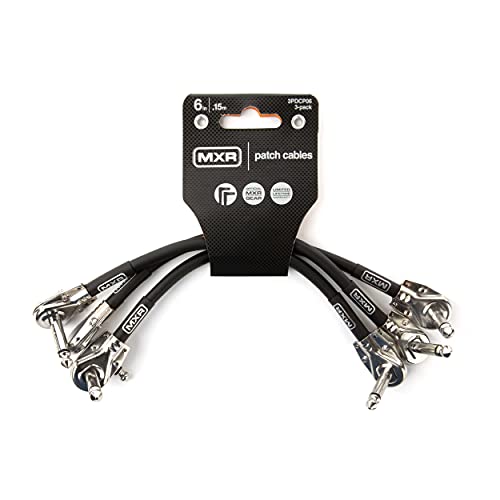
- Three flexible 6-inch male-to-male cables
- 20-AWG oxygen-free copper conductors
- Shielding helps limit unwanted noise
Best For: Flexible pedal-to-pedal routing
External Connection Hub
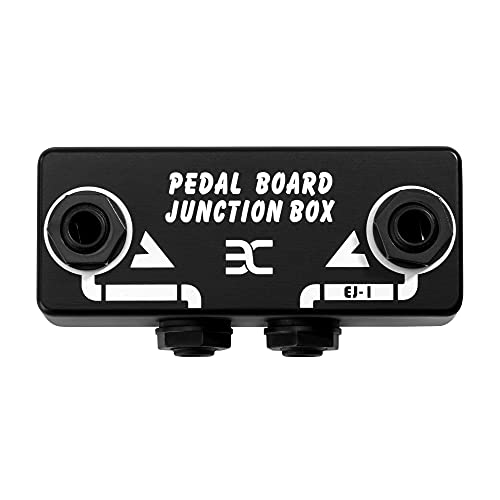
- Centralizes guitar and amplifier connections
- Passive operation needs no power
- Supports vertical or horizontal cable entry
Best For: Fast pedalboard setup and protected pedal jacks
Budget Board Basics
6-Inch Right-Angle Patch Cable 6-Pack

- Six 6-inch 1/4-inch TS cables
- Right-angle connectors save pedalboard space
- Shielding helps reduce outside interference
Best For: Compact guitar and bass pedalboards
Space-Saving Signal Routing
4-Inch Flat Patch Cable 3-Pack

- Ultra-thin flat design keeps boards tidy
- C-shaped right-angle plugs fit varied jack positions
- Braided shielding supports low-noise routing
Best For: Crowded pedalboards with closely spaced effects
Pedalboard Routing Hub
Passive 4-Channel TRS Junction Box

- Four passive TRS channels for signal routing
- Supports compatible mono and stereo connections
- No power supply needed for plug-and-play use
Best For: Organized mono or stereo pedalboard routing
Versatile Cable Kit
Ernie Ball Flat Ribbon Multi-Pack

- 10 cables in four useful lengths
- Flat design helps reduce pedalboard clutter
- Low-profile metal connectors with strain relief
Best For: Pedalboards with varied spacing and routing needs
Compact Value Pick
5-Inch Right-Angle Patch Cables

- Three short 5-inch patch cables
- Flat, space-saving construction
- Dual-layer shielding for reduced hum
Best For: Compact pedalboards with closely spaced pedals
Dense-Board Specialist
Gold-Plated Low-Profile Cables
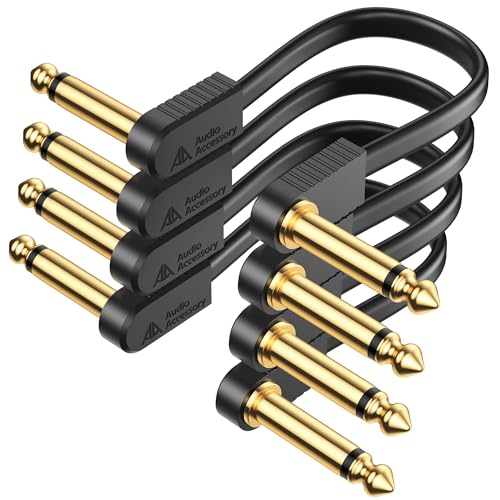
- 6-inch flat cables for compact routing
- Plugs fit jack spacing as tight as 0.2 inch
- Kevlar reinforcement and quad-layer shielding
Best For: Densely packed boards with closely spaced pedal jacks
Space-Saving Couplers – Rayzm Pedal Patch Connectors
If you want a compact patch bay for guitar pedals setup, the Rayzm connectors replace short patch cables with direct male-to-male couplers. The pack includes two straight and two Z-type connectors, giving you options for pedals with matching or different jack heights.
Best For: Guitarists building tidy, space-efficient pedalboards with compatible 1/4-inch pedal jacks.
Pros:
- Includes two straight and two offset Z-type connectors.
- Can place compatible pedals closer together than patch cables allow.
- Solid copper construction with nickel-plated surfaces.
Cons:
- Rigid couplers offer less routing flexibility than patch cables.
- Compatibility depends on the position and height of each pedal’s jacks.
Choose this Rayzm pack when minimal spacing and a clean-looking board matter more than adjustable cable routing. The straight and offset designs make it more adaptable than a pack containing only one connector style.
Integrated Pedalboard Interface – RockBoard MOD 5 Patchbay
The RockBoard MOD 5 is a compact patch bay for guitar pedals designed as a pedalboard interface rather than a simple cable. Its listed function combines patchbay connectivity with cab-simulator and DI use, helping centralize board connections in a compact unit.
Best For: Players who want a compact pedalboard interface with cab-simulator and DI functionality.
Pros:
- Combines pedalboard patchbay, cab simulator, and DI functions.
- Compact 6.89-by-3.35-by-1.85-inch format.
- Includes a two-year warranty.
Cons:
- More specialized and substantial than a basic passive junction box.
- The supplied details do not specify the full input and output configuration.
The MOD 5 is worth considering when you want more than front-panel cable aggregation. Verify that its connection layout and features match your board before choosing it as your main interface.
Low-Noise Cable Set – MXR 6-Inch Patch Cables
For a flexible patch bay for guitar pedals arrangement, the MXR 6-inch three-pack provides short male-to-male cables instead of rigid couplers. Oxygen-free copper wire, shielding, and flexible PVC construction are intended to support clear signal transfer and practical pedalboard routing.
Best For: Players who need flexible short cables for connecting pedals with varied layouts.
Pros:
- Three 6-inch cables provide adjustable routing between pedals.
- 20-AWG oxygen-free copper wire and polyethylene insulation.
- Shielding is designed to reduce radio, electromagnetic, and handling noise.
Cons:
- Six-inch lengths may be too long for tightly spaced pedal pairs.
- Cables take more board space than direct couplers.
This MXR pack is a practical choice when pedal spacing or jack positions vary and you want cable flexibility. It is less space-efficient than a connector, but easier to route around different pedal layouts.
External Connection Hub – EX Pedalboard Junction Box
The EX Junction Box is a practical patch bay for guitar pedals when you want instrument input and amplifier output gathered at one accessible point. It is passive, supports vertical or horizontal cable insertion, and is designed to simplify board setup while reducing repeated plugging into pedal jacks.
Best For: Players who want centralized input and output connections on a pedalboard.
Pros:
- Aggregates guitar input and amplifier output in one place.
- Passive design requires no power supply.
- Vertical or horizontal connector insertion can help save space.
- Metal, powder-coated construction with screw-in installation.
Cons:
- It does not replace the pedal-to-pedal patch cables within the chain.
- Screw-in installation requires a suitable mounting location.
Choose the EX Junction Box if your main priority is quicker stage or studio connections and less wear on pedal input and output jacks. It complements, rather than replaces, the cables or couplers used between pedals.
Budget Board Basics – 6-Inch Right-Angle Patch Cable 6-Pack
If you need a straightforward patch bay for guitar pedals setup, the Amazon Basics BC335 pack provides six short 1/4-inch TS cables for connecting effects pedals on a pedalboard. Its right-angle-to-right-angle design helps keep closely placed pedals connected without excessive cable slack.
Best For: Guitarists and bassists building a compact pedalboard on a budget.
Pros:
- Six 6-inch cables provide useful coverage for a multi-pedal board.
- Right-angle connectors support close pedal placement.
- OFC spiral and conductive PVC shielding are designed to help block outside interference.
- Full metal casings support durable, reliable use.
Cons:
- At 6 inches, the cables may not suit wider pedal layouts.
- The connectors are right-angle-to-right-angle, limiting configuration options compared with mixed connector styles.
This is a practical cable multipack for organizing standard pedal connections. Choose it when you want several short, durable leads rather than a dedicated routing box or a range of cable lengths.
Space-Saving Signal Routing – 4-Inch Flat Patch Cable 3-Pack
For a space-conscious patch bay for guitar pedals layout, these 4-inch flat cables use ultra-thin construction and C-shaped right-angle connectors. They are intended to help connect crowded pedalboards while keeping the signal path neat and minimizing unnecessary cable bulk.
Best For: Crowded pedalboards that need short, low-profile connections.
Pros:
- Flat, ultra-thin construction helps conserve pedalboard space.
- C-shaped right-angle connectors accommodate top- and side-mounted 1/4-inch jacks.
- Braided copper shielding and PVC jackets help protect against outside noise.
- Gold-tipped connectors are corrosion-resistant and available in multiple lengths.
Cons:
- This package contains only three cables.
- The fixed 4-inch length may be too short for pedals with wider spacing.
These cables are a strong fit when clean routing and pedal density matter more than long reach. The 4-inch format is best suited to closely packed pedals, while the same product line offers longer options for more spread-out boards.
Pedalboard Routing Hub – Passive 4-Channel TRS Junction Box
Unlike a basic patch cable, the SONICAKE QCS-02 functions as a compact patch bay for guitar pedals by providing four passive TRS channels for signal routing and pedalboard organization. It accepts mono or stereo connections, requires no power, and is designed to help save space and protect jacks.
Best For: Players who need flexible mono or stereo routing and a neater pedalboard connection point.
Pros:
- Four passive channels provide multiple routing options.
- TRS connectivity supports compatible mono and stereo setups.
- Passive plug-and-play operation requires no power supply.
- True bypass is designed to preserve the instrument signal when bypassed.
Cons:
- It is a junction box, not a bundle of patch cables, so additional cables are required.
- Its routing benefits depend on the connectors and signal configuration used in the rest of the setup.
- The supplied warranty description is limited to 90 days.
The QCS-02 is the most direct choice here for centralized pedalboard routing. Its compact passive design makes it useful for organizing lines and accommodating customized mono or stereo signal paths without adding a power requirement.
Versatile Cable Kit – Ernie Ball Flat Ribbon Multi-Pack
For a flexible patch bay for guitar pedals setup, the Ernie Ball Flat Ribbon Multi-Pack offers 10 cable lengths to accommodate compact and spread-out pedal layouts. Its flat construction helps reduce clutter while the low-profile connectors make routing easier.
Best For: Guitarists building or reorganizing pedalboards that need several cable lengths in one kit.
Pros:
- Includes 10 cables in four lengths: 3, 6, 12, and 24 inches.
- Flat ribbon design allows easy maneuvering and cleaner pedalboard routing.
- Low-profile metal connectors include built-in strain relief.
- Oxygen-free copper and shielding are designed to resist corrosion and preserve signal.
Cons:
- The multi-pack may include more cable lengths than a simple, uniform setup requires.
- PVC jackets and flat construction may not suit players seeking premium braided cable coverings.
This is a practical all-purpose kit for pedalboards with varying spacing. The range of lengths makes it especially useful when planning a tidy patch bay for guitar pedals without buying each cable separately.
Compact Value Pick – 5-Inch Right-Angle Patch Cables
If you need a space-saving patch bay for guitar pedals, this three-pack uses short, flat 5-inch cables with right-angle 1/4-inch TS plugs. The uniform length is suited to compact pedal connections and tidy, consistent wiring.
Best For: Players who want an affordable three-pack for short pedal-to-pedal connections.
Pros:
- Short 5-inch length helps conserve pedalboard space.
- Flat cable design supports a tidier setup.
- Oxygen-free copper is intended to preserve clear signal transmission.
- Dual-layer shielding is designed to reduce hum on crowded boards.
Cons:
- All three cables are the same 5-inch length, limiting flexibility for wider pedal spacing.
- The supplied notes identify a three-pack, so it may not cover a larger pedal chain.
This is a straightforward choice for compact boards or as a small replacement bundle. Its consistent length and right-angle connectors make it convenient when most pedals sit close together.
Dense-Board Specialist – Gold-Plated Low-Profile Cables
For a densely packed patch bay for guitar pedals, this four-pack pairs 6-inch flat cables with especially small gold-plated plugs. The low-profile design is made to fit closely spaced jacks, while Kevlar reinforcement and multi-layer shielding target durability and quiet operation.
Best For: Crowded pedalboards with closely spaced input and output jacks.
Pros:
- Low-profile plugs are designed for jack spacing as tight as 0.2 inch.
- Flat cable construction has a small bend radius for compact routing.
- Kevlar-reinforced cable and protected solder joints support everyday durability.
- Gold-plated connectors and quad-layer shielding are designed to resist oxidation and interference.
Cons:
- Each cable is 6 inches, so longer connections may require a different length.
- The four-pack may be insufficient for larger pedal chains.
This option stands out when bulky plugs cause fit problems between adjacent pedals. It is purpose-built for tight layouts and adds construction features aimed at maintaining reliable connections through repeated bending.
How We Picked the Best Patch Bay for Guitar Pedals
We focused on products that solve common pedalboard connection problems: awkward cable access, excess cable length, crowded jacks, and difficult setup changes. The selection includes dedicated patch bays and junction boxes as well as compact patch cables and couplers that can serve a similar organizational purpose in smaller or simpler rigs.
We considered connector type, cable length, footprint, mounting practicality, shielding, construction, and compatibility with standard 1/4-inch pedal connections. Since pedalboards vary widely, the best choice depends on whether you need a true front-and-back interface or simply a cleaner way to link adjacent effects.
Quick Comparison
- Dedicated patch bays: RockBoard MOD 5 and similar junction boxes are best for fixed input, output, and routing access.
- Compact junction boxes: EX and SONICAKE options help relocate connections without adding another effect.
- Short patch cables: MXR, Ernie Ball, Amazon Basics, and the various flat or right-angle packs suit conventional pedalboard wiring.
- Minimal connections: The Rayzm coupler can join compatible pedals directly where space is extremely limited.
Key Buying Factors for a Patch Bay for Guitar Pedals
Connection Type and Routing
Check whether you need simple input and output pass-throughs, stereo or TRS support, multiple channels, or additional routing. A passive box is convenient for relocating jacks but does not buffer, split, or alter the signal.
Connector Orientation and Cable Length
Right-angle plugs and flat ribbon cables are useful when pedals are tightly spaced. Measure the gap between jacks before buying: a cable that is too short can stress connectors, while excess length creates loops and clutter.
Board Compatibility and Mounting
Confirm the patch bay’s dimensions, mounting method, and clearance beneath or beside your board. A unit may require an open side, a specific mounting bracket, or room for cables to bend without pressing against neighboring pedals.
Shielding and Build Quality
Look for sturdy plugs, flexible strain relief, and reliable shielding. Gold plating can resist surface corrosion, but good construction and secure connections matter more than finish alone. Keep unneeded cable runs short to reduce clutter and possible noise.
Who Should Buy Which Patch Bay for Guitar Pedals?
Choose a dedicated pedalboard patch bay if your board is semi-permanent, your jacks are hard to reach, or you want fast stage connections. Choose a junction box if you need several relocated inputs and outputs or stereo-compatible routing in a compact enclosure.
Choose flat or right-angle patch cable multipacks for ordinary pedal-to-pedal wiring, especially when building or rewiring a full board. Choose a direct coupler only when adjacent pedals align securely and the connection will not place leverage on their jacks. For most players, combining a small junction box with appropriately sized, shielded patch cables offers the best balance of convenience, serviceability, and clean signal-chain organization.