The best graphic audio equalizers give you precise control over frequency balance, helping tame harsh highs, add warmth, or improve clarity in a home stereo, DJ rig, or studio system.
We compare 10 graphic audio equalizers across band count, connectivity, display features, rack compatibility, and ease of use so you can choose the right fit for your setup.
Best 10 Graphic Audio Equalizers Picks for 2026
Precision Rack Control
15-Band Stereo Graphic Equalizer

- Dual 15-band channel control
- Low-cut and bass-output adjustment
- XLR and 1/4-inch connectivity
Best For: Rack-based home, DJ, studio, and live audio systems
Pro-Level Bandwidth
dbx 231s Dual 31-Band Equalizer

- Dual 31-band constant-Q design
- Selectable 6 or 12 dB ranges
- XLR and TRS I/O with LED monitoring
Best For: Professional live-sound and studio rack systems
Connected Audio Hub
31-Band Home Graphic Equalizer

- 31-band tuning with spectrum analyzer
- Bluetooth, optical, coaxial, and USB
- 12 modes with auto-save presets
Best For: Connected home theater, KTV, studio, and DJ systems
Visual Level Tuning
Rockville REQ20 Dual 10-Band EQ

- Dual 10-band control
- Front-panel VU meters
- Stereo RCA and record outputs
Best For: RCA-based rack stereo and DJ systems
Versatile Visualizer
TNZ SGE6 15-Band Audio Graphic Equalizer

- Two-channel 15-band EQ
- Bluetooth, USB, RCA, and 3.5mm connectivity
- 16-color spectrum display with preamp function
Best For: Flexible home audio and DJ setups
Professional Control
EQ-231 31-Band Stereo Graphic Equalizer

- 31 bands on each stereo channel
- Low-cut and bypass switches
- XLR and 1/4-inch input/output options
Best For: Live sound, studios, and audio installations
Digital Precision
31-Band Equalizer with Dynamic LED Display

- 31-band tuning with ±12dB control
- Bluetooth, optical, coaxial, USB, RCA, and XLR
- Dynamic spectrum display with preset auto-save
Best For: Versatile home and professional audio systems
Precision Rack EQ
15-Band Stereo Graphic Equalizer
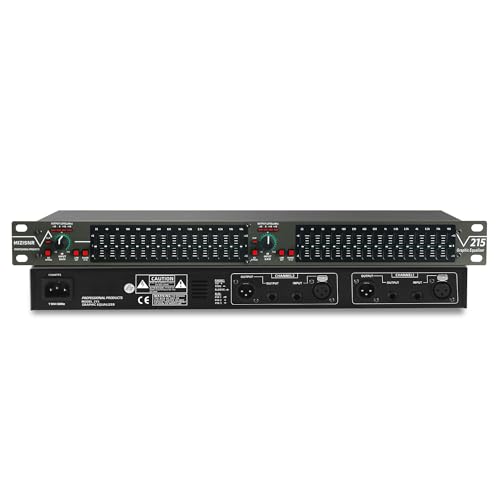
- 15 bands per channel with ±12 dB adjustment
- Low-cut filter and bypass switch
- XLR and 1/4-inch TRS connectivity
Best For: Hands-on stereo EQ control in rack-based audio systems
Visual Digital EQ
31-Band Equalizer with Bluetooth and Spectrum Display

- 31-band control with real-time LED spectrum display
- 10 presets, bypass, and intelligent noise reduction
- Bluetooth 5.2, USB playback, and bass output
Best For: Feature-rich home theater, KTV, studio, and DJ setups
PC-Tuned Digital EQ
31-Band Dual-Channel Equalizer with PC Tuning

- 31-band dual-channel control with PC software
- LED spectrum display and 10 presets
- XLR, L/R, and TRS connectivity with DSP noise reduction
Best For: Studio and live systems needing detailed digital tuning
Precision Rack Control – 15-Band Stereo Graphic Equalizer
For listeners and audio professionals comparing graphic audio equalizers, the EQX-215S offers dual-channel control in a 1U rack-mount design. Its 15 bands per channel, selectable low-cut function, and balanced or unbalanced connections make it practical for detailed system tuning.
Best For: Home audio systems, DJ setups, live events, studios, and rack installations needing flexible stereo EQ control.
Pros:
- Provides 15 adjustable bands per channel with a ±12 dB range.
- Includes low-cut control for reducing unwanted low-end noise.
- Supports XLR balanced and 1/4-inch TRS unbalanced connections.
- Offers a dedicated adjustable-frequency bass output and 2-year warranty.
Cons:
- Its 1U rack-mount format may be more equipment than casual users need.
- The supplied notes do not specify digital or wireless connectivity.
The EQX-215S is a strong fit when hands-on analog-style adjustment and installation flexibility matter more than compact, consumer-focused features.
Pro-Level Bandwidth – dbx 231s Dual 31-Band Equalizer
The dbx 231s is a straightforward choice among graphic audio equalizers for users who want extensive frequency control across two channels. Its dual 31-band, 1/3-octave layout is paired with selectable boost/cut ranges, level monitoring, and common pro-audio connections.
Best For: Live sound, studio, and professional rack systems requiring detailed dual-channel frequency shaping.
Pros:
- Delivers dual 31-band control with constant-Q frequency bands.
- Allows selectable 6 dB or 12 dB boost/cut ranges.
- Includes front-panel bypass and a 12 dB input gain range.
- Uses both 1/4-inch TRS and XLR inputs and outputs.
Cons:
- The 31-band professional layout may be unnecessary for basic home listening.
- The supplied notes do not mention digital, Bluetooth, or USB connectivity.
With its detailed 1/3-octave control and LED output monitoring, the 231s is best suited to users who need conventional, hands-on signal shaping in a professional audio chain.
Connected Audio Hub – 31-Band Home Graphic Equalizer
This digital option expands the usual role of graphic audio equalizers with 31-band tuning, real-time spectrum monitoring, Bluetooth, optical and coaxial inputs, and USB playback. It is designed for users who want preset-based control and broad compatibility across home and performance audio setups.
Best For: Home theaters, KTV systems, recording studios, DJ setups, and users connecting multiple digital audio sources.
Pros:
- Offers 31-band adjustment with real-time spectrum analysis.
- Includes 12 customizable modes and auto-save presets.
- Supports Bluetooth, optical, coaxial, and USB connectivity.
- Targets home, studio, live-stage, car-audio, and office applications.
Cons:
- The broad feature set may be more complex than needed for simple analog systems.
- The supplied notes do not provide detailed specifications for every supported audio format.
This model stands out for connectivity and convenience, particularly when quick preset changes and integration with several digital sources are priorities.
Visual Level Tuning – Rockville REQ20 Dual 10-Band EQ
Rockville REQ20 19" Rack Mount Pro Dual 10 Band Graphic Equalizer EQ w/VU Meters
Check Price On AmazonThe Rockville REQ20 keeps graphic audio equalizers practical with dual 10-band control, front-panel VU meters, and a 19-inch rack-mount format. Stereo RCA inputs and outputs also provide a simple way to place it in a conventional line-level setup.
Best For: Rack-mounted stereo systems, DJ setups, and users who want visible level monitoring with basic dual-channel EQ control.
Pros:
- Provides dual 10-band equalizers for 20 total bands of control.
- Includes dual VU meters for monitoring levels.
- Offers stereo RCA input, output, and a record output.
- Covers a stated 20 Hz–20 kHz frequency response.
Cons:
- Its 10-band-per-channel layout offers less detailed control than 31-band models.
- Connectivity is centered on RCA rather than XLR or TRS connections.
- The 19-inch rack format may not suit compact desktop systems.
The REQ20 is a sensible, visually oriented choice for stereo systems that need straightforward EQ adjustment, RCA connectivity, and front-panel level feedback.
Versatile Visualizer – TNZ SGE6 15-Band Audio Graphic Equalizer
The TNZ SGE6 is one of the more flexible graphic audio equalizers for home audio, theater, car audio, or DJ setups. Its 15-band, two-channel EQ adds practical sound shaping, while Bluetooth, USB, RCA, and 3.5mm connections make it easy to integrate with different systems.
Best For: Home listeners and DJs who want flexible connectivity, visual spectrum effects, and preamp functionality.
Pros:
- 15-band EQ across two channels for detailed sound adjustment.
- Supports RCA, 3.5mm auxiliary, USB, and Bluetooth 5.0 inputs.
- Built-in microphone can drive the spectrum display without an audio cable.
- Offers 16 display colors plus brightness, speed, and gain controls.
Cons:
- Its 15-band EQ is less granular than 31-band alternatives.
- The compact unit is primarily suited to systems using the listed RCA and auxiliary connections.
The SGE6 stands out when connectivity and visual presentation matter as much as basic EQ control. It can also function as an amplifier or pre-amplifier, making it a useful all-in-one addition to compatible audio systems.
Professional Control – EQ-231 31-Band Stereo Graphic Equalizer
The EQ-231 is a professional-style choice among graphic audio equalizers, with independent 31-band control on each stereo channel. Its balanced XLR and unbalanced 1/4-inch connections, low-cut filter, bypass switch, and LED meters make it well suited to studios, installations, and live audio work.
Best For: DJs, studios, live sound operators, and installations needing precise dual-channel EQ control.
Pros:
- 31 bands per channel with up to ±12dB adjustment.
- Low-cut switch helps attenuate rumble, hum, wind noise, and other low-frequency distractions.
- Balanced XLR and unbalanced 1/4-inch inputs and outputs support varied setups.
- Bypass switch and four-segment LED meters simplify monitoring and troubleshooting.
Cons:
- At 6.69 pounds, it is less portable than lighter home-oriented units.
- The professional feature set may be more than casual listeners need.
Choose the EQ-231 when detailed channel-by-channel adjustment and conventional pro-audio connectivity are priorities. The low-cut and bypass controls add useful flexibility for live applications and system debugging.
Digital Precision – 31-Band Equalizer with Dynamic LED Display
This digital model is a strong option for graphic audio equalizers when broad connectivity and detailed tuning are important. It combines 31-band adjustment from 32Hz to 16kHz with Bluetooth 5.4, optical, coaxial, USB, RCA, and XLR support, plus a dynamic spectrum display for real-time visual feedback.
Best For: Home theaters, recording studios, DJs, and performers who need extensive connections and saved EQ settings.
Pros:
- 31-band tuning with ±12dB control per band and independent adjustment.
- Supports Bluetooth 5.4, optical, coaxial, USB, RCA, and XLR sources.
- Plays listed lossless formats including APE, FLAC, WAV, MP3, and PCM 16-bit.
- Dynamic 31-segment display, 12 rhythm modes, and preset auto-save support easy operation.
Cons:
- At 8.8 pounds, it is the heaviest of these three options.
- Its extensive controls and connections may be excessive for a simple stereo setup.
The unit is designed for users who want a modern processor rather than a basic analog EQ. Its metal 1U chassis, wide input selection, and preset-saving features make it adaptable for fixed installations or transport to gigs.
Precision Rack EQ – 15-Band Stereo Graphic Equalizer
If you want straightforward control over a stereo system, this 15-band model is a practical choice among graphic audio equalizers. Its dual-channel layout, adjustable gain range, low-cut filter, and rack-mount design suit home audio, studio, installation, and live-sound setups.
Best For: Users who need hands-on stereo EQ control and flexible rack integration.
Pros:
- Provides 15 adjustable bands per channel with up to ±12 dB of control.
- Low-cut switch helps reduce wind noise, floor rumble, and electrical hum.
- Includes XLR balanced and 1/4-inch TRS unbalanced inputs and outputs.
- Bypass switch and standard 1U rack-mount format simplify setup and troubleshooting.
Cons:
- Offers fewer adjustment bands than the 31-band models in this roundup.
- Does not list digital presets, Bluetooth, USB playback, or PC tuning.
This EQ is a solid fit when tactile, analog-style adjustment matters more than advanced digital features. Its connectivity and low-cut function make it adaptable, while the 15-band layout keeps operation relatively direct.
Visual Digital EQ – 31-Band Equalizer with Bluetooth and Spectrum Display
This 31-band digital unit is designed for buyers who want detailed sound shaping plus visual feedback. Among graphic audio equalizers, it stands out with real-time LED spectrum indication, saved presets, Bluetooth 5.2, USB playback, and an additional adjustable bass output.
Best For: Home theaters, KTV venues, studios, and DJ systems that benefit from presets and spectrum monitoring.
Pros:
- Offers 31 segments with LED spectrum display for real-time frequency observation.
- Includes 10 preset modes, EQ bypass, and independent high, mid, and bass adjustment.
- Built-in Bluetooth 5.2 and USB playback expand source options.
- Supports XLR and 1/4-inch TRS connections plus an adjustable bass output.
Cons:
- The larger feature set may require more setup than a basic analog equalizer.
- The supplied notes do not specify PC tuning or a detailed noise-reduction adjustment range.
Choose this model if visual monitoring and convenient playback features are priorities. Its 31-band control provides fine adjustment, while presets and bypass make repeated listening comparisons easier.
PC-Tuned Digital EQ – 31-Band Dual-Channel Equalizer with PC Tuning
For detailed digital processing and computer-based setup, this dual-channel model offers a strong mix of control and connectivity. It is one of the more versatile graphic audio equalizers here, combining 31-band adjustment, PC software tuning, presets, a spectrum display, and DSP noise reduction.
Best For: Studio and live-sound users who want fine channel-by-channel control with PC tuning.
Pros:
- Provides dedicated 31-band equalization for left and right channels.
- Included PC software supports detailed tuning and setup refinement.
- Real-time LED display, 10 presets, and bypass mode support quick adjustments and comparisons.
- Offers XLR, stereo L/R, and TRS connections for microphones, instruments, mixers, and home audio gear.
Cons:
- PC software may add setup complexity compared with a purely manual EQ.
- The supplied details do not mention Bluetooth or USB music playback.
- Noise-reduction control is specified from -3 dB to -9 dB, offering less range than the EQ bands.
This is the most suitable option for buyers who value precise digital control and system integration. The combination of PC tuning, dual-channel processing, and broad I/O makes it well suited to more involved audio workflows.
How We Picked the Best Graphic Audio Equalizers
We focused on the features that matter most in real-world sound systems: number of frequency bands, dual-channel control, connection options, noise reduction, display visibility, construction, and installation flexibility. The selection includes straightforward analog rack units, digital models with spectrum displays, and versatile home-audio options with Bluetooth, USB, auxiliary, or PC connectivity.
Because specifications and included accessories can vary by seller, confirm the current input/output layout, power requirements, rack dimensions, and frequency range before purchasing.
Quick Comparison
| Type | Best For | What to Look For |
|---|---|---|
| 15-band equalizer | Simple home and DJ adjustments | Easy controls, compact rack design |
| 19-band equalizer | Basic professional system tuning | VU meters and independent channel control |
| 31-band equalizer | Detailed speaker and room correction | Fine frequency resolution and low noise |
| Digital equalizer | Visual control and flexible connectivity | LED spectrum display, presets, or computer support |
| Bluetooth-enabled model | Convenient home listening | Stable wireless input and usable analog outputs |
Key Buying Factors for Graphic Audio Equalizers
Band Count and Control Range
More bands provide finer adjustment. A 15-band unit is often sufficient for broad tonal shaping, while a 31-band equalizer is better for correcting specific room or speaker-frequency problems. More controls also require more setup time.
Inputs, Outputs, and System Compatibility
Check whether the equalizer uses RCA, 3.5mm auxiliary, professional connectors, Bluetooth, USB, or PC connectivity. Make sure its output level and connector types match your receiver, amplifier, mixer, powered speakers, or subwoofer. A dedicated subwoofer output can simplify system integration.
Analog Versus Digital Operation
Analog sliders make changes immediate and easy to see. Digital models may add presets, independent tuning, noise reduction, rhythm patterns, or spectrum displays. Choose based on whether you value hands-on control or additional functionality.
Noise, Headroom, and Display Visibility
Look for low-noise operation and enough adjustment range without introducing distortion. VU meters and LED spectrum displays are useful in dark rooms or live settings, but they should support—not replace—careful listening.
Installation and Build
For a rack system, verify the unit’s rack width, height, mounting hardware, and ventilation needs. A tabletop home setup may be better served by a compact equalizer with accessible front-panel controls and convenient wireless inputs.
Who Should Buy Which Graphic Audio Equalizers?
For Home Stereo Listeners
Choose a 15-band or Bluetooth-enabled equalizer if you want straightforward tonal shaping and convenient streaming without building a complex rack system.
For DJs and Live Audio Users
A dual-channel 31-band model offers more precise control for speakers, rooms, and changing venues. Clear meters, durable construction, and reliable outputs are especially valuable.
For Studios and Serious System Tuning
Prioritize low noise, independent left/right adjustment, consistent frequency controls, and sufficient headroom. A digital model with computer support may be useful when repeatable settings matter.
For Buyers Who Want Simplicity
Select the model with the fewest unnecessary features that still matches your connections. A simpler graphic equalizer is often easier to configure and less likely to complicate signal routing.