Clear, intelligible church audio depends on more than powerful speakers. The right equalizer can reduce feedback, improve speech clarity, shape music, and help volunteers manage a consistent mix from service to service.
These 10 picks cover practical options for small sanctuaries, worship teams, presentation systems, and larger PA setups. Use the guide below to match features such as band count, feedback control, routing, and installation format to your sound system.
Best 10 Audio Equalizers for Church Sound Systems Picks for 2026
Signal Routing Specialist

- Three selectable stereo or mono crossover modes
- Separate band gain and phase controls
- Balanced XLR I/O with 40 Hz low-cut filter
Best For: Multi-amplifier PA systems and subwoofer routing
Compact Church EQ Choice
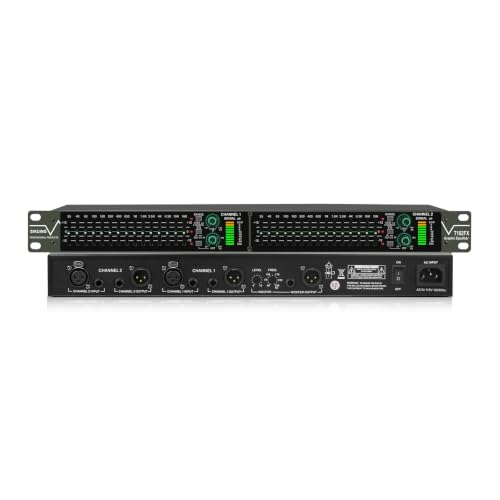
- Independent 15-band EQ from 25 Hz to 16 kHz
- Adjustable low-cut filter and subwoofer output
- 1U rack chassis with XLR and TRS connections
Best For: Compact church PA racks and basic room tuning
Vocal Processing Option
DSP Preamp and Karaoke Equalizer

- Four-level FBX feedback suppression
- Bluetooth, USB, optical, coaxial, and AUX inputs
- Mic/tone controls with multiple XLR and sub outputs
Best For: Vocal-focused worship and multipurpose AV systems
Precision Room-Tuning Pick
Dual 31-Band Graphic Equalizer

- Dual 31-band, 1/3-octave frequency control
- Balanced XLR/TRS I/O with 40 Hz low-cut
- Mono subwoofer mode and phase inversion
Best For: Detailed church auditorium tuning and feedback control
Feedback Control Pick

- Real-time feedback frequency detection and removal
- Smart auto mode for simpler setup
- 6-in/6-out connectivity for PA and mixer systems
Best For: Churches and PA systems needing automated microphone feedback control
All-in-One Mixing Pick
8-Channel Mixer with Graphic EQ

- Eight XLR and eight line inputs
- 3-band channel EQ and 7-band master EQ
- Bluetooth, USB, DSP, and headphone monitoring
Best For: Churches needing multi-input mixing with built-in equalization
Precision EQ Pick

- 31-band DSP graphic equalization
- LED spectrum analyzer and ten custom presets
- Rack-mount design with XLR and 1/4-inch I/O
Best For: Church PA systems requiring detailed frequency tuning
Best Analog Mixer EQ
Pyle 6-Channel Mixer with 10-Band Equalizer

- Six-channel mixer with 10-band graphic EQ
- Mic bass, mid, and high adjustments
- Bluetooth, effects, and 5U rack mounting
Best For: All-in-one church mixing and equalization
Best Straightforward Rack EQ
15-Band Stereo Graphic Equalizer

- 15 adjustable bands per stereo channel
- Low-cut switch reduces unwanted low noise
- 1U rack mount with XLR and TRS connections
Best For: Dedicated church system EQ in an existing rack
Best Subwoofer-Ready EQ
15-Band Stereo EQ with Adjustable Bass Output

- 15 bands per channel with ±12 dB adjustment
- Adjustable low-cut frequency control
- Dedicated bass output for low-end routing
Best For: Church systems with subwoofer or bass-management needs
Signal Routing Specialist – 2/3-Way Stereo Crossover
For church sound systems that use separate amplifiers or speaker drivers, this crossover helps route low, mid, and high frequencies to the appropriate outputs. Its selectable stereo and mono operating modes make it a flexible option for building a more controlled PA setup.
Best For: Churches and venues needing frequency-band routing for woofers, tweeters, subwoofers, or multi-amplifier systems.
Pros:
- Supports two-way stereo, three-way stereo, and four-way mono operation.
- Provides separate output gain controls and phase-reverse switches for each band.
- Includes balanced XLR inputs and outputs, a 40 Hz low-cut filter, and a rugged rack-mount metal chassis.
Cons:
- It is a crossover rather than a traditional graphic equalizer, so it does not provide multiple individual EQ sliders.
- Operation is limited to 110-volt power according to the supplied specifications.
This is a practical choice when the main goal is cleaner speaker and amplifier signal distribution. Choose a dedicated equalizer instead if you need detailed room tuning or feedback control across many frequency bands.
Compact Church EQ Choice – 15-Band Stereo Equalizer
This 15-band stereo unit is a straightforward option among audio equalizers for church sound systems, offering independent channel control from 25 Hz to 16 kHz. Its low-cut filter, signal meters, and feedback-oriented controls can help operators refine speech, music, and live sound.
Best For: Small to medium church PA racks that need practical stereo tone shaping, low-frequency cleanup, and subwoofer adjustment.
Pros:
- Provides 15 precision EQ bands per channel across 25 Hz to 16 kHz.
- Includes EQ bypass, adjustable low-cut filtering, and an independent subwoofer output adjustable from 50 Hz to 250 Hz.
- Uses XLR and TRS connections, LED signal metering, and a durable 1U rack-mount chassis.
Cons:
- Offers fewer adjustment bands than a 31-band equalizer.
- The supplied specifications list 110-volt operation, which may limit installation flexibility.
Its combination of useful filtering, subwoofer control, and compact rack design makes it a balanced fit for churches seeking hands-on EQ without moving to a larger 31-band model.
Vocal Processing Option – DSP Preamp and Karaoke Equalizer
Churches that prioritize vocal clarity and flexible media playback may appreciate this DSP processor. Along with tone and microphone adjustments, it provides four-level feedback suppression and multiple digital and analog inputs for combining microphones, music, and presentation sources.
Best For: Worship, event, and multipurpose systems where vocal processing, microphone feedback control, and varied playback inputs matter.
Pros:
- Includes four-level FBX feedback suppression for more stable microphone performance.
- Supports Bluetooth, USB, optical, coaxial, AUX1, and AUX2 inputs.
- Offers microphone and tone adjustment plus RCA, subwoofer, and four XLR outputs.
Cons:
- Its karaoke-oriented design may be less suitable than a dedicated graphic equalizer for detailed room-by-room tuning.
- The supplied notes do not specify individual EQ band counts or frequency ranges.
This is best viewed as a versatile front-end processor rather than a conventional rack EQ. It can be especially useful when a church system needs vocal enhancement, feedback suppression, and convenient wireless or digital source connectivity.
Precision Room-Tuning Pick – Dual 31-Band Graphic Equalizer
For churches needing detailed acoustic adjustment, this dual 31-band equalizer provides 1/3-octave control on two independent channels. Balanced connections, low-cut filtering, phase reversal, and LED monitoring support practical tuning for auditoriums, stages, and installed PA systems.
Best For: Church sound engineers who need precise stereo room tuning and anti-feedback control in a professional rack system.
Pros:
- Provides dual 31-band, 1/3-octave EQ for detailed tone shaping and feedback management.
- Includes balanced XLR and TRS inputs and outputs, switchable 40 Hz low-cut filters, and phase inversion.
- Offers selectable ±6 dB or ±12 dB ranges, LED output meters, and a selectable mono subwoofer mode.
Cons:
- The 2U chassis occupies more rack space than a compact 1U equalizer.
- Its many controls may require more setup knowledge than a simpler stereo EQ.
With the most extensive frequency control of these options, the EQ-231 is a strong fit for permanent church installations and live worship systems where repeatable, detailed tuning is a priority.
Feedback Control Pick – Automatic Feedback Suppressor
For church sound systems where microphone howling is a recurring concern, this feedback suppressor focuses on detecting and removing feedback frequencies in real time. Its automatic mode and 6-in/6-out design make it a practical add-on for PA, mixer, microphone, and amplifier setups.
Best For: Churches, conferences, stage performances, and PA systems that need automated feedback control.
Pros:
- Automatically detects and suppresses feedback frequencies.
- Smart auto mode reduces the need for manual adjustments.
- DSP processing is designed to reduce distortion while preserving vocal clarity.
- Offers flexible connections for microphones, mixers, speakers, amplifiers, and PA systems.
Cons:
- It is primarily a feedback-control processor rather than a traditional multi-band equalizer.
- At 5.72 pounds and nearly 19 inches wide, it may require dedicated rack or shelf space.
This is a strong choice when feedback prevention is the main priority. Churches seeking detailed tonal shaping should pair it with a mixer or dedicated equalizer.
All-in-One Mixing Pick – 8-Channel Mixer with Graphic EQ
This 8-channel mixer is a versatile option for church sound systems that need input control and basic equalization in one console. It combines 3-band channel EQ, a 7-band master graphic EQ, DSP effects, phantom power, and multiple playback options.
Best For: Churches managing multiple microphones, instruments, playback sources, and live PA mixes.
Pros:
- Provides eight XLR and eight line inputs for larger audio setups.
- Includes 3-band EQ on each channel plus a 7-band graphic EQ on the main output.
- Offers +48V phantom power, dual AUX/FX controls, mute switches, and individual faders.
- Bluetooth, USB playback, and headphone monitoring support flexible operation.
Cons:
- The master graphic EQ has seven bands, offering less detailed shaping than a dedicated 31-band unit.
- Its broad feature set may require more setup familiarity than a simple mixer.
For congregations needing one central console for microphones, playback, effects, and overall tonal balance, this mixer offers a practical combination of control and connectivity.
Precision EQ Pick – 31-Band Rack-Mount Equalizer
For church sound systems that need detailed tonal adjustment, this rack-mount digital equalizer provides 31-band graphic control with a spectrum analyzer display. Balanced XLR and unbalanced 1/4-inch connections, presets, bypass, and noise reduction support more refined system tuning.
Best For: Churches, live stages, and installed PA systems where precise frequency shaping and rack integration matter.
Pros:
- 31-band DSP equalization enables precise frequency adjustments.
- Real-time LED spectrum display helps visualize frequency activity.
- Ten custom presets, noise reduction, and a bypass switch support repeatable operation.
- Includes rack-mount construction, XLR and 1/4-inch I/O, and an adjustable subwoofer output.
Cons:
- Detailed 31-band operation may be more involved for users without audio-tuning experience.
- Bluetooth and USB playback may add features that are unnecessary in a dedicated church PA rack.
This is the most adjustment-focused option in the group. It suits churches that want hands-on control over room response, vocal clarity, and low-end management rather than only basic mixer EQ.
Best Analog Mixer EQ – Pyle 6-Channel Mixer with 10-Band Equalizer
For churches seeking audio equalizers for church sound systems with hands-on mixing, the Pyle PYD1964B.5 combines a six-channel mixer with a 10-band graphic equalizer. Its microphone tone controls, rack-mount design, and onboard effects provide practical control for services, announcements, and music playback.
Best For: Churches that want an all-in-one mixer and equalizer with traditional slider controls.
Pros:
- 10-band graphic equalizer provides broad sound-shaping control.
- Separate bass, mid, and high microphone adjustments help refine announcements.
- Includes two microphone inputs, Bluetooth, echo, delay, repeat, and digital effects.
- 5U rack-mount construction suits permanent or mobile setups.
Cons:
- Its DJ-oriented layout and effects may be more than needed for a simple church audio chain.
- The 10-band design offers less frequency-by-frequency control than the dedicated 15-band units.
This is a versatile choice when the church needs mixing, microphone adjustment, and equalization in one unit. It is less focused than a dedicated rack EQ, but its broad feature set can simplify a compact sound system.
Best Straightforward Rack EQ – 15-Band Stereo Graphic Equalizer
For audio equalizers for church sound systems that need detailed stereo adjustment, this 1U rack-mount EQ provides 15 bands per channel with up to ±12 dB of control. Balanced XLR and unbalanced 1/4-inch TRS connections make it suitable for a range of live, installed, and studio signal paths.
Best For: Churches wanting dedicated stereo EQ control with low-cut filtering and flexible rack integration.
Pros:
- 15 bands per channel allow more detailed shaping than a 10-band unit.
- Low-cut switch helps reduce wind noise, floor rumble, and electrical hum.
- Bypass switch simplifies setup checks and troubleshooting.
- Supports XLR balanced and 1/4-inch TRS unbalanced inputs and outputs.
Cons:
- It is a dedicated equalizer rather than a mixer, so other equipment is required for input management.
- The supplied notes do not mention a dedicated subwoofer output or adjustable low-cut frequency.
With its standard 1U format and straightforward controls, this model is a practical fit for a church rack that already has a mixer. The low-cut switch is particularly useful where unwanted low-frequency noise affects speech clarity.
Best Subwoofer-Ready EQ – 15-Band Stereo EQ with Adjustable Bass Output
Churches comparing audio equalizers for church sound systems may prefer this 1U dual-channel EQ when low-end routing matters. It offers 15-band control per channel, a low-cut frequency knob, and a dedicated adjustable bass output for more flexible integration with a subwoofer or other low-frequency system.
Best For: Church installations that need detailed stereo EQ and dedicated control over bass output.
Pros:
- 15 bands per channel provide precise tone adjustment up to ±12 dB.
- Adjustable low-cut frequency helps target unwanted low-end noise.
- Dedicated bass output includes adjustable frequency control.
- Offers XLR balanced and 1/4-inch TRS unbalanced connectivity in a 1U rack format.
Cons:
- It is a rack EQ, not an all-in-one mixer, so a separate mixing stage is needed.
- The bass-output features may be unnecessary for systems without dedicated low-frequency equipment.
This model is the most specialized option of the three for systems with a subwoofer or stronger low-frequency management needs. Its adjustable low-cut and bass-output controls can help tailor the system, while the bypass mode supports easier troubleshooting.
How We Picked These Audio Equalizers for Church Sound Systems
We focused on equipment that can address common church audio challenges: microphone feedback, muddy speech, harsh vocals, uneven room response, and limited system control. The selection includes dedicated graphic equalizers, feedback suppressors, crossovers, mixers with built-in EQ, and digital processing units.
We also considered practical installation details, including balanced XLR connections, rack-mount designs, stereo or dual-channel operation, subwoofer routing, visible controls, and features that make setup easier for volunteers. A unit with many bands is not automatically the best choice; useful routing and dependable control matter just as much.
Quick Comparison
| Type | Best Use | What to Look For |
|---|---|---|
| 15- or 31-band graphic EQ | Room tuning and tonal shaping | Dual channels, balanced I/O, bypass, clear metering |
| Feedback suppressor | Reducing microphone howling | Automatic detection, frequency shifting, sufficient inputs and outputs |
| Crossover | Separating mains and subwoofers | Adjustable crossover points, stereo/mono modes, XLR connectivity |
| Mixer with graphic EQ | Small or simplified systems | Channel count, DSP effects, monitor outputs, intuitive controls |
Key Buying Factors for Audio Equalizers for Church Sound Systems
Choose the Right EQ Format
A 15-band graphic EQ is often sufficient for basic system tuning and is easy to understand. A 31-band model offers finer adjustments when the room has difficult resonances or the system needs more precise control. Digital units may save presets, while analog-style sliders provide immediate visual feedback.
Check Signal Routing and Connections
Confirm that the unit has the inputs and outputs your system requires. Balanced XLR connections are preferable for longer cable runs because they help resist noise. If your church uses separate subwoofers, choose a crossover or equalizer with an appropriate sub output rather than relying on improvised routing.
Prioritize Feedback Management
EQ can reduce feedback by cutting problem frequencies, but a dedicated feedback suppressor may be more helpful for changing microphone positions or volunteer-operated systems. Automatic anti-howling features should supplement, not replace, sensible speaker placement, gain structure, and microphone technique.
Consider Installation and Operation
Rack space, front-panel visibility, bypass controls, LED meters, and simple labeling all matter during live services. Avoid choosing a feature-heavy processor that volunteers cannot adjust confidently. Also verify power requirements, signal level compatibility, and whether the unit is intended for line-level rather than speaker-level connections.
Who Should Buy Which Audio Equalizers for Church Sound Systems?
Choose a 15-band graphic EQ for a straightforward, budget-conscious way to tune a small sanctuary, rehearsal room, or basic PA. Choose a 31-band EQ when you need more detailed room correction or separate control of stereo channels.
Choose a feedback suppressor for systems that regularly experience microphone howling, especially when several speakers or rotating volunteers use the setup. Choose a crossover when the PA includes subwoofers and you need cleaner separation between low-frequency and main speaker signals.
Choose a mixer with built-in EQ when you are building a compact system or replacing several pieces of entry-level equipment. For a larger worship setup, a dedicated EQ or processor connected after the mixer usually provides more focused control and easier troubleshooting.