The best voice recorders for podcasts make it easier to capture clear speech without relying on a complicated computer setup. The right model depends on whether you record solo shows, field interviews, remote guests, or multiple microphones.
This roundup compares ten practical options, including dedicated podcast mixers, handheld recorders, and affordable digital dictation devices, so you can choose the right balance of inputs, portability, storage, and recording control.
Best 10 Voice Recorders for Podcasts Picks for 2026
Best Podcast Hub

- Four XLR inputs with phantom power
- Four headphone outputs with separate volume controls
- Mix-minus for phone and remote interviews
Best For: Multi-person podcasts with call-in or remote guests
Best Flexible Field Recorder

- Built-in stereo microphones for fast setup
- Two XLR/TRS inputs for external gear
- 32-bit float and USB-C recording support
Best For: Podcasters also recording music, video audio, or field interviews
Best Compact Voice Recorder
EVISTR L357 64GB Voice Recorder

- Compact metal design with built-in microphone
- Voice activation and adjustable recording gain
- WAV/MP3 recording with 64GB storage
Best For: Portable solo speech recording and interview notes
Best AI-Enhanced Podcast Recorder

- Four XLR inputs and four headphone outputs
- AI noise reduction, tone enhancement, and compression
- Up to +70dB of microphone gain
Best For: Multi-person podcasts seeking simpler audio processing
Best High-Capacity Option
EVIDA 128GB Digital Voice Recorder

- 128GB storage with WAV and MP3 recording options
- Voice activation and organized four-folder file storage
- Up to 54 hours of continuous recording
Best For: Simple podcast interviews, lectures, and extended voice recording
Best Two-Person Podcast Pick
Zoom PodTrak P2 Podcast Recorder

- Two USB microphone inputs and two headphone outputs
- Mix-Minus support for echo-free remote guests
- Streams while saving individual tracks to SD card
Best For: Two-person podcasts with USB microphones and call-in guests
Best Flexible Audio Input

- Two XLR/TRS combo inputs for microphones and instruments
- 32-bit/96kHz recording with waveform monitoring
- 3.5mm stereo input and headphone output
Best For: Podcasters using XLR microphones or varied audio sources
Best Complete Podcast Kit
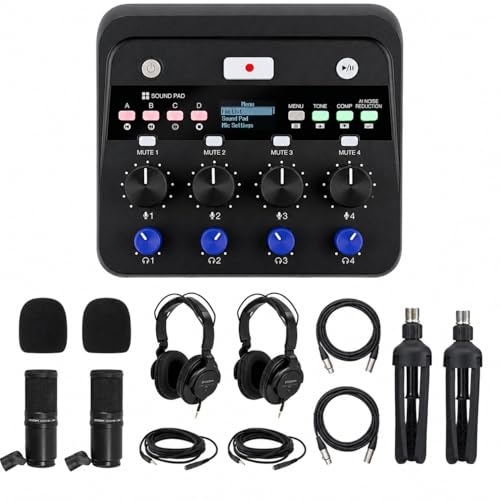
- Two ZDM-1 microphones and accessories included
- Four XLR inputs for multi-person recording
- Individual headphone monitoring for four people
Best For: Two-person podcasts and small multi-person productions
Best Flexible Handheld

- Three mics with nine selectable recording patterns
- 32-bit float recording reduces gain management
- USB microphone mode with simultaneous SD backup
Best For: Interviews, field recording, and adaptable podcast workflows
Best Simple Stereo Recorder

- X/Y stereo microphones for quick voice recording
- 32-bit float audio simplifies gain management
- USB microphone mode for calls and streaming
Best For: Solo podcasts, interviews, and portable content creation
Best Podcast Hub – Zoom PodTrak P4
For creators comparing voice recorders for podcasts, the Zoom PodTrak P4 is built around multi-person recording. It combines four XLR microphone inputs, four individually controlled headphone outputs, multitrack recording, and phone or USB connectivity in a battery-powered recorder.
Best For: Podcast teams recording up to four microphones, including call-in or remote guests.
Pros:
- Four XLR inputs with phantom power support multiple microphones.
- Four headphone outputs provide separate volume controls.
- Mix-minus supports phone and remote interviews through TRRS or USB.
- Sound pads and multitrack recording add production flexibility.
Cons:
- Battery life is listed at up to 3.5 hours on two AA batteries.
- Its feature set may be more than needed for solo recording.
The P4 is a practical choice when a podcast involves several speakers and monitoring matters. Its dedicated inputs and remote-interview features make it more suitable for structured podcast production than basic voice-note recording.
Best Flexible Field Recorder – Zoom H4 Essential
The Zoom H4 Essential is a versatile option among voice recorders for podcasts, especially when recording conditions vary. Its built-in stereo microphones work alongside two XLR/TRS inputs, while USB-C connectivity supports recording or streaming to a phone, tablet, or computer.
Best For: Podcasters who also record interviews, video audio, music, or live performances.
Pros:
- Built-in stereo microphones allow quick standalone recording.
- Two XLR/TRS inputs accommodate external microphones, instruments, mixers, or soundboards.
- 32-bit float recording is designed to help avoid distorted takes.
- USB-C supports recording or streaming while saving a backup to an SD card.
Cons:
- It provides two XLR/TRS inputs rather than four.
- Two AA batteries are required for battery-powered use.
Choose the H4 Essential if you want one recorder for podcasting and broader creative work. The combination of built-in microphones, external inputs, USB-C, and SD backup gives it more flexibility than a podcast-only setup.
Best Compact Voice Recorder – EVISTR L357 64GB Voice Recorder
The EVISTR L357 is a compact, straightforward choice for voice recorders for podcasts when portability and simple speech capture are priorities. It offers a built-in noise-reduction microphone, adjustable recording gain, voice activation, WAV or MP3 recording, and 64GB of storage.
Best For: Solo podcasters, interview note-taking, lectures, and portable speech recording.
Pros:
- Small metal body measures approximately 3.86 by 1.2 by 0.47 inches.
- Voice activation can reduce silent sections in recordings.
- Records in WAV or MP3 and includes playback controls such as A-B repeat and variable speed.
- 64GB storage and Type-C file transfer support extended use.
Cons:
- It has a built-in microphone rather than XLR inputs for podcast microphones.
- It is better suited to speech capture than multi-person podcast production.
The L357 makes sense for lightweight recording, field notes, and simple interview capture. Podcasters needing studio-style microphone connections or multiple headphone outputs should consider a dedicated podcast recorder instead.
Best AI-Enhanced Podcast Recorder – Zoom PodTrak P4next
The Zoom PodTrak P4next is designed for creators who want a focused podcast recorder with newer processing tools. It supports four XLR microphones, four headphone outputs, multitrack recording, up to +70dB of gain, and AI-assisted noise reduction, tone enhancement, and compression.
Best For: Podcast groups that want four-microphone recording with built-in tools for clearer, more balanced sound.
Pros:
- Four XLR inputs support up to four people in one room.
- Up to +70dB of gain accommodates demanding microphones.
- AI noise reduction, Tone Enhancement, and COMP reduce manual mixing work.
- Four headphone outputs have separate volume controls, and phone connection supports direct video audio capture.
Cons:
- Two AA batteries are required for battery-powered operation.
- Its processing features may be unnecessary for simple voice recording.
The P4next is a strong fit for a dedicated podcast workflow where several speakers need monitoring and cleaner sound with less post-production. It is especially appealing for creators recording directly into phone video or using microphones that need substantial gain.
Best High-Capacity Option – EVIDA 128GB Digital Voice Recorder
If you need voice recorders for podcasts that can also handle lectures, interviews, and meetings, the EVIDA 128GB recorder emphasizes storage and straightforward file management. It supports WAV and MP3 recording, voice activation, playback, and computer file transfers.
Best For: Podcasters who want a compact recorder with extensive storage and simple voice-activated recording.
Pros:
- 128GB capacity stores up to 9,296 hours of recordings according to the supplied specifications.
- Supports up to 1536kbps WAV recording, plus 128kbps and 192kbps MP3 options.
- Includes voice activation, password protection, A-B repeat, bookmarks, and four storage folders.
- Offers up to 54 hours of continuous recording and USB computer compatibility.
Cons:
- The built-in microphone operates in mono, which may be limiting for stereo podcast production.
- It has no headphone jack for direct monitoring.
- The recorder is designed around a built-in microphone rather than external podcast microphone inputs.
The EVIDA is a practical choice when long recording time, onboard storage, and organization matter more than multichannel podcast connectivity. For a simple interview or solo setup, its voice activation and playback tools can be useful.
Best Two-Person Podcast Pick – Zoom PodTrak P2 Podcast Recorder
The Zoom PodTrak P2 is built specifically for straightforward podcast production, with two USB microphone inputs and two headphone outputs. It also supports remote call-ins, simultaneous streaming and recording, and onboard processing for voices.
Best For: Two-person podcasts that use USB microphones and may include remote guests.
Pros:
- Connects two USB microphones and provides two headphone outputs for easy co-host monitoring.
- Mix-Minus helps reduce echo and feedback when bringing in a phone or computer guest.
- AI noise reduction, tone shaping, compression, and de-essing help shape voices during recording.
- Can stream to a smartphone or computer while saving individual tracks to an SD card.
Cons:
- Battery life is rated at up to four hours when using four AA batteries.
- Its USB microphone-focused design may not suit setups centered on XLR microphones.
- An SD card is required for onboard recording, based on the supplied feature description.
For creators who want a dedicated podcast workflow without a complicated setup, the P2 is the most purpose-built option in this selection. Its dual USB inputs, headphone outputs, and remote-guest features cover the essentials for a two-person show.
Best Flexible Audio Input – Zoom H1 XLR Recorder
The Zoom H1 XLR is one of the more flexible voice recorders for podcasts because it accepts two XLR/TRS sources while also offering 3.5mm input and headphone monitoring. Its 32-bit/96kHz recording capability and waveform display are useful for creators who want more control over connected microphones and instruments.
Best For: Podcasters who use XLR microphones or need flexible connections for interviews and field recording.
Pros:
- Two XLR/TRS combo inputs support microphones, instruments, and other sources.
- Records up to 32-bit/96kHz for detailed audio capture.
- OLED waveform display helps monitor levels while recording.
- Includes a 3.5mm stereo input and headphone output, with SDXC support up to 1TB.
Cons:
- It requires two AA batteries, with a listed battery life of up to 10 hours.
- The recorder does not include the two USB microphone inputs highlighted on the PodTrak P2.
- Its feature set may be more than needed for a basic single-microphone setup.
The H1 XLR is the stronger fit when microphone compatibility and monitoring flexibility are priorities. Its dual combo inputs make it suitable for more varied podcast rigs, while the waveform display and 32-bit recording support provide useful production control.
Best Complete Podcast Kit – Zoom PodTrak P4next Bundle
If you need voice recorders for podcasts that can handle a full conversation, this bundle provides a ready-to-use two-person setup. The PodTrak P4next offers four XLR inputs, multitrack recording, built-in audio tools, and four individual headphone outputs, while the included ZDM-1 packs supply microphones and core accessories.
Best For: Two-person podcasts, interviews, and small productions that need dedicated microphones and monitoring.
Pros:
- Includes two dynamic ZDM-1 microphones, headphones, tripods, windscreens, and XLR cables.
- Four XLR inputs support up to four people plus a call-in guest.
- Provides up to +70dB of gain and built-in noise reduction, tone enhancement, and compression.
- Four headphone outputs offer separate volume controls for individual monitoring.
Cons:
- It is a larger, more involved setup than a handheld recorder.
- The included microphones are designed for spoken voice rather than a broad range of recording applications.
This is the strongest choice here for a complete, multi-person podcast station. Choose it if you value flexible inputs and included accessories more than portability.
Best Flexible Handheld – Zoom H2 Essential Recorder
The Zoom H2 Essential is one of the more adaptable voice recorders for podcasts, with three built-in microphones and nine selectable recording patterns. Its 32-bit float recording is designed for clip-free audio without constant gain adjustments, and it can work as a USB microphone while recording a backup to an SD card.
Best For: Podcasters, journalists, and creators who need flexible handheld recording for interviews, voices, and wider soundscapes.
Pros:
- Three built-in microphones provide nine recording patterns, including mono, stereo, and surround options.
- 32-bit float recording helps capture audio without manually adjusting gain.
- Works as a USB microphone with computers, smartphones, and tablets while recording to an SD card.
- Bluetooth timecode can wirelessly sync multiple units.
Cons:
- It does not include dedicated XLR microphone inputs or bundled podcast microphones.
- It requires two AA batteries.
The H2 Essential is a practical middle ground for creators who want more recording flexibility than a basic stereo recorder. Its built-in microphones and clip-free workflow are particularly useful when recording conditions can change quickly.
Best Simple Stereo Recorder – Zoom H1 Essential Recorder
For creators seeking compact voice recorders for podcasts, the Zoom H1 Essential offers a straightforward stereo setup with X/Y microphones and 32-bit float recording. It can capture conversations, interviews, voiceovers, and meetings, while USB-C connectivity lets it serve as a microphone for calls, streaming, and desktop or mobile recording.
Best For: Solo podcasters, interviewers, and content creators who prioritize a simple, portable stereo recorder.
Pros:
- X/Y stereo microphones capture voices and surrounding sound with a simple setup.
- 32-bit float recording supports clip-free audio without frequent gain adjustments.
- USB microphone mode works for livestreams, calls, voiceovers, podcasts, and mobile recording.
- Rated for up to 10 hours of battery life with two AAA batteries.
Cons:
- Its stereo microphone design is less suited to multi-person XLR podcast setups.
- It offers fewer microphone and pattern options than the H2 Essential.
The H1 Essential is a sensible pick when portability and ease of use matter most. It is well suited to solo recording and quick interviews, but larger productions will benefit from a recorder with more inputs.
How We Picked the Best Voice Recorders for Podcasts
We focused on the features that most directly affect podcast recording: microphone compatibility, input count, headphone monitoring, ease of use, portability, storage, battery operation, and support for remote or USB-based workflows. We also included both purpose-built podcast recorders and compact handheld devices because podcasters have different production needs.
Models with multiple XLR inputs are generally better for roundtable conversations, while handheld recorders are more useful for interviews, location audio, backup tracks, and solo creators who value mobility. Large-capacity dictation recorders are included for buyers whose priority is extended voice recording rather than studio-quality production.
Quick Comparison
| Best For | Recommended Type | What to Prioritize |
|---|---|---|
| Multi-person podcasts | Podcast mixer-recorder | Several microphone inputs, headphone outputs, and independent level control |
| Solo creators | Compact handheld recorder | Simple controls, built-in microphones, and USB connectivity |
| Field interviews | Portable handheld recorder | Battery life, durable construction, wind protection, and low handling noise |
| Remote interviews | Podcast recorder with phone or USB input | Flexible connection options and separate monitoring |
| Lectures and meetings | Digital voice recorder | Long battery life, ample storage, playback, and voice activation |
Key Buying Factors for Voice Recorders for Podcasts
Inputs and Microphone Compatibility
Check whether the recorder accepts XLR microphones, USB microphones, 3.5mm sources, or only its built-in microphones. XLR inputs are the most flexible for dynamic podcast microphones, while USB inputs can simplify computer-free setups.
Number of Channels and Headphone Outputs
Choose enough inputs for every guest and host, with at least one monitoring option for checking levels. Multiple headphone outputs are especially useful when recording in the same room.
Recording Quality and Noise Control
Look for dependable level controls, quality preamps, limiter or safety-track functions, and—where available—noise-reduction tools. AI noise reduction can help, but microphone placement and a quiet room still matter most.
Portability, Power, and Storage
Handheld models are ideal for mobile recording, but confirm battery type and expected runtime. For long sessions, verify removable storage or internal capacity and whether the recorder supports the file formats you use.
Who Should Buy Which Voice Recorders for Podcasts?
Choose a multitrack podcast recorder if you regularly host several people, use XLR microphones, or want independent control over each voice. A two-input model is a sensible fit for a host-and-guest format, while a four-input unit provides more room for panels and co-hosts.
Pick a handheld recorder if you record interviews away from your desk, capture ambient sound, or need a lightweight backup device. A compact built-in-microphone model suits beginners and mobile creators, while an XLR-capable handheld offers more flexibility as your setup grows.
Finally, choose a high-capacity digital voice recorder for lectures, meetings, research, or simple spoken notes where convenience and recording duration matter more than advanced podcast mixing. Before buying, match the recorder’s inputs and monitoring features to your actual microphone setup rather than paying for controls you will not use.