Looking for a cleaner, safer way to print? The best 3d printer enclosures with ventilation can help reduce fumes, stabilize temperatures, and keep dust off your machine.
In this roundup, we focus on practical options for FDM, resin, and mixed-use setups so you can choose an enclosure that fits your printer, workspace, and budget.
Best 10 3d Printer Enclosures with Ventilation Picks for 2026
Resin Fume-Filter Option
Resin enclosure with UV window and adjustable venting

- UV-blocking window for resin monitoring
- Adjustable fan with three-layer filtration
- Fire-resistant fabric and ventilation kit
Best For: Resin printing setups that need odor control and UV protection
Large Resin Workstation Pick
Double-space resin enclosure with vent kit and LED
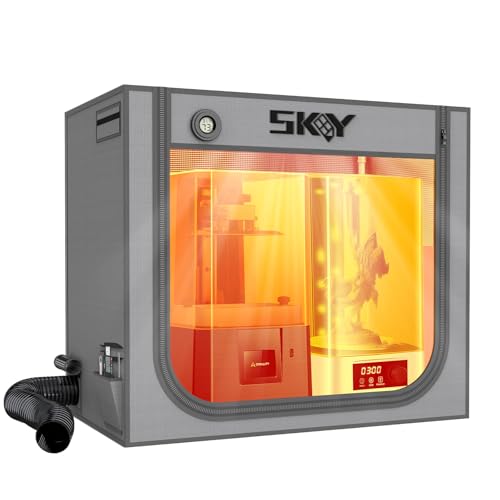
- Fits a resin printer plus curing box
- Activated carbon and duct kit for odor control
- LED light and thermo-hygrometer included
Best For: Resin makers who want more workspace and better odor management
Best Fit for Bambu A1 Combo
Bambu A1 Combo enclosure with fan and LED

- Sized for Bambu Lab A1 with AMS Lite
- 8025 fan helps remove smoke and dust
- LED lighting and fire-resistant materials
Best For: Bambu Lab A1 Combo owners who want a tailored ventilated enclosure
Resin Fume Control Pick
YOOPAI Multifunctional Resin Enclosure

- Carbon filter sheet helps reduce resin odors
- Exhaust fan and pipe support ventilation
- Clear front window for easy print monitoring
Best For: Resin printer users who want odor control and visibility
Temperature Control Upgrade
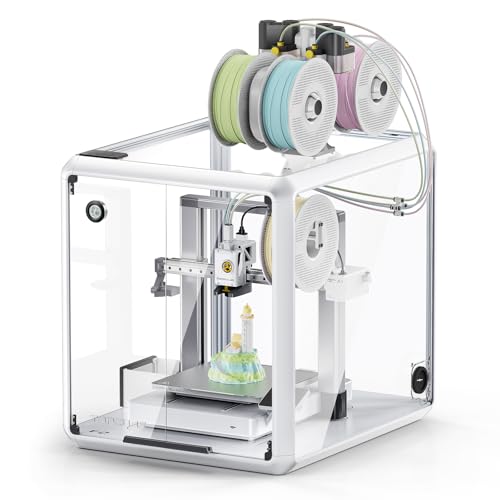
- Active cooling base helps manage heat
- Fully enclosed acrylic design stabilizes conditions
- 360° transparency and LED lighting aid monitoring
Best For: Bambu Lab A1 owners wanting cooling and visibility
Flexible Ventilation Tent
Dual-Placement Resin Enclosure with Fan Kit

- Dual horizontal or vertical placement options
- 12V fan filter system with speed control
- Three-layer filtration plus UV filter membrane
Best For: Users wanting a flexible tent with adjustable airflow
Space-Saving Print Station
YOOPAI Medium Enclosure with LED

- Six-sided enclosed print space
- Thermo-hygrometer built in
- LED lighting and ventilation kit
Best For: Desktop users wanting a compact enclosed setup with light and monitoring
Resin-Friendly Ventilated Tent
VEVOR Constant-Temp Printer Case
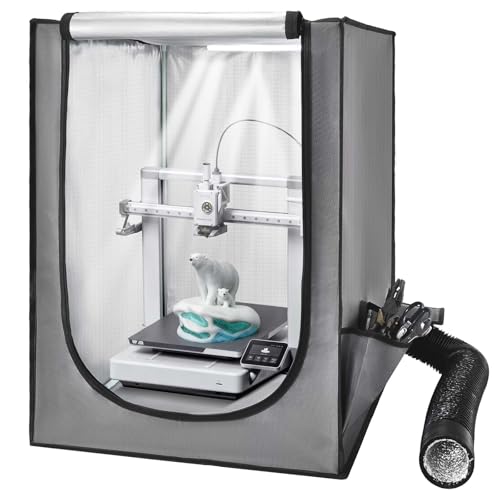
- Quickly expels smoke and dust
- Constant-temperature support
- Transparent window with LED light
Best For: Compact resin or small FDM printer users who want ventilation and visibility
Heavy-Duty Fume Control
Insulated Enclosure with Exhaust Kit

- 180 CFM exhaust system included
- Insulation raises chamber temperature
- Complete kit with fan, ducting, and LED
Best For: Users wanting a full-featured enclosure with active exhaust and thermal insulation
All-in-One Visibility Pick – YOOPAI Ender 3 enclosure with LED and monitoring
If you want 3d printer enclosures with ventilation that also make day-to-day monitoring easier, this YOOPAI enclosure is built around visibility, stability, and basic workspace control. The built-in LED strip helps you see the print clearly, while the ventilation kit and six-sided enclosure design aim to keep the area quieter, cleaner, and more consistent during long jobs.
Best For: Creality Ender and other compatible printer owners who want LED lighting, temperature and humidity monitoring, and a ventilated enclosure for a safer, quieter workspace.
Pros:
- Built-in LED strip improves visibility while printing.
- Includes temperature and humidity monitoring for better print control.
- Six-sided enclosure helps reduce noise and limit dust entry.
- Fire-resistant materials and sturdy construction add peace of mind.
Cons:
- Compatibility depends on measuring printer height and overall size first.
- Focused more on enclosed printing than heavy-duty ventilation extraction.
This is a practical choice if you want an enclosed setup that balances lighting, monitoring, and workspace protection. It looks especially appealing for users who need a simple, quick-install solution that supports cleaner and more controlled printing.
Resin Fume-Filter Option – Resin enclosure with UV window and adjustable venting
For buyers looking at 3d printer enclosures with ventilation for resin setups, this tent-style enclosure is designed to help manage smoke, fumes, and UV exposure. It includes a UV-blocking window, fire-resistant fabric, and a fan-filter setup with adjustable speed, making it a practical fit for users who want extra control around odor and airflow.
Best For: Resin printer users who want a ventilated enclosure with UV protection, odor filtering, and adjustable airflow.
Pros:
- UV-block window allows monitoring while helping protect resin prints from harmful rays.
- Ventilation kit helps extract smoke and maintain a safer working environment.
- Three-layer filter is designed to absorb large particles of dust and harmful gases.
- Adjustable 12V fan speed gives you airflow control.
Cons:
- Requires printing a plastic adaptor for the fan bracket replacement.
- Best suited to smaller LCD/resin printers, so size checks are important.
This enclosure makes the most sense for resin users who care about airflow and odor management more than a rigid cabinet-style structure. The bundled filtration and adjustable fan speed are the standout reasons to consider it.
Large Resin Workstation Pick – Double-space resin enclosure with vent kit and LED
If your priority is a bigger enclosed workspace, this option stands out among 3d printer enclosures with ventilation because it is built to hold both a resin printer and a curing box. The ventilation duct kit, activated carbon box, LED lighting, and thermo-hygrometer make it easier to manage odor, visibility, and print conditions in one larger setup.
Best For: Resin users who need room for both a printer and curing box, plus odor control and workspace lighting.
Pros:
- Large internal space is designed for a resin printer and curing box.
- Ventilation duct kit and activated carbon box help manage odors.
- LED light improves visibility inside the enclosure.
- Thermo-hygrometer helps monitor temperature conditions.
Cons:
- Internal dimensions must be checked carefully before ordering.
- Bulkier footprint may be less convenient for smaller workbenches.
This is a strong pick for makers who want a more complete resin workstation rather than a basic cover. The extra space and odor-management features make it especially useful for organized print-and-cure workflows.
Best Fit for Bambu A1 Combo – Bambu A1 Combo enclosure with fan and LED
For Bambu owners comparing 3d printer enclosures with ventilation, this model is built specifically around the A1 with AMS Lite and adds the basics most users want: airflow, lighting, and a controlled print environment. The included 8025 fan helps remove smoke and dust, while the LED system and fire-resistant construction round out a setup aimed at cleaner, more consistent printing.
Best For: Bambu Lab A1 Combo users with AMS Lite who want a ventilated, fire-resistant enclosure with LED lighting.
Pros:
- Made for the Bambu Lab A1 with AMS Lite in mind.
- Ventilation kit with 8025 fan helps remove smoke and dust.
- Built-in LED lighting improves visibility inside the enclosure.
- Fireproof, dustproof design supports a cleaner workspace.
Cons:
- Not intended for A1 setups without AMS Lite.
- Size is fixed, so compatibility depends on your exact setup.
This enclosure is a focused match for Bambu Lab A1 Combo owners who want an easy-fit solution instead of a generic tent. The ventilation and lighting features make it a practical upgrade for users who print often and want a more controlled environment.
Resin Fume Control Pick – YOOPAI Multifunctional Resin Enclosure
If you want one of the more practical 3d printer enclosures with ventilation for resin work, this YOOPAI tent focuses on odor control, dust protection, and easier monitoring. Its carbon filter sheet, exhaust fan support, and expandable pipe are aimed at keeping resin fumes moving out of your workspace while the clear front window lets you check prints without opening the cover.
Best For: Resin printer users who want a compact enclosure with built-in odor filtering and a clear view of the print process.
Pros:
- Built-in carbon filter sheet helps absorb resin odors and emissions.
- Exhaust fans and expandable pipe support venting polluted air away.
- Six-sided enclosed structure helps block dust and resin splashing.
- Transparent front window makes it easier to observe prints without opening the enclosure.
Cons:
- Best suited to smaller resin printers within the stated size range.
- Ventilation hardware is described as supportive, but installation details are limited in the notes.
For resin users prioritizing cleaner air and a tidier print area, this enclosure offers a strong mix of filtration and visibility. The constant-temperature design may also help with more stable resin printing, as long as your printer fits the internal dimensions.
Temperature Control Upgrade – TOPCUBE F2 for Bambu Lab A1
This is a more specialized option among 3d printer enclosures with ventilation, built for the Bambu Lab A1 and A1 Combo. The TOPCUBE F2 combines a fully enclosed acrylic structure with an active cooling base fan, so it is aimed at keeping internal conditions more stable while also helping dissipate heat from the printer and mainboard.
Best For: Bambu Lab A1 owners who want an enclosure with active cooling, full visibility, and family-friendly protection.
Pros:
- Active cooling system in the base helps dissipate heat and prevent overheating.
- Fully enclosed design helps stabilize temperature and humidity during printing.
- 360° transparent acrylic body makes it easy to monitor prints in real time.
- LED lighting and centralized controls add convenience for everyday use.
Cons:
- Made specifically for Bambu Lab A1/A1 Combo, so compatibility is limited.
- Additional fan-and-pipe exhaust setup is sold separately if you want to vent air outside.
For A1 owners, this enclosure stands out because it pairs temperature management with built-in active cooling rather than relying only on passive insulation. If your priority is a safer, more controlled indoor setup with good visibility, it is a strong match.
Flexible Ventilation Tent – Dual-Placement Resin Enclosure with Fan Kit
If you need a more adaptable option in 3d printer enclosures with ventilation, this dual-placement tent is designed to work either horizontally or vertically. It includes a 12V fan filter system with speed control, three-layer filtration, and a removable UV filter membrane, making it useful when you want airflow management for resin fumes, smoke, or dust.
Best For: Users who want a lightweight, flexible enclosure with adjustable ventilation and broad printer compatibility.
Pros:
- Dual placement design can be used horizontally or vertically for different setups.
- Included fan filter system has speed control for adjustable airflow.
- Three-layer filtration helps absorb dust and harmful gases.
- 5-layer composite material and fireproof inner construction add durability.
Cons:
- You need to confirm your printer dimensions carefully before buying.
- Ventilation depends on the included fan system, so setup matters.
This enclosure is appealing if you want more placement flexibility than a rigid cabinet-style design offers. Its mix of filtration, lightweight materials, and UV-related filtering features makes it a practical tent-style choice for mixed-use printing spaces.
Space-Saving Print Station – YOOPAI Medium Enclosure with LED
If you want a practical 3d printer enclosures with ventilation setup for a desktop machine, this YOOPAI enclosure combines a defined print area, LED lighting, and a ventilation kit in one compact tent. It’s designed to help reduce drafts, dust exposure, and day-to-day workspace interference while giving you a simple way to monitor temperature and humidity inside the chamber.
Best For: Makers who want a medium-size enclosed print space with basic ventilation, lighting, and environmental monitoring.
Pros:
- Six-sided enclosure helps create a separated printing area and reduce draft exposure.
- Built-in thermo-hygrometer lets you check temperature and humidity at a glance.
- Integrated LED lighting improves visibility during prints and inspections.
- Flame-resistant enclosure material and supported frame add practical protection.
Cons:
- Compatibility depends on your printer, spool holder, and accessories fitting the interior space.
- Ventilation is listed as a kit, but airflow routing will depend on your setup.
- Best suited to desktop configurations rather than larger machines.
Overall, this is a straightforward pick for users who want a tidy enclosure with useful monitoring and light built in. It focuses more on controlled printing conditions than on heavy-duty exhaust performance.
Resin-Friendly Ventilated Tent – VEVOR Constant-Temp Printer Case
This VEVOR option is built for users shopping for 3d printer enclosures with ventilation that can help manage fumes, dust, and print temperature. With a transparent window, LED lighting, and a ventilation system designed to expel smoke and dust after printing, it’s aimed at keeping the work area cleaner while supporting stable conditions during resin or FDM jobs.
Best For: Users who want a ventilated enclosure for resin or small FDM printers with clear visibility and temperature support.
Pros:
- Ventilation system is designed to quickly expel smoke and dust after printing.
- Constant-temperature design helps reduce warping, cracking, clogging, and jamming.
- Transparent window and LED light make it easier to monitor print progress.
- Flame-retardant materials and closed structure add practical safety and dust control.
Cons:
- Requires checking dimensions carefully, especially for larger printers or accessories.
- Best fit is small printers and most LCD resin machines, not oversized setups.
- Airflow is focused on post-print expelling rather than advanced filtration claims.
In practice, this enclosure balances visibility, temperature stability, and simple ventilation in a size that suits many compact machines. It’s a sensible choice if you want a controlled printing space without overcomplicating setup.
Heavy-Duty Fume Control – Insulated Enclosure with Exhaust Kit
For buyers comparing 3d printer enclosures with ventilation and wanting more than a basic cover, this insulated tent adds an exhaust system, seal gaskets, and LED lighting to support cleaner and steadier printing. It is designed to reduce fumes and odors, help stabilize chamber warmth, and provide a more controlled environment for filament and resin workflows.
Best For: Makers who want a more complete enclosure package with active fume reduction, insulation, and included accessories.
Pros:
- 180 CFM exhaust system with sealed ports is designed to reduce fumes and odors.
- Insulation lining can raise internal temperature by 5°C to 15°C.
- Includes fan, ducting, backdraft valve, shelf, and LED lighting bar.
- Dual exhaust ports offer flexible hose routing for different room layouts.
Cons:
- Larger footprint means it needs more room than a basic desktop tent.
- Assembly involves multiple components, so setup is more involved than simpler enclosures.
- Some benefits, like passive drying, depend on long-term use and conditions.
This is the most feature-rich option in the group for users who want a full enclosure with ventilation hardware included. It leans toward controlled airflow and thermal stability, making it a strong pick for more demanding home or office setups.
How We Picked the Best 3d Printer Enclosures with Ventilation
We prioritized enclosures that balance airflow, build quality, and everyday usability. That means looking for effective exhaust or filtration options, enough internal space for common desktop printers, and features that support safer, more consistent printing such as LED lighting, fire-resistant materials, and temperature retention.
For 3d Printer Enclosures with Ventilation, the main goal is not just odor control. Good designs also help reduce drafts, limit airborne dust, and create a more stable environment for materials that are sensitive to temperature swings.
Quick Comparison
If you want the simplest choice, start by matching the enclosure to your printer type: FDM, resin, or a larger multi-part setup. Then compare three things: ventilation method, internal size, and material construction. Active exhaust or filtration is usually better for fumes, while larger tents or framed enclosures are better for bigger printers or accessory storage.
Also consider whether you need extras like LED lighting, access panels, cable ports, or a rigid frame. Those details can make a big difference in how easy the enclosure is to use day to day.
Key Buying Factors for 3d Printer Enclosures with Ventilation
Ventilation Type
Some enclosures use an exhaust fan to move air outside, while others rely on filtration to capture odors and particles. Exhaust is often best if you can vent outdoors. Filtration is a better fit for apartments, offices, or rooms where external venting is not practical.
Size and Printer Compatibility
Measure your printer before buying, including any spool holders, cable clearance, and bed movement. A tight fit can limit airflow and make maintenance harder, while too much extra space may reduce thermal efficiency.
Material and Safety
Look for fire-resistant or flame-retardant materials when possible, especially for long prints or enclosed electronics. For resin setups, splash resistance and odor control matter as much as heat retention.
Lighting, Access, and Noise
LED lighting, wide openings, and clear panels improve visibility. If your printer runs in a shared room, noise reduction and zipper quality can matter just as much as ventilation.
Who Should Buy Which 3d Printer Enclosures with Ventilation?
FDM users who want stable temperatures should lean toward insulated, vented enclosures with good cable access. Resin users should focus on odor management, filtration, and easy cleanup surfaces. If you print in a small room or apartment, choose one of the more compact 3d Printer Enclosures with Ventilation that emphasizes filtration and dust control. If you run a larger machine or multiple accessories, pick a spacious model with strong airflow and room to work comfortably.
In short, the right enclosure depends on your printer size, how much fumes matter in your space, and whether you value heat retention, filtration, or portability most.