Choosing a 3D scanner for small objects is mostly about precision, stability, and how much setup you can tolerate. The right model should capture fine details without demanding endless retries or heavy post-processing.
This roundup focuses on scanners that balance accuracy, scan speed, color capture, and ease of use so you can match the tool to your workflow, whether that is 3D printing, product design, or hobby modeling.
Best 10 3d Scanner for Small Objects Picks for 2026
Precision Mini Scanner
Revopoint MINI 2 for Tiny Details

- 0.02 mm precision for fine small-object scans
- Lightweight 175 g design with USB or Wi-Fi 6
- RGB texture capture plus marker help for easier tracking
Best For: Miniatures, small parts, and 3D printing details
Wireless Dual-Mode Scanner

- 0.03 mm accuracy for intricate small parts
- Blue laser and NIR modes cover tiny to large objects
- Wi-Fi 6, touchscreen, and swappable batteries add mobility
Best For: Portable users who want precision on small objects and room to grow
Entry-Level Detail Scanner
3DMakerpro Fox for Desktop Parts
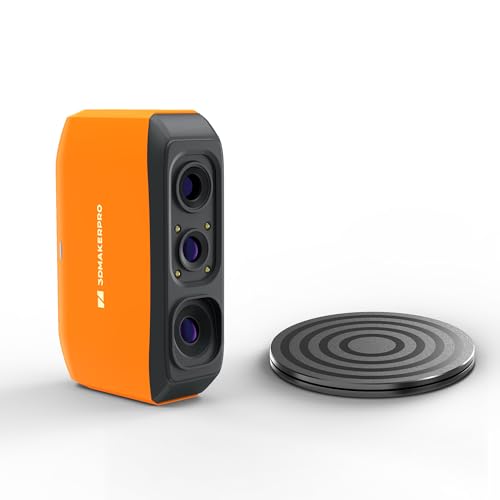
- 0.07 mm accuracy with NIR-based scanning
- Markerless tracking and anti-shake support
- Made for small-to-medium objects, including miniatures
Best For: Beginners scanning small-to-medium objects on a budget
Industrial Precision Scanner

- 0.01 mm single-frame precision for tiny details
- Five modes cover small parts to medium objects
- Handles dark, glossy, and metallic surfaces without spray
Best For: Precision inspection, reverse engineering, and small parts
Most Detailed Portable Choice
Creality Otter Lite Basic 3D Scanner

- 0.05mm accuracy for fine-detail capture
- Scans small items up to large objects
- No-spray scanning for dark/metal surfaces
Best For: Handheld scanning of small parts, collectibles, and mixed-size objects
Best Desktop Precision Option

- Up to 0.02 mm accuracy for detailed parts
- Auto turntable supports repeatable scans
- Handles dark or shiny surfaces without spray
Best For: Desktop scanning of small parts, inspection, and CAD prep
Most Portable Value Pick
Creality CR-Scan Ferret 3D Scanner

- 0.1mm accuracy in high-accuracy mode
- Firmware upgrades improve small-object scanning
- Color camera adds realistic textures
Best For: Portable scanning for hobby projects and 3D printing
Wireless Dual-Mode Capture
EINSTAR 2 for Small to Large Objects

- 17-line blue laser captures fine detail on small objects
- VCSEL infrared helps with black surfaces and outdoors
- Wireless battery design supports portable scanning
Best For: People scanning small parts who also need flexibility for larger or difficult surfaces
Portable Precision Pick
Creality Otter Lite for Detailed Small Scans

- 0.05mm precision is suited to fine small-object detail
- Scans objects as small as 20mm without spray
- Wi-Fi and phone support add portable convenience
Best For: Users who want accurate small-part scans and easy wireless use across devices
Ultra-Compact Detail Capture

- 0.03mm accuracy targets very small parts with fine detail
- Scans objects as small as 5mm and up to 2000mm
- Wireless Wi-Fi 6 and hot-swappable batteries support portability
Best For: People who need maximum detail for tiny components and still want broad scanning flexibility
Precision Mini Scanner – Revopoint MINI 2 for Tiny Details
If you need a 3d scanner for small objects, the Revopoint MINI 2 is built around tiny-detail capture. Its blue light system, up to 0.02 mm single-frame precision, and 16 fps scanning speed make it a strong fit for miniatures, small parts, and 3D printing workflows where fine geometry matters.
Best For: Small objects, intricate details, and users who want a lightweight scanner for 3D printing and basic scan-to-CAD work.
Pros:
- Up to 0.02 mm single-frame precision for fine detail capture
- Blue light technology helps filter ambient light interference
- RGB camera, Flash LEDs, and marker recognition support texture and featureless scans
- Lightweight 175 g body with USB or Wi-Fi 6 connection options
Cons:
- Scanning results can vary by material and color
- Scanning spray is recommended for some objects
- Best suited to small items rather than very large objects
The MINI 2 focuses on precision and portability, but it works best when the object fits its scanning range and you follow the setup guidance. For buyers prioritizing compact size and detailed results on small targets, it is a very practical pick.
Wireless Dual-Mode Scanner – Creality Pika for Miniatures
The Creality Pika is a flexible 3d scanner for small objects, but it is also ready for much larger jobs. Its 7-line blue laser mode targets fine detail, while NIR structured light adds full-color scanning and broad size coverage, making it useful when you want one scanner for miniatures, parts, and body scans.
Best For: Users who want a portable scanner with detailed small-object capture and the option to scale up to larger subjects.
Pros:
- Up to 0.03 mm accuracy and 0.1 mm 3D resolution for small details
- Dual-mode scanning with blue laser and NIR structured light
- AI hole filling, body completion, and retexturing add convenience
- Wireless Wi-Fi 6 support and swappable batteries improve mobility
Cons:
- Its wide feature set may be more than needed for simple scans
- Best performance may depend on matching the right mode to the subject
- Included workflow is spread across multiple platforms and accessories
For shoppers who want portability without giving up detail, the Pika stands out. It is especially appealing if you need a scanner that can handle small objects accurately now and still remain useful for larger scanning projects later.
Entry-Level Detail Scanner – 3DMakerpro Fox for Desktop Parts
If you are shopping for a 3d scanner for small objects on a tighter budget, the 3DMakerpro Fox is positioned as an entry-level option with 0.07 mm accuracy and markerless tracking. It is aimed at small to medium items, making it a practical choice for desktop miniatures, prototypes, and other manageable scan targets.
Best For: Beginners who want an accessible scanner for small-to-medium objects and are willing to learn the workflow.
Pros:
- 0.07 mm accuracy with NIR light for useful structural detail
- Markerless tracking simplifies object setup
- Anti-shake support helps with minor hand movement
- Sized for objects from 40 mm to 1200 mm
Cons:
- Results require patience and a learning curve
- Basic CAD or 3D modeling experience is recommended
- Needs a capable PC, with a dedicated GPU strongly recommended
The Fox is less about instant results and more about accessible entry into scanning. If you want a lower-barrier way to start capturing small objects and are comfortable learning the software workflow, it offers a sensible balance of cost and capability.
Industrial Precision Scanner – Revopoint MetroY Ultra
The Revopoint MetroY Ultra is aimed at users who need a high-end 3d scanner for small objects and precise inspection work. With up to 0.01 mm single-frame precision, multiple blue-laser scanning modes, and support for dark or shiny surfaces without spray, it is built for demanding detail capture and efficient reverse-engineering workflows.
Best For: Precision-focused users scanning small parts, industrial components, and objects that need tight tolerance measurement.
Pros:
- Up to 0.01 mm single-frame precision for fine geometry
- Five scanning modes handle small parts through medium objects
- Scans black, glossy, and metallic surfaces without spray
- Wi-Fi 6, battery grip, and up to 90 fps support efficient work
Cons:
- Minimum system requirements are demanding
- More specialized than a basic hobby scanner
- Best suited to users focused on precision and inspection
If your priority is accuracy over simplicity, the MetroY Ultra delivers a serious feature set. It is especially compelling for small-object scanning where dimensional detail, surface handling, and workflow speed all matter.
Most Detailed Portable Choice – Creality Otter Lite Basic 3D Scanner
If you want a 3d scanner for small objects that still handles bigger items later, the Creality Otter Lite Basic is built around precision and flexibility. Its 0.05mm accuracy, 30fps scanning, and quad-camera design are aimed at capturing fine surface detail while keeping the workflow quick for printing, reverse engineering, and inspection.
Best For: Users who want high-detail handheld scanning for coins, figurines, small parts, and mixed-size projects.
Pros:
- 0.05mm accuracy and up to 30fps help capture fine details smoothly.
- Quad-camera design supports both tiny objects and much larger items.
- Scans black and metallic surfaces without spray, which is useful for small mechanical parts.
- Full-color texture capture adds realistic surface detail for display or documentation.
Cons:
- Handheld use may benefit from the optional Scan Bridge handle for steadier sessions.
- Some advanced features and alignment modes may take practice to use well.
Overall, the Otter Lite Basic stands out if you need a portable scanner that can resolve small-object detail without giving up versatility. It is especially appealing when you want color, speed, and no-spray scanning in one package.
Best Desktop Precision Option – Revopoint MetroX 3D Scanner
For buyers comparing a 3d scanner for small objects, the Revopoint MetroX leans hard into precision and controlled desktop scanning. It combines blue laser scanning, multiple modes, and an auto turntable option to deliver detailed results for parts, models, and inspection tasks where accuracy matters most.
Best For: Desktop users who want high-precision scanning for small mechanical parts, quality control, and scan-to-CAD workflows.
Pros:
- Up to 0.02 mm accuracy and 0.01 mm precision support very detailed scans.
- Four scanning modes, including auto turntable, make it adaptable for different object types.
- Blue laser performance helps scan dark or shiny surfaces without spray.
- Includes software tools for point cloud processing, meshing, and export to CAD workflows.
Cons:
- Designed more for desktop use than quick handheld scanning on the go.
- Software compatibility is limited to x86_64 architecture.
The MetroX is the strongest pick here if your priority is repeatable, metrology-style scanning of small objects. It is especially well suited to users who value automation, inspection, and clean data for downstream design work.
Most Portable Value Pick – Creality CR-Scan Ferret 3D Scanner
If you need a practical 3d scanner for small objects without moving up to the most expensive option, the Creality CR-Scan Ferret offers a good balance of portability and detail. Its firmware updates, dual-mode scanning, and color capture make it a flexible choice for users who want better small-object results from a handheld unit.
Best For: Hobbyists and makers who want a portable scanner for small objects, prototyping, and everyday 3D printing projects.
Pros:
- High-accuracy mode reaches 0.1mm precision with 0.16mm resolution.
- Firmware improvements are aimed at smoother tracking and better small-object capture.
- 30 FPS point cloud capture and fast processing help scanning feel responsive.
- Built-in RGB camera records full-color textures for more realistic models.
Cons:
- High-accuracy mode is still less precise than premium metrology-focused scanners.
- Mobile scanning is Android-only, so iPhone users need to look elsewhere.
The Ferret is a solid practical pick if portability matters and your small-object work is mostly for 3D printing or general modeling. It is not the most precise scanner in this group, but its flexibility and updated small-object performance make it easy to recommend for everyday use.
Wireless Dual-Mode Capture – EINSTAR 2 for Small to Large Objects
If you need a 3d scanner for small objects that can also grow with your workflow, the EINSTAR 2 is built around dual capture modes. Its 17 parallel blue laser lines are aimed at high-detail scanning, while the VCSEL infrared mode helps when you want broader coverage, black surfaces, or outdoor use. That makes it a flexible option for users who want one scanner for mixed-size projects.
Best For: Users who want a portable scanner for detailed small parts, reflective materials, and occasional larger-object scanning.
Pros:
- 17 parallel blue laser lines support high-resolution detail capture on small objects
- VCSEL infrared mode improves scanning on black surfaces and outdoors
- Wireless operation with a swappable battery for up to 3 hours of use
- No spray required for black or reflective objects, based on the supplied notes
Cons:
- Heavier than some compact handheld scanners at 5.72 pounds
- Best results may depend on choosing the right mode for the job
- Cable connection may still be needed if Wi-Fi interference occurs
Overall, the EINSTAR 2 stands out as a versatile scanner for buyers who want detailed small-object capture without giving up support for larger or more challenging surfaces. It is a practical pick if you value wireless convenience and mixed-material flexibility.
Portable Precision Pick – Creality Otter Lite for Detailed Small Scans
The Creality Otter Lite is a strong 3d scanner for small objects if your priority is fine detail in a portable package. It advertises 0.05mm precision, supports objects as small as 20mm, and uses structured-light stereo vision to capture detail without spraying black or metal surfaces. The wireless setup and phone support also make it easier to use on the go.
Best For: Users who want high-precision scanning for small parts, mixed materials, and mobile workflows.
Pros:
- 0.05mm ultra-high precision for detailed capture
- Scans objects as small as 20mm and supports up to 2000mm
- Handles black and metal objects without spray, according to the notes
- Wi-Fi, anti-shake, and 30 FPS speed improve convenience and stability
Cons:
- Wireless scanning may depend on the separate Lite Bridge battery handle
- Its feature set may be more than casual users need for simple scans
- Item weight is listed at 2.6 kg, so it is not the lightest option
For buyers focused on small-object scanning, the Otter Lite offers a good mix of precision and portability. It is especially appealing if you need color capture and compatibility across multiple devices.
Ultra-Compact Detail Capture – Creality Pika for Tiny Parts
If you’re shopping for a 3d scanner for small objects, the Creality Pika is designed to go after very tiny parts with 0.03mm accuracy and support for objects as small as 5mm. Its 7-parallel blue laser system is built for fine detail, while the infrared mode broadens its usefulness for faster scans and larger items. The result is a compact scanner that aims at precision without giving up versatility.
Best For: Makers and professionals scanning tiny components, mixed-size objects, and challenging surfaces.
Pros:
- 0.03mm accuracy and 7-parallel blue laser for fine detail
- Scans objects from 5mm to 2000mm, covering tiny to large items
- No spray needed for black or metal objects, per the supplied notes
- Wireless design with Wi-Fi 6 and hot-swappable batteries adds portability
Cons:
- Feature-rich design may be more complex than basic entry-level scanners
- Battery system and wireless workflow may be unnecessary for desktop-only use
- Advanced AI features may matter more to some users than others
The Pika is the most detail-focused option in this group for very small objects, especially when accuracy is the top priority. It also brings enough wireless and AI-assisted features to handle broader scanning jobs efficiently.
How We Picked the Best 3d Scanner for Small Objects
We prioritized scanners that are well suited to compact subjects like figurines, mechanical parts, collectibles, jewelry-scale components, and prototype pieces. For a 3d Scanner for Small Objects, the most important factors are stated accuracy, close-range performance, lighting or texture handling, and whether the software makes alignment and cleanup manageable.
We also favored models with flexible capture modes, useful color scanning, and enough portability to make tabletop scanning practical.
Quick Comparison
If you want the most detailed capture, look for higher stated precision and laser-based scanning. If you want easier operation, structured light and mixed-mode scanners can be more forgiving. For users scanning both small and medium subjects, a wider size range and faster frame rates help reduce repositioning and stitching issues.
Key Buying Factors for a 3d Scanner for Small Objects
Accuracy and Detail
For small objects, nominal accuracy matters more than raw speed. Higher precision helps preserve edges, embossed text, mechanical tolerances, and surface features that can disappear in lower-end scans.
Scan Mode and Surface Type
Blue laser systems are often strong on detail and surface definition, while structured light can be easier for general use. If you scan shiny, dark, or translucent items, check whether the scanner needs spray, targets, or special surface prep.
Workflow and Software
Good hardware is only part of the experience. Stable tracking, simple alignment tools, mesh cleanup, and export options for common CAD or 3D printing workflows can save a lot of time.
Portability and Object Size Range
Some buyers only need a dedicated tabletop solution for miniatures and components, while others want a scanner that can also handle larger objects. A wider working range adds flexibility, but it should not come at the expense of close-up detail.
Who Should Buy Which 3d Scanner for Small Objects?
If you are a beginner, choose a scanner that emphasizes ease of use, automatic alignment, and forgiving tracking. If you are focused on 3D printing or reverse engineering, prioritize higher accuracy and consistent mesh quality. If you want one device for both tiny parts and larger items, pick a model with multiple scan modes and a broader size range.
In short, the best choice depends on whether you value detail, speed, mobility, or simplicity most. For small-object scanning, the safest buy is usually the scanner that delivers the cleanest close-range results with the least amount of fuss.