The best camera slider for beginners makes camera movement easier to control without adding unnecessary complexity. The options below range from compact manual dollies to motorized systems with app control, time-lapse modes, and longer travel distances.
Use this roundup to match slider length, payload, portability, and control features to your camera setup and shooting style.
Best 10 Camera Slider for Beginners Picks for 2026
Portable Starter Pick
Zecti 16-Inch Carbon Fiber Slider

- Compact 16-inch carbon fiber track
- Adjustable legs and bubble level
- Multiple mounting points and carrying bag
Best For: Beginners needing a portable manual slider
Automated Long-Track Pick
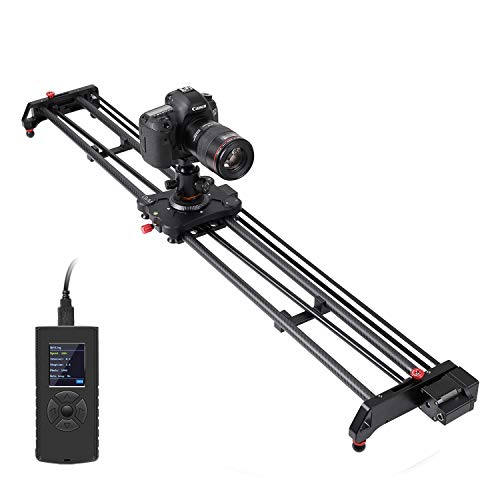
- Automatic round-trip and time-lapse modes
- Adjustable speed, intervals, and torque
- Includes battery, cables, controller, and bag
Best For: Beginners wanting automated long tracking shots
All-in-One Compact Pick

- Includes ball head, phone clamp, and action mount
- Smooth four-bearing carbon fiber track
- Adjustable legs and bubble level
Best For: Beginners using cameras, phones, and action cameras
Heavy-Duty Tabletop Pick
NEEWER Scaled Camera Table Dolly

- Supports up to 22 pounds
- Adjustable straight, curved, and circular paths
- Rotatable rubber wheels and fluid bearings
Best For: Beginners creating tabletop or curved tracking shots
Versatile Motorized Pick
GVM 48-Inch Carbon Fiber Slider
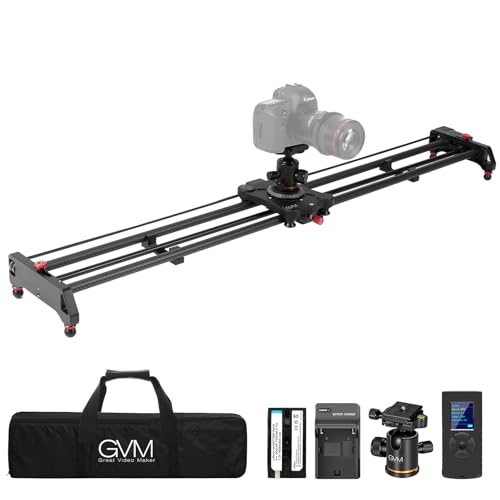
- Motorized and manual shooting modes
- Remote control with programmable movements
- Supports tracking, time-lapse, and panorama
Best For: Beginners building longer automated camera moves
Simple Desktop Pick
Tiiyee Adjustable Camera Dolly Slider

- Compact roller design for flat surfaces
- Adjusts for straight, curved, or circular paths
- Supports up to 10 kilograms
Best For: Tabletop, product, and low-level beginner shots
Advanced Smart Pick
IFOOTAGE Shark Slider Nano II-660

- App and touchscreen control with keyframes
- AI face and object tracking
- Quiet motor with a 7.7-pound payload
Best For: Solo creators learning automated and tracking shots
Best Beginner Motorized Pick

- Motorized video, time-lapse, and round-trip modes
- Adjustable feet and multiple tripod threads
- Supports up to 2.5 kg
Best For: Beginners using DSLR cameras, video cameras, or phones
Best Long-Rail Option
GVM 48-Inch App-Controlled Slider

- 48-inch carbon-fiber rail for extended moves
- App control with six automated shooting modes
- Includes six shutter cables and an extension cable
Best For: Creators needing long tracking shots and programmable movement
Best Quiet Lightweight Choice
NEEWER ER1-80 Motorized Slider

- Silent motor with app and manual controls
- Includes 4400mAh NP-F750 battery
- Supports up to 11 lb horizontally
Best For: Quiet filming, time-lapses, and portable carbon-fiber setups
Portable Starter Pick – Zecti 16-Inch Carbon Fiber Slider
For beginners searching for a camera slider for beginners, the Zecti offers a compact manual setup with adjustable legs, a bubble level, and multiple mounting threads. Its 16-inch carbon fiber track is easy to pack for travel and supports cameras, camcorders, mirrorless bodies, and compatible phones.
Best For: Beginners who want a portable manual slider for horizontal, vertical, or angled shots.
Pros:
- Lightweight 16-inch design includes a carrying bag.
- Adjustable legs, non-skid feet, and bubble level help with setup.
- Multiple 1/4-inch and 3/8-inch mounting points support flexible positioning.
Cons:
- Some users may experience noise or uneven movement if the screws are overtightened.
- Phone holder is not included.
- Maximum recommended load is 4.4 pounds.
The Zecti is a practical entry-level choice when portability and straightforward manual operation matter most. Check the carriage tension during setup to help achieve smoother movement.
Automated Long-Track Pick – GVM 48-Inch Motorized Slider
The GVM motorized slider is a strong option for a camera slider for beginners who want repeatable motion instead of manually pushing the carriage. Its 48-inch carbon fiber track supports automatic round trips, time-lapse work, panoramic shooting, and adjustable speed, intervals, torque, and stopping times.
Best For: Beginners creating longer tracking shots, time-lapses, or panoramic movements with automated control.
Pros:
- Motorized operation supports automatic round trips and manual use.
- Offers adjustable speed, interval, stop time, photo count, and motor torque.
- Includes battery, charger, controller, shutter cables, and carrying bag.
- 48-inch track and multiple tripod screw ports suit longer movements.
Cons:
- At 11.8 pounds and 48 inches long, it is less portable than compact sliders.
- Its motorized controls may be more involved for a first-time user.
- It is not water resistant.
The GVM provides more automation and travel length than a basic manual slider, making it useful for planned camera moves. Its size and control options are best suited to users prepared for a larger setup.
All-in-One Compact Pick – NEEWER CS1M 16-Inch Slider
For beginners choosing a camera slider for beginners, the NEEWER CS1M combines a 16-inch carbon fiber track with a 360-degree ball head, phone clamp, and action camera adapter. Adjustable legs, a bubble level, and four bearings make it adaptable for horizontal, vertical, and 45-degree shooting.
Best For: Beginners who shoot with cameras, smartphones, GoPros, or other action cameras and want accessories included.
Pros:
- Includes a ball head, phone clamp, and action camera mount.
- Four bearings are designed for smooth, quiet carriage movement.
- Adjustable legs help level the slider on uneven terrain.
- Supports up to 4.4 pounds horizontally and weighs about 1.3 pounds.
Cons:
- Load capacity decreases to 2.2 pounds at a 45-degree tilt or vertically.
- The 16-inch track provides less travel than a long motorized slider.
- It is not water resistant.
The CS1M is especially approachable for creators using mixed camera gear because the key mounting accessories are included. Its compact track favors portable close-range movements rather than long tracking shots.
Heavy-Duty Tabletop Pick – NEEWER Scaled Camera Table Dolly
The NEEWER tabletop dolly takes a different approach to a camera slider for beginners, using rotatable rubber wheels and adjustable aluminum rods instead of a conventional rail. It can create straight, curved, or circular moves on flat surfaces and supports up to 22 pounds.
Best For: Beginners who want tabletop tracking, curved paths, or circular movements with heavier camera equipment.
Pros:
- 22-pound load capacity accommodates heavier camera setups.
- Adjustable rods allow straight, curved, or complete circular paths.
- Rotatable rubber wheels and fluid roller bearings support smooth movement.
- 1/4-inch and 3/8-inch threads offer flexible camera or accessory mounting.
Cons:
- Designed for flat surfaces such as tables or ground rather than elevated rail mounting.
- It does not provide the long, fixed track of a traditional slider.
- It is not water resistant.
The NEEWER table dolly is a good beginner option when shot design matters more than a conventional linear rail. Its high load rating and adjustable path make it particularly useful for product scenes and tabletop motion.
Versatile Motorized Pick – GVM 48-Inch Carbon Fiber Slider
The GVM 48-inch slider is a strong option for beginners who want a camera slider for beginners that can grow with more ambitious video and time-lapse projects. Its motorized operation, remote control, and multiple shooting modes provide useful automation without limiting manual control.
Best For: Beginners shooting longer tracking moves, time-lapses, horizontal slides, and 120-degree panoramas.
Pros:
- Supports manual and electric operation, plus video and time-lapse modes.
- Remote control adjusts speed, endpoints, dwell time, pauses, shot count, and looping.
- Includes multiple 1/4-inch and 3/8-inch mounting ports and six shutter cables.
- Offers tracking, horizontal, and 120-degree panoramic shooting options.
Cons:
- Its 120-centimeter length and 5.42-kilogram weight make it less portable than compact sliders.
- It is not water resistant.
Choose this model if you want a feature-rich platform for learning automated camera movement. Its long rail and broad control options are useful, though the size and weight favor planned setups over quick travel shooting.
Simple Desktop Pick – Tiiyee Adjustable Camera Dolly Slider
The Tiiyee dolly is a straightforward choice for anyone seeking a compact camera slider for beginners. Instead of a long rail, it rolls across a flat surface and can follow straight paths, curves, or circles, making it approachable for tabletop and low-angle experiments.
Best For: Beginners creating tabletop, desktop, low-level, and product-tracking shots with cameras, camcorders, or smartphones.
Pros:
- Compact tabletop design is easy to carry and set up on flat surfaces.
- Adjustable wheels support straight paths, curves, and complete circles.
- Aluminum-alloy construction is described as lightweight, durable, quiet, and scratch-resistant.
- Rated for equipment weighing up to 10 kilograms.
Cons:
- Requires a flat surface rather than providing a dedicated elevated rail.
- Its short 150-millimeter folded size limits the length of a continuous slide.
- It does not offer motorized movement or remote control in the supplied specifications.
This is the most approachable option for learning basic camera movement on a desk, table, or floor. Its compact format is convenient, but users needing long, automated, or elevated moves should consider a full-length slider instead.
Advanced Smart Pick – IFOOTAGE Shark Slider Nano II-660
The IFOOTAGE Shark Slider Nano II-660 suits beginners who want a camera slider for beginners with room to develop into advanced production work. App and touchscreen controls, keyframe programming, AI tracking, and DJI RS compatibility make it highly capable, although its feature set is more sophisticated than a basic manual slider.
Best For: Solo creators and learners who want automated video, time-lapse, macro, panorama, and subject-tracking capabilities.
Pros:
- Offers app and IPS touchscreen control with up to eight programmable keyframes.
- Includes six shooting modes, including time-lapse, stop motion, macro, panorama, and multi-point.
- AI face and object tracking supports horizontal tracking, with expanded multi-axis control when paired with compatible DJI RS stabilizers.
- Provides 0.01-millimeter positioning accuracy, quiet operation below 20dB, and a 7.7-pound payload.
Cons:
- Its advanced tracking and multi-axis features may be more than a first-time user needs.
- Full 5-axis tracking requires a compatible DJI RS stabilizer.
- It is not water resistant.
This slider is a strong long-term choice for beginners who prefer guided digital controls and expect to tackle more complex shots. It offers a 26-inch working length and portable construction, while advanced features may require extra setup and compatible equipment.
Best Beginner Motorized Pick – GVM 27-Inch Motorized Slider
For beginners shopping for a camera slider for beginners, the GVM 27-inch model offers automated movement without an overly complicated setup. Its aluminum-alloy rail supports video, time-lapse, and automatic round-trip shooting, while adjustable feet help keep the slider level.
Best For: Beginners who want a versatile motorized slider for DSLR, video camera, or cellphone shots.
Pros:
- Supports video, time-lapse, and auto round-trip shooting.
- Works horizontally, vertically, and at 45-degree angles.
- Includes adjustable non-slip feet, a carrying bag, wire controller, and remote cable.
- Offers multiple 1/4-inch and 3/8-inch mounting points for tripods and accessories.
Cons:
- Its maximum recommended load is 2.5 kg.
- At 2.36 kg, it may be less convenient to carry than lighter carbon-fiber options.
- It is not water resistant.
This GVM is a practical starting point if you want motorized camera movement and several shooting angles in one beginner-friendly package. The shorter 27-inch length and included accessories make it suitable for controlled indoor or outdoor setups.
Best Long-Rail Option – GVM 48-Inch App-Controlled Slider
For a camera slider for beginners who want longer, more programmable moves, this 48-inch GVM model adds app control and several automated shooting modes. Its carbon-fiber construction, adjustable legs, and multiple mounting ports support larger setups, though the longer rail is better suited to users with room to work.
Best For: Beginners and advancing creators who need extended camera travel, app control, and panoramic or time-lapse functions.
Pros:
- Provides tracking, panoramic, time-lapse, video, and looping modes.
- Offers iOS and Android app control instead of relying only on a wired controller.
- Includes six shutter-release cables and an extension cable for broad camera compatibility.
- Carbon-fiber rail includes adjustable legs and 1/4-inch and 3/8-inch screw ports.
Cons:
- The 120 cm rail and 4 kg weight make it less portable than shorter sliders.
- The product is not water resistant.
- Its many programmable settings may be more than a first-time user needs.
This is the most capable choice here for beginners who expect to grow into more advanced camera movement. The long rail and app-based controls are useful for cinematic tracking and panoramic work, but the size calls for a stable support setup and adequate workspace.
Best Quiet Lightweight Choice – NEEWER ER1-80 Motorized Slider
The NEEWER ER1-80 is a strong camera slider for beginners who want quiet operation and wireless control. Its 31.5-inch carbon-fiber rail uses a silent stepper motor, supports app control, and includes a 4400mAh NP-F750 battery for extended filming away from an outlet.
Best For: Beginners filming quiet scenes, time-lapses, and smooth horizontal or angled movements.
Pros:
- Silent stepper motor provides smooth, low-noise movement.
- Supports app control, manual mode, video mode, and time-lapse shooting.
- Handles up to 11 lb horizontally and 5.5 lb at a 45-degree tilt.
- Includes a 4400mAh NP-F750 battery and tripod-mounting threads.
Cons:
- The battery charger is not included.
- The optional 2.4G RT-08 remote control is not included.
- It is not water resistant.
With its quiet drive, app support, and useful load rating, the ER1-80 balances beginner-friendly operation with room for more demanding camera setups. Remember to charge the included battery before first use and plan separately for a charger or optional remote if needed.
How We Picked the Best Camera Slider for Beginners
We focused on the factors that matter most when learning controlled camera movement: smooth travel, stable construction, manageable setup, useful controls, and compatibility with common cameras and tripods. The selection includes manual sliders for straightforward tabletop or tripod work, as well as motorized models for repeatable moves, time-lapse sequences, and longer tracking shots.
We also considered the trade-off between portability and capacity. A short carbon-fiber slider is easier to carry, while a longer aluminum or motorized rail can create more dramatic movement but may require additional support and setup time.
Quick Comparison
| Type | Best For | What to Check |
|---|---|---|
| Compact manual slider | Tabletop shots and first projects | Travel length, carriage smoothness, and mounting options |
| Table dolly | Product videos and desktop filming | Wheel grip, surface compatibility, and load limit |
| Motorized slider | Time-lapse and repeatable movement | Battery life, controls, speed range, and noise |
| Long slider | Wide tracking shots | Rail support, total weight, and transport size |
Key Buying Factors for a Camera Slider for Beginners
Manual or Motorized Operation
Manual sliders are usually the simplest and most affordable starting point. They let you learn speed control and framing without batteries or software. Choose motorized operation if you specifically need consistent motion, automated round trips, panoramic moves, or time-lapse recording.
Length and Portability
A 16-inch slider is easier to use on a desk or small tripod, while 27- to 48-inch models provide more visible travel. Longer rails can be less portable and may need two tripod supports to prevent flex or vibration.
Payload and Stability
Check the slider’s stated load capacity against the complete setup—not just the camera body. Include the lens, cage, microphone, monitor, fluid head, and any motor or tracking accessories. A higher capacity does not automatically guarantee smooth results if the support surface is unstable.
Control and Compatibility
Look for a standard mounting thread, a secure camera carriage, and compatibility with your preferred tripod head or ball head. For motorized units, review whether control comes from buttons, a remote, or an app, and confirm that your phone and camera workflow are supported.
Who Should Buy Which Camera Slider for Beginners?
First-time users: Start with a compact manual carbon-fiber slider if you want the least complicated learning curve and easy storage.
Product and tabletop creators: A table dolly with grippy wheels can be more practical than a rail slider when filming small items on a smooth, level surface.
Time-lapse creators: Choose a motorized slider with programmable speed, interval, and repeat functions. Battery capacity becomes especially important for long sessions.
Creators using larger rigs: Pick a longer, higher-capacity model, but plan for sturdy tripod support and confirm that the carriage and motor can handle your complete rig.
Traveling filmmakers: Prioritize low weight, short packed length, and fast setup over maximum travel distance. A shorter slider that you actually carry is often more useful than a larger model left at home.