Compact infrared repeaters make it easier to control TVs, receivers, streaming devices, and other hidden components without pointing a remote directly at each device.
We compare 10 options across wired and wireless designs, device capacity, range, installation flexibility, and everyday usability so you can choose the right setup for your room.
Best 10 Compact Infrared Repeaters Picks for 2026
High-Capacity Choice

- Controls up to 10 devices, expandable to 12
- Includes five long dual IR emitters
- Real-time, CFL-friendly signal transmission
Best For: Large concealed home-theater installations
Simple Cable Pick

- 6-foot Y-cable supports neat routing
- USB-powered with signal-confirmation LED
- Adhesive-backed components simplify mounting
Best For: Single-source TV and home-theater setups
Balanced Wired Option
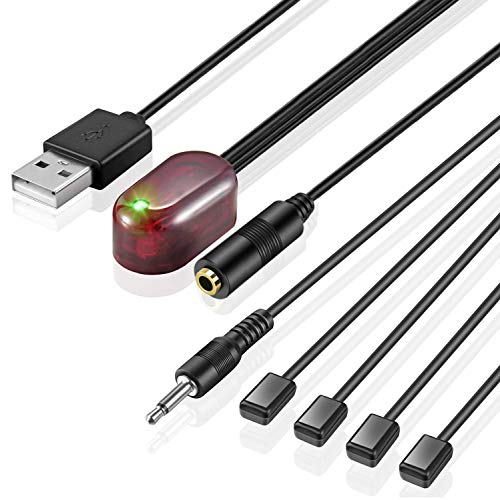
- Controls up to four IR devices
- Includes one receiver and four emitters
- USB-powered with 34–60 kHz compatibility
Best For: Small multi-device home-theater systems
Long-Range Wireless Pick
Ultra-Compact 200M IR Extender

- Wireless RF range reaches up to 200 meters
- Supports 20–60 kHz IR signals
- Compact units provide real-time transmission
Best For: Long-distance control of a single A/V device
Best Overall Expandable Kit
Multi-Device IR Repeater System

- Controls up to 10 devices, expandable to 12
- Includes five IR emitters and one receiver
- Broad 20–60 kHz compatibility range
Best For: Multi-component entertainment cabinets
Best Long-Range Option

- Stated 700-foot emitter-to-receiver range
- Supports 20–60 kHz IR devices
- Compact design with LED signal indicator
Best For: Remote equipment racks and separated rooms
Best for Large Hidden Setups

- Designed to control up to 32 A/V components
- Works through closed doors or walls
- Includes four emitter outputs and a confirmation LED
Best For: Large equipment closets and home theaters
Best with Extra Features
2CH IRBlast Wireless IR Repeater Kit

- Up to 500-foot 433MHz wireless range
- Two adjustable channels for separate device pairs
- Includes dual power options and two IR extension cables
Best For: Long-distance cabinet or room-to-room IR control
Simple Six-Device Setup
SPENFiLY LD-Series IR Repeater Kit

- Controls up to six hidden IR devices
- 45-degree receiving angle and over-8-meter reception
- Includes one-tap setup and interference filtering
Best For: Organized home-theater cabinets with several IR components
High-Capacity Choice – 10-Device IR Repeater System
For buyers comparing compact infrared repeaters for a concealed home-theater setup, this ICESPRING kit stands out for its multi-device capacity. It supports up to 10 devices, with expandability to 12, and includes several emitters for organizing equipment behind cabinet doors or in another room.
Best For: Managing multiple hidden A/V components from one existing IR remote.
Pros:
- Controls up to 10 devices and can expand to 12.
- Includes five 10-foot dual IR emitters and a 5-foot receiver.
- Supports a broad range of IR-controlled electronics and up to 10-meter placement.
- Real-time transmission, status lights, and CFL-friendly operation.
Cons:
- Plasma displays may cause interference and require careful receiver placement.
- Multiple receivers should be spaced at least 6 meters apart.
- Wired installation requires routing the included cables.
This is a strong choice when device count and flexible emitter placement matter more than the simplest possible installation. Pay close attention to receiver spacing and potential display interference during setup.
Simple Cable Pick – 6-Foot USB IR Extender
This Cable Matters model is a straightforward option for compact infrared repeaters in a TV or home-theater setup. Its 6-foot Y-cable, adhesive-backed transmitter and receiver, and USB power connection make it practical for linking a concealed video source to a wall-mounted television.
Best For: Extending control from a TV area to one concealed Blu-ray player, cable box, receiver, or similar IR source.
Pros:
- 6-foot cable provides useful routing flexibility.
- USB-powered design uses a 5V USB wall charger.
- Blue receiver LED confirms signal transmission.
- Adhesive backing helps secure the IR transmitter and receiver.
Cons:
- Does not support RF-controlled devices.
- TV USB ports may not power it when the television is off.
- Performance can be affected by Wi-Fi routers or CFL bulbs.
Choose this cable when you want a lightweight, focused solution rather than a multi-emitter distribution system. Use a separate 5V wall charger and keep the receiver positioned with its blue LED facing forward.
Balanced Wired Option – Four-Emitter IR Extender Kit
For compact infrared repeaters that balance device coverage and simple setup, this URWOOW kit includes one receiver and four emitters. Its 34–60 kHz operating range and USB-powered design support common entertainment components while allowing control between two rooms.
Best For: Controlling up to four IR-equipped A/V components from another room or location.
Pros:
- Four emitters support simultaneous control of multiple devices.
- 34–60 kHz range is compatible with many common IR components.
- USB 5V power provides convenient connectivity.
- Receiver and emitter cables measure 2 meters and 1 meter, respectively.
Cons:
- Supports a maximum of four devices.
- Remote should be aimed at the receiver for optimal performance.
- Wired cables may require more planning than a wireless system.
This kit is a sensible middle ground for a modest entertainment system. It offers more device coverage than a single-cable extender without the larger capacity or more involved distribution hardware of a high-end multi-device kit.
Long-Range Wireless Pick – Ultra-Compact 200M IR Extender
SIIG Ultra Compact Wireless IR Remote Control Extender Repeater Kit – 200M (CE-RC0014-S1)
Check Price On AmazonIf distance and minimal cabling are priorities, this SIIG kit is a notable choice among compact infrared repeaters. It uses wireless RF communication between the transmitter and receiver, with a stated range of up to 200 meters or 656 feet depending on obstructions, while recognizing IR signals from 20 to 60 kHz.
Best For: Extending control across a long distance between an IR remote and A/V equipment.
Pros:
- Wireless RF link supports up to 200 meters or 656 feet under suitable conditions.
- Ultra-compact design supports flexible placement.
- Recognizes common 20–60 kHz IR frequencies.
- Real-time transmission and LED feedback aid operation.
Cons:
- Listed maximum device support is one device.
- Actual range depends on surrounding obstructions.
- Extension cables need close line-of-sight placement near the source sensor when used.
This is the most distance-focused option in the group and suits installations where a wired repeater cable is inconvenient. For best results, try the receiver unit in line of sight first; use the extension cables only if necessary.
Best Overall Expandable Kit – Multi-Device IR Repeater System
For a tidy entertainment cabinet with several hidden components, this compact infrared repeaters kit offers a practical way to control up to 10 devices, with expansion support for as many as 12. Its broadband 20–60 kHz range and included emitters make it a flexible choice for common IR-controlled A/V equipment.
Best For: Households that need to control multiple concealed receivers, players, cable boxes, or other IR A/V devices from one location.
Pros:
- Controls up to 10 devices and can expand to 12.
- Includes one receiver and five IR emitters.
- Supports a broad 20–60 kHz frequency range.
- Plug-and-play setup with real-time signal transmission and status lights.
Cons:
- Receivers should be spaced at least 20 feet apart when using two or more to reduce interference.
- Designed for IR-controlled devices, not Bluetooth- or app-controlled equipment.
This is a well-rounded option when the priority is managing several hidden components without adding much complexity. The included five emitters and 18-month seller warranty add practical value for larger setups.
Best Long-Range Option – Fourair Wireless IR Repeater
If distance is the main concern, this compact infrared repeaters system stands out with a stated 700-foot span between the emitter and receiver. It supports 20–60 kHz IR equipment and is intended for hiding components in cabinets, closets, or other separated locations.
Best For: Larger homes, offices, hotels, or entertainment setups where the controlled A/V equipment is far from the remote-control position.
Pros:
- Offers a stated 700-foot emitter-to-receiver range.
- Supports mainstream 20–60 kHz infrared devices.
- Provides real-time transmission and an LED signal indicator.
- Compact 3 × 2 × 1-inch design.
Cons:
- Not compatible with Bluetooth remotes or devices controlled through apps or Wi-Fi.
- Compatibility should be verified for the specific device model before purchase.
- The remote receiver’s stated coverage is 30 feet at a 90-degree angle.
The Fourair is the distance-focused pick in this group, but its long-range specification should not obscure the need for an active IR receiver on the target device. It is a sensible fit for separated equipment racks when conventional IR compatibility is confirmed.
Best for Large Hidden Setups – 32-Component IR Repeater Kit
For a cabinet or equipment closet with many concealed components, this compact infrared repeaters kit is designed to operate up to 32 A/V devices through closed doors or walls. It uses one IR receiver and four emitter outputs, with a confirmation LED to show when commands are received.
Best For: Extensive home-theater or equipment-closet installations using multiple IR-controlled components.
Pros:
- Supports up to 32 audio/video components.
- IR signals can pass through solid doors or walls without direct line of sight.
- Includes four IR emitter outputs and a dual-sensor receiver.
- Works with practically all brands of IR remote controls, according to the supplied product notes.
Cons:
- Its stated operating range is 4 meters.
- Uses a 38 kHz frequency specification rather than the broader range listed for some alternatives.
- Only one receiver input is provided.
This model makes the most sense when device capacity matters more than maximum transmission distance. Its 32-component claim and wall-or-door operation suit complex installations, while the four outputs provide a straightforward starting point for distributing IR signals.
Best with Extra Features – 2CH IRBlast Wireless IR Repeater Kit
If you need compact infrared repeaters for equipment hidden in a cabinet or located in another room, this wireless 2CH IRBlast kit emphasizes distance and flexible placement. It works with IR remotes and uses a 433MHz wireless link rated for up to 500 feet, with longer open-air range claimed by the manufacturer.
Best For: Long-distance control of cable boxes, Blu-ray players, DVD equipment, and home audio receivers.
Pros:
- Wireless range is rated at up to 500 feet, helping solve line-of-sight problems.
- Two adjustable channels can help prevent cross-control between nearby devices.
- Includes two IR extension cables, AC and USB power adapters, adhesive stickers, and a manual.
- The receiver has a 45-degree IR catch angle, while the emitter LED provides signal feedback.
Cons:
- Works only with IR remotes, not RF, Bluetooth, Wi-Fi, or app-controlled remotes.
- Channel settings must match between the receiver and emitter for pairing.
- Its long wireless range may be more than needed for a small single-cabinet setup.
Choose this model when wireless distance and multi-device separation matter most. Before ordering, confirm that your remote uses infrared and that your equipment has an accessible IR window for the adhesive emitter probes.
Multi-Device Hub – Ensigear 1×6 IR Repeater System
For installations that need to operate several hidden components, this compact infrared repeater system provides a central connection block for controlling multiple IR devices from one remote. It supports up to six emitters as supplied, with expansion options described for as many as 12 or 18 devices.
Best For: Home theaters and media cabinets with multiple cable, satellite, audio, disc-player, or gaming components.
Pros:
- Controls multiple IR devices in a closed cabinet or remote location.
- Supports a wide 20–60kHz frequency range and is listed as compatible with many A/V devices.
- Offers an Ethernet input for extending the receiver up to 120 meters with additional equipment.
- Installation requires no software and includes a dual-band mini receiver and power supply.
Cons:
- The package includes four emitters, while expansion to more devices requires additional accessories.
- Ethernet-based receiver extension requires a separately sold terminal block.
- This is a wired IR system rather than a wireless repeater.
This is the strongest fit for a larger, permanent A/V installation where one receiver must feed several components. Its expansion capability is useful, but budget for extra emitters or extension hardware if your setup exceeds the included configuration.
Simple Six-Device Setup – SPENFiLY LD-Series IR Repeater Kit
This SPENFiLY kit is a practical choice among compact infrared repeaters when you want to hide up to six IR-controlled devices while keeping the receiver outside the cabinet. Its one-tap setup, 45-degree receiving angle, and reception distance over 8 meters are aimed at straightforward home-theater use.
Best For: Neat entertainment centers with up to six amplifiers, receivers, players, cable boxes, or satellite components.
Pros:
- Supports control of up to six IR devices.
- Works across a listed 20–60kHz range and includes filtering for unwanted IR interference.
- Includes a host, receiver, transmitter, emitter, power cord, adapter, and manual.
- Additional accessories and alternate two-, four-, and six-device configurations are available.
Cons:
- Its stated reception distance is over 8 meters, shorter than the wireless range of some alternatives.
- It requires compatible infrared remotes and devices.
- The included configuration is limited to six devices.
Consider this model for a tidy, moderately sized media setup where easy installation matters more than extreme range. Its broad frequency support and interference filtering should suit many standard IR components, while expansion options provide some flexibility.
How We Picked the Best Compact Infrared Repeaters
We evaluated these Compact Infrared Repeaters by focusing on the features that affect real-world installation and reliability. Key considerations included the number of supported devices, wired versus wireless operation, claimed transmission range, receiver and emitter placement, cable length, and whether the system is designed for concealed equipment.
Because infrared performance depends on room layout and remote compatibility, published range should be treated as a best-case figure rather than a guarantee. We also considered how practical each kit is for entertainment centers, cabinets, wall-mounted televisions, and multi-room expansions.
Quick Comparison
| Best For | What to Look For |
|---|---|
| Basic hidden components | Simple wired repeater with a clear IR receiver and emitter |
| Several devices | Multiple emitters or support for six to 10 components |
| Long-distance layouts | Wireless design with a strong stated range and suitable placement options |
| Small cabinets | Ultra-compact receiver and low-profile emitter heads |
| Multi-room expansion | Wireless transmission, flexible power, and dependable line-of-sight at the receiver |
Key Buying Factors for Compact Infrared Repeaters
Wired or Wireless Design
Wired kits are usually straightforward and economical when the source and hidden devices are close together. Wireless models reduce cable routing and are more useful when the equipment is in another cabinet or room, but they may require more careful positioning and separate power connections.
Device Capacity and Emitter Layout
Check how many components the kit can control and whether individual emitter cables are included. A system supporting multiple devices is useful for receivers, Blu-ray players, cable boxes, game consoles, and streaming hardware, but only if the emitters can be positioned without blocking front-panel sensors.
Range, Compatibility, and Installation
Compare the claimed range with the distance in your home, then allow extra margin for walls, cabinets, and interference. Confirm that your equipment uses standard infrared remote commands. Look for adhesive-backed emitters, flexible cables, compact receivers, and clear instructions if you want a tidy installation.
Power and Everyday Reliability
Review the power requirements before buying. A convenient kit should fit near an outlet or USB power source without creating unnecessary cable clutter. If the repeater will be used daily, stable signal pickup and discreet placement matter more than an unusually high maximum-range claim.
Who Should Buy Which Compact Infrared Repeaters?
Choose a basic wired kit if you only need to hide one or a few components in a nearby cabinet. A higher-capacity system is better for a full home theater with several infrared-controlled devices. Select an ultra-compact model when cabinet space is limited, and consider a wireless long-range repeater for wall-mounted televisions, remote cabinets, or room-to-room control.
Before ordering, measure the distance between the remote-control position, repeater receiver, and hidden equipment. Then count your devices and confirm that the included emitters and power connections match your installation. The best choice is the one that provides enough capacity and range without adding unnecessary hardware.