The best DMX controllers make it easier to program, trigger, and adjust stage lighting without relying on manual fixture controls. The right choice depends on your fixture count, preferred workflow, wireless needs, and whether you are running a simple DJ setup or a more complex live production.
This roundup compares 10 DMX controllers across standalone consoles, app-based systems, wireless kits, and rack-friendly boards. Use the guide below to narrow the options by control style, channel capacity, portability, and setup requirements.
Best 10 Dmx Controllers Picks for 2026
Best for Complex Setups

- Controls up to 12 fixtures and 192 DMX channels
- Stores up to 240 scenes plus chase sequences
- Adds fog, strobe, MIDI, and reversible-slider controls
Best For: Complex lighting rigs and repeatable live shows
Best Standalone Option

- Supports up to four DMX universes
- Includes four output sockets
- Uses 37 backlit buttons and four rotary encoders
Best For: Hands-on control of larger DMX systems
Best for DJ Integration

- Offers two DMX universes and dual USB connections
- Works with compatible Engine DJ devices without a computer
- Adds touch-strip, encoder, pad, and BPM-synced controls
Best For: DJs performing music-synced lighting shows
Best App-Based Controller

- Controls 256 DMX channels from an iPad or Android tablet
- Includes a 15,000-plus fixture library
- Provides presets, automatic effects, Wi-Fi, and USB control
Best For: Easy tablet-based lighting control without traditional programming
Best for Programmable Stage Shows

- 384 channels for detailed lighting control
- 30 banks of eight programmable scenes
- Supports 24 fixtures with DMX512
Best For: Programmed club, bar, and stage lighting shows
Best for DJs and Fog Effects
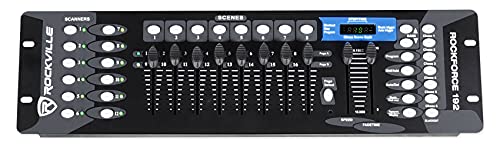
- 192 channels across 12 scanners
- Sound-activated lighting and fog effects
- 23 scene banks plus six long chases
Best For: DJ events and rack-mounted lighting setups
Best for Wireless DMX512 Setups

- One transmitter with seven receivers
- Seven selectable wireless network groups
- Rechargeable receivers with frequency hopping
Best For: Cable-free DMX512 lighting installations
Versatile 192-Channel Control
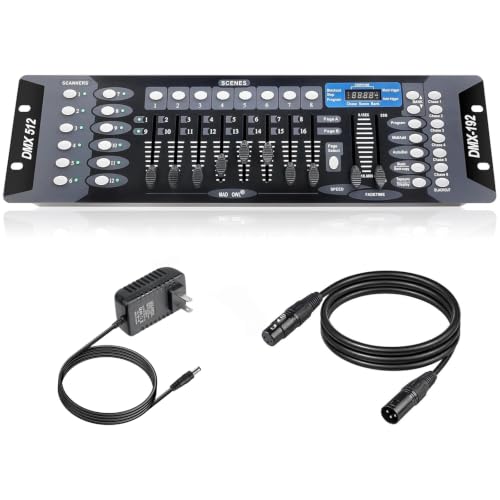
- Controls up to 12 compatible fixtures
- Stores scenes and programmable chases
- Includes a 6.6-foot DMX cable
Best For: Stages, clubs, and DJ lighting setups
Wireless DMX Expansion
2.4G Transmitter and Receivers
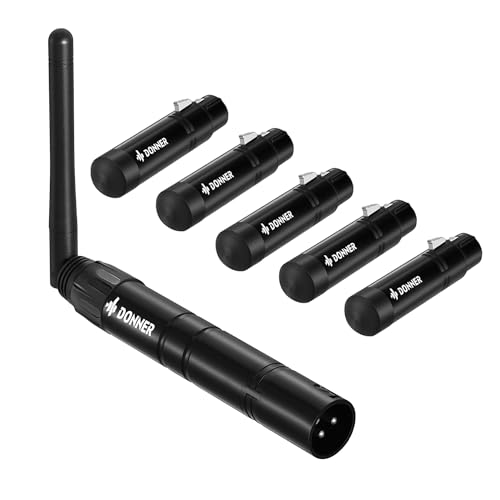
- Includes one transmitter and five receivers
- Offers seven selectable wireless groups
- Supports up to 500 meters visible distance
Best For: Compatible DMX512 stage and event lighting
Dual-Mode 384-Channel Control

- Combines 384-channel wired and wireless control
- Supports sound activation and MIDI
- Stores 30 banks and 240 static scenes
Best For: Mobile DJs, weddings, bars, and indoor stages
Best for Complex Setups – CHAUVET DJ OBEY40
The CHAUVET DJ OBEY40 is one of the more capable DMX controllers in this roundup, with enough channel capacity and scene storage for organized, multi-fixture lighting systems. It controls up to 12 fixtures with up to 16 channels each, while dedicated fog and strobe controls add flexibility for performances and events.
Best For: Users managing larger or more complex lighting rigs that need extensive scene, bank, and chase storage.
Pros:
- Controls up to 12 fixtures and 192 DMX channels.
- Stores up to 240 scenes across 30 banks.
- Includes chase playback, fog and strobe controls, MIDI compatibility, and reversible sliders.
Cons:
- Its broad feature set may be more than needed for simple lighting setups.
- At 6.7 pounds, it is less lightweight than some compact controllers.
The OBEY40 stands out when detailed programming and scalable control matter more than portability. Its structured storage and chase features make it a practical choice for repeatable live shows.
Best Standalone Option – ADJ WMX1 Mk2
The ADJ WMX1 Mk2 is a standalone DMX controller built around hands-on operation. Its 37 backlit silicone buttons and four rotary encoders provide a tactile control layout, while support for up to four universes gives it room for larger lighting systems.
Best For: Operators who want a compact, physical controller with multiple universe outputs and direct controls.
Pros:
- Supports up to four DMX universes.
- Provides four output sockets for flexible connections.
- Combines 37 backlit buttons with four rotary encoders.
Cons:
- The supplied notes do not specify scene-storage or effects-programming details.
- Its physical control layout may be less convenient than an app-based system for some users.
With its standalone design and multi-universe support, the WMX1 Mk2 is aimed at users who prefer dedicated hardware over software control. The backlit interface can also help with operation in darker environments.
Best for DJ Integration – SoundSwitch Control One
The SoundSwitch Control One is a compact DMX controller designed for direct interaction with SoundSwitch software and compatible DJ equipment. It offers two DMX universes, dual USB connections, an accurate touch strip, encoders, and RGB performance pads for adjusting lighting during a set.
Best For: DJs and performers who want tactile, on-the-fly lighting control that can integrate with Engine DJ and supported AlphaTheta setups.
Pros:
- Provides two DMX universe inputs and outputs with a thru option.
- Works directly with compatible Engine DJ devices without a computer.
- Offers touch-strip, encoder, and RGB-pad controls for lighting effects.
- Supports live audio BPM detection and control of colors, brightness, strobes, gobos, and moving heads.
Cons:
- Full functionality is tied closely to SoundSwitch software and compatible hardware.
- Using PRO DJ LINK Bridge with rekordbox requires a laptop running SoundSwitch.
Control One is particularly appealing for performance-focused users who want lighting changes to follow music and remain accessible during a DJ set. Its compact 1.76-pound design adds portability without giving up tactile controls.
Best App-Based Controller – ADJ MyDMX Go
The ADJ MyDMX Go takes a streamlined app-based approach to DMX controllers, using an iPad or Android tablet over Wi-Fi or USB. Its 256-channel capacity, fixture library, automatic effects, and preset support make it useful for users who want to create lighting displays without traditional programming.
Best For: Beginners and mobile operators seeking quick control of compatible fixtures through a tablet-based interface.
Pros:
- Provides 256-channel control through an iPad or Android tablet.
- Includes a library of more than 15,000 fixtures.
- Offers 50 user presets and 21 automatic effects without requiring programming.
- Can connect to up to two lighting universes and includes truss-mounting O-Clamp brackets.
Cons:
- Operation depends on a compatible tablet and app-based control.
- The supplied notes do not describe a built-in physical control surface.
MyDMX Go is a practical choice when setup speed and ease of use are priorities. Its broad fixture library and automatic effects reduce the amount of manual programming needed for smaller shows and installations.
Best for Programmable Stage Shows – 384-Channel DMX Controller
For buyers comparing DMX controllers for programmed stage lighting, this 384-channel console offers extensive scene capacity in a compact format. It supports 24 fixtures, 30 banks of eight programmable scenes, and DMX512 control for detailed show programming.
Best For: DJs, clubs, bars, and small stage productions that need repeatable, creative lighting sequences.
Pros:
- Provides 384 DMX channels for detailed fixture control.
- Stores 30 banks of eight programmable scenes.
- Includes an LED gooseneck light and protective gel handles.
- Supports 24 fixtures and DMX512 control.
Cons:
- Programming may be more involved than with simpler controllers.
- The supplied dimensions vary between the product listing and detail fields.
Choose this model when scene capacity and channel count matter most. Its compact design and included work light are practical for operators building programmed lighting shows.
Best for DJs and Fog Effects – Rockville ROCKFORCE 192
Among DMX controllers for venues that combine lighting and fog, the Rockville ROCKFORCE provides 192 channels across 12 scanners. Its scene banks, chases, music trigger, and rack-ready 3U design suit repeatable event programming.
Best For: DJs, event planners, concerts, parties, and theatrical setups using DMX512 lighting and fog systems.
Pros:
- Controls 192 channels across 12 scanners with 16 channels each.
- Programs 23 banks of eight scenes and six chases of 240 scenes.
- Built-in microphone enables sound-activated effects.
- Includes eight manual sliders and power-failure memory.
Cons:
- Offers fewer channels than 384-channel controllers.
- Its 3U rack format is less compact than tabletop designs.
The ROCKFORCE is a practical choice for users who want hands-on controls and music-synchronized effects. Its broad compatibility with DMX512 lighting and fog systems adds flexibility for event use.
Best for Wireless DMX512 Setups – Donner Wireless DMX Kit
For buyers seeking DMX controllers that reduce cable runs, this Donner wireless DMX512 kit includes one transmitter and seven receivers. It uses selectable wireless groups, automatic frequency hopping, and rechargeable receivers for flexible stage, disco, bar, and party lighting setups.
Best For: DMX512-compatible fixtures where wireless installation and reduced cable clutter are priorities.
Pros:
- Includes one transmitter and seven receivers.
- Offers seven selectable wireless network ID groups.
- Uses automatic frequency hopping across 126 channels.
- Receivers have rechargeable batteries and a stated 500-meter visible-range distance.
Cons:
- Works only with devices marked as DMX512-compatible.
- The transmitter does not include a built-in battery.
- It is a wireless transmission kit rather than a scene-programming console.
This Donner system is best viewed as a wireless link for an existing DMX512 lighting rig, not a replacement for a programmable console. It is especially useful when running signal cables would be inconvenient.
Versatile 192-Channel Control – Programmable DMX Board
This 192-channel DMX controller is a practical choice for managing multiple stage or DJ lighting fixtures from one console. Its faders, programmable scenes, and chase functions provide hands-on control for users who want to build and recall customized light shows.
Best For: Stages, clubs, performance venues, and DJ lighting setups using up to 12 fixtures.
Pros:
- Controls up to 12 fixtures with 16 channels or fewer.
- Offers 23 banks of 8 programmable scenes.
- Supports 240-step scenes across 6 programmable chases.
- Includes a 6.6-foot DMX cable.
Cons:
- Uses a corded-electric setup rather than wireless operation.
- Its 192-channel design may be limiting for larger, more complex rigs.
Choose this console if you prefer direct fader control and extensive scene programming in a rack-mount metal enclosure. It is especially well suited to conventional DMX512 fixtures and repeatable performance setups.
Wireless DMX Expansion – 2.4G Transmitter and Receivers
This wireless DMX512 kit helps reduce cable runs between a lighting console and compatible fixtures. With one transmitter and five receivers, it is designed for stage, disco, party, and bar lighting installations that support DMX512.
Best For: DMX512 lighting setups that need wireless links across a visible-distance range of up to 500 meters.
Pros:
- Includes one transmitter and five receivers.
- Supports seven selectable wireless network groups.
- Uses automatic frequency hopping across 126 channels for interference resistance.
- Transmits standard DMX512 data without a stated transmission delay.
Cons:
- Works only with devices marked as DMX512 compatible.
- Receivers do not have built-in batteries and require power adapters.
- This is a wireless transmission kit rather than a standalone lighting console.
This Donner kit makes the most sense when your existing DMX controller already generates the lighting data and you want to replace long signal cables. Confirm fixture compatibility and provide power at each receiver before choosing it.
Dual-Mode 384-Channel Control – Wireless DMX Lighting Console
This 384-channel DMX controller combines traditional 3-pin XLR connectivity with 2.4G wireless transmission. It also adds sound activation, MIDI support, manual control, and programmable scenes for flexible lighting control at events and indoor venues.
Best For: DJs, weddings, bars, discos, churches, banquet halls, and live stages needing wired and wireless control options.
Pros:
- Provides 384 channels and supports up to 12 intelligent lights.
- Offers both 2.4G wireless and 3-pin XLR wired operation.
- Includes sound-activated, automatic, manual, and MIDI control modes.
- Stores 30 banks and 240 preset static scenes with scene editing functions.
Cons:
- Requires a 9V battery according to the supplied specifications.
- Its wider feature set may take more time to learn than a basic controller.
- Wireless operation may still require compatible receiving equipment in the lighting rig.
The DMX-384 is a strong all-around option for users who want more channels and multiple control methods in one console. Its sound activation and scene recall features are particularly useful for mobile events and repeat performances.
How We Picked These Dmx Controllers
We selected models covering the main ways buyers control DMX lighting in 2026: physical fader consoles, software and app-based systems, wireless transmitter-and-receiver kits, and controllers designed for DJs or small stage productions. We considered channel capacity, fixture and scene support, programming flexibility, portability, connectivity, and compatibility with common DMX512 equipment.
Because lighting systems vary widely, no single controller is best for every user. A compact controller may be easier to operate at a mobile event, while a higher-capacity board or software system may be better for permanent installations and larger rigs.
Quick Comparison
- Best for straightforward live control: A traditional fader-based console with dedicated fixture and scene controls.
- Best for software-focused workflows: An app or computer-connected controller that supports visual programming and updates.
- Best for wireless setups: A transmitter-and-receiver kit when running DMX cable is inconvenient.
- Best for larger fixture counts: A 192- or 384-channel controller with enough banks, scenes, and fixture assignments for future expansion.
- Best for mobile DJs: A portable controller that is quick to patch, transport, and operate during a performance.
Key Buying Factors for Dmx Controllers
Channel and Fixture Capacity
Check both the advertised channel count and the number of fixtures or devices the controller can address. More channels provide room for moving heads, LED pars, strobes, fog machines, and other multi-channel fixtures, but capacity is useful only if the interface remains manageable.
Programming and Playback
Look for the scene, chase, bank, and playback features that match your workflow. Beginners may prefer direct faders and simple presets, while experienced operators may want MIDI support, sound activation, editing software, or more detailed fixture programming.
Wired Versus Wireless DMX
Wired DMX is generally the predictable choice for permanent or critical installations. Wireless systems can simplify mobile setups and reduce cable runs, but verify range, receiver count, battery life, line-of-sight requirements, and compatibility with your fixtures before buying.
Connections and Compatibility
Confirm the controller uses the appropriate DMX connectors and supports the devices in your rig. Also check whether the package includes cables, wireless receivers, software access, power supplies, or fixture profiles. These details can significantly affect the total setup cost.
Portability and Operation
For DJs and touring users, weight, rack compatibility, power requirements, and control visibility matter as much as channel count. A controller that can be set up quickly and operated confidently in low light is often more useful than a larger board with features you rarely use.
Who Should Buy Which Dmx Controllers?
Choose a traditional 192-channel board if you want hands-on faders, straightforward scene triggering, and a familiar layout for small to medium lighting rigs.
Choose a 384-channel or expandable controller if you expect to add fixtures, need more banks and scenes, or want greater flexibility for club and stage productions.
Choose an app- or software-based system if you prefer visual programming, computer-assisted control, MIDI integration, or an easier way to save and revise complex shows.
Choose wireless DMX if portability and fast deployment are priorities, especially for temporary events where cable runs would be difficult or distracting.
Before ordering, list every fixture you plan to control, count its DMX channels, and decide whether you need live fader access, automated scenes, sound activation, or wireless operation. That checklist will usually narrow the field more effectively than choosing by channel count alone.