A dependable fiber optic tester can make home-office network troubleshooting much faster, especially when a connection may be affected by damaged cable, weak light levels, or a faulty termination.
We selected 10 testers and kits with practical features such as optical power measurement, visual fault locating, Ethernet cable testing, and support for common fiber connectors. The right choice depends on your network type, testing frequency, and need for measurement accuracy.
Best 10 Fiber Optic Testers for Home Offices Picks for 2026
Best All-in-One Pick

- Combines OPM, VFL, and RJ45 testing
- Supports eight standard wavelengths
- Includes auto-shutdown and calibration features
Best For: Home offices wanting one compact tool for fiber and Ethernet checks
Best Troubleshooting Kit
Fiber Optic Cable Troubleshoot Kit

- Locates breaks, bends, cracks, and poor connections
- Includes five adapters and three patch cords
- Works with single-mode and multimode cables
Best For: Patch-panel troubleshooting with mixed fiber connectors
Best for Detailed Measurements
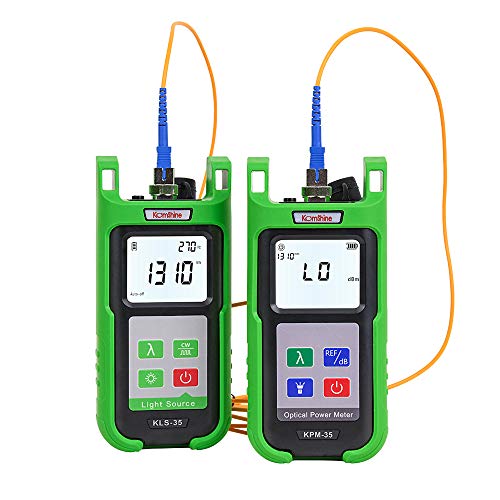
- Pairs a power meter with a light source
- Supports seven calibrated meter wavelengths
- Includes self-calibration and auto-shutdown
Best For: Structured fiber testing with separate measurement and signal tools
Best for Quick Signal Checks

- Detects signals from 850 to 1625 nm
- Uses non-contact light and sound alerts
- Includes AAA batteries and a two-year warranty
Best For: Fast optical-signal presence checks on ports and patch cords
Versatile Pocket Tester

- Tests 10 wavelengths from 850nm to 1650nm
- Combines OPM, VFL, RJ45 test, and LED light
- Stores up to 500 readings
Best For: Portable home-office fiber and network checks
Complete FTTH Kit
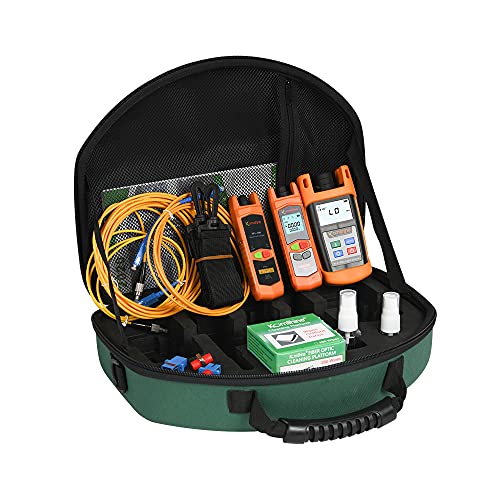
- Includes OPM, light source, VFL, and jump cable
- Supports 1310/1550nm single-mode loss testing
- Adds cleaning supplies and protective portability
Best For: FTTH installation and maintenance tasks
Connector-Flexible Tester
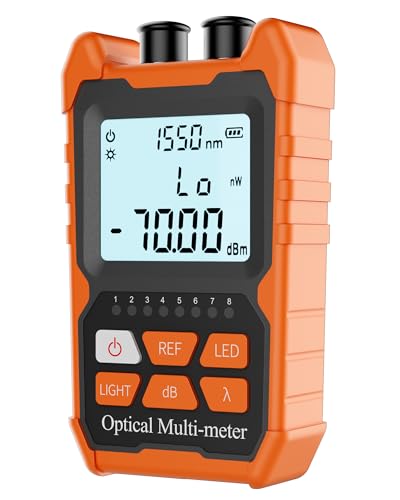
- Combines optical power measurement and 2mW VFL
- Supports FC, SC, and ST interfaces
- Adds RJ45 testing for copper networks
Best For: Mixed fiber-connector and RJ45 troubleshooting
Best with Extra Features
TLP-528D Cable and Fiber Tester
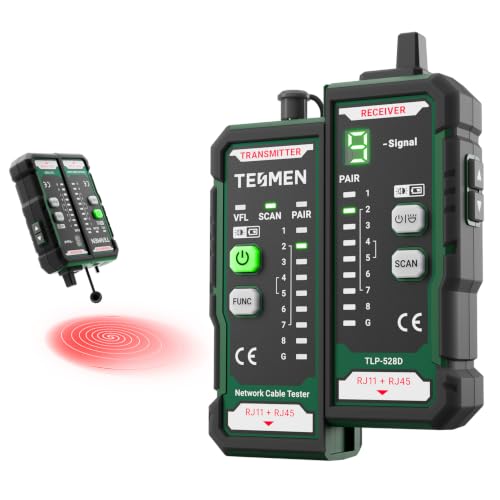
- Tests Ethernet, telephone, and fiber connections
- Includes tracing, continuity, and VFL functions
- Detachable remote unit supports long-cable testing
Best For: Home offices needing one tool for copper and fiber troubleshooting
Best Simple VFL

- Locates breaks, bends, cracks, and poor connections
- Supports ST, SC, FC, and LC fiber interfaces
- Durable aluminum body with low-battery warning
Best For: Home-office fiber tracing and continuity checks
Best Measurement Features

- Measures eight wavelengths from 850 to 1650nm
- Combines OPM, VFL, and RJ45 testing
- USB-rechargeable with calibration and memory features
Best For: Home offices needing optical power readings and cable checks
Best All-in-One Pick – OPM-VFL-1 Fiber Tester
For home offices seeking fiber optic testers for home offices, the OPM-VFL-1 combines optical power measurement, visual fault locating, and RJ45 testing in one portable unit. It supports eight wavelengths, a -70 to +6 dBm test range, and FC/SC/ST interfaces.
Best For: Home-office users who want one compact tool for basic fiber and Ethernet checks.
Pros:
- Combines OPM, VFL, and RJ45 testing.
- Supports eight standard wavelengths from 850 to 1650 nm.
- Offers backlight, auto-shutdown, wavelength memory, and user calibration.
- Displays linear mW and dBm readings simultaneously.
Cons:
- Requires two AA batteries, which are not included.
- Its optical interfaces are listed as FC/SC/ST; other connections may require an adapter.
This is a versatile choice when a home office needs more than a simple signal detector. Its broad wavelength support and integrated functions make it practical for troubleshooting and measurements without carrying several separate devices.
Best Troubleshooting Kit – Fiber Optic Cable Troubleshoot Kit
This troubleshooting kit is a practical option among fiber optic testers for home offices when the main goal is finding breaks, bends, cracks, or poor connections. Its visual fault locator works with ST, SC, and FC interfaces, while the included adapters and patch cords expand connection flexibility.
Best For: Home-office troubleshooting at patch panels and with mixed fiber connectors.
Pros:
- Helps locate breaks, bends, cracks, and poor connections.
- Includes five adapters and three short patch cords.
- Supports single-mode and multimode cables.
- Compact and portable for field testing.
Cons:
- Two AA batteries are not included.
- LC testing requires the included FC-male-to-LC-female adapter.
- It is a visual fault locator rather than a listed optical power meter.
The included accessories are the main advantage here. For a home office dealing with distribution panels or several connector styles, the kit can reduce the need to disconnect existing fiber during basic fault tracing.
Best for Detailed Measurements – Komshine KPM-35/KLS-35-MS Kit
The Komshine kit suits home offices that need both measurement and signal generation. It pairs the KPM-35 optical power meter, with seven calibrated wavelengths and a -70 to +6 dBm range, with a KLS-35-MS light source for single-mode and multimode testing.
Best For: Users who need a dedicated power meter and light source for more structured fiber testing.
Pros:
- Includes both a fiber power meter and fiber light source.
- Supports seven power-meter wavelengths from 850 to 1625 nm.
- Light source covers 850/1300 nm and 1310/1550 nm.
- Features self-calibration, automatic shutdown, backlight, and a silicone jacket.
Cons:
- At 0.45 kg, it is less lightweight than a single handheld tester.
- The kit requires managing two separate instruments.
- Power sources are battery-based, with no battery inclusion stated in the supplied details.
This is a stronger fit for repeatable link checks than casual fault finding. Home-office buyers should choose it when the added light source and separate power-meter workflow justify the larger two-piece kit.
Best for Quick Signal Checks – Fluke FiberLert-125
The Fluke Networks FiberLert-125 is a simple choice among fiber optic testers for home offices when you only need to confirm whether an optical signal is present. Its non-contact detector covers single-mode and multimode fiber from 850 to 1625 nm and uses light and sound indicators instead of requiring setup or result interpretation.
Best For: Fast presence checks on fiber ports and patch cords.
Pros:
- Detects optical signals across 850–1625 nm.
- Works with single-mode, multimode, UPC, and APC connections.
- Non-contact detection helps reduce the risk of fiber damage.
- Includes two AAA batteries and a two-year warranty.
Cons:
- It indicates signal presence rather than providing a listed numerical power reading.
- It is designed for detection, not full fault-location or RJ45 testing.
- Its five-minute auto-off may interrupt longer checks.
Choose the FiberLert-125 for speed and simplicity rather than detailed diagnostics. It is especially convenient for verifying live ports or patch cords before moving on to more involved testing.
Versatile Pocket Tester – M70-10 OPM & VFL
For home offices that need occasional fiber and network checks, this compact tester combines an optical power meter, visual fault locator, RJ45 wiring test, and LED light. It supports 10 wavelengths and fits easily in a pocket or backpack.
Best For: Home-office users who want one portable tool for basic fiber, copper-network, and fault checks.
Pros:
- Measures 10 standard wavelengths across an optical power range of -70dBm to +10dBm.
- Combines OPM, 10mW VFL, RJ45 testing, and LED lighting.
- Stores up to 500 readings and supports user calibration.
- Small, lightweight, and designed to resist falls.
Cons:
- Requires two AAA batteries, which are not included.
- Its FC-LC adapter and 2.5mm universal interface may not cover every connector setup without additional accessories.
This is a practical all-in-one choice among fiber optic testers for home offices, especially when portability and multiple basic diagnostic functions matter more than a larger professional kit.
Complete FTTH Kit – Komshine KLT-12E Loss Tester
This Komshine kit is aimed at home offices or small installations that need more than a single meter. It includes an optical power meter, 1310/1550nm single-mode light source, visual fault locator, jump cable, couplers, and a fiber-cleaning platform.
Best For: Users handling fiber installation, loss testing, inspection, and cleaning in a home-office or small FTTH setup.
Pros:
- Includes OPM, optical light source, VFL, jump cable, and cleaning platform.
- The power meter covers -70~+10dB and the light source supports 1310/1550nm.
- Includes cleaning paper for more than 200 cleanings.
- Shockproof, wear-resistant case is designed for portable use.
Cons:
- More equipment than needed for users who only want basic signal readings.
- The listed light source is for single-mode 1310/1550nm testing rather than a broad range of wavelengths.
- It is battery powered, so batteries are part of ongoing setup considerations.
Among fiber optic testers for home offices, this is the most comprehensive option in the group for users who need to test loss, locate faults, and maintain connector cleanliness with one organized toolkit.
Connector-Flexible Tester – OPM-VFL Fiber Cable Tester
For home offices working with mixed fiber and copper connections, this portable tester pairs optical power measurement with a 2mW red-light visual fault locator. Its FC, SC, and ST interfaces, along with RJ45 testing, make it adaptable for common connector and network checks.
Best For: Home-office troubleshooting across common FC, SC, ST fiber connectors and RJ45 network devices.
Pros:
- Combines OPM and VFL functions in one compact device.
- Supports up to eight wavelengths for varied fiber-testing needs.
- Offers FC/SC/ST interfaces for broad connector compatibility.
- Includes RJ45 testing for copper-network diagnostics.
Cons:
- Uses non-rechargeable batteries.
- The supplied notes do not specify the optical measurement range or exact wavelengths.
- It is a basic tester rather than a complete loss-testing or cleaning kit.
This model is a sensible middle ground among fiber optic testers for home offices: more connector-flexible than a single-interface meter, while remaining simpler than a full FTTH toolkit.
Best with Extra Features – TLP-528D Cable and Fiber Tester
For home offices that need to troubleshoot both Ethernet and fiber connections, the TESMEN TLP-528D is a practical choice among fiber optic testers for home offices. It combines RJ45/RJ11 cable testing, continuity checks, wire tracing, and visual fault locating in one compact unit.
Best For: Home wiring, LAN DIY projects, and users who want one tester for copper and compatible fiber connections.
Pros:
- Tests CAT5/CAT6, RJ45, and RJ11 cables alongside fiber connections.
- Visual fault locator helps identify breaks, bends, cracks, and poor connections.
- Detachable main and remote units can test both ends of long or wall-mounted cables.
- Includes a storage box and four AAA batteries.
Cons:
- Its fiber connector is a 2.5mm universal interface, so connector compatibility should be confirmed before purchase.
- Uses replaceable AAA batteries rather than USB charging.
The TLP-528D stands out when a home-office toolkit needs broad cable coverage rather than fiber-only testing. Its combination of tracing, continuity testing, and VFL functions makes it especially useful for structured cabling and repair tasks.
Best Simple VFL – Moocci Visual Fault Locator
The Moocci Visual Fault Locator is a focused option for home-office users who mainly need to trace fiber and locate visible faults. As fiber optic testers for home offices go, it emphasizes straightforward breakpoint, bend, crack, and continuity detection rather than broader network diagnostics.
Best For: Fiber tracing, routing, continuity checks, and locating faults before a splice or repair.
Pros:
- Helps reveal fiber breaks, poor connections, bends, and cracks with visible light.
- Supports ST, SC, FC, and LC connections through its 2.5mm universal connector and included FC-to-LC adapter.
- Offers constant output, low-battery warning, and long-distance detection features.
- Stainless-steel head and aluminum body provide a crash- and dust-resistant design.
Cons:
- It is primarily a visual fault locator and does not list an integrated optical power meter or RJ45 tester.
- Requires two AA batteries.
This Moocci tester is a sensible pick when the main task is finding a fiber fault quickly and confirming continuity. Its multi-interface support adds flexibility for home-office fiber runs, while the durable body suits field-style maintenance.
Best Measurement Features – Portable OPM and VFL Tester
For users who need more than a visible fault check, this portable optical power meter combines measurement and troubleshooting functions. It is one of the more capable fiber optic testers for home offices, with OPM, VFL, and RJ45 testing in a rechargeable handheld design.
Best For: Home-office networks where users need optical power readings, fiber fault locating, and basic RJ45 testing in one device.
Pros:
- Measures eight standard wavelengths from 850 to 1650nm with a stated range of -70dBm to +6dBm.
- Combines optical power meter, visual fault locator, and RJ45 functions.
- Supports FC, SC, and ST interfaces, plus simultaneous mW and dBm display.
- Offers USB charging, automatic shutdown, backlight selection, wavelength memory, and user calibration.
Cons:
- Its listed fiber interface support does not include LC directly.
- May offer more measurement functionality than users who only need basic fault locating require.
The OPM&VFL-Li is the strongest fit when actual optical power measurement matters alongside fault finding. Its rechargeable battery and memory features make it convenient for recurring checks, while RJ45 testing broadens its usefulness in a home office.
How We Picked the Best Fiber Optic Testers for Home Offices
We focused on tools that are useful for home-office installations, repairs, and routine diagnostics rather than specialized laboratory work. The selection includes compact optical power meters, visual fault locators, combination fiber and Ethernet testers, and complete loss-testing kits.
Key considerations included supported connector types, wavelength coverage, measurement range, portability, included adapters, ease of operation, and whether the tester can help diagnose both fiber and copper network problems. Products with OPM and VFL functions offer broader troubleshooting capability, while kits with a light source and power meter are better suited to testing link loss.
Quick Comparison
| Tester Type | Best For | Typical Advantage |
|---|---|---|
| Optical power meter | Checking received signal strength | Useful numerical readings |
| Visual fault locator | Finding breaks and poor bends | Simple visible red-light tracing |
| OPM/VFL combination | General home-office troubleshooting | Two essential functions in one tool |
| Loss-testing kit | Installation verification | Measures end-to-end fiber loss |
| Fiber and RJ45 tester | Mixed fiber and Ethernet networks | One tester for multiple cable types |
Key Buying Factors for Fiber Optic Testers for Home Offices
Measurement Functions
An optical power meter measures signal strength and can reveal excessive loss, while a visual fault locator sends visible light through the cable to expose breaks, severe bends, or connector problems. If you only need quick fault isolation, a VFL may be sufficient. For more dependable diagnosis, choose an OPM/VFL model.
Connector and Fiber Compatibility
Check whether the tester supports the connectors used by your equipment. FC, SC, and ST interfaces are common on many meters, while LC compatibility is important for compact modern network hardware. An included FC-to-LC adapter can be useful, but confirm the adapter type and connector cleanliness before testing.
Wavelengths and Testing Range
Singlemode and multimode systems may use different wavelengths, so broader wavelength support improves versatility. A wider measurement range is helpful when checking links with substantial attenuation, but home users should also prioritize clear controls and readable displays.
Build, Power, and Accessories
For occasional troubleshooting, a compact battery-powered meter is convenient. If the tool will be used regularly, look for durable construction, automatic shutoff, a protective case, calibration information, and included cleaning or adapter accessories. Never look directly into an active fiber or VFL output.
Who Should Buy Which Fiber Optic Testers for Home Offices?
Choose a basic VFL if you mainly need to locate visible breaks, sharp bends, or incorrectly connected fibers. Choose an OPM/VFL combination for the best all-around option for most home offices. It provides both a visual diagnostic and a numerical signal reading without requiring two separate devices.
Choose a fiber-and-RJ45 combination tester if your setup includes Ethernet patch panels, copper runs, or mixed media. Choose a loss-testing kit when installing a new fiber link or verifying performance from end to end. For frequent professional-grade work, a model with multiple wavelengths, a broad dynamic range, and documented calibration is usually worth the additional cost.