Choosing the best field recorder with timecode means balancing synchronization, input capacity, 32-bit float recording, portability, and workflow compatibility. The right model can simplify multi-camera shoots while protecting dialogue and location audio from unexpected level changes.
We compare 10 recorders and bundles for filmmakers, production sound mixers, musicians, and solo creators, with options ranging from compact lavalier units to full-featured multitrack recorders.
Best 10 Field Recorder with Timecode Picks for 2026
Best Compact Timecode Recorder

- 32-bit float recording for flexible capture
- Built-in timecode generation and sync
- Dual XLR/TRS inputs in a compact body
Best For: Videographers who prioritize portability and integrated timecode
Best Six-Input Timecode Recorder

- Six XLR inputs and up to 14 tracks
- 32-bit float recording helps avoid clipping
- Timecode I/O for frame-accurate sync
Best For: Filmmakers and crews recording multiple microphones
Best Pocket Timecode Recorder

- Pocket-sized recorder with 32-bit float
- Up to 30 hours from two AA batteries
- Includes W.Lav Pro microphone and timecode support
Best For: Solo operators and lavalier-based video setups
Best Professional Timecode Recorder
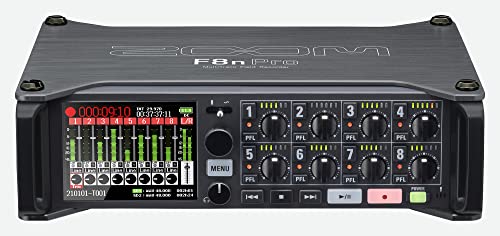
- Eight inputs and 10-track recording
- 0.2 ppm timecode accuracy
- Dual SD slots for redundant recording
Best For: Professional film crews needing capacity and recording redundancy
Compact Pro Pick

- 32-bit float recording up to 192kHz
- Four inputs and six-track capability
- Sidus App control with extended AA battery life
Best For: Professional crews needing flexible inputs in a compact recorder
Two-Channel Sync Bundle

- Includes a dedicated TCA-1 timecode adapter
- Two locking XLR inputs with phantom power
- 32-bit float WAV recording to microSD
Best For: Small video crews needing compact two-channel timecode capture
Integrated Video Rig Choice

- Built-in timecode generator and HDMI sync
- Four XLR/TRS inputs with six-track recording
- Mixer, 32-bit float capture, and 4K/8K HDMI pass-through
Best For: Camera rigs requiring four inputs and integrated sync features
Compact Float Capture

- 32-bit float recording for wide dynamic range
- Two locking XLR mic/line inputs
- Includes 64GB card, batteries, cable, and bag
Best For: Two-channel interviews, filmmaking, and portable location recording
Wireless Sync Convenience

- 32-bit float recording for clip-resistant dialogue capture
- Bluetooth control through the F2 Control app
- Includes lavalier microphone and uses two AAA batteries
Best For: Wearable lavalier recording for video creators and interviews
Production Timecode Powerhouse
Zoom F6 6-Input Field Recorder Bundle
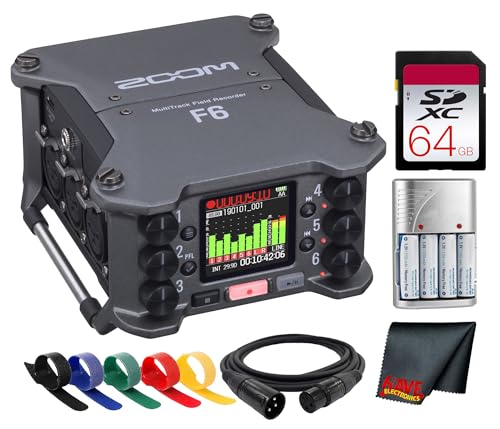
- Dedicated timecode I/O with ±0.2 ppm TCXO accuracy
- Six locking XLR inputs and 32-bit float recording
- Supports multitrack, Ambisonics, USB, and SD backup
Best For: Synchronized multi-camera productions and professional location sound
Best Compact Timecode Recorder – TASCAM FR-AV2
The TASCAM FR-AV2 is a practical field recorder with timecode for videographers who want synchronized audio without carrying a separate timecode device. Its compact body combines 32-bit float recording, dual XLR/TRS inputs, and timecode generation in a travel-friendly package.
Best For: Videographers needing a compact recorder with built-in timecode and flexible input options.
Pros:
- 32-bit float recording with dual ADCs helps support worry-free capture.
- Built-in timecode IN/OUT and generation can simplify syncing with video gear.
- Dual XLR/TRS combo inputs plus a 3.5 mm input support varied setups.
- Small 9.5-ounce design is convenient for location work.
Cons:
- Requires three AA batteries.
- Wireless monitoring requires the optional AK-BT2 adapter, which is the only compatible adapter.
- Its two-input design is less suited to larger multichannel productions.
Choose the FR-AV2 if portability and an integrated timecode workflow matter more than a high input count. It is a streamlined option for small video crews and mobile recording kits.
Best Six-Input Timecode Recorder – Zoom F6
The Zoom F6 is a versatile field recorder with timecode for filmmakers, musicians, and location crews handling multiple microphones. Its six XLR inputs, 32-bit float recording, and up to 14-track capability provide considerable flexibility while retaining a portable form factor.
Best For: Filmmakers and production teams recording several microphones while requiring frame-accurate synchronization.
Pros:
- Dual A/D converters and 32-bit float recording support a wide dynamic range without clipping.
- Six XLR inputs allow simultaneous multichannel recording.
- Timecode I/O supports frame-accurate audio and video sync.
- Can operate as a standalone recorder or USB audio interface.
Cons:
- At 2.4 pounds, it is heavier than compact pocket-style recorders.
- Its larger feature set may be more than a simple one- or two-microphone setup requires.
- It requires four AA batteries for operation.
The F6 is a strong middle ground for productions that need more inputs than a compact recorder but still value portability. It is especially compelling when timecode and multitrack flexibility are central to the workflow.
Best Pocket Timecode Recorder – Deity PR-2
The Deity PR-2 is a pocket-sized field recorder with timecode for interviews, lavalier work, and lightweight video rigs. It combines 32-bit float recording with a locking 3.5 mm input, Bluetooth control, long battery life, and a bundled W.Lav Pro microphone.
Best For: Videographers and journalists who need a discreet recorder for lavalier, stereo, or line-level sources.
Pros:
- Compact design and 30-hour battery life support extended mobile recording.
- 32-bit float and 24-bit recording options provide flexible capture.
- Compatible with Deity timecode products and can function as a standalone timecoder.
- Includes a W.Lav Pro microphone and supports wireless control through the Sidus Audio App.
Cons:
- The locking 3.5 mm input is not a substitute for multiple XLR inputs.
- Wireless monitoring and control depend on Bluetooth and the Sidus Audio App.
- Its pocket format is better suited to small-source setups than larger productions.
The PR-2 stands out when size, battery endurance, and lavalier compatibility are more important than extensive I/O. The included microphone and timecode compatibility make it a particularly convenient option for solo operators.
Best Professional Timecode Recorder – Zoom F8n Pro
The Zoom F8n Pro is a professional field recorder with timecode for demanding film and location audio workflows. It offers eight inputs, 10-track recording, precise 0.2 ppm timecode accuracy, dual SD card slots, and strong preamps for both quiet dialogue and dynamic scenes.
Best For: Professional film crews that need extensive inputs, redundant recording, and highly accurate synchronization.
Pros:
- Eight-channel, 10-track recording supports complex production setups.
- Timecode accuracy down to 0.2 ppm helps keep audio aligned with picture.
- Dual SD slots enable redundant recording, with support for cards up to 1 TB each.
- Can function as an 8-in/4-out USB interface while recording to SD.
Cons:
- Its 1.8 kg weight is substantial for handheld or minimalist kits.
- Battery life is listed at approximately 8.5 hours.
- The professional input and recording capacity may be excessive for simple field recording.
The F8n Pro is the most production-oriented choice in this group. It makes sense for crews that need a high input count, dependable file redundancy, and exceptionally precise timecode rather than maximum portability.
Compact Pro Pick – Deity PR-4 Recorder
The Deity PR-4 is a compact field recorder with timecode compatibility for productions that need flexible inputs, high-resolution capture, and portable operation. It supports 32-bit float recording up to 192kHz, with inputs for microphones, 48V sources, line-level devices, AES3, and AES42.
Best For: Professional field and video crews needing multiple input options, app control, and extended battery operation in a compact recorder.
Pros:
- Supports 32-bit float recording up to 192kHz.
- Offers four inputs and six-track capability.
- Provides Sidus App control and up to nearly 30 hours on two AA batteries, according to the supplied notes.
Cons:
- The supplied information does not specify an included timecode generator or adapter.
- Its broad professional feature set may be more than needed for simple two-channel recording.
The PR-4 stands out for input flexibility and long battery life, making it a strong choice when a compact recorder needs to support varied production sources. Verify the exact timecode workflow and included accessories before purchase.
Two-Channel Sync Bundle – Zoom F3 with TCA-1 Timecode
The Zoom F3 bundle pairs a two-channel 32-bit float field recorder with the TCA-1 timecode adapter, creating a compact field recorder with timecode for camera, slate, and generator synchronization. Its locking XLR inputs, dual A/D converters, and low-noise preamps suit changing sound levels in production environments.
Best For: Video shooters and small production teams that need two high-quality XLR channels with a dedicated timecode connection.
Pros:
- Includes the Zoom TCA-1 adapter for 3.5mm TRS timecode input and output.
- Records mono or stereo WAV files in 32-bit float.
- Supports two locking XLR inputs with 24V/48V phantom power.
- Can run on AA batteries, USB power, or an AD-17 AC adapter.
Cons:
- It is limited to two recording channels.
- Timecode syncing requires compatible firmware and compatible external equipment.
This is the most straightforward option here for adding timecode to a compact two-channel setup. The included adapter reduces accessory shopping, while the F3’s 32-bit float workflow helps accommodate unpredictable recording levels.
Integrated Video Rig Choice – TASCAM FR-AV4 Field Recorder
The TASCAM FR-AV4 is a four-channel field recorder with timecode built into a camera-oriented mixer and recorder. It combines four XLR/TRS inputs, 32-bit float recording, six-track capture to SDXC, HDMI sync, and USB-C connectivity for more integrated video production workflows.
Best For: Camera rigs and video productions that need four inputs, onboard mixing, built-in timecode generation, and HDMI-based synchronization.
Pros:
- Includes a built-in timecode generator with HDMI and 3.5mm timecode In/Out.
- Records four input tracks plus a stereo mix for six-track recording.
- Provides four low-noise XLR/TRS combo inputs with Ultra-HDDA preamps.
- Supports 4K/8K HDMI pass-through, control, and cascade functions.
Cons:
- Wireless monitoring and app control require the optional AK-BT2 accessory.
- The supplied notes list USB power rather than an internal battery system.
The FR-AV4 is the most fully integrated choice for camera-based workflows. Its built-in timecode, HDMI synchronization, mixer, and four combo inputs make it especially appealing when the recorder must serve as part of a larger rig rather than operate as a basic standalone unit.
Compact Float Capture – Zoom F3 Field Recorder Bundle
The Zoom F3 is a practical choice when you need a compact field recorder with timecode-adjacent production flexibility, though the supplied specifications do not identify a dedicated timecode input. Its 32-bit float recording, dual XLR inputs, and multiple powering options make it well suited to interviews, location audio, and small production setups.
Best For: Filmmakers, journalists, sound designers, and anyone recording with one or two professional microphones.
Pros:
- 32-bit float recording helps capture quiet and loud sources without clipping or constant gain adjustments.
- Two locking XLR mic/line inputs support dynamic microphones, condenser microphones, and line-level feeds.
- Records uncompressed BWF audio from 44.1 to 192 kHz and can also operate as a USB audio interface.
- The bundle includes batteries, charger, 64GB microSDXC card, XLR cable, travel bag, and accessories.
Cons:
- The supplied notes do not list a dedicated timecode I/O connection.
- With two inputs, it is less suitable for larger multichannel recording jobs than the Zoom F6.
The F3 is a strong value for portable, high-quality two-channel recording. Choose it when simple operation and 32-bit float protection matter more than built-in timecode synchronization or a larger input count.
Wireless Sync Convenience – Zoom F2-BT Lavalier Recorder
The Zoom F2-BT is a lightweight option for anyone seeking a field recorder with timecode workflow support for video. Its built-in Bluetooth connects to the F2 Control app, while the included lavalier microphone and 32-bit float recording simplify dialogue capture for mobile productions.
Best For: Presenters, interview subjects, and solo video creators who need discreet lavalier recording with Bluetooth control.
Pros:
- 32-bit float recording reduces the need for gain adjustment and helps avoid clipped dialogue.
- Built-in Bluetooth supports settings adjustment and remote transport control through the F2 Control app.
- Records to microSD and SDHC cards up to 512GB, with up to 2,000 hours of stated recording time.
- Compact battery operation uses two AAA batteries and the included lavalier microphone.
Cons:
- The supplied notes do not specify a dedicated timecode input or output.
- It has a lavalier-focused single-recorder design rather than multiple XLR inputs.
- No headphones jack is listed in the supplied specifications.
The F2-BT is best viewed as a wearable dialogue recorder with wireless control rather than a full production mixer. It makes sense when portability, simple lavalier placement, and 32-bit float protection are the priorities.
Production Timecode Powerhouse – Zoom F6 6-Input Field Recorder Bundle
The Zoom F6 is the most complete choice here for a field recorder with timecode. Its dedicated 3.5mm TRS timecode I/O, TCXO accuracy of ±0.2 ppm, and jam-sync capability are designed for dependable camera and recorder synchronization on demanding location productions.
Best For: Production sound mixers, filmmakers, ENG crews, and mult-camera teams needing synchronized multitrack audio.
Pros:
- Dedicated timecode I/O, ±0.2 ppm TCXO accuracy, and jam sync support professional synchronization workflows.
- Six locking Neutrik XLR inputs provide up to 75 dB of clean gain for multichannel recording.
- 32-bit float recording with dual A/D converters handles very quiet and loud sources without digital clipping.
- Supports 6-track or 14-track recording, Ambisonics mode, USB audio, and SD card backup recording.
Cons:
- Its broader production feature set and six-input design may be more than a simple interview setup requires.
- The supplied bundle details list a generic XLR cable and accessories rather than a complete microphone package.
- At 3.19 pounds, it is less lightweight than the F2-BT.
For productions where accurate synchronization is essential, the F6 is the clear standout. It combines dedicated timecode hardware with extensive input capacity, flexible track modes, and 32-bit float recording for a robust on-location workflow.
How We Picked the Best Field Recorder with Timecode
We evaluated these recorders according to the features that matter most in real production environments: timecode generation or synchronization, recording format, input count, preamp flexibility, portability, battery practicality, monitoring, and camera integration. We also considered whether each model is best suited to a specific role, such as a hidden lavalier recorder, compact camera-mounted unit, or multitrack production recorder.
32-bit float recording was another major consideration. It can provide useful protection against clipped takes when gain levels change quickly, although proper microphone placement, monitoring, and overall workflow still matter. Bundles were assessed for the value of included timecode accessories and other production essentials.
Quick Comparison
| Best For | Recommended Type | What to Prioritize |
|---|---|---|
| Solo filmmakers | Compact recorder with timecode | Simple synchronization, low weight, and easy camera mounting |
| Production sound | Multichannel field recorder | Input count, routing, preamps, timecode stability, and battery life |
| Dialogue backup | 32-bit float pocket or lavalier recorder | Small size, secure attachment, and reliable wireless sync |
| Camera rigs | Recorder with XLR/TRS inputs | Camera connectivity, HDMI or timecode integration, and physical controls |
| Music and live recording | Recorder with multiple inputs | Track count, clean preamps, monitoring, and high-resolution formats |
Key Buying Factors for a Field Recorder with Timecode
Timecode Compatibility
Check whether the recorder generates, receives, or wirelessly syncs timecode, and confirm compatibility with your cameras, timecode boxes, and editing software. A built-in generator can reduce accessories, while wireless systems may be more convenient for distributed crews.
Input Count and Connector Type
Two inputs may be sufficient for a compact interview setup, but larger productions benefit from four or more XLR/TRS inputs and independent track recording. Consider phantom power, mic-level and line-level support, and whether the connector layout works on your camera rig or bag.
32-Bit Float and Recording Quality
32-bit float is valuable for unpredictable dialogue and location work because it provides substantial digital headroom. It does not fix microphone distortion, excessive background noise, or poor placement. Confirm supported sample rates, file formats, and whether the recorder creates isolated tracks as well as a mix.
Size, Power, and Controls
Compact units are easier to hide or mount, while larger recorders usually offer better routing and monitoring. Review battery type, expected runtime, storage media, screen visibility, headphone output, and physical gain or transport controls before buying.
Who Should Buy Which Field Recorder with Timecode?
Choose a pocket or lavalier-focused recorder if you need discreet talent backups or lightweight solo production. A two-channel model suits interviews, small cameras, and simple stereo recording. Move to a four-input recorder when you need multiple microphones, camera feeds, or a more flexible rig.
For boom, multiple wireless receivers, and larger crews, an eight-input multitrack recorder offers the most room to grow. Musicians and live-recording users should prioritize track capacity and clean preamps, while video creators should place greater emphasis on dependable synchronization, camera connectivity, and fast post-production alignment.