Moisture can turn a dependable classroom 3D printer into a source of stringing, bubbling, weak layers, and inconsistent results. A suitable filament dryer helps schools protect materials and make student projects more predictable.
This roundup compares ten options across capacity, temperature control, storage, heating performance, and classroom practicality so you can choose equipment that matches your lab’s workload and budget.
Best 10 Filament Dryers for Schools Picks for 2026
High-Capacity Dual-Chamber Pick
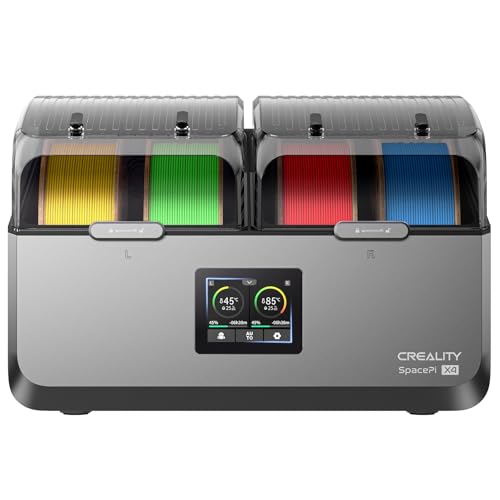
- Dries and feeds up to four spools
- Independent dual-chamber temperature control
- Reaches 85°C for engineering filaments
Best For: Busy school makerspaces with multiple printers
Classroom Throughput Pick

- Holds and dries four 1kg spools
- Eight outlets support multiple printers
- Three fans circulate heat evenly
Best For: Large labs preparing filament for several printers
Smart Safety Pick
Comgrow SH03 Dual-Chamber Dryer

- Dries up to four 1kg spools
- Automatic humidity-based drying mode
- Four integrated monitoring and protection systems
Best For: Supervised school labs using varied filament types
Compact Storage Pick

- Stores one large or two narrower rolls
- Shows temperature and humidity in real time
- Supports sealed power-off storage
Best For: Small classrooms and introductory 3D-printing programs
Best All-in-One Moisture Control

- Dries, stores, and prints without breaking the seal
- Supports common materials and three filament diameters
- Includes humidity monitoring and 360° airflow
Best For: School labs needing integrated drying and storage
Best for Simple Classroom Operation

- Touchscreen controls simplify drying setup
- Adjustable temperature and timer settings
- Dries filament while it is being used
Best For: Classrooms needing an easy-to-operate dryer
Best for High-Visibility Controls
Creality Space Pi Filament Dryer

- Shows temperature, humidity, and countdown status
- Provides material presets and manual temperature control
- Includes power-outage memory and a 48-hour timer
Best For: Makerspaces needing monitoring and repeatable drying
Simple Single-Spool Choice
Creality Space Pi SE Filament Dryer

- Handles one 1 kg spool
- Displays humidity and drying countdown
- Adjusts from 45°C to 65°C
Best For: Classrooms needing easy, routine filament preparation
Safety-Focused Two-Spool Pick

- Dries two 1 kg spools at once
- Includes heater and fan safety protections
- Offers presets for nine filament types
Best For: School labs needing two-spool capacity with sealed storage
High-Capacity Dual-Chamber Pick – Creality Space Pi X4
For schools managing several printers, the Creality Space Pi X4 is a high-capacity option among filament dryers for schools. It can dry and feed up to four spools at once, while its two independently controlled chambers allow different filament types to be handled at separate temperatures.
Best For: School makerspaces running multiple printers and using engineering materials such as PA, PAHT, PC, or flexible filament.
Pros:
- Supports drying and printing with four spools simultaneously.
- Dual chambers provide independent temperature control.
- Reaches up to 85°C with two 200W PTC heaters.
- Single-chamber operation can save up to 40% energy.
Cons:
- Other brands’ plastic trays should be checked for heat resistance.
- The higher-temperature settings may be more capability than a basic PLA classroom setup requires.
The Space Pi X4 stands out when throughput and material flexibility matter. Its four-spool design can reduce interruptions in a busy lab, while the single-chamber mode offers a way to limit energy use for smaller jobs.
Classroom Throughput Pick – SUNLU S4 4-Spool Dryer
The SUNLU S4 is designed for classrooms that need to prepare several spools without taking up multiple dryer units. As one of the more practical filament dryers for schools, it combines four-spool capacity, eight filament outlets, three circulation fans, and a timer that can run for up to 99 hours.
Best For: Larger school labs that use several 1kg spools and need to supply multiple printers at different loading angles.
Pros:
- Dries up to four 1kg spools at once.
- Eight outlets support multiple printers and loading positions.
- Three fans provide 360-degree air circulation.
- Supports materials including PLA, PETG, ABS, TPU, PA, PC, and nylon.
Cons:
- Its 460 × 220 × 310mm external size and 4kg weight require dedicated space.
- The temperature range tops out at 70°C, below some higher-temperature dryers.
- DIY modifications are needed for 3kg rolls or shoe-drying use.
The S4 is a strong choice when a school values capacity and straightforward multi-printer feeding. Its broad material compatibility and long timer are useful for scheduled lab preparation, provided the classroom has room for its larger enclosure.
Smart Safety Pick – Comgrow SH03 Dual-Chamber Dryer
The Comgrow SH03 is a dual-chamber dryer aimed at schools that want separate controls and automatic moisture management. It handles up to four 1kg spools, offers adjustable heating from 45–85°C, and includes monitoring features that are useful in supervised educational environments.
Best For: School makerspaces that need independent settings for different materials and want automatic drying and multiple protection systems.
Pros:
- Two independent chambers can hold two 1kg spools each.
- Temperature range of 45–85°C suits varied filament types.
- Automatic mode responds to internal humidity and enters energy-saving storage mode.
- Includes temperature, fan, PTC, and control-board monitoring.
Cons:
- The supplied information does not specify the unit’s external dimensions or weight.
- Its advanced controls may require more orientation for younger students.
The SH03 is compelling for structured school labs where material separation and operational monitoring are priorities. Its automatic mode can simplify routine drying, while the dual chambers let instructors prepare different filaments concurrently.
Compact Storage Pick – Sovol SH01 Filament Dryer
The Sovol SH01 is a simpler, lower-capacity option for classrooms that need to dry one or two rolls and keep filament protected between lessons. Its real-time temperature and humidity display, sealed storage design, and built-in fan make it a practical entry point among filament dryers for schools.
Best For: Small classrooms, introductory 3D-printing programs, and labs that mainly use PLA, PETG, TPU, or ABS.
Pros:
- Stores two rolls under 70mm wide or one roll under 150mm wide.
- Displays internal temperature and humidity in real time.
- Offers 40°C, 45°C, and 50°C settings with six- to 12-hour timing.
- Sealed silicone and PTFE construction supports power-off storage.
Cons:
- Lower capacity than four-spool school-lab dryers.
- It may not reach 50°C when the room is below 16°C.
- Desiccant bags improve storage performance but are not included.
The SH01 makes sense when a school needs dependable basic drying rather than maximum throughput. It is easier to match to a small classroom inventory, though larger makerspaces will likely outgrow its two-roll capacity.
Best All-in-One Moisture Control – Polymaker PolyDryer
For schools seeking filament dryers for schools, the Polymaker PolyDryer combines heated drying, sealed storage, and direct printing in one modular setup. It supports several common filament types and includes humidity monitoring to help staff manage materials between classroom print jobs.
Best For: Schools that want one system for drying, storing, monitoring, and feeding filament without repeatedly exposing it to ambient moisture.
Pros:
- Combines drying, sealed storage, and printing without breaking the seal.
- Supports PA Nylon, PLA, PVB, PETG, ABS, ASA, and TPU.
- Fits 1.75 mm, 2.85 mm, and 3.00 mm filament and includes a built-in hygrometer.
- Uses heated drying, 360° airflow, sealing, and desiccant support.
Cons:
- The modular dryer-and-storage design may require more setup than a basic dryer.
- It is listed as a one-spool, 1 kg-capacity solution.
Its strongest advantage for a school lab is workflow continuity: filament can be dried, stored, and fed from the same connected setup. The humidity monitoring and broad material compatibility also make it practical for shared equipment.
Best for Simple Classroom Operation – SUNLU Filament Dryer S2
The SUNLU S2 is a straightforward choice for schools looking for filament dryers for schools with accessible controls and flexible settings. Its large touchscreen, adjustable temperature and drying time, and ability to hold filament during printing suit shared classroom workflows.
Best For: Classrooms that prioritize simple operation, adjustable drying programs, and a translucent lid for checking filament without opening the unit.
Pros:
- Large touchscreen allows temperature and time adjustments from 35–70°C and 0–99 hours.
- Built-in spindle rotates filament for more even drying.
- Can dry filament while serving as a spool holder during printing.
- Supports 1.75 mm, 2.85 mm, and 3.00 mm filament with a 265 × 274 × 118 mm capacity.
Cons:
- Its maximum temperature is 70°C, which may not suit every high-temperature drying requirement.
- The notes do not specify sealed storage or humidity readout.
For student-facing environments, the S2’s clear controls and broad adjustment range reduce the learning curve. It is especially useful where operators need to dry and feed filament from the same unit without complex programming.
Best for High-Visibility Controls – Creality Space Pi Filament Dryer
The Creality Space Pi is a strong option for schools comparing filament dryers for schools that need visible status information and preset material settings. Its 3.7-inch touch display shows temperature, humidity, and countdown information, while 360° hot-air circulation supports more uniform drying.
Best For: School makerspaces that want quick material selection, extended drying programs, and clear real-time monitoring at the unit.
Pros:
- Displays real-time temperature, humidity, and drying countdown information.
- Uses an 80W PTC heater and fan-assisted 360° hot-air circulation.
- Offers presets for up to 12 filament types and manual settings from 45–70°C.
- Supports 0–48-hour drying times and remembers settings after a power outage.
Cons:
- Its listed weight is 5 kg, making it less convenient to move between classrooms.
- The manual temperature range starts at 45°C, offering less low-temperature flexibility than the SUNLU S2.
The Space Pi stands out when several users need to understand the drying status quickly. Presets, power-outage memory, and a long timer range can help make repeatable operation easier in a busy school makerspace.
High-Capacity Classroom Pick – Sovol SH03 4-Spool Filament Dryer
For schools managing several 3D printers, the Sovol SH03 is a high-capacity option among filament dryers for schools. Its four-spool design, dual independently controlled chambers, and maximum temperature of 85°C support shared labs with varied filament needs.
Best For: School makerspaces running multiple printers or drying different filament types simultaneously.
Pros:
- Dries up to four 1 kg spools at once.
- Dual chambers can run at different temperatures or operate separately for storage.
- Offers one-key presets for 10 filament types and automatic moisture venting.
- Reaches 50°C within 4 minutes and 70°C within 12 minutes, according to the supplied specifications.
Cons:
- Its four-spool capacity and dual-heater design may be more than a small classroom needs.
- The 3.6 kg unit requires more space than a single-spool dryer.
The SH03 stands out when throughput and flexibility matter most. Independent chamber controls are particularly useful for school labs using PLA, PETG, ABS, TPU, and other materials with different drying requirements.
Simple Single-Spool Choice – Creality Space Pi SE Filament Dryer
The Creality Space Pi SE is a straightforward choice for schools seeking filament dryers for schools that are easy to operate and monitor. Its 45–65°C temperature range, real-time humidity display, and adjustable 0–24-hour timer suit routine classroom maintenance.
Best For: Classrooms that typically prepare one 1 kg spool at a time and want simple controls.
Pros:
- Fits most 1 kg spools and supports 1.75 mm and 2.85 mm filament.
- 360° hot-air circulation and insulation help heat the chamber evenly.
- Display and control knob show humidity and drying time with a countdown.
- Adjustable temperature and drying time accommodate different filament types and conditions.
Cons:
- Its listed capacity is limited to one 1 kg spool.
- The maximum temperature is 65°C, lower than some higher-temperature dryers.
- The supplied warranty description is six months.
With no assembly required and an uncomplicated interface, the Space Pi SE can be a practical fit where staff or students need a manageable, single-spool drying workflow rather than a high-capacity lab system.
Safety-Focused Two-Spool Pick – Comgrow SH02 Filament Dryer
The Comgrow SH02 gives schools a middle-ground option among filament dryers for schools, holding two 1 kg spools while adding touch controls, sealed storage features, and built-in safety protection. It supports common classroom materials across a 40–70°C range.
Best For: School labs that need two-spool capacity and additional heater and enclosure protections.
Pros:
- Dries two 1 kg spools simultaneously and feeds filament through two PTFE-compatible holes.
- 360° circulation and a 150W PTC heater support even heating up to 70°C.
- One-key presets cover nine filament types, with drying times up to 98 hours.
- Includes over-temperature cutoff, fan-failure alerting, and multiple sealing rings.
Cons:
- Its 70°C maximum temperature is below the Sovol SH03’s 85°C maximum.
- It has less capacity than four-spool systems for larger makerspaces.
- The supplied details do not specify a humidity display.
The SH02 is a sensible choice for schools balancing capacity with protective features. Its two-spool layout can serve two printers at once without taking on the size and complexity of a four-spool dryer.
How We Picked the Best Filament Dryers for Schools
We evaluated these Filament Dryers for Schools by focusing on the features that matter in shared maker spaces: spool capacity, supported filament sizes, maximum temperature, drying control, storage design, operating convenience, and space requirements. Multi-spool models can support busy print labs, while compact units may be easier to deploy beside individual printers.
We also considered whether a dryer can feed filament directly to a printer, how clearly it manages temperature and time, and whether its design is practical for repeated use by students and staff. Always confirm the manufacturer’s material-temperature guidance before drying specialty filaments.
Quick Comparison
| Best For | What to Look For | Shortlist Types |
|---|---|---|
| Large classrooms | Four-spool capacity, independent heating, and clear controls | Space Pi X4, SUNLU S4, SH03 models |
| Small labs | Compact footprint and one- or two-spool operation | SUNLU S2, Space Pi, SH02 |
| Higher-temperature materials | Higher maximum temperature and stable heat management | 85°C-capable dryers |
| Everyday PLA and PETG | Simple presets, sealed storage, and easy feeding | Compact storage-focused units |
Key Buying Factors for Filament Dryers for Schools
Capacity and Classroom Workflow
Choose capacity based on how many printers operate simultaneously. Four-spool dryers reduce interruptions in busy labs, but a smaller unit may be more efficient when students work in rotating groups or when shelf space is limited.
Temperature Range and Material Support
PLA and PETG generally need less heat than moisture-sensitive materials such as nylon. A wider temperature range offers more flexibility, but accurate control and clear presets are just as important as the maximum temperature. Avoid assuming that a higher setting is automatically better.
Storage and Direct Feeding
A dryer that doubles as a sealed storage box can help keep filament dry between classes. Check spool-size compatibility, outlet placement, feed-path design, and whether the unit can remain connected to a printer while operating.
Controls, Safety, and Maintenance
For school use, favor readable displays, straightforward timers, stable construction, and automatic temperature management. Place the dryer on a heat-resistant, well-ventilated surface, keep cords organized, and establish staff-approved operating procedures for younger users.
Who Should Buy Which Filament Dryers for Schools?
Choose a Multi-Spool Dryer for High-Throughput Labs
Schools running several printers or frequent student projects should prioritize four-spool models such as the Space Pi X4, SUNLU S4, or SH03-style dryers. Their capacity can simplify material rotation and reduce the need for repeated drying cycles.
Choose a Compact Dryer for Limited Space
For a small classroom, library makerspace, or single-printer station, the SUNLU S2, Creality Space Pi, or Comgrow SH02 can provide a more manageable footprint and simpler daily handling.
Choose Higher-Temperature Capability for Advanced Materials
If the lab regularly uses nylon or other moisture-sensitive engineering filaments, consider an 85°C-capable option, provided its controls, safety practices, and spool compatibility suit your environment.
Finally, buy enough capacity for your actual workflow rather than the largest model available. The best classroom dryer is one that staff can operate consistently, students can use safely under supervision, and the lab can keep loaded without creating clutter.