Moisture can turn good filament into inconsistent prints, stringing, popping, and weak layers. The right filament dryer helps restore damp materials and keeps sensitive spools ready to use.
We compared 10 popular options across capacity, temperature control, heating design, storage, and everyday usability so you can choose a dryer that fits your printer setup and filament habits.
Best 10 Filament Dryers Picks for 2026
High-Capacity Choice
Creality Space Pi X4 4-Spool Dryer

- Holds four 1kg or two 2kg spools
- Dual 200W chambers reach 85°C
- Sealed enclosure supports dry storage
Best For: High-volume users drying and storing multiple spools
Multi-Printer Pick
SUNLU S4 4-Spool Filament Dryer

- Dries four 1kg spools simultaneously
- 350W heater with three circulation fans
- Eight outlets support multiple printers
Best For: Multi-printer workspaces and high-throughput drying
Dual-Material Specialist
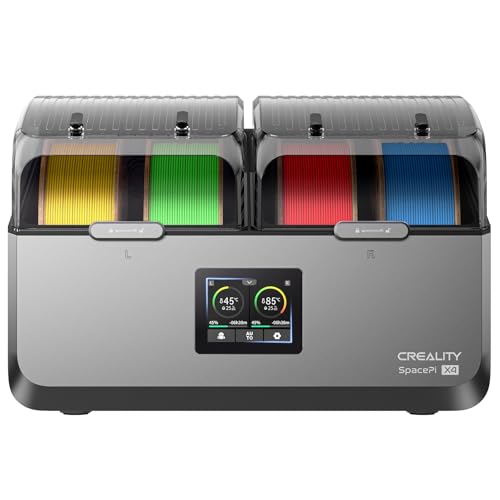
- Independent chambers use separate temperatures
- Four-spool drying and printing capacity
- Dual 200W heaters reach 85°C
Best For: Mixed-material workflows using different drying temperatures
Compact Everyday Option

- Adjustable 35–70°C temperature range
- 0–99-hour timer and rotating spindle
- Translucent lid supports easy monitoring
Best For: Home users maintaining one spool at a time
Best Dual-Spool Pick

- Dries two 1 kg spools at once
- 150W PTC heater with 70°C maximum
- Preset programs for nine filament types
Best For: Multi-spool printing and routine filament drying
Best for Everyday Use

- Fits four 1 kg or two 2 kg spools
- Dual 200W chambers reach 75°C
- Sealed storage helps prevent re-absorption
Best For: High-volume printing and multi-spool workshops
Best Simple Storage Pick

- Real-time temperature and humidity display
- Stores two narrow or one wide spool
- Sealed power-off storage with optional desiccants
Best For: Everyday moisture control and compact storage
Best Integrated Storage

- Dries, stores, and feeds filament without breaking the seal
- Supports common materials and three filament diameters
- Uses airflow, sealing, desiccant, and hygrometer monitoring
Best For: Makers wanting an integrated drying and storage workflow
Best Touchscreen Control

- 360° PTC hot-air heating for uniform drying
- 12 material presets and 45–70°C adjustment
- 48-hour timer with power-off memory
Best For: Users wanting guided controls and flexible drying settings
High-Capacity Choice – Creality Space Pi X4 4-Spool Dryer
For high-volume printing, this Creality filament dryer combines four-spool capacity with dual heating chambers. It reaches up to 85°C, supports common and engineering filaments, and can help keep filament dry during printing pauses.
Best For: Users who need organized, high-capacity drying and storage for multiple spools.
Pros:
- Holds four standard 1kg spools or two 2kg spools.
- Dual 200W heating chambers can dry two filament groups independently.
- Supports filament diameters of 1.75mm and 2.85mm, with temperature settings from 50–85°C.
- Sealed storage helps limit moisture re-absorption during pauses.
Cons:
- Larger than single-spool filament dryers.
- The supplied specifications do not list a humidity sensor or humidity readout.
Choose this model if capacity and flexible temperature control matter more than a compact footprint. Its dual-chamber layout is especially useful for mixed-material workflows.
Multi-Printer Pick – SUNLU S4 4-Spool Filament Dryer
The SUNLU S4 is a large filament dryer designed to dry up to four 1kg spools while feeding several printers. Its 350W heater, three circulation fans, adjustable timer, and eight outlet holes make it suited to busy multi-printer setups.
Best For: Makers running multiple printers or drying several spools at once.
Pros:
- Fits up to four 1kg spools and includes eight filament exit holes.
- Three fans and 360-degree circulation promote more even drying.
- Offers 35–70°C temperature control and a 0–99-hour timer.
- Supports 1.75mm, 2.85mm, and 3.00mm filament diameters.
Cons:
- Its large 460 × 220 × 310mm exterior requires substantial workspace.
- Maximum temperature is 70°C, lower than some engineering-focused dryers.
- At 4kg, it is less convenient to move than smaller models.
The S4 prioritizes throughput and flexible routing. It is a practical fit when four-spool capacity and multiple filament exits are more important than portability or maximum heat.
Dual-Material Specialist – Creality Space Pi X4 DB-05
This Creality filament dryer is built around independently controlled chambers, allowing two filament types to dry at different temperatures. With four-spool capacity, eight filament holes, and heating up to 85°C, it targets users working with both everyday and engineering materials.
Best For: Advanced users drying different materials at separate temperatures while feeding multiple printers.
Pros:
- Dries and feeds up to four spools at once.
- Independent chambers support different temperature settings simultaneously.
- Dual 200W PTC heaters reach up to 85°C for materials such as PA, PAHT, and PC.
- Single-chamber mode can save up to 40% energy, according to the supplied product notes.
Cons:
- Creality cautions that other brands’ plastic trays should be heat resistant.
- Dual-chamber features may be unnecessary for simple single-material workflows.
- The supplied notes do not specify a humidity display.
The DB-05 stands out when material separation is central to your workflow. Its independent temperature control offers more flexibility than a single shared drying chamber.
Compact Everyday Option – SUNLU S2 Filament Dryer
The SUNLU S2 is a straightforward filament dryer for users who need to revive damp spools and keep filament dry while printing. It offers adjustable temperature and drying time, a built-in rotating spindle, and compatibility with several filament diameters.
Best For: Individual makers who want an easy-to-use dryer for routine filament maintenance.
Pros:
- Temperature adjusts from 35–70°C, with a 0–99-hour timer.
- Rotating spindle supports more even drying as filament turns.
- Works with 1.75mm, 2.85mm, and 3.00mm filament.
- Translucent lid allows monitoring without opening the enclosure.
Cons:
- Designed for a single spool rather than four-spool workflows.
- Its 70°C maximum is less suited to some higher-temperature engineering materials.
- The supplied notes do not state a humidity readout or active humidity sensor.
The S2 is a sensible entry point for everyday PLA, PETG, TPU, and ABS maintenance. Its simple controls and spool-holder function make it convenient for home users without large drying demands.
Best Dual-Spool Pick – Comgrow SH02 Filament Dryer
The Comgrow SH02 is a practical choice if you need filament dryers for two printers or multiple spools at once. Its 150W PTC heater, circulating fan, sealed construction, and preset programs support common materials from PLA and PETG to ABS, TPU, PA, and PC.
Best For: Makers who want to dry two 1 kg spools simultaneously and use preset settings for different filament types.
Pros:
- Holds two 1 kg spools and includes two filament pass-through holes.
- 150W PTC heating reaches 50°C in about 7 minutes and 70°C in about 25 minutes.
- One-key settings cover nine filament types, with drying times up to 98 hours.
- Multiple sealing rings help limit moisture re-entry during storage.
Cons:
- The maximum temperature is 70°C, which may not suit every high-temperature drying requirement.
- Its two-spool capacity may be more than needed for occasional single-spool users.
With fast heating, broad preset support, and safety monitoring for the heater and fan, the SH02 is a well-equipped option for regular multi-spool printing. Its sealed design also lets it function as a storage box between prints.
Best for Everyday Use – Creality SpacePi X4L Dryer
The Creality SpacePi X4L stands out among filament dryers for high-volume setups. It holds four standard 1 kg spools or two 2 kg spools, while dual 200W heating chambers and a sealed enclosure are designed to dry filament efficiently and help maintain its condition during pauses.
Best For: High-volume users who need to dry and organize several spools in one unit.
Pros:
- Large capacity for four 1 kg spools or two 2 kg spools.
- Dual independent 200W heating chambers reach up to 75°C.
- Touch controls allow temperature adjustments from lower PLA/PETG settings to higher-temperature materials.
- Silicone-sealed storage and an illuminated viewing window help limit moisture re-absorption without opening the enclosure.
Cons:
- The four-spool capacity requires more workspace than smaller filament dryers.
- The supplied notes do not specify a warranty or detailed drying-time range.
The X4L is geared toward users who print frequently or manage multiple materials. Its combination of large capacity, separate heating chambers, and sealed storage makes it particularly suited to a busy workshop rather than occasional single-spool use.
Best Simple Storage Pick – Sovol SH01 Filament Dryer
The Sovol SH01 is one of the more straightforward filament dryers for users who want moisture removal plus sealed storage. It supports two narrower spools or one wider spool, monitors internal temperature and humidity, and offers adjustable settings from 40°C to 50°C.
Best For: Home users who want a compact two-spool dryer with humidity monitoring and power-off storage.
Pros:
- Displays the dry box temperature and humidity in real time.
- Supports two spools under 70 mm wide or one spool under 150 mm wide.
- Silicone and PTFE seals support storage without power; desiccant bags can be added.
- Built-in fan is designed to distribute heat more evenly.
Cons:
- Temperature settings top out at 50°C.
- Drying performance can be affected when room temperature is below 16°C.
- Desiccants are not included, and the PTFE seals should be opened during heating for moisture evaporation.
The SH01 favors simple operation and storage over high-temperature drying. It is a sensible fit for common materials and everyday moisture control, especially when real-time humidity information and unpowered storage matter more than maximum heat.
Best Integrated Storage – Polymaker PolyDryer
The Polymaker PolyDryer is a practical choice among filament dryers for users who want drying, storage, and direct printing in one connected setup. Its heated dock, sealed box, desiccant support, and built-in hygrometer are designed to reduce moisture exposure before and between print jobs.
Best For: Makers who want a compact dry-and-store workflow for multiple common filament types.
Pros:
- Combines heated drying, sealed storage, and direct filament feeding.
- Supports PA Nylon, PLA, PVB, PETG, ABS, ASA, and TPU.
- Works with 1.75mm, 2.85mm, and 3.00mm filament sizes.
- Includes 360° airflow, sealing, desiccant support, and a hygrometer.
Cons:
- Designed around one 1kg spool.
- At 1.3kg, it is less suited to users needing a large multi-spool dryer.
The PolyDryer stands out for moisture management beyond the drying cycle. If you value sealed storage and printing without repeatedly exposing the spool to room air, its integrated design is especially appealing.
Best High-Capacity Dryer – Sovol SH03
The Sovol SH03 is one of the more capable filament dryers for multi-material or multi-printer setups. It holds four 1kg spools, uses two independently controlled heating chambers, and reaches up to 85°C with automatic moisture venting.
Best For: High-volume users who need to dry or store several spools at once.
Pros:
- Dries up to four 1kg spools simultaneously.
- Two chambers can run independently at different temperatures.
- Dual 200W PTC heaters provide 360° circulation and fast heating.
- Offers preset settings for 10 filament types, including PA, PC, PP, and PETG.
Cons:
- At 3.6kg, it is substantially heavier than single-spool options.
- Its larger capacity requires more workspace.
For users running multiple printers or multicolor projects, the SH03’s capacity and independent chambers are its main advantages. It is a strong fit when throughput matters more than compact size.
Best Touchscreen Control – Creality Space Pi
The Creality Space Pi offers straightforward control for users comparing filament dryers with guided settings. Its 3.7-inch touchscreen, 360° PTC hot-air circulation, material presets, adjustable 45–70°C range, and timer up to 48 hours make drying sessions easy to configure.
Best For: Users who want touchscreen operation, broad material presets, and flexible drying times.
Pros:
- Uses a 110W PTC heater and 360° hot-air circulation.
- Provides one-key settings for 12 filament types, including PLA-CF and PA-CF.
- Offers a 0–48-hour timer and adjustable temperatures from 45°C to 70°C.
- Power-off memory retains material and temperature settings after an outage.
Cons:
- Its maximum temperature is lower than the Sovol SH03’s 85°C maximum.
- It is intended for 1.75mm and 2.85mm filament, not 3.00mm filament.
The Space Pi is a user-friendly single-spool option with useful automation and control flexibility. Its touchscreen and preset support are particularly helpful when switching among standard and composite materials.
How We Picked the Best Filament Dryers
We focused on the features that matter during real 3D-printing workflows: usable temperature ranges, heating consistency, spool capacity, sealed storage, filament-feed compatibility, controls, and overall practicality. The selection includes compact single- or dual-spool units, larger four-spool dryers, and models designed to combine drying with ongoing storage.
Because filament requirements vary, we also considered whether a dryer is suitable for common materials such as PLA and PETG as well as more moisture-sensitive options, including nylon. Manufacturer temperature claims are useful starting points, but actual performance can depend on spool size, ambient humidity, loading, and drying time.
Quick Comparison
- Best for high capacity: Four-spool models such as the Creality Space Pi X4/X4L, SUNLU S4, and Sovol SH03.
- Best for compact setups: The SUNLU S2, Comgrow SH02, and Polymaker Polydryer.
- Best for independent control: Dual-chamber designs that let you dry different spools or run separate settings.
- Best for routine storage: Models with sealed chambers and direct filament-feed ports.
- Best for higher-temperature materials: Choose a unit with a suitable maximum temperature and verify that the setting matches the filament manufacturer’s recommendations.
Key Buying Factors for Filament Dryers
Capacity and Footprint
Match capacity to your printing schedule. A one- or two-spool dryer takes less desk space and may heat smaller loads efficiently, while four-spool models make sense for multi-material projects or frequent printing. Check both the external dimensions and the supported spool width and diameter.
Temperature and Control
Look for adjustable temperature and drying-time controls rather than a single preset. PLA, PETG, TPU, ABS, and nylon can require different treatment. Higher maximum temperature is not automatically better; stable, appropriate heat is more important than using the hottest setting.
Heating and Moisture Management
PTC heating elements are common because they can provide controlled, relatively efficient heat. Circulating airflow and even heating help prevent one side of a spool from drying faster than the other. For storage, consider sealing quality, desiccant compatibility, and whether the dryer can feed filament while closed.
Ease of Use
A clear display, simple controls, quiet operation, removable spool supports, and accessible feed ports can make a noticeable difference. Also check power requirements and whether the included adapters, tubes, or accessories suit your printer.
Who Should Buy Which Filament Dryers?
Choose a compact dryer if you print occasionally, have limited workspace, or usually run one or two spools at a time. Choose a four-spool model if you regularly switch materials, operate multiple printers, or want to dry several spools in one cycle.
Choose dual independent chambers when you want separate temperature settings or more flexible batch management. Choose a dryer with sealed storage if humidity is a recurring problem and you want to keep filament protected between prints. For nylon and other highly hygroscopic materials, prioritize suitable temperature control, reliable sealing, and enough drying time rather than selecting solely by capacity.