A headphone amplifier with bass boost can add impact and presence to headphones that sound thin, quiet, or lacking in low-end energy. The right model can also improve control, connectivity, and listening flexibility.
We selected 10 options ranging from compact portable amps and bass practice devices to desktop models with gain controls, multiple outputs, and broader headphone compatibility.
Best 10 Headphone Amplifier with Bass Boost Picks for 2026
Best for Shared Monitoring
4-Channel Bass-Boost Headphone Amp
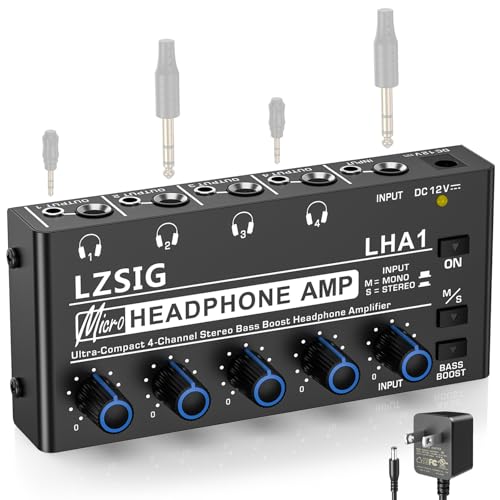
- Four independently controlled headphone outputs
- Bass-boost switch for vocals and bass
- 3.5mm and 6.35mm compatibility
Best For: Home studios and group monitoring
Best for High-Impedance Headphones

- Drives headphones from 18 to 600Ω
- Up to 1500mW at 32Ω
- Replaceable op-amp design
Best For: Powerful desktop headphone setups
Best Portable Bass Boost
eSynic Rechargeable Headphone Amp

- Stated +13.3dB boost at 50Hz
- Supports 16–300Ω headphones
- Rechargeable battery and aluminum chassis
Best For: Bass-focused mobile listening
Best Value Desktop Amp
Douk Audio U3 Class A Headphone Amp
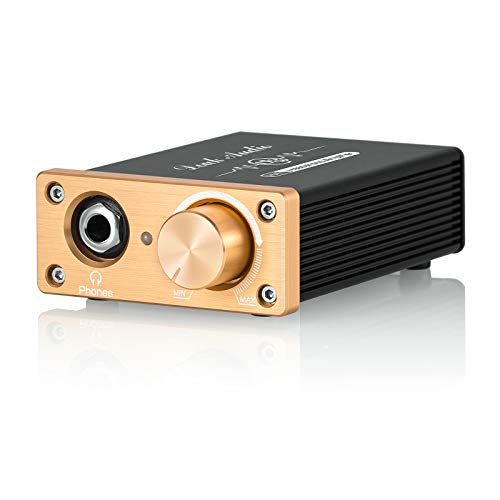
- 1300mW maximum output
- Class A circuit with warm presentation
- Upgrade-friendly pluggable op-amp socket
Best For: Desktop use with high-impedance headphones
Portable Bass Effects Pick

- Amp models with cab simulation
- Modulation and ambience effects
- Aux input and USB charging
Best For: Bassists who want multi-effects and portable headphone practice
Versatile Hi-Fi Pick
MYPIN Bass Boost Headphone Amp
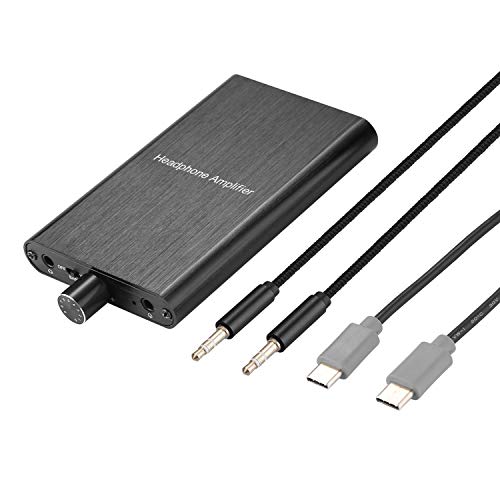
- Supports 16–600Ω headphones
- Two-stage gain and bass switch
- AUX and USB Type-C inputs
Best For: Music listeners and gamers using varied devices
Practice-Focused Bass Pick

- Three bass amp-style modes
- Nine built-in rhythm tracks
- Up to 17 hours on AAA batteries
Best For: Bassists wanting lightweight silent practice
Portable Bass Pick

- Bass switch for enhanced low frequencies
- Supports 16–300-ohm headphones
- More than 8 hours of rechargeable use
Best For: Portable listeners wanting simple bass enhancement
Adjustable Bass Choice

- Dedicated bass knob for custom tuning
- L/H gain switch for 16–600-ohm headphones
- USB-C charging with up to 8–10 hours of use
Best For: Listeners wanting adjustable bass and gain
Most Versatile Tone Controls

- Bass, midrange, and treble controls
- Up to 2400mW in high-impedance mode
- 3.5mm and 6.35mm headphone outputs
Best For: Users wanting detailed analog tone shaping
Best for Shared Monitoring – 4-Channel Bass-Boost Headphone Amp
If you need a headphone amplifier with bass boost for a home studio or shared listening setup, the LZSIG LHA2 offers four independently controlled headphone outputs. It accepts both 3.5mm and 6.35mm connections and is designed for headphones rated from 32 to 100Ω.
Best For: Home studios, rehearsal spaces, and groups monitoring one stereo source through up to four headphones.
Pros:
- Four outputs with independent volume controls
- Bass-boost switch enhances selected frequency bands
- Supports 3.5mm and 6.35mm TS/TRS plugs
- Solid metal chassis with heavy-duty knobs
Cons:
- It is a headphone distributor, not a mixer
- Designed for a narrower 32–100Ω headphone range
The LHA2 is a practical choice when multiple listeners need separate level control from one source. Its compact metal construction and low-noise circuitry suit desk, studio, and stage use.
Best for High-Impedance Headphones – U3 PRO Class A Desktop Amp
The Douk Audio U3 PRO is a high-power desktop headphone amplifier for listeners who need substantial drive capability. It delivers up to 1500mW at 32Ω and supports headphones from 18 to 600Ω, while its compact design fits easily into a home or office setup.
Best For: Desktop listeners using headphones across a wide range of impedances, including demanding high-impedance models.
Pros:
- Supports headphones rated from 18 to 600Ω
- Up to 1500mW output at 32Ω
- Includes RCA and 3.5mm inputs plus dual headphone outputs
- Replaceable op-amp design offers customization
Cons:
- Bass boost is not specifically listed among the supplied features
- Desktop use requires a DC 5V power connection
Choose the U3 PRO if output power and impedance flexibility matter more than portability. Its voltage-boost circuit, Class A architecture, and swappable op-amp design give experienced desktop-audio users room to tailor their setup.
Best Portable Bass Boost – eSynic Rechargeable Headphone Amp
For mobile listening, the eSynic is a headphone amplifier with bass boost that emphasizes the 50Hz range by a stated 13.3dB. Its rechargeable battery, 3.5mm connectivity, and compact aluminum enclosure make it suitable for phones, laptops, MP3 players, and other devices with an analog headphone output.
Best For: Portable listeners who want a pronounced low-end boost with compatible 3.5mm sources and headphones from 16 to 300Ω.
Pros:
- Dedicated bass boost with stated +13.3dB enhancement at 50Hz
- Supports headphone impedances from 16 to 300Ω
- Rechargeable 1000mAh battery with stated 8-plus-hour runtime
- Lightweight aluminum chassis with EMI shielding
Cons:
- Uses 3.5mm connections only
- Bass-forward tuning may not suit listeners seeking a neutral presentation
The eSynic stands out for portable bass emphasis rather than broad desktop connectivity. Its included cables and rechargeable design make it a convenient add-on for compatible analog devices.
Best Value Desktop Amp – Douk Audio U3 Class A Headphone Amp
The Douk Audio U3 is a compact Class A desktop headphone amplifier for users who want stronger output and a warm, detailed presentation from a PC or home audio system. It accepts RCA input, supports 3.5mm and 6.35mm headphones, and is designed to drive many high-impedance models.
Best For: Home and office desktop listeners seeking a small amplifier for demanding headphones and an upgradeable op-amp platform.
Pros:
- 1300mW maximum output with strong drive capability
- Class A circuit with a stated warm, mellow sound
- Pluggable op-amp socket supports future experimentation
- Works with 3.5mm and 6.35mm headsets
Cons:
- Bass boost is not specifically listed among the supplied features
- Designed for freestanding desktop use rather than travel
The U3 is a sensible desktop option when you value compact size, high output, and the ability to change op-amps. It is especially relevant for owners of high-impedance headphones who want more drive from a computer or home source.
Portable Bass Effects Pick – Valeton Rushead Max
The Valeton Rushead Max is a practical choice if you want a headphone amplifier with bass boost-style tone shaping plus built-in effects for private bass practice. Its amp models, cabinet simulation, modulation, ambience effects, and auxiliary input create a flexible setup for bedroom playing or travel.
Best For: Bassists who want portable multi-effects and play-along functionality in a pocket-sized headphone amp.
Pros:
- Includes clean, overdrive, and distortion bass amp models with cab simulation.
- Adds chorus, tremolo, flanger, reverb, and echo effects.
- Aux input supports jamming with an external audio player.
- USB rechargeable battery provides up to 5 hours of use.
Cons:
- Its listed output wattage is only 0.5 watts, so it is designed primarily for headphones or line-out use.
- Battery runtime is shorter than some competing portable models.
The Rushead Max stands out for players who value variety more than a simple bass-only signal path. It is especially useful when amp modeling and effects are more important than maximum battery life.
Versatile Hi-Fi Pick – MYPIN Bass Boost Headphone Amp
The MYPIN is a strong option when you need a headphone amplifier with bass boost for both music listening and gaming. It supports 16–600Ω headphones, offers two-stage gain, and connects through either 3.5mm AUX or USB Type-C, making it adaptable across phones, computers, consoles, and portable players.
Best For: Listeners and gamers who need broad device compatibility, adjustable gain, and a rechargeable portable amplifier.
Pros:
- Supports headphones rated from 16–600Ω.
- Provides two-stage gain and a dedicated bass boost switch.
- Offers 3.5mm AUX and USB Type-C connectivity.
- Rechargeable 3000mAh battery is rated for more than 10–15 hours of operation.
Cons:
- It uses a wired connection rather than wireless audio playback.
- It is not water resistant.
With its gain controls, bass switch, volume knob, and wide impedance range, the MYPIN is the most general-purpose option in this group. It makes sense for users who want one compact amp for music, travel, and console use.
Practice-Focused Bass Pick – Vox amPlug 3 Bass
Vox amPlug 3 Bass Compact Bass Headphone Amplifier w/ Built-In FX and Speaker Emulation
Check Price On AmazonThe Vox amPlug 3 Bass is a focused choice for players seeking a compact headphone amplifier with bass boost-style tone control and practice features. Its three bass modes, compressor, speaker emulation, rhythm tracks, and auxiliary input are designed specifically for silent bass-guitar practice.
Best For: Bass guitarists who want quick plug-in practice with built-in rhythms, amp-style modes, and a lightweight design.
Pros:
- Offers Classic, Smooth, and Funk bass modes.
- Includes nine rhythm tracks for practice and play-along sessions.
- Built-in compressor helps create a consistent, punchy sound.
- Weighs 40 grams and provides up to 17 hours of battery operation.
Cons:
- It is designed for bass guitar rather than general headphone amplification.
- It runs on two AAA batteries instead of a rechargeable battery.
The amPlug 3 Bass is the simplest pick for dedicated bass practice. Its rhythm section and long stated battery life make it particularly convenient for musicians who want to plug in and play without carrying a larger effects unit.
Portable Bass Pick – Neoteck 3.5mm Headphone Amp
If you want a straightforward headphone amplifier with bass boost, the Neoteck adds a dedicated bass switch to a compact 3.5mm setup. It supports headphones rated from 16 to 300 ohms and is designed for phones, computers, MP3 players, gaming controllers, and other compatible devices.
Best For: Portable listeners who want louder, cleaner wired audio with a simple bass-enhancement switch.
Pros:
- Dedicated bass switch for a fuller low-end presentation.
- Supports 16–300-ohm headphones and common 3.5mm sources.
- Rechargeable battery provides more than 8 hours of use.
- Compact aluminum housing is easy to carry.
Cons:
- Uses a 3.5mm connection rather than USB audio.
- The manufacturer advises against using it while charging.
- Bass adjustment is limited to the included switch rather than a continuous control.
The Neoteck is a practical choice when portability and uncomplicated bass enhancement matter most. Its 16–300-ohm range and extended battery make it suitable for everyday wired listening, while the single bass switch keeps operation simple.
Adjustable Bass Choice – XU09 HiFi Headphone Amp
The XU09 is a headphone amplifier with bass boost for listeners who want more control than a fixed enhancement mode provides. Its dedicated bass knob lets you adjust low-frequency intensity, while the L/H gain switch is intended to accommodate wired headphones across a 16–600-ohm range.
Best For: Music, movie, and gaming listeners who want adjustable bass and gain in a portable 3.5mm amplifier.
Pros:
- Dedicated bass control knob enables finer low-end adjustment.
- L/H gain selection supports a broad 16–600-ohm headphone range.
- USB-C charging and a 1350mAh battery provide up to 8–10 hours of operation.
- Aluminum alloy housing includes practical volume and power controls.
Cons:
- It is a wired 3.5mm amplifier, not a wireless audio receiver.
- Actual battery life depends on volume, connected devices, and usage.
- It has no listed water-resistance rating.
Choose the XU09 if adjustable bass is more important than a minimal control layout. The combination of bass adjustment, gain selection, USB-C charging, and broad stated impedance support makes it a flexible option for everyday wired setups.
Most Versatile Tone Controls – Fosi Audio SK01 Headphone Amp
The Fosi Audio SK01 goes beyond a basic headphone amplifier with bass boost by adding independent bass, midrange, and treble controls. It also includes gain selection, loudness compensation, tone defeat, and both 3.5mm and 6.35mm headphone outputs for a more adaptable portable or desktop setup.
Best For: Listeners and electric-guitar users who want extensive analog tone shaping and multiple headphone connections.
Pros:
- Tri-band bass, midrange, and treble controls allow detailed sound shaping.
- Up to 2400mW output is available in high-impedance mode.
- Includes 3.5mm and 6.35mm jacks for headphones rated from 32–300 ohms.
- Functions as a headphone amp, preamp, and instrument equalizer.
Cons:
- Its feature set is more complex than a simple bass-boost amplifier.
- Battery life is listed at up to 6 hours, shorter than some compact alternatives.
- It is specified for 32–300-ohm headphones, so lower-impedance models may not be the intended match.
The SK01 is the strongest fit for buyers who want bass boost as part of a complete tone-control system. Its multiple controls, gain switch, loudness function, and dual headphone jacks make it especially useful for flexible listening or instrument-related setups.
How We Picked the Best Headphone Amplifier with Bass Boost
We focused on the features that matter most in everyday use: bass-control design, headphone impedance support, output power, input and output connections, portability, battery or power requirements, and ease of operation. We also separated general-purpose listening amplifiers from bass-guitar headphone amps, since they serve different needs.
Product specifications can vary by source and setup, so treat stated impedance ranges and power figures as guidance rather than a guarantee of identical performance with every headphone. A clean source, suitable cable, and sensible volume level remain important.
Quick Comparison
| Best For | Look For | Typical Features |
|---|---|---|
| Desktop listening | Power and connectivity | RCA or AUX input, gain, 3.5mm and 6.35mm outputs |
| Portable listening | Small size and battery life | Rechargeable battery, compact controls, pocket-friendly design |
| Bass guitar practice | Instrument-focused effects | Built-in effects, speaker emulation, instrument input |
| Multi-headphone setups | Multiple outputs | Several channels and independent listening access |
Key Buying Factors for a Headphone Amplifier with Bass Boost
Bass Control and Sound Character
A simple bass knob is useful when you want quick adjustment, while an equalizer-style model may offer separate bass, midrange, and treble controls. Bass enhancement should add weight without overwhelming vocals, cymbals, or other detail.
Headphone Impedance and Power
Check whether the amplifier is intended for low-, medium-, or high-impedance headphones. Models supporting roughly 16–600 ohms offer broad compatibility, but power output, sensitivity, and gain design all affect real-world loudness and control.
Connections and Device Compatibility
Choose inputs that match your source, such as 3.5mm AUX, RCA, USB-C, or instrument input. A 6.35mm jack is convenient for studio headphones, while a line output can help connect powered speakers or another component.
Portable Versus Desktop Use
Portable amps prioritize battery operation and compact controls. Desktop units generally provide greater output, more room for connectors, and easier access to tone or gain adjustments, but they need a power adapter and a fixed listening position.
Who Should Buy Which Headphone Amplifier with Bass Boost?
Choose a desktop amplifier if you mainly listen at a desk, use demanding headphones, or want gain, tone, and multiple connection options. These models are usually the best fit for home hi-fi and computer audio.
Choose a portable amplifier if you want stronger bass and more volume from a phone, laptop, or compact player without carrying a full-size component. Confirm battery charging and source compatibility before buying.
Choose a bass practice amp if your priority is playing electric bass through headphones. Built-in effects and speaker emulation are more relevant here than broad headphone impedance support.
Choose a multi-output unit for shared listening, monitoring, or simple distribution to several headphones. Verify whether all outputs share the same volume control and whether the unit is intended for simultaneous use.