A reliable cable tester can save hours of guesswork when a home-office connection drops, runs slowly, or refuses to negotiate at the expected speed. The best models quickly identify wiring mistakes, breaks, crossed pairs, and other common Ethernet problems.
This roundup compares 10 network cable testers for home offices, from simple RJ45 continuity tools to more advanced options with PoE checks, wire tracing, length testing, and support for telephone cables.
Best 10 Network Cable Testers for Home Offices Picks for 2026
Best Overall

- Backlit LCD wiremap results
- Detects multiple Ethernet faults
- Tests CAT5e through CAT6A RJ45 cables
Best For: Detailed Ethernet troubleshooting in a home office
Best Simple Tester

- Single-button operation
- Tests RJ11, RJ12, and RJ45
- Compact body stores the remote
Best For: Quick pass/fail checks around a home office
Best for Wire Tracing
Klein Tools Tone and Probe Kit

- Traces Ethernet and other low-voltage wires
- Includes alligator clips and RJ45 test cable
- Probe has work light and volume control
Best For: Finding and mapping unlabeled home-office wiring
Best for Multi-Cable Testing
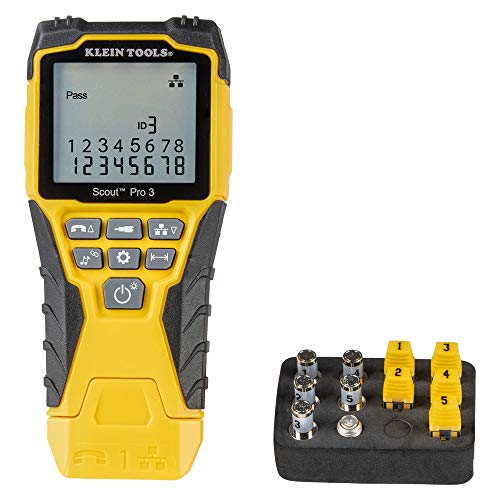
- Tests RJ11/12, RJ45, and coax
- Measures cable length to 2,000 feet
- Includes LANMap and CoaxMap remotes
Best For: Home offices with Ethernet, phone, and coax wiring
Best for Easy Setup
NOYAFA NF-8209 Network Cable Tester

- Tests continuity, faults, PoE, and cable length
- Traces cables with anti-interference and NCV modes
- Includes rechargeable transmitter and complete accessory kit
Best For: Home-office troubleshooting and broader Ethernet cable diagnostics
Best Budget Pick
iMBAPrice RJ45 Network Cable Tester
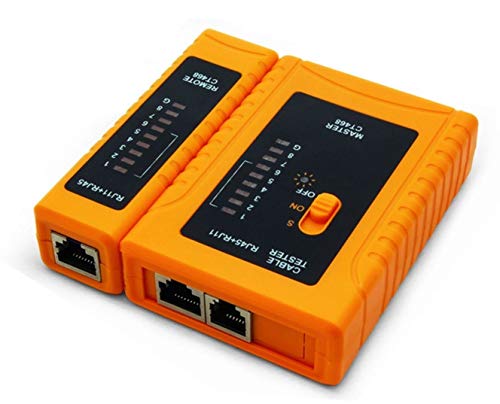
- Checks continuity, opens, shorts, and crossed pairs
- Supports RJ45 and RJ11 cable types
- Compact LED-based design for basic testing
Best For: Simple Ethernet and telephone cable checks on a budget
Best for Advanced Testing
Multifunctional Tester with Optical Power Meter

- Combines Ethernet testing with optical power and VFL tools
- Measures cable lengths from 5 to 350 meters
- Includes PoE, port flashing, tracing, NCV, and rechargeable power
Best For: Advanced home-office or small-network copper and fiber testing
PoE-Safe All-Rounder

- Tests RJ45, RJ11, and RJ12 connections
- Checks continuity and common wiring faults
- Includes PoE protection and LED indicators
Best For: Mixed Ethernet and telephone cable troubleshooting
Long-Run Tester
TESMEN TLP-528A Network Cable Tester

- Detachable remote unit tests long cable runs
- Supports RJ45 and RJ11 continuity checks
- Offers fast and slow test modes
Best For: Wall ports, structured cabling, and home-office maintenance
Shielding Check Specialist

- Checks RJ45 and RJ11 wiring faults
- Identifies shielded and unshielded cables
- Uses a detachable remote for long runs
Best For: Home-office cable repair and shielding verification
Best Overall – Klein Tools LAN Scout Jr
For home offices that need clear, detailed results, the Klein Tools LAN Scout Jr is a versatile choice among network cable testers for home offices. It tests RJ45-terminated CAT5e, CAT6, and CAT6A cables and shows pin-to-pin wiremap results on a backlit LCD.
Best For: Home-office users who want readable fault diagnostics and a compact tester for Ethernet patch cords.
Pros:
- Detects opens, shorts, miswires, split pairs, crossover faults, and shield issues.
- Backlit LCD is useful in low-light areas.
- Includes a tester, remote, and two batteries.
- Compact design weighs 4.32 ounces.
Cons:
- Designed for RJ45 data cables rather than RJ11, RJ12, or coax.
- Tone tracing requires the separately sold VDV500-123 probe.
Its straightforward three-button interface and automatic power-off make it practical for occasional troubleshooting, while its broader fault detection is useful when a simple pass/fail check is not enough.
Best Simple Tester – LAN Explorer Cable Tester
The LAN Explorer keeps network cable testing for home offices simple with single-button operation and quick LED status responses. It supports RJ11, RJ12, and RJ45 voice and data cables, including CAT3, CAT5e, CAT6, and CAT6A.
Best For: Home users who want a pocket-size tester for fast cable checks without a display-heavy interface.
Pros:
- Tests RJ11, RJ12, and RJ45 terminated cables.
- LEDs indicate pass, miswire, open fault, short fault, and shield status.
- Remote stores securely inside the tester body.
- Includes a 9V battery and low-battery indicator.
Cons:
- LED indicators provide less detail than an LCD wiremap display.
- Does not list cable-length measurement or tone-tracing functions.
For basic installation checks and troubleshooting, its compact body, integrated remote storage, and automatic power-off offer a convenient setup that is easy to keep in a desk drawer or toolkit.
Best for Wire Tracing – Klein Tools Tone and Probe Kit
The Klein Tools VDV500-705 goes beyond standard network cable testers for home offices by helping identify and trace wires. Its tone generator and probe work with open-ended, non-active low-voltage wires up to 60 volts, including Ethernet, telephone, speaker, coax, and video cabling.
Best For: Home-office projects involving unlabeled, unterminated, or hard-to-identify low-voltage wires.
Pros:
- Supports tracing across Ethernet, telephone, speaker, coax, video, and data cables.
- Includes alligator clips for unterminated wires and an RJ45-to-RJ45 test cable.
- Performs pin-to-pin wire mapping with the toner and probe.
- Probe includes a work light, volume control, and headphone jack.
Cons:
- Intended for non-active low-voltage wires below 60 volts.
- Analog tracing may require separating wires and providing proper grounding for best results.
This is a specialized pick rather than a basic Ethernet pass/fail tester. Choose it when locating a particular cable or conductor is as important as checking its wiring.
Best for Multi-Cable Testing – Klein Tools Scout Pro 3
The Klein Tools Scout Pro 3 is a flexible option for home offices using more than Ethernet. It tests RJ11/12 voice cables, RJ45 data cables, and coaxial cables, while its backlit LCD reports wiremap, cable ID, test results, and cable length.
Best For: Home offices that need one tester for Ethernet, telephone, and coax runs, including longer installed cables.
Pros:
- Measures cable length up to 2,000 feet.
- Detects opens, shorts, miswires, and split pairs.
- Includes self-storing remotes, five LANMap locators, five CoaxMap locators, and a coax adapter.
- Backlit LCD displays wiremap, cable ID, length, and test results.
Cons:
- Not designed to test PoE.
- Tracing requires the separately sold VDV500-123 analog probe.
- Its broader feature set may be more than needed for simple patch-cable checks.
With support for three connector types and included locator remotes, the Scout Pro 3 is well suited to larger home-office wiring projects where identifying runs and estimating cable length matter.
Best for Easy Setup – NOYAFA NF-8209 Network Cable Tester
For home offices that need more than a basic continuity check, the NOYAFA NF-8209 is a versatile choice among network cable testers for home offices. It combines wire mapping, length measurement, cable tracing, PoE testing, and port identification in one rechargeable kit.
Best For: Home-office users troubleshooting Ethernet runs, locating cables, and checking PoE or switch-port connections.
Pros:
- Tests open, short, miswired, and normal connections on RJ45 cables, including shielded cables.
- Measures CAT5/CAT6 cable lengths from 2.5 to 200 meters.
- Supports PoE testing, port flashing, link testing, and anti-interference tracing.
- Includes transmitter, receiver, remote adapter, accessories, carrying bag, and rechargeable transmitter battery.
Cons:
- The receiver requires a 9V battery.
- Its broad feature set may be more than needed for simple cable checks.
The NF-8209 is a strong all-around option when a home office needs cable verification and troubleshooting features in one package. Its length, PoE, and tracing functions make it especially useful for diagnosing longer or harder-to-identify runs.
Best Budget Pick – iMBAPrice RJ45 Network Cable Tester
iMBAPrice - RJ45 Network Cable Tester for Lan Phone RJ45/RJ11/RJ12/CAT5/CAT6/CAT7 UTP Wire Test Tool
Check Price On AmazonIf you mainly need straightforward cable verification, the compact iMBAPrice tester is a practical budget option among network cable testers for home offices. Its LED display automatically checks common wiring problems on Ethernet and telephone cables.
Best For: Home users who want a simple tester for RJ45, RJ11, CAT5, CAT6, or CAT7 cable checks.
Pros:
- Automatically tests continuity, open, shorted, and crossed wire pairs.
- Uses visible LEDs to show cable status.
- Works with RJ45 LAN and RJ11 telephone cables, including CAT5 through CAT7 connections.
- Also supports basic two-wire line detection and ringing-signal checks.
Cons:
- A 9V battery is required but is not included.
- It does not provide the length, PoE, or advanced tracing functions found on more feature-rich testers.
The iMBAPrice is best suited to basic home-office wiring checks rather than detailed network troubleshooting. Its simple LED-based operation can be enough for confirming whether a patch cable is wired correctly.
Best for Advanced Testing – Multifunctional Tester with Optical Power Meter
For users managing both copper and fiber connections, this multifunctional model expands beyond typical network cable testers for home offices. It combines wire mapping, cable-length measurement, PoE detection, port flashing, tracing, optical power measurement, VFL, and NCV detection.
Best For: Advanced home-office, lab, or small-network setups that may involve Ethernet, telephone, and fiber maintenance.
Pros:
- Measures RJ45 cable lengths from 5 to 350 meters and checks opens, shorts, crossed pairs, and miswiring.
- Provides digital and analog tracing modes, plus PoE detection and port flashing.
- Includes an optical power meter with support for 10 wavelengths and a three-mode visual fault locator.
- Features a backlit color display, adjustable receiver sensitivity, NCV detection, and a rechargeable battery.
Cons:
- Its professional feature set may be unnecessary for basic home Ethernet testing.
- Fiber functions require compatible FC, SC, or ST adapters and related equipment.
This tester is the most capable choice of the three for mixed copper-and-fiber work. Its extended measurement range and optical tools offer useful flexibility, though basic users may prefer a simpler tester.
PoE-Safe All-Rounder – RJ45/RJ11 Cable Tester
For shoppers comparing network cable testers for home offices, this model is a versatile choice when you need to check both Ethernet and telephone wiring. It supports RJ45, RJ11, and RJ12 connections across several Cat cable types, with LED-based testing for common wiring faults.
Best For: Home offices and small workspaces that need one tester for Ethernet, telephone, and PoE-related troubleshooting.
Pros:
- Supports RJ45, RJ11, and RJ12 cables, including Cat5 through Cat7 UTP.
- Checks continuity, open circuits, shorts, and miswiring.
- PoE protection and anti-burn design help reduce testing-related damage risks.
- Compact plug-and-test design with clear LED wiring indicators.
Cons:
- Battery-powered operation requires a suitable battery.
- Its feature set is focused on basic cable testing rather than advanced network diagnostics.
This is a practical general-purpose tester for routine home-office wiring checks, especially if your setup includes both Ethernet and telephone cables. Its broad compatibility and PoE protection make it a convenient troubleshooting tool.
Long-Run Tester – TESMEN TLP-528A Network Cable Tester
Among network cable testers for home offices, the TESMEN TLP-528A stands out for its detachable remote unit and selectable fast or slow test modes. It is designed for checking RJ45 and RJ11 cables while also helping with connector crimping quality control.
Best For: Home-office users testing wall ports, longer cable runs, and both Ethernet and telephone lines.
Pros:
- Supports RJ45 and RJ11 cables and checks continuity and shielding status.
- Detachable main and remote units can test opposite ends of long runs.
- Fast and slow modes provide flexible testing.
- Includes a storage box, manual, and two AAA batteries.
Cons:
- It does not list RJ12 support in the supplied specifications.
- Its functions center on continuity, shielding, and crimping checks rather than broader network analysis.
The TLP-528A is a sensible pick when cable runs disappear into walls or structured cabling. Its remote unit and included batteries make it convenient for setup and maintenance tasks without adding much bulk.
Shielding Check Specialist – HT812A Ethernet Cable Tester
This HT812A is a useful option for shoppers seeking network cable testers for home offices, particularly when checking shielded and unshielded runs. It supports RJ45 Ethernet cables and RJ11 telephone lines, with separate master and remote units for testing longer connections.
Best For: Home repairs and office installations where identifying wiring faults and UTP versus FTP/STP cable status matters.
Pros:
- Supports Cat5 through Cat7 RJ45 cables and RJ11 telephone lines.
- Detects continuity, shorts, opens, miswiring, and shielding status.
- Fast and slow scan modes help inspect wiring more precisely.
- Split design supports testing long runs and wall-mounted ports.
Cons:
- The supplied notes do not describe advanced network performance testing.
- It is battery powered and relies on two AAA batteries.
Choose the HT812A if cable type and shielding status are as important to you as basic continuity. Its remote unit and clear LEDs make it well suited to diagnosing installed runs in a home office or small network.
How We Picked the Best Network Cable Testers for Home Offices
We focused on the features that matter most in a home-office troubleshooting kit: dependable continuity testing, clear result displays, useful remote units, connector compatibility, portability, and ease of operation. We also considered whether each tester supports common cable categories such as Cat5e, Cat6, Cat6a, and Cat7, along with RJ45 network connections and, where applicable, RJ11 or RJ12 telephone wiring.
More advanced models were assessed for practical extras, including PoE detection, cable-length measurement, tone generation, optical power measurement, and protection against incorrect or powered connections. A basic tester may be sufficient for occasional checks, while installers and technically minded users may benefit from broader diagnostic capabilities.
Quick Comparison
For straightforward Ethernet continuity checks, compact RJ45 testers are usually the most affordable and easiest to use. Models with a detachable remote are particularly useful for testing installed cables that run between rooms. Wire tracer kits add a tone generator and probe, helping identify one cable among several bundled or unlabeled lines.
If your home office uses powered network equipment, consider a tester with PoE support or PoE protection. Cable-length testing can help locate breaks and estimate the distance to a fault, while an optical power meter is intended for more specialized fiber-related work rather than ordinary copper Ethernet checks.
Key Buying Factors for Network Cable Testers for Home Offices
Connector and Cable Compatibility
Confirm that the tester supports the connectors and cable types you actually use. RJ45 is standard for Ethernet, while RJ11 and RJ12 support telephone wiring. Compatibility with Cat5e, Cat6, Cat6a, and Cat7 generally refers to testing the wiring and continuity rather than certifying full network performance at every speed.
Test Functions
Look for LED or screen-based wire mapping, open and short detection, crossed-pair identification, and continuity testing. PoE detection is useful when checking cables connected to switches, access points, cameras, or other powered devices. Length testing and tone tracing are valuable upgrades for diagnosing harder-to-find faults.
Ease of Use and Safety
A clear display, simple controls, automatic scanning, and a remote that stores securely in the kit make routine testing faster. If you may test live network runs, choose a model with appropriate PoE protection and follow the manufacturer’s connection instructions. No basic tester replaces proper electrical safety practices.
Who Should Buy Which Network Cable Testers for Home Offices?
Choose a basic RJ45 tester if you need an inexpensive tool for checking patch cables and occasional home-office wiring. Select a tester with a remote for permanent in-wall runs. A PoE-capable model is better for offices using powered switches, wireless access points, or security cameras. Pick a wire tracer when identifying cables in a crowded panel is a regular task, and consider a feature-rich tester with length or optical measurements if you manage a larger, more complex network.