Choosing a podcast microphone preamp for Mac comes down to clean gain, low noise, and simple compatibility with your recording setup. The best options make your voice sound polished without adding technical headaches.
Whether you want a compact XLR-to-USB-C interface, a feature-rich podcast rig, or a quiet inline booster for a dynamic mic, this roundup focuses on practical gear that works well for Mac creators in 2026.
Best 10 Podcast Microphone Preamp for Mac Picks for 2026
Studio Starter
Focusrite Scarlett 2i2 4th Gen for Mac

- Two ultra-low-noise mic preamps
- Auto Gain, Clip Safe, and Air mode
- Works with Mac OS plus included software
Best For: Mac podcasters who want an easy all-in-one interface
Simple Gain Booster
Compact Mic Preamp for Vocal Recording

- 20dB balanced gain for cleaner signal
- 48V power supports dynamic and condenser mics
- Compact metal case for portable setups
Best For: Users who want a small, low-noise gain booster
High-Gain Budget Pick
RO03 Mic Preamp with Type-C Power

- Listed EIN of -120dB for lower noise
- 19~66dB gain range with built-in 48V
- Type-C powered and portable for mobile use
Best For: Budget users who need a portable low-noise mic preamp
Compact Creator Interface
MAONO PS22 Lite USB Audio Interface

- 56 dB preamp with 48V phantom power
- 24-bit/192kHz recording with loopback
- Mac-compatible, plug-and-play design
Best For: Podcasters and voice actors needing a simple Mac interface
Studio-Grade Podcast Interface
Antelope Audio Zen Quadro USB-C Interface

- Four mic preamps with up to +75 dB gain
- 130 dB dynamic range and Antelope clocking
- Built-in effects plus dual USB-C
Best For: Multi-mic Mac podcasts that need studio-grade gain and processing
All-in-One Podcast Mixer
MAONO MaonoCaster E2 Gen2 Bundle

- Dual XLR inputs with up to 60 dB gain
- 8 custom sound effects and pitch controls
- Loopback, mute, monitoring, and 8-hour battery
Best For: Mac podcasters who want a feature-rich mixer bundle
Portable USB Audio Starter
- Transparent Crystal Preamp for microphones
- 48kHz USB recording with zero-latency monitoring
- One combo XLR/Line input plus one instrument input
Best For: Solo podcasting and simple Mac recording setups
Wireless Podcast Voice Hub

- Wireless, USB, and XLR connection options
- Cardioid dynamic capsule with noise cancellation
- MAONO Link software works with Mac and Windows
Best For: Creators who want a flexible mic for podcasting and streaming
Dual-Input Podcast Interface
- Two combo XLR/Line/Instrument inputs
- Crystal Preamps for clean microphone capture
- Zero-latency monitoring with Mac support
Best For: Two-person podcasting and compact Mac recording
Studio Starter – Focusrite Scarlett 2i2 4th Gen for Mac
If you want a podcast microphone preamp for Mac that also doubles as a full interface, the Scarlett 2i2 4th Gen is a practical all-in-one pick. It brings two ultra-low-noise mic pres, 24-bit/192kHz recording, Auto Gain, Clip Safe, and Air mode, making it easy to get clean voice tracks with very little setup.
Best For: Mac users who want a simple, studio-quality interface for podcasting, streaming, and voice recording.
Pros:
- Two 4th Gen mic preamps with a high 120dB dynamic range
- Auto Gain helps set levels quickly, and Clip Safe helps prevent clipping
- Air mode can add extra presence to vocal recordings
- Works with Mac OS and includes recording software plus plugins
Cons:
- It is a full audio interface, so it may be more than you need if you only want gain boosting
- Only two input channels
Overall, this is a strong choice if you want dependable microphone handling on a Mac and also expect to expand into music or streaming. Its bundled software and streamlined controls make it especially friendly for first-time podcast setups.
Simple Gain Booster – Compact Mic Preamp for Vocal Recording
This microphone preamp is aimed at users who need straightforward gain and low-noise operation without a lot of extras. For a podcast microphone preamp for Mac setup, it can be used as a compact inline-style solution for dynamic or condenser microphones, with 20dB gain and 48V power support.
Best For: Budget-minded users who want a compact mic preamp for recording, podcasting, or live streaming.
Pros:
- 20dB clean, transparent gain from a balanced amplification circuit
- Supports both dynamic and condenser microphones with 48V power
- Low-noise, fully balanced design is intended to minimize added coloration
- Compact and lightweight metal housing for easy carrying
Cons:
- Product details do not specify Mac compatibility
- Fewer advanced controls than a full audio interface
If your priority is a small, simple gain stage rather than a feature-heavy interface, this model is worth a look. It focuses on clean amplification and portability, which suits basic home podcast setups where space and simplicity matter.
Portable USB-C Link – Shure MVX2U for XLR Mics
The Shure MVX2U is a smart option if you need a podcast microphone preamp for Mac that turns an XLR mic into a USB-C recording source. It offers up to +60 dB clean gain, 48V phantom power, and onboard processing like Auto Level, a Real-Time Denoiser, and a Digital Popper Stopper for controlled vocal recordings.
Best For: Podcasters and streamers who want portable XLR-to-USB-C recording on Mac and other devices.
Pros:
- XLR-to-USB-C interface with Apple MFi certification
- Onboard DSP includes Auto Level, denoiser, and pop filtering
- Up to +60 dB clean gain with 48V phantom power
- Works across Mac, iOS, Windows, Android, desktop, tablet, and phone setups
Cons:
- Single-channel design only
- Requires the MOTIV apps for full control of settings and processing
For creators who value portability and built-in processing, this is one of the most versatile choices in the group. It is especially useful when you want consistent voice quality without relying heavily on external software adjustments.
High-Gain Budget Pick – RO03 Mic Preamp with Type-C Power
If you are shopping for a podcast microphone preamp for Mac on a tighter budget, the RO03 focuses on gain, portability, and low noise. It offers a redesigned 19~66dB gain range, Type-C power, built-in 48V, and support for dynamic, condenser, and ribbon microphones, with the notes specifically recommending TRS line connection to keep noise low.
Best For: Budget podcast and voice-recording setups that need a portable, low-noise preamp with built-in phantom power.
Pros:
- Improved low-noise design with listed EIN of -120dB
- 19~66dB gain range is described as fully achievable in real use
- Type-C powered with built-in 48V for portable recording
- Supports dynamic, condenser, ribbon microphones, and instruments
Cons:
- The two input ports cannot work simultaneously
- Best results depend on using the recommended TRS line input connection
The RO03 is best viewed as a value-focused preamp for users who care most about practical gain and noise control. It is less about premium convenience and more about giving you a usable signal path for recording on the go or in a simple home setup.
Compact Creator Interface – MAONO PS22 Lite USB Audio Interface
If you’re looking for a podcast microphone preamp for Mac that also handles music and streaming, the MAONO PS22 Lite is a practical all-in-one option. It supports Mac, offers up to 56 dB of preamp gain with 48V phantom power, and includes direct monitoring plus routing software for a more flexible home-studio setup.
Best For: Podcasters, voice actors, and beginners who want a compact Mac-compatible interface with solid mic gain.
Pros:
- Up to 56 dB of preamp gain with 48V phantom power for condenser and dynamic mics
- 24-bit/192kHz recording and 106dB dynamic range for detailed capture
- Works with Mac and supports plug-and-play use
- Includes ProStudio routing software, loopback, and direct monitoring
Cons:
- Designed as a compact interface, so it may not suit larger multi-mic studio setups
- Advanced routing still depends on software setup for best results
Overall, the PS22 Lite is a strong pick if you want a straightforward Mac-ready interface that gives podcast voices enough gain, monitoring control, and recording quality without adding complexity.
Studio-Grade Podcast Interface – Antelope Audio Zen Quadro USB-C Interface
For a podcast microphone preamp for Mac that’s built for higher-end recording, the Antelope Audio Zen Quadro stands out with four discrete studio-grade mic preamps and up to +75 dB of clean gain. It also adds pro conversion, clocking, and built-in effects, making it a serious choice for round-table podcasts and polished production workflows.
Best For: Podcasters and creators who want four-mic recording, strong gain, and studio-style processing on Mac.
Pros:
- Four discrete mic preamps with up to +75 dB of clean gain
- Up to 130 dB dynamic range conversion and Antelope clocking
- Includes 93 modeled analog effects, with 37 available at no extra step
- Dual USB-C and bus-powered operation for flexible setups
Cons:
- More advanced than a basic podcast preamp, so it may be more than casual users need
- Features and software behavior can vary by operating system
The Zen Quadro is best if your Mac podcast setup needs more than a simple mic boost. Its extra headroom, multi-mic support, and onboard processing make it well suited to creators who want a cleaner, more controlled studio workflow.
All-in-One Podcast Mixer – MAONO MaonoCaster E2 Gen2 Bundle
If you want a podcast microphone preamp for Mac with more creative controls built in, the MAONO MaonoCaster E2 Gen2 is an all-in-one bundle designed for podcasting, streaming, and studio recording. It offers dual XLR combo inputs, up to 60 dB of gain, and plug-and-play compatibility with Mac and Windows, so it can serve as the center of a simple co-host or solo show setup.
Best For: Podcasters who want an easy Mac-compatible mixer with sound effects, loopback, and portable battery power.
Pros:
- Two XLR combo inputs with up to 60 dB gain for dynamic microphones
- 8 customizable sound effect buttons for intros and show personality
- Loopback, mute, monitoring, and pitch effects for live production control
- Built-in battery offers up to 8 hours of use
Cons:
- More of a podcast mixer bundle than a pure preamp-only interface
- Sound effects and extra controls may be unnecessary for minimal setups
The E2 Gen2 makes sense if you want more than just mic gain from your Mac setup. It combines preamp power, live controls, and portable operation in one unit, which is helpful for creators who value convenience and on-the-fly production features.
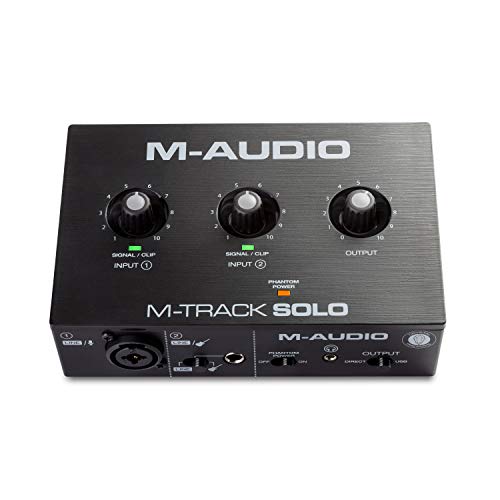
Portable USB Audio Starter – M-AUDIO M-Track Solo for Mac
If you need a podcast microphone preamp for Mac that keeps setup simple, the M-AUDIO M-Track Solo is a practical entry-level interface. It gives you a transparent Crystal Preamp for microphones, 48kHz recording, and direct USB monitoring, so you can move from recording to playback without extra fuss.
Best For: Solo podcasters, voice recording, and Mac users who want a compact USB interface with basic mic and instrument inputs.
Pros:
- Transparent Crystal Preamp is designed to get the best out of microphones, including condenser mics.
- USB/Direct switch supports zero-latency monitoring.
- Includes one combo XLR/Line input with phantom power plus one Line/Instrument input.
- Works with Mac or PC and includes MPC Beats software.
Cons:
- Only one mic input, so it is not ideal for two-person podcasting.
- Maximum sample rate is 48kHz, which is basic for this class.
- Monitoring uses a 1/8″ headphone output rather than a larger connector.
Overall, this is a straightforward choice if you want a compact Mac-compatible interface that handles podcast vocals cleanly and keeps the signal path simple.
Wireless Podcast Voice Hub – MAONO PD200W Hybrid Mic
If you want a podcast microphone preamp for Mac-like flexibility in a mic setup, the MAONO PD200W stands out because it works wirelessly, by USB, or through XLR. Its dynamic capsule, cardioid pickup, and MAONO Link software make it a strong pick for creators who want control over voice tone and noise reduction.
Best For: Podcasters, streamers, and voice creators who want a versatile mic that can connect wirelessly, via USB, or through XLR.
Pros:
- Three connection modes: wireless, USB, and XLR.
- Dynamic 30mm capsule with cardioid pickup for focused vocal capture.
- Three-stage noise cancellation helps reduce background noise and room echo.
- MAONO Link software supports Mac and Windows for tuning EQ, reverb, and presets.
Cons:
- It is a microphone, not a standalone audio interface or traditional preamp.
- Wireless operation depends on battery life and range.
- Camera/Lightning accessories are sold separately for some use cases.
This is best if you want a flexible all-in-one voice solution for Mac, especially when you value wireless convenience and onboard sound shaping.
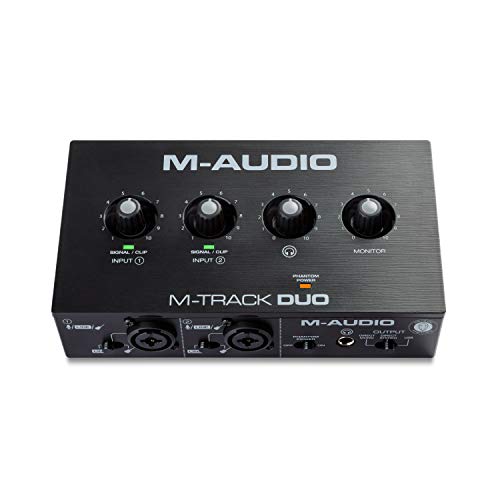
Dual-Input Podcast Interface – M-AUDIO M-Track Duo for Mac
For anyone shopping for a podcast microphone preamp for Mac with room to grow, the M-AUDIO M-Track Duo is a simple two-channel interface. It offers dual combo XLR/Line/Instrument inputs, Crystal Preamps, and zero-latency monitoring, making it a practical step up for interviews, dual-mic shows, and basic home recording.
Best For: Two-person podcasts, Mac recording sessions, and users who want dual mic inputs in a compact interface.
Pros:
- Two combo XLR/Line/Instrument inputs support multiple recording sources.
- Transparent Crystal Preamps are built for clean microphone capture.
- USB/Direct switch allows zero-latency monitoring.
- Compatible with Mac or PC and includes MPC Beats software.
Cons:
- Maximum sample rate is 48kHz.
- Monitoring uses a 1/4″ headphone output and 1/4″ stereo outputs, which may not suit every setup.
- It is still a basic 2-channel interface rather than a feature-heavy production unit.
If your main goal is clean, dependable mic preamps on a Mac with support for two sources, this interface gives you the essentials without overcomplicating the setup.
How We Picked the Best Podcast Microphone Preamp for Mac
We focused on preamps and audio interfaces that suit Mac users who need dependable vocal capture for podcasting, streaming, and voice recording. Priority went to clean preamp gain, low self-noise, USB-C or Mac-friendly connectivity, phantom power where needed, and straightforward software or driver support.
We also considered how each option fits real-world workflows: solo creators, two-person shows, mobile recording, and users upgrading from a basic USB mic. A good Podcast Microphone Preamp for Mac should improve audio quality without forcing a complicated studio setup.
Quick Comparison
Simple XLR-to-USB-C adapters and compact interfaces are best for minimal setups and portable recording. Dual-input interfaces make sense for co-hosts or guests, while mixer-style podcast bundles add routing flexibility and built-in show control. If you already have a mic you like, a low-noise inline preamp can be the most affordable way to add gain and clarity.
Key Buying Factors for Podcast Microphone Preamp for Mac
Gain and Noise Performance
Look for enough clean gain to drive dynamic microphones without hiss or distortion. If your mic needs a lot of level, prioritize a preamp known for low EIN and quiet performance.
Mac Compatibility
Check for class-compliant USB support, Apple MFi certification where applicable, and software that runs smoothly on macOS. USB-C is convenient, but stable drivers and simple plug-and-play behavior matter more than the connector alone.
Inputs, Outputs, and Monitoring
Match the number of XLR inputs to your format. Also consider direct monitoring, headphone controls, loopback, and line inputs if you plan to stream, record guests, or connect external sources.
Phantom Power and Mic Type
Condenser microphones need 48V phantom power; many dynamic mics do not. If you use ribbon microphones, verify that the preamp is safe for them and offers the right gain structure.
Who Should Buy Which Podcast Microphone Preamp for Mac?
Solo podcasters who want the simplest upgrade should choose a compact interface or XLR-to-USB-C option. Co-hosted shows and interview setups benefit from dual-input interfaces or podcast mixers. Mac users with gain-hungry dynamic microphones should look closely at ultra-low-noise preamps or booster-style solutions. If you want the most flexibility for future expansion, a higher-end interface with multiple preamps and stronger routing options is the safest long-term pick.