The best portable field recorders make it easier to capture clean audio away from a studio, whether you are recording interviews, live music, film dialogue, nature sound, or podcast material.
This roundup compares 10 options across compact stereo recorders, expandable multi-input models, 32-bit float devices, and practical recording bundles so you can choose the right fit for your workflow.
Best 10 Portable Field Recorders Picks for 2026
Professional Pick

- 32-bit float recording for clip-resistant capture
- Dual locking XLR/TRS inputs
- Low-noise preamps and flexible power options
Best For: Filmmakers, musicians, and professional location recordists
Long-Battery Value

- Up to 68 hours of recording
- 136GB total storage capacity
- Voice activation and automatic noise reduction
Best For: Lectures, meetings, interviews, and everyday voice notes
Versatile Production Choice

- Four-track, 32-bit float recording
- Built-in stereo mics and two XLR/TRS inputs
- USB-C recording or streaming with SD backup
Best For: Musicians, podcasters, filmmakers, and live performances
Compact Simplicity
Zoom H1essential Stereo Recorder

- Lightweight 3.2-ounce design
- 32-bit float stereo recording
- USB microphone mode for computers and mobile devices
Best For: Portable stereo recording and simple creator workflows
Most Versatile

- Three built-in mics with nine recording patterns
- 32-bit float recording reduces gain adjustments
- USB microphone mode with simultaneous SD backup
Best For: Flexible interviews, podcasts, music, and field recording
Best Accessory Bundle
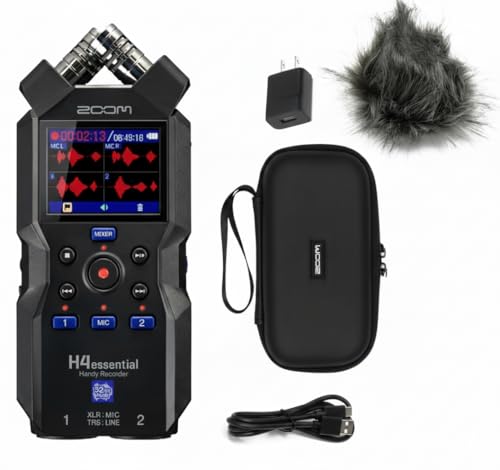
- Includes windscreen, case, adapter, and USB-C cable
- 32-bit float recording supports worry-free levels
- XLR/TRS and stereo mini-jack inputs
Best For: Mobile creators using external microphones and line sources
Best Manual Control

- Large 19.4mm X/Y microphones for detailed stereo sound
- Dedicated gain knobs provide hands-on level control
- Up to four tracks and 192kHz WAV recording
Best For: Filmmakers and musicians needing detailed multi-track capture
Best Multitrack Pick

- Four-track recording with bounce and undo
- 32-bit float capture without gain adjustments
- Battery or USB-C operation with combo inputs
Best For: Mobile music demos and layered songwriting
Best Pro-Ready Option

- Up to six tracks plus a stereo mix
- Microphones handle up to 140 dB SPL
- 44.1–192 kHz recording and 15-hour battery life
Best For: Film, music, and demanding location recording
Best Compact Bundle
Zoom H1essential Recorder Bundle

- Includes lav mic, windscreen, card, and batteries
- 32-bit float recording for easier level management
- Supports interviews, mono mode, and pre-record
Best For: Portable interviews, podcasts, and storytelling
Professional Pick – Zoom F3 Field Recorder
The Zoom F3 is one of the more purpose-built portable field recorders for filmmakers, musicians, and location recordists. Its 32-bit float recording, dual locking inputs, and ultra-low-noise preamps are designed to help preserve clean audio when recording conditions change quickly.
Best For: Run-and-gun filmmaking, professional location recording, and complex microphone setups.
Pros:
- 32-bit float recording helps capture quiet dialogue and sudden peaks without constant level adjustments.
- Dual locking XLR/TRS inputs help keep connected microphones secure.
- Ultra-low-noise preamps support clean recordings in unpredictable environments.
- Runs on two AA batteries and supports standalone or USB workflows.
Cons:
- Designed around external microphones rather than casual built-in-mic recording.
- The compact 2-inch screen may feel limited for detailed menu work.
The F3 is a strong choice when recording reliability matters more than having a broad set of consumer-friendly extras. Its focused design suits serious field audio and production work.
Long-Battery Value – Tonfarb A20 Voice Recorder
The Tonfarb A20 is a practical option among portable field recorders for lectures, meetings, interviews, and everyday voice notes. It combines one-click recording, voice activation, automatic noise reduction, and substantial storage in a pocket-friendly design.
Best For: Students, journalists, meeting attendees, and anyone needing extended voice recording.
Pros:
- Supports 1536 kbps PCM recording with dual noise-reduction microphones.
- Includes 8GB built-in storage plus a 128GB TF card for up to 136GB total storage.
- Up to 68 hours of continuous recording on a charge.
- One-click recording, USB-C file transfers, voice activation, and password protection add convenience.
Cons:
- Its built-in microphones and MP3-focused design are less suited to professional multi-mic production.
- The 1.44-inch display is compact.
Choose the A20 if storage capacity and battery endurance are higher priorities than advanced inputs. Its simple controls make it especially convenient for long classes, interviews, and meetings.
Versatile Production Choice – Zoom H4 Essential Recorder
The Zoom H4 Essential is a versatile entry in portable field recorders for musicians, podcasters, filmmakers, and live-performance capture. It combines built-in stereo microphones, four-track recording, 32-bit float audio, and two XLR/TRS inputs for flexible production setups.
Best For: Creators who need built-in stereo recording plus external microphones, instruments, or mixer connections.
Pros:
- 32-bit float recording helps reduce concerns about distorted takes.
- Built-in stereo microphones and two XLR/TRS inputs support varied setups.
- Four-track recording helps capture larger projects.
- USB-C supports recording or streaming to a phone, tablet, or computer while saving to an SD card.
Cons:
- At 243 grams, it is heavier than the smaller Zoom F3 and H1essential.
- It requires two AA batteries and has a relatively compact 2-inch screen.
The H4 Essential offers a useful middle ground between a simple handheld recorder and a more involved production rig. It is particularly appealing when you want built-in microphones without giving up external-input flexibility.
Compact Simplicity – Zoom H1essential Stereo Recorder
The Zoom H1essential is a compact choice among portable field recorders for straightforward stereo capture. Its X/Y microphones, 32-bit float recording, SD-card storage, and USB-C microphone mode make it useful for quick recordings at home or on location.
Best For: Creators who want a lightweight stereo recorder for basic field audio, spoken content, or computer and mobile use.
Pros:
- 32-bit float recording avoids the need to set gain manually.
- X/Y microphones capture stereo audio up to 120 dB SPL.
- Records up to 96kHz to an SD card.
- Works as a USB microphone with PC, Mac, iOS, or Android devices and includes audio guidance.
Cons:
- It has no headphone jack for direct monitoring.
- It relies on built-in stereo microphones rather than external mic inputs.
- The supplied notes list a 90-day limited warranty.
At just 3.2 ounces, the H1essential is easy to carry and quick to operate. It is best suited to uncomplicated stereo recording rather than expandable multi-microphone production.
Most Versatile – Zoom H2 Essential
The Zoom H2 Essential is a flexible choice for portable field recorders, combining three built-in microphones with nine selectable recording patterns. Its 32-bit float recording, USB microphone mode, and compact 6.72-ounce design make it practical for interviews, podcasts, music, and location sound.
Best For: Journalists, podcasters, musicians, and field recordists who need adaptable mono, stereo, or surround recording.
Pros:
- Three microphones and nine recording patterns support a wide range of applications.
- 32-bit float recording helps capture clip-free audio without constant gain adjustments.
- Can function as a USB microphone while recording a backup to an SD card.
- Offers audible menu navigation in seven languages for improved accessibility.
Cons:
- Uses two AA batteries rather than a built-in rechargeable battery.
- Its 1.3-inch screen is relatively small for navigating settings.
The H2 Essential stands out when versatility and simple operation matter most. Bluetooth timecode support for multiple units adds useful flexibility for synchronized multi-recorder setups.
Best Accessory Bundle – Zoom H4essential 4-Track
The Zoom H4essential is a practical portable field recorder bundle for users who want recording flexibility plus useful location accessories. It combines 32-bit float capture with XLR/TRS combo inputs, a stereo mini-jack input, and an accessory pack containing a windscreen, case, adapter, and USB-C cable.
Best For: Filmmakers, musicians, and mobile creators who need external-input connectivity and a ready-to-use accessory kit.
Pros:
- 32-bit float recording helps prevent clipping without repeated gain adjustments.
- XLR/TRS combo jacks accommodate microphones and line-level sources.
- Includes a hairy windscreen, padded shell case, AC adapter, and USB-C cable.
- Offers up to 20 hours of continuous recording with lithium batteries.
Cons:
- The supplied details do not specify the bundle’s total weight.
- The accessory pack adds value but may be unnecessary for users who already own field gear.
Choose the H4essential when input flexibility and included protection are more important than the smallest possible setup. Its full-color 2-inch LCD also supports straightforward monitoring and menu navigation.
Best Manual Control – Zoom H5 Studio
The Zoom H5 Studio is a strong option among portable field recorders for filmmakers and musicians who want hands-on control. Its large 19.4mm X/Y microphones, dedicated gain knobs, 32-bit float recording, and multi-track capabilities are suited to detailed location and studio-style capture.
Best For: Filmmakers and musicians who need large stereo microphones, direct level control, and multiple simultaneous tracks.
Pros:
- Large 19.4mm X/Y microphones are designed for rich, detailed stereo sound.
- Dedicated gain knobs make quick, precise level adjustments easy.
- Records up to four tracks simultaneously at up to 192kHz in WAV format.
- Includes two XLR/TRS inputs and USB audio-interface functionality.
Cons:
- At 14.4 ounces, it is heavier than the H2 Essential.
- Requires four AA batteries and lists up to 15 hours of digital recording time.
The H5 Studio is the best fit when physical controls and expanded recording capability take priority over minimum weight. Its 32-bit float mode adds protection against clipping, while the large stereo microphones target higher-quality on-location sound.
Best Multitrack Pick – Zoom R4 Multi-Track Recorder
The Zoom R4 is a practical choice among portable field recorders for musicians who want to capture ideas, layer parts, and build arrangements without bringing a computer. Its four-track workflow, built-in microphones, effects, and battery or USB-C power make it flexible for mobile sessions.
Best For: Musicians who want portable multitrack recording, layering, and quick demos.
Pros:
- Records, layers, and bounces up to four tracks with undo support.
- 32-bit float recording helps avoid clipping without manual gain adjustments.
- XLR/TRS combo inputs support microphones, instruments, keyboards, and other sources.
- Includes more than 80 rhythm patterns and can operate on four AA batteries or USB-C.
Cons:
- Its four-track design is less suitable for larger multitrack projects.
- The built-in microphone is stereo rather than a dedicated directional field microphone.
The R4 stands out when portability and creative layering matter more than extensive track counts. It also doubles as a 32-bit float 2-in/2-out USB audio interface for computer or smartphone use.
Best Pro-Ready Option – Zoom H6 Studio Handy Recorder
The Zoom H6 Studio is one of the more capable portable field recorders in this lineup, offering up to six individual tracks plus a stereo mix. Its high sound-pressure handling, selectable recording rates, and look-ahead limiters suit demanding music, filmmaking, and location work.
Best For: Filmmakers, musicians, and field recordists who need multitrack flexibility and wide recording specifications.
Pros:
- Records up to six individual tracks plus a stereo mix in 32-bit float.
- 19.4mm microphones handle sound levels up to 140 dB SPL.
- Look-ahead limiters help prevent distortion before overloads occur.
- Supports recording from 44.1 to 192 kHz and offers up to 15 hours on four AA batteries.
Cons:
- At 1.05 pounds, it is heavier than simpler handheld recorders.
- Its larger dimensions may be less convenient for minimal everyday carry.
The H6 Studio is the strongest fit here for users who need more tracks and greater control over demanding recordings. It is particularly well suited to location sessions where clean capture and extended battery life are priorities.
Best Compact Bundle – Zoom H1essential Recorder Bundle
The Zoom H1essential bundle is a straightforward entry point for portable field recorders, especially for interviews, podcasts, and quick storytelling sessions. It combines the recorder with a lavalier microphone, memory card, furry windscreen, batteries, and cloth, reducing the need to buy basic accessories separately.
Best For: Podcasters, interviewers, and storytellers who want a compact recorder with useful starter accessories.
Pros:
- Includes a 32GB microSDHC card, lavalier condenser microphone, windscreen, and four AAA batteries.
- 32-bit float recording reduces the need to adjust levels during takes.
- Onboard X/Y microphones capture sound up to 120 dB SPL.
- Offers overdubbing, pre-record, auto record, playback-speed adjustment, and mono mode.
Cons:
- Its 120 dB SPL microphone handling is below the H6 Studio’s 140 dB SPL rating.
- The bundle is oriented toward compact recording rather than multitrack music production.
For buyers who want a simple, ready-to-use setup, the included accessories add practical value. The H1essential is especially convenient for tripod interviews and on-the-go mono recording.
How We Picked the Best Portable Field Recorders
We focused on recording flexibility, microphone and input options, portability, file-handling features, ease of use, and suitability for common field applications. The selection includes simple stereo recorders for beginners, XLR-equipped models for microphones and instruments, and multitrack options for more involved music or production work.
We also considered features that matter outside a controlled studio, including 32-bit float recording, onboard microphones, USB connectivity, storage support, accessory bundles, and controls that can be operated quickly while recording.
Quick Comparison
| Best For | Look For |
|---|---|
| Interviews and casual notes | Compact design, simple controls, built-in stereo microphones |
| Filmmaking and dialogue | XLR inputs, low-noise preamps, 32-bit float, headphone monitoring |
| Music and instruments | Combo inputs, multitrack recording, overdubbing, effects, and strong input gain control |
| Podcasting and USB workflows | USB microphone or audio-interface functionality and reliable monitoring |
| Long-form voice recording | Large storage capacity, battery life, playback controls, and straightforward file management |
Key Buying Factors for Portable Field Recorders
Inputs and Microphone Options
A built-in X/Y or similar stereo microphone is convenient for ambient sound, meetings, and quick musical sketches. Choose XLR or XLR/TRS combo inputs when you need external microphones, mixers, instruments, or professional-level connections. Check the number of inputs if you plan to record several sources at once.
32-Bit Float Recording
32-bit float can provide greater protection against poorly judged recording levels, which is especially useful for unpredictable dialogue, live events, and film work. It does not replace good microphone placement, and compatible editing software is still needed to adjust levels during post-production.
Track Count and Workflow
Basic stereo recorders are faster to operate and easier to carry. Multitrack models are better for layering instruments, recording separate sources, or building complete arrangements without a computer. Consider whether you need overdubbing, effects, bouncing, or isolated tracks before paying for additional complexity.
Storage, Power, and Accessories
Confirm the supported card type and expected recording time for your preferred format. Battery life matters for outdoor sessions, while a windscreen, lavalier microphone, case, memory card, or accessory pack can reduce additional setup costs. Headphone monitoring is valuable for catching cable, handling, and background-noise problems immediately.
Who Should Buy Which Portable Field Recorders?
Choose a compact stereo model if you want an uncomplicated recorder for interviews, lectures, travel, rehearsal ideas, or ambient sound. These are generally the easiest options for beginners and mobile creators.
Choose an XLR-equipped 32-bit float recorder if you record film dialogue, professional interviews, podcasts, or music with external microphones. It offers more connection flexibility and better protection when sound levels change unexpectedly.
Choose a multitrack recorder if you are a musician who wants overdubbing, separate tracks, effects, or a more self-contained production setup. These models trade some simplicity for much broader creative control.
Choose a bundle when you need to start recording immediately and the included microphone, memory card, wind protection, or accessory kit matches your use case. Otherwise, compare the base recorder first and add only the accessories you actually need.