The best portable multitrack recorders let you capture ideas, rehearsals, interviews, and complete productions without relying on a computer. The right model depends on how many sources you record, where you work, and how much hands-on control you want.
This roundup compares compact multitrack studios, podcast-focused recorders, and professional field units so you can choose a practical fit for your workflow and budget.
Best 10 Portable Multitrack Recorders Picks for 2026
Touchscreen Studio

- Eight-track recording with touchscreen editing
- Built-in drum loops, synths, MIDI, and effects
- USB-C interface with battery operation
Best For: Computer-free songwriting and portable music production
Classic Portastudio

- Eight-track recording with two-input simultaneous capture
- Built-in stereo condenser microphones
- Onboard editing, mastering, tuner, and metronome
Best For: Straightforward dedicated recording and songwriting
Clip-Free Mixer

- Ten-track recording plus stereo mix to SD
- 32-bit float capture without gain setting
- Mixer controls, effects, MIDI, and sound pads
Best For: Live performers, bands, streamers, and podcasters
Pocket Songwriter

- Six-track recording with two-track simultaneous input
- Two built-in omni-directional condenser microphones
- Battery-operated CD-quality recording
Best For: Portable songwriting demos and quick musical ideas
Best All-Around Choice

- Up to six tracks plus stereo mix
- 32-bit float with look-ahead limiters
- Up to 15 hours on four AA batteries
Best For: Musicians, filmmakers, and field recordists
Best Compact 4-Channel Pick
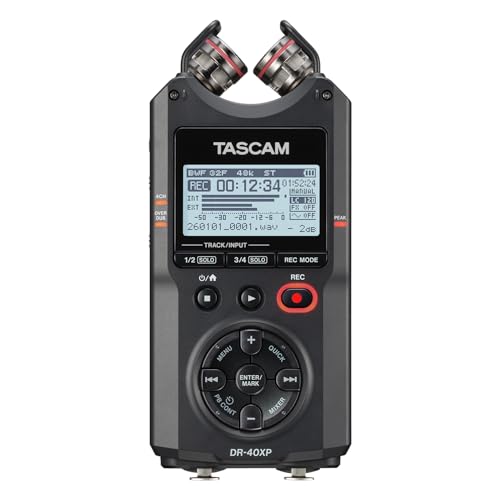
- Four-channel simultaneous recording
- 32-bit float and adjustable A-B/X-Y mics
- USB-C audio interface functionality
Best For: Interviews, music, and video creators
Best for Professional Location Work
Zoom F6 Professional Field Recorder

- Six XLR inputs and up to 14 tracks
- 32-bit float with dual A/D converters
- Timecode I/O for video synchronization
Best For: Film, broadcast, and multi-microphone location recording
Best for Podcast Interviews

- Four XLR inputs with phantom power
- Four headphone outputs with individual volume
- Mix-minus for phone and remote interviews
Best For: Podcast hosts and small interview teams
Best for Professional Field Audio
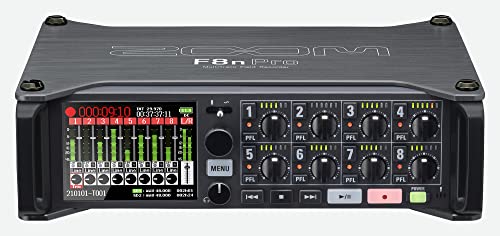
- Eight inputs and 10-track recording
- 32-bit float capture with high-gain preamps
- Dual SD slots and precise timecode
Best For: Film crews and professional location sound
Best for Layered Music Ideas

- Four-track recording with bounce workflow
- Two XLR/TS combo inputs for varied sources
- Built-in rhythms and battery operation
Best For: Musicians and mobile songwriting
Touchscreen Studio – Zoom R12
The Zoom R12 is a practical choice among portable multitrack recorders for musicians who want computer-free recording with modern editing controls. It combines eight-track recording, a touchscreen interface, onboard effects, rhythm tools, and battery operation in one compact unit.
Best For: Musicians who want to sketch, edit, and mix songs away from a computer.
Pros:
- Records up to eight tracks and supports cutting, copying, looping, and mixing on its touchscreen.
- Includes 150 drum loops, 18 FM synth instruments, MIDI support, and onboard effects.
- Offers two XLR/TRS inputs, 48V phantom power, and Hi-Z guitar or bass input on channel 1.
- Works as a stereo USB-C audio interface and DAW control surface.
Cons:
- Battery life is rated at up to five hours on four AA batteries.
- Its two physical inputs may limit larger multitrack recording setups.
The R12 stands out for hands-on workflow and built-in creative tools. It is especially appealing if portability means leaving the computer behind while still having substantial editing and arrangement features.
Classic Portastudio – TASCAM DP-03SD 8-Track
The TASCAM DP-03SD brings a straightforward Portastudio workflow to portable multitrack recorders. Its eight-track design, two-channel simultaneous input, built-in stereo microphones, and onboard mastering tools make it suited to simple recording without relying on a computer.
Best For: Songwriters and home recordists who prefer dedicated, tactile recording hardware.
Pros:
- Provides eight-track recording with two-channel simultaneous input.
- Includes built-in stereo condenser microphones for recording on demand.
- Offers onboard editing, mastering effects, a tuner, and a metronome.
- Supports condenser microphones through XLR and guitar or keyboard connections through TRS inputs.
Cons:
- At 5.3 pounds, it is heavier than several compact portable recorders.
- Its listed recording format is WAV, with a 4 GB storage capacity.
- Power is supplied through two AAA batteries according to the specifications.
The DP-03SD favors simplicity over a modern touchscreen or extensive built-in accompaniment. Choose it if the familiar Portastudio approach, dedicated controls, and onboard mastering are more important than minimum weight.
Clip-Free Mixer – Zoom LiveTrak L6
The Zoom LiveTrak L6 is a mixer-focused option among portable multitrack recorders, recording 10 discrete tracks plus a stereo mix to SD cards. Its 32-bit float interface, channel processing, MIDI connectivity, and sound pads make it useful for live setups as well as computer-based production.
Best For: Bands, podcasters, streamers, and performers who need multiple inputs and live mixing control.
Pros:
- Records 10 discrete tracks and a stereo mix to SD cards up to 1TB.
- Uses 32-bit float recording to provide clip-free audio without manual gain setting.
- Can record to a card and computer simultaneously while functioning as a DAW control surface.
- Provides EQ, AUX sends, pan, effects, MIDI, and four assignable sound pads.
Cons:
- Its mixer-oriented design may be more complex than a basic songwriting recorder.
- The supplied notes do not specify battery runtime.
- It has two combo inputs plus four stereo inputs, which may not suit every microphone-heavy setup.
The L6 is the strongest fit here for live audio routing and flexible multichannel capture. Its compact 1.4-pound body and clip-free workflow are particularly useful when recording changing sources or performing without time for detailed gain adjustment.
Pocket Songwriter – TASCAM DP-006 6-Track
The TASCAM DP-006 is a compact, battery-operated option among portable multitrack recorders. It supports up to six tracks, two-track simultaneous recording, six-track playback, and built-in omni-directional microphones for capturing song ideas with minimal setup.
Best For: Songwriters who want a simple pocketstudio for portable demos and ideas.
Pros:
- Records up to six tracks with a dedicated stereo master track.
- Supports two-track simultaneous recording and six-track simultaneous playback.
- Includes two built-in omni-directional condenser microphones.
- Runs on four included AA batteries and records at CD-quality 16-bit/44.1kHz.
Cons:
- It has fewer tracks and fewer stated features than the eight- and ten-track alternatives.
- The 2.5 mm headphone jack may require an adapter for some headphones.
- The supplied recording-time specification is limited to nine hours.
The DP-006 prioritizes portability and ease of use over deep production features. It makes sense for quick songwriting sessions, especially when built-in microphones and AA-battery operation are more valuable than extensive effects or computer integration.
Best All-Around Choice – Zoom H6 Studio
The Zoom H6 Studio is a capable option among portable multitrack recorders for musicians, filmmakers, and field recordists who want up to six individual tracks plus a stereo mix. Its 32-bit float recording, high-SPL microphones, and look-ahead limiters help keep recordings clean in changing environments.
Best For: Musicians, filmmakers, and location recordists needing flexible multitrack capture and long battery life.
Pros:
- Records up to six individual tracks plus a stereo mix.
- 32-bit float recording and look-ahead limiters help prevent distortion.
- 19.4mm microphones handle sound levels up to 140 dB SPL.
- Runs for up to 15 hours on four AA batteries.
Cons:
- Its larger body may be less convenient than more compact handheld recorders.
- It is listed with a USB 2.0 interface rather than USB-C.
Choose the H6 Studio if you want a versatile portable multitrack recorder with strong built-in microphones, broad sample-rate support up to 192 kHz, and dependable battery operation for extended sessions.
Best Compact 4-Channel Pick – TASCAM DR-40XP
The TASCAM DR-40XP is a practical choice among portable multitrack recorders when you need a compact unit for interviews, music, or video work. It can record its adjustable built-in microphones and external inputs simultaneously, while 32-bit float capture and USB-C connectivity support flexible production workflows.
Best For: Creators who want four-channel recording, adjustable stereo microphones, and USB-C computer or mobile connectivity.
Pros:
- Captures four channels from built-in microphones and external inputs at the same time.
- 32-bit float recording helps provide clip-free capture.
- Adjustable A-B or X-Y microphones handle up to 125 dB SPL.
- Works as a 2-in/2-out USB-C audio interface.
Cons:
- microSD card and batteries are not included.
- It provides fewer channels than the six-input recorders in this roundup.
The DR-40XP stands out for straightforward four-channel flexibility in a small handheld format. It is especially appealing if USB-C integration and simultaneous microphone-plus-input recording matter more than a larger track count.
Best for Professional Location Work – Zoom F6 Professional Field Recorder
The Zoom F6 is designed for demanding production work and is one of the most flexible portable multitrack recorders here. Six XLR inputs, up to 14 tracks, dual A/D converters, and timecode I/O make it well suited to multi-microphone film, broadcast, and location recording setups.
Best For: Filmmakers, broadcast crews, and musicians needing multiple XLR inputs and frame-accurate video synchronization.
Pros:
- Six XLR inputs support simultaneous multi-microphone recording.
- Records up to 14 tracks with 32-bit float and dual A/D converters.
- Timecode I/O supports frame-accurate synchronization with video.
- Can operate as a standalone recorder or USB audio interface.
Cons:
- At 2.4 pounds, it is heavier than the listed handheld alternatives.
- Its professional feature set may be more than needed for simple stereo recordings.
For serious location production, the F6 offers the greatest input and track capacity of these options. Its rugged portable design, multiple power options, and timecode support make it the strongest fit for synchronized, multi-microphone workflows.
Best for Podcast Interviews – Zoom PodTrak P4
The Zoom PodTrak P4 is a practical choice among portable multitrack recorders for podcasting and spoken-word production. It combines four XLR microphone inputs, four individually controlled headphone outputs, programmable sound pads, and phone or USB connectivity in a battery-powered design.
Best For: Podcast hosts, interviewers, and small remote recording teams.
Pros:
- Four XLR inputs with phantom power support multiple microphones.
- Four headphone outputs offer individual volume control.
- Automatic mix-minus simplifies phone and remote interviews.
- Records inputs and sound pads as separate tracks.
Cons:
- Battery life is rated at up to 3.5 hours on two AA batteries.
- Its feature set is focused on podcasting rather than full music production.
The P4 stands out when easy interview routing and multiple headphone feeds matter most. Its compact, straightforward design makes it especially suitable for podcast setups that need to work away from a desktop.
Best for Professional Field Audio – Zoom F8n Pro Field Recorder
The Zoom F8n Pro is a professional-grade option among portable multitrack recorders for film and location work. Its eight inputs, 10-track recording, 32-bit float capture, high-gain preamps, timecode support, and dual SD card slots are designed for demanding production workflows.
Best For: Filmmakers, production sound teams, and field-recording professionals.
Pros:
- 32-bit float recording and dual AD converters help deliver clip-free audio.
- Eight inputs and 10 tracks accommodate larger production setups.
- Timecode accuracy is specified down to 0.2 ppm.
- Dual SD slots support redundant recording, while USB operation provides 8-in/4-out interface functionality.
Cons:
- At 1.8 kg, it is substantially heavier than compact portable recorders.
- Its professional feature set may be more than needed for simple voice recording.
The F8n Pro is the strongest fit here for productions where track count, backup recording, and synchronization are priorities. Choose it when field reliability and flexible routing matter more than minimal size or weight.
Best for Layered Music Ideas – Zoom R4 Multi-Track Recorder
The Zoom R4 is a musician-focused option among portable multitrack recorders, offering four-track recording, stereo bouncing, built-in microphones, effects, and more than 80 rhythm patterns. Its 32-bit float operation and battery power make it useful for capturing layered ideas without constant gain adjustments.
Best For: Musicians, songwriters, and mobile demo recording.
Pros:
- Records, layers, and bounces tracks to keep building arrangements.
- Two XLR/TS combo inputs accept microphones, instruments, and keyboards.
- Built-in rhythms provide more than 80 patterns for practice and songwriting.
- Works as a 2-in/2-out USB audio interface and runs on four AA batteries or USB-C.
Cons:
- Four-track recording is less suited to large ensembles or complex live sessions.
- Its musician-oriented workflow may not be ideal for multi-microphone podcast production.
The R4 is a flexible sketchpad for performers who want to record, layer, and develop arrangements away from a computer. It is particularly appealing if built-in rhythms and battery operation are as important as multitrack capture.
How We Picked the Best Portable Multitrack Recorders
We focused on recording flexibility, input and track counts, portability, monitoring, storage, battery options, and ease of use. The selection includes dedicated music workstations, mixer-recorders, handheld devices, podcast systems, and professional field recorders because “portable” can mean very different things depending on the job.
We also considered features that affect real-world results, including built-in microphones, XLR/TRS connectivity, overdubbing, effects, USB audio functionality, time-saving recording modes, and 32-bit float support where available.
Quick Comparison
| Best For | Look For | Recommended Type |
|---|---|---|
| Songwriting and overdubbing | Simple track controls, effects, and battery operation | Compact multitrack recorder |
| Live music and small sessions | Multiple inputs, mixing, and direct recording | Mixer-recorder or digital Portastudio |
| Podcasts and remote interviews | Several headphone outputs, mic inputs, and phone connectivity | Podcast recorder |
| Film and location sound | Low-noise preamps, reliable power, and safety recording | Professional field recorder |
| Fast voice or ambience capture | Built-in microphones and straightforward controls | Handheld recorder |
Key Buying Factors for Portable Multitrack Recorders
Inputs, Tracks, and Expandability
Count the sources you expect to record simultaneously, not just the maximum track number. A songwriter may need two inputs, while a band, film crew, or panel discussion may need four, six, or eight. Also check whether inputs accept microphones, line-level signals, instruments, or phantom-powered condenser microphones.
Workflow and Editing
Dedicated Portastudios provide tactile controls and independent recording, while mixer-recorders may suit live performances and streaming. Handheld units are faster for location capture but may offer fewer song-production tools. If you prefer detailed editing, confirm how the recorder connects to a computer and whether it functions as a USB audio interface.
Audio Quality and Reliability
Look for clean preamps, suitable gain range, dependable monitoring, and strong storage support. 32-bit float recording can provide extra protection against unexpected peaks on compatible models, but microphone placement and noise control still matter. For professional work, prioritize safety tracks, timecode, robust connectors, and dependable power options.
Portability and Power
Small recorders are easier to carry, but larger units may offer more inputs and better physical controls. Check battery life, USB power, mounting options, included accessories, and whether the device remains practical with cables and microphones attached.
Who Should Buy Which Portable Multitrack Recorders?
Choose a Compact Multitrack Studio for Songwriting
Musicians who want to sketch arrangements, overdub instruments, and work away from a computer should choose a dedicated multitrack recorder with physical controls, effects, and simple bounce or mix functions.
Choose a Podcast Recorder for Conversations
For podcasts, prioritize enough XLR inputs, separate headphone outputs, remote-call connectivity, and easy level control. Built-in sound pads can also simplify intros, transitions, and recurring effects.
Choose a Field Recorder for Film and Professional Location Work
Filmmakers and production crews should prioritize low-noise inputs, multiple channels, safety recording, timecode or synchronization features, rugged construction, and flexible power. More advanced field recorders are worthwhile when missed audio is costly.
Choose a Handheld Recorder for Speed and Simplicity
If you mainly capture rehearsals, ambience, interviews, or quick musical ideas, a handheld model with built-in microphones offers the fastest setup. Match the input count and connector types to the sources you expect to use most often.