Choosing the right power amplifier can transform a capable audio system into a more authoritative, spacious, and engaging setup. The best match depends on your speakers, room, listening habits, and whether you need a dedicated power amp or an all-in-one integrated solution.
We selected 10 standout options spanning Class D, Class AB, hybrid tube, streaming, stereo, and monoblock designs. Use the guide below to compare power, connectivity, system flexibility, and value before buying.
Best 10 Power Amplifier for Audiophiles Picks for 2026
Flexible GaN Power
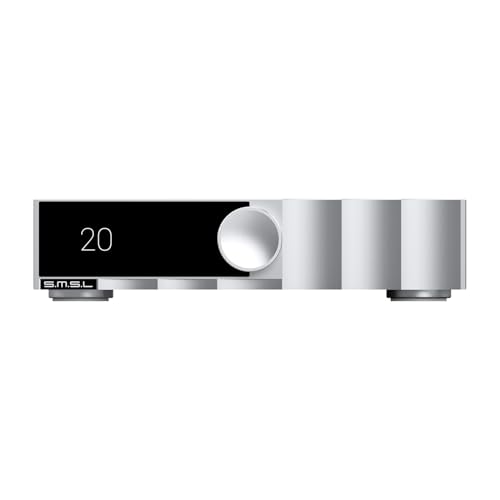
- GaN power technology and PGA2311 volume chip
- Stereo pass-through or XLR mono operation
- Overheat and overcurrent protection
Best For: Audiophiles planning a flexible stereo or dual-mono system
French High-Power Hybrid

- Up to 190W per channel into 8 ohms
- XLR, phono, USB-B, optical, and coaxial inputs
- Dual Class A/AB architecture with VU meters
Best For: Full-featured systems with demanding speakers and varied sources
High-Current Control

- Up to 500W at 8 ohms in bridged mode
- 115dB SNR and 0.003% THD+N
- XLR/RCA inputs and damping factor over 400
Best For: Large speakers and demanding two-channel listening rooms
Tube-Warmth Versatility
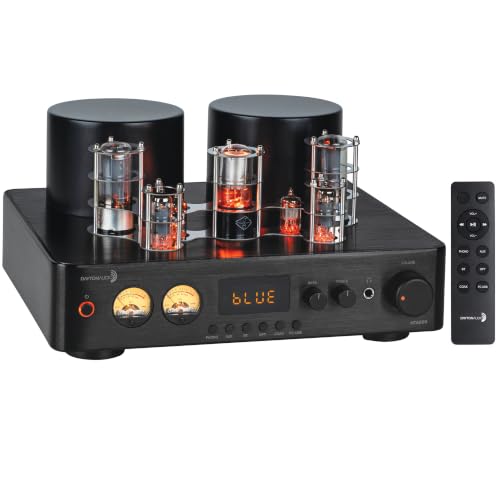
- 100W per channel at 4 ohms
- Hybrid tube preamp and Class A/B output
- Bluetooth, USB DAC, phono, and subwoofer output
Best For: Mixed-source home systems seeking tube character and convenience
Compact Class-D Control

- 70W per channel with Hypex NCORE Class D
- RCA and XLR inputs in a compact chassis
- Bridgeable to 250W mono mode
Best For: Compact two-channel systems with a separate source or preamp
Streaming System Hub

- 100W per channel in stereo mode
- BluOS streaming with 23+ licensed services
- HDMI eARC, Dirac Live ready, and THX AAA headphone output
Best For: All-in-one music streaming and compact home-theater systems
Hybrid Hi-Fi Authority

- 130W per channel into 8 ohms
- RCA, XLR, digital, USB-B, and phono inputs
- Hybrid Class A/Class D design with dual toroidal transformers
Best For: Demanding two-channel speaker systems with varied sources
Hybrid High-Output Pick

- Class A warmth with Class AB peak power
- Dual toroidal transformers and 21kg chassis
- Balanced XLR, RCA, bi-wiring, and speaker protection
Best For: Demanding passive speakers and dedicated Hi-Fi systems
Established Stereo Choice
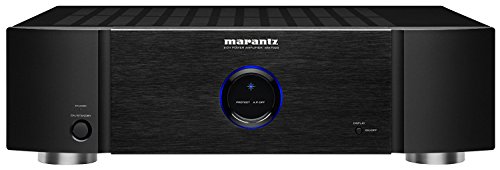
- 140W per channel at 8 ohms
- Balanced XLR and RCA inputs
- Supports stereo or two-zone setups
Best For: Flexible home theater and stereo installations
Compact Monoblock Value

- Up to 240W at 4 ohms per mono unit
- Balanced XLR/TRS and RCA inputs
- Scalable design for multi-channel systems
Best For: Modular Hi-Fi and AVR upgrades with limited space
Flexible GaN Power – SMSL VMV PA200
For audiophiles who need a flexible power amplifier for audiophiles’ two-channel system, the SMSL VMV PA200 combines stereo operation, XLR connectivity, and a selectable mono mode. Its Infineon GaN power technology, PGA2311 volume chip, and dedicated switching power supply target clean, reliable performance.
Best For: Listeners who want a compact stereo amplifier with the option to pair two units in mono for greater power.
Pros:
- XLR mono mode can support a two-amplifier stereo configuration.
- Offers stereo pass-through and mono operating modes.
- Includes overheat and overcurrent protection.
- Claims THD+N of 0.003% and includes a remote control.
Cons:
- Its advanced mono setup may be more than a simple system requires.
- A 12-month warranty is shorter than some competing coverage.
The PA200 is a strong choice when system flexibility matters. Its mono capability and balanced input make it especially appealing for enthusiasts planning future upgrades or higher-power speaker matching.
French High-Power Hybrid – Advance Paris A12 Classic
The Advance Paris A12 Classic is an integrated power amplifier option for audiophiles who want substantial output and broad source connectivity in one chassis. Its dual Class A/AB design, balanced XLR input, phono stage, and digital inputs make it suitable for a complete hi-fi setup.
Best For: Audiophiles driving demanding speakers who want integrated amplification, vinyl support, and multiple digital and analog inputs.
Pros:
- Delivers up to 190 watts per channel into 8 ohms and 280 watts into 4 ohms.
- Combines Class A/AB architecture with oversized toroidal transformers.
- Includes XLR, RCA, optical, coaxial, USB-B, and phono connectivity.
- Brushed aluminum construction and dual VU meters provide a distinctive presentation.
Cons:
- At 21 kg, it is a substantial component to position.
- Its integrated design may be unnecessary for systems already using separate source components.
Choose the A12 Classic when you want power and source versatility without assembling a separate preamp and power amp. It is particularly well suited to a centerpiece hi-fi system with both digital and vinyl playback.
High-Current Control – Eversolo AMP-F8
The Eversolo AMP-F8 is a dedicated Class-AB power amplifier for audiophiles seeking high output, low measured noise, and strong speaker control. Its 800W toroidal linear power supply, balanced XLR and RCA inputs, and damping factor above 400 support demanding two-channel systems.
Best For: Owners of large floorstanding speakers or complex speaker loads who want substantial reserve power and precise bass control.
Pros:
- Can deliver up to 500 watts at 8 ohms in bridged mode.
- Offers 115dB SNR and THD+N as low as 0.003%.
- Provides both professional-grade XLR and RCA inputs.
- High damping factor and independent power supply design support driver control and channel separation.
Cons:
- Its high power may be excessive for smaller rooms or efficient speakers.
- As a dedicated power amplifier, it requires a separate preamplifier or source with volume control.
- The supplied warranty is one year.
The AMP-F8 is aimed at listeners who prioritize authority and control over an all-in-one design. Its specifications and bridged-mode capability make it a compelling foundation for a scalable high-end stereo system.
Tube-Warmth Versatility – Dayton Audio HTA200
The Dayton Audio HTA200 gives audiophiles a practical power amplifier for audiophiles’ everyday systems while adding hybrid tube character. Its tube preamp stage and Class A/B output section are paired with Bluetooth 5.0, a USB DAC, phono input, and a subwoofer preamp output.
Best For: Listeners who want warm tube-inspired sound, modern streaming, turntable support, and enough power for larger home audio setups.
Pros:
- Produces 100 watts per channel RMS at 4 ohms.
- Combines vacuum-tube preamplification with a Class A/B amplifier stage.
- Supports Bluetooth 5.0, USB DAC, phono, optical, coaxial, and AUX sources.
- Includes a powered-subwoofer preamp output, headphone output, tone controls, and remote.
Cons:
- It is an integrated amplifier rather than a dedicated power amp.
- Its tube-influenced presentation may not suit listeners seeking strictly neutral solid-state operation.
- The supplied notes do not specify a warranty.
The HTA200 is a versatile choice for a mixed-source living-room system. It offers useful connectivity and straightforward 2.1 expansion while retaining the visual and sonic appeal of a hybrid tube design.
Compact Class-D Control – Cambridge Audio MXW 70
For audiophiles who want a compact power amplifier for audiophiles’ stereo system, the Cambridge Audio MXW 70 combines 70 watts per channel with Hypex NCORE Class D amplification. RCA and XLR inputs make it practical for a range of source components, while its bridgeable design adds flexibility for future system upgrades.
Best For: Compact two-channel systems needing RCA/XLR connectivity and efficient Class D power.
Pros:
- 70 watts per channel from Hypex NCORE Class D amplification
- Both RCA and XLR inputs
- Compact casework with 12V trigger input and pass-through
- Bridgeable into a 250-watt mono amplifier
Cons:
- Only two channels in standard operation
- No built-in streaming or digital inputs listed
The MXW 70 is a focused choice for listeners who already have a source or preamplifier and want compact, flexible amplification. Its bridge mode is particularly useful when a later system expansion calls for more mono-channel power.
Streaming System Hub – Bluesound Powernode (2025)
The Bluesound Powernode is a power amplifier for audiophiles who also want streaming, multi-room playback, and home-theater connectivity in one compact component. It delivers 100 watts per channel in stereo, supports high-resolution services through BluOS, and adds HDMI eARC, Dirac Live readiness, and a dedicated THX AAA headphone output.
Best For: Listeners building an all-in-one streaming stereo or compact TV and music system.
Pros:
- 100 watts per channel in stereo and 80 watts per channel in three-channel LCR mode
- BluOS supports services including Spotify, Tidal Connect, Qobuz, and internet radio
- HDMI eARC, USB-C, optical, RCA, Bluetooth, AirPlay 2, and network connectivity
- THX AAA headphone amplification and Dirac Live room-correction readiness
Cons:
- Its many streaming and home-theater features may be unnecessary for a simple analog setup
- Three-channel LCR operation provides less per-channel power than stereo mode
Choose the Powernode when system simplicity matters as much as amplification. It can serve as a stereo streaming amplifier, headphone station, or compact TV-centered system, with room to expand through compatible Bluesound components.
Hybrid Hi-Fi Authority – Advance Paris A10 Classic
The Advance Paris A10 Classic is a power amplifier for audiophiles who want substantial two-channel output plus broad source compatibility. Its hybrid Class A and Class D design is rated at 130 watts per channel into 8 ohms and 190 watts into 4 ohms, while RCA, XLR, digital inputs, and a built-in phono stage help it anchor a complete hi-fi system.
Best For: Audiophiles driving demanding speakers who want analog, digital, and turntable connectivity in one amplifier.
Pros:
- 130 watts per channel into 8 ohms and 190 watts into 4 ohms
- Hybrid Class A/Class D amplification approach
- RCA, XLR, optical, coaxial, and USB-B inputs
- Built-in phono stage and dual toroidal transformers
Cons:
- Larger, more traditional integrated-amplifier format than compact alternatives
- Its extensive connectivity may exceed the needs of a basic two-source system
The A10 Classic is the strongest fit here for a conventional, component-based hi-fi setup. Its higher output ratings and 4-ohm capability suit listeners prioritizing speaker control, while the phono stage and digital inputs reduce the need for additional equipment.
Hybrid High-Output Pick – Class A/AB 200W Stereo Amp
For audiophiles seeking a powerful, full-size amplifier, this FLYINSKY model combines lower-volume Class A operation with higher-power Class AB output for demanding musical peaks. Its balanced XLR and RCA connectivity, substantial power supply, and speaker-control specifications make it a serious option for a dedicated home Hi-Fi system.
Best For: Audiophiles with demanding passive speakers who want hybrid Class A/AB operation, high output, and flexible balanced or single-ended connections.
Pros:
- Switches from 30W Class A operation to up to 200W per channel in Class AB at 8 ohms.
- Uses dual 650W toroidal transformers, ELNA capacitors, and 110V–120V US-market power design.
- Offers XLR and RCA inputs, bi-wiring support, 125dB SNR in Direct Mode, and a 480 damping factor.
- Heavy 21kg CNC-aluminum chassis includes VU meters and protection circuitry.
Cons:
- Its 46-pound chassis is substantial and may be difficult to place in smaller racks.
- The notes specify a one-year warranty, shorter than some competing options.
- Its high-power design may be more amplifier than modest speaker systems require.
This is the most ambitious choice of the three for listeners who value robust power delivery, a tube-like tonal description, and premium-style construction. Confirm your speakers’ impedance and rack space before buying.
Established Stereo Choice – Marantz MM7025 2-Channel Amp
The Marantz MM7025 is a straightforward power amplifier for audiophiles who want a recognized two-channel component with 140 watts per channel at 8 ohms. It supports both balanced XLR and single-ended RCA inputs and can serve a dedicated stereo system or two-zone setup.
Best For: Home theater and stereo owners who want a compact, flexible two-channel amplifier from an established audio brand.
Pros:
- Delivers 140 watts per channel at 8 ohms for substantial home audio output.
- Accepts both RCA and balanced XLR connections.
- Can be configured for a dedicated two-channel system or two zones.
- Quiet fan-assisted cooling and a relatively compact cabinet aid installation.
Cons:
- It provides less rated power than the FLYINSKY and Fosi Audio options listed here.
- It is a conventional two-channel amplifier rather than a mono-block or hybrid design.
- The supplied details do not specify measurements such as SNR, THD, or damping factor.
The MM7025 is a practical, versatile pick when installation flexibility and brand familiarity matter more than maximum output or extensive audiophile specifications. Its zone capability also makes it useful beyond a single listening room.
Compact Monoblock Value – Fosi Audio V3 Mono Class D
This Fosi Audio V3 Mono is a compact power amplifier for audiophiles building a modular system. Each unit drives one passive speaker, delivering up to 240 watts at 4 ohms, while balanced XLR/TRS and RCA inputs allow it to work with Hi-Fi preamps or AV receivers.
Best For: Space-conscious listeners assembling multi-channel systems or adding power to an AVR with one mono amplifier per speaker.
Pros:
- Mono-block design makes it easy to scale a system to two, three, four, or five channels.
- Provides up to 240W at 4 ohms and supports XLR/TRS balanced or RCA inputs.
- PFFB Class D technology and the TPA3255 platform are specified with 0.006% THD and 101dB SINAD.
- Compact metal chassis includes heat-dissipation features, auto signal sensing, and replaceable DIP8 op-amps.
Cons:
- One unit powers only a single passive speaker, so stereo or surround systems require multiple units.
- It requires the included 48V/5A external power supply.
- Its compact Class D format may appeal less to buyers seeking a traditional full-size component.
The V3 Mono stands out for flexible system building and a very small footprint. It is especially compelling for listeners who want to expand an AVR or create a custom multi-amplifier setup, provided they plan for one amplifier per speaker.
How We Picked the Best Power Amplifier for Audiophiles
We focused on amplifiers that offer a meaningful combination of sound-system compatibility, output capability, connection options, build quality, and practical value. The selection includes dedicated power amplifiers for preamp-based systems, integrated amplifiers with built-in control sections, streaming amplifiers, and compact models suited to smaller listening spaces.
Specifications such as power ratings, balanced and unbalanced inputs, amplifier topology, damping factor, signal-to-noise performance, and expansion options helped shape the comparison. Because published wattage does not tell the whole story, speaker matching and real-world system requirements remain central to the recommendations.
Quick Comparison
| Best For | Recommended Type | What to Prioritize |
|---|---|---|
| Dedicated two-channel system | Stereo power amplifier | Clean gain, adequate headroom, balanced inputs |
| Power-hungry speakers | High-output Class AB or Class D | Current delivery, damping factor, stable speaker load |
| Compact or efficient setup | Mini Class D amplifier | Small footprint, efficient operation, input flexibility |
| Streaming-first system | Wireless streaming amplifier | App support, network features, multi-room compatibility |
| Flexible all-in-one system | Integrated amplifier | Inputs, source control, subwoofer and speaker connectivity |
Key Buying Factors for a Power Amplifier for Audiophiles
Power, Headroom, and Speaker Compatibility
Match amplifier output to the speakers’ sensitivity, impedance, and recommended power range. Low-sensitivity or difficult-to-drive speakers generally benefit from greater current capability and reserve power, while efficient speakers may perform well with a lower-powered design. Extra headroom can improve dynamics, but excessive power is not automatically better.
Amplifier Topology
Class AB designs remain popular for their familiar linear approach and robust performance. Class D models are typically lighter, cooler-running, and highly efficient, while newer implementations can deliver excellent transparency. Hybrid tube amplifiers add a different tonal character and may appeal to listeners who value a warmer presentation.
Inputs and System Architecture
Check whether you need RCA, balanced XLR, or both. XLR connections can be useful in longer cable runs or systems with balanced source components. A dedicated power amplifier requires a preamp or compatible processor, whereas an integrated or streaming amplifier may include volume control, source switching, and network playback.
Size, Heat, and Everyday Usability
Measure your rack or shelf before buying, especially for large high-output amplifiers. Consider ventilation, standby behavior, remote control, app quality, and the accessibility of front- and rear-panel connections. Efficient compact amplifiers are often easier to place, while heavier designs may provide larger power supplies and greater physical stability.
Who Should Buy Which Power Amplifier for Audiophiles?
Choose a dedicated stereo amplifier if you already own a quality preamp or DAC and want to build a component-based system. A high-output Class AB or premium Class D model is the better fit for demanding floorstanding speakers and larger rooms. Compact Class D options suit desktop systems, secondary rooms, and efficient bookshelf speakers. Integrated amplifiers are ideal for listeners who want fewer components, while a streaming amplifier makes the most sense when wireless playback and multi-room control are priorities.
Before purchasing, confirm the amplifier’s power ratings are measured under comparable conditions, verify speaker impedance compatibility, and leave room for proper ventilation. The best Power Amplifier for Audiophiles is ultimately the one that fits the entire signal chain—not simply the model with the largest wattage number.