The right amplifier can give a home studio cleaner headroom, better speaker control, and more dependable monitoring without forcing you into a full professional rack. However, amplifier power ratings, speaker impedance, connectivity, and cooling requirements vary widely between models.
We’ve selected 10 options spanning compact desktop amplifiers, studio reference designs, home-theater units, and professional two-channel power amps. Use the guide below to match output and features to your speakers, room, and workflow.
Best 10 Power Amplifiers for Home Studios Picks for 2026
Compact Power Pick

- Up to 300W per channel
- Compact Class D design for 2–8Ω speakers
- Replaceable op-amps and adjustable pre-out
Best For: Desktop monitoring and compact passive-speaker systems
Studio Reference Choice

- 100W per channel at 8 ohms
- Stereo studio reference amplifier
- Convection-cooled chassis with 2-year warranty
Best For: Straightforward passive-monitor amplification
Rack-Ready Pro Power

- 300W per channel at 4 ohms
- 600W bridged output at 8 ohms
- Flexible I/O with forced-air cooling
Best For: High-output passive systems and larger studio spaces
Multichannel Integration Pick

- Four channels at up to 200W each
- Bridged mode delivers 300W at 8 ohms
- XLR, RCA, 12V trigger, and 5-year warranty
Best For: Multichannel passive systems and integrated installations
Clean Reference Power

- 2 x 400 watts into 4 ohms
- Fanless convection cooling
- Stereo or bridged mono operation
Best For: Passive studio monitors needing quiet, high-output amplification
Feature-Packed Rack Power

- Up to 2000 watts bridged
- Bluetooth and USB-A playback
- TRS, XLR, and Speakon connections
Best For: Studios wanting flexible inputs and rack-mounted system power
Compact Studio Control

- 60 watts per side at 4 ohms
- Balanced 1/4-inch and RCA inputs
- Convection-cooled operation
Best For: Smaller passive-monitor setups needing simple amplification
Compact Starter Amp
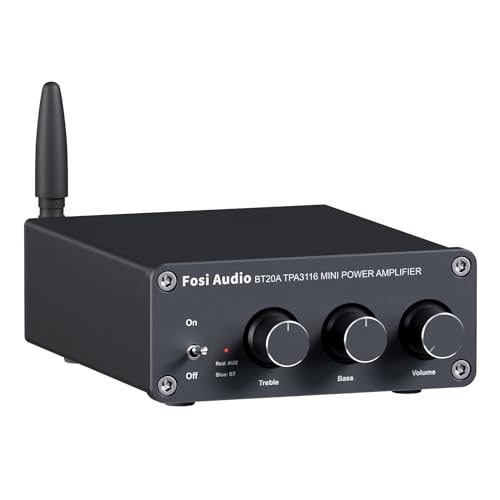
- Two-channel Class D design with up to 100W per channel maximum output
- Bluetooth and RCA inputs for simple source connection
- Compact enclosure with bass and treble controls
Best For: Entry-level passive-speaker setups in small home studios and rooms
Versatile High-Power Receiver

- 400W rated and 2000W peak power for 4–16Ω speakers
- Four mic inputs with reverb, delay, and five-band EQ controls
- Bluetooth, USB, SD, AUX/DVD, and 12V/110V operation
Best For: Karaoke, parties, and flexible home audio setups with microphones
Multi-Channel Studio Receiver
Donner MAMP5 4-Channel Amplifier

- Four independently controlled channels with 440W peak output
- Bluetooth 5.0, USB, SD, RCA, AUX, FM, and dual mic inputs
- Bass, treble, mic volume, echo, LED display, and remote controls
Best For: Multi-speaker rooms, presentations, karaoke, and versatile home audio
Compact Power Pick – Fosi Audio V3
For home studios that need substantial power without a large chassis, the Fosi Audio V3 is a compact option among power amplifiers for home studios. Its two-channel Class D design can drive 2–8Ω passive speakers and includes a 32V power supply.
Best For: Desktop monitoring, bookshelf speakers, and compact home theater or studio setups.
Pros:
- Up to 300W per channel and 600W total output
- Compact design with top-and-bottom vents and whole-body heatsink cooling
- Adjustable pre-out and replaceable NE5532 op-amps
- Low-noise specifications, including up to 110dB SNR
Cons:
- Designed for passive speakers rather than direct connection to powered monitors
- Op-amp replacement requires careful installation and correct orientation
- Supplied details do not specify professional studio rack mounting
The V3 is a flexible choice when space is limited and you want strong output, tweakable circuitry, and a convenient pre-out. Check speaker impedance and connection requirements before buying.
Studio Reference Choice – Avantone Pro CLA-100
The Avantone Pro CLA-100 is a straightforward stereo reference amplifier for home studios seeking dedicated amplification for passive monitors. It provides 100W per channel into 8-ohm loads in a convection-cooled chassis.
Best For: Stereo studio monitoring with 8-ohm passive speakers.
Pros:
- 100W per channel at 8 ohms
- Purpose-built stereo studio reference design
- Convection-cooled chassis avoids reliance on forced-air cooling
- Includes a 2-year warranty
Cons:
- Lower stated power output than several other products in this roundup
- Supplied notes do not list input connections or bridging capability
- Intended for passive monitors rather than powered speakers
The CLA-100 favors a simple studio-reference approach over extensive feature extras. It is worth considering when 100W per channel is appropriate for your monitors and room.
Rack-Ready Pro Power – Crown XLi800
Crown XLi800 Two-channel, 600-Watt Bridged 8Ω Power Amplifier. Professional DJ, PA, Stage Amp. Black
Check Price On AmazonThe Crown XLi800 brings professional two-channel amplification to setups that need more output than a typical desktop unit. Among power amplifiers for home studios, it stands out with 300W continuous per channel at 4 ohms, 600W bridged output at 8 ohms, flexible I/O, and forced-air cooling.
Best For: Larger passive-speaker systems, rehearsal spaces, and home studios needing professional-style power.
Pros:
- 300W continuous per channel at 4 ohms
- Up to 600W bridged output at 8 ohms
- Two channels with flexible input/output connections
- Selectable input voltage and forced-air cooling
Cons:
- Large, heavy 25.1-pound chassis may not suit desktop setups
- Forced-air cooling may be less desirable in quiet monitoring environments
- Professional power level can be excessive for small rooms or modest speakers
The XLi800 is a better fit for demanding passive systems than compact nearfield arrangements. Confirm speaker ratings, ventilation, and power requirements before integrating it into a home studio.
Multichannel Integration Pick – OSD Audio Nero HTA4200
OSD Audio Nero HTA4200 Multi Channel (4X) 200W/Ch Home Theater Amplifier, Bridgeable 300W/Ch
Check Price On AmazonThe OSD Audio Nero HTA4200 is suited to home studios or hybrid listening rooms that need four amplifier channels from one chassis. It delivers 200W per channel at 4 ohms, 140W at 8 ohms, and supports bridged operation at 300W into 8 ohms.
Best For: Multichannel passive-speaker systems and installations requiring XLR, RCA, or 12V-trigger integration.
Pros:
- Four channels with all-channels-driven output ratings
- Bridged mode provides 300W at 8 ohms
- Balanced XLR, RCA inputs, and 12V trigger support
- 110dB SNR at full power and a 5-year warranty
Cons:
- Heavy 52-pound chassis is not especially portable
- Four-channel capacity may be unnecessary for a basic stereo setup
- Large enclosure requires adequate rack or equipment space
The Nero HTA4200 is the most connectivity-focused option here for expanding beyond two passive channels. Its bridging flexibility and long warranty add value when building a permanent multichannel system.
Clean Reference Power – Behringer A800
For home studios using passive monitors, the Behringer A800 is a high-output option designed for recording, post-production, live sound, and HiFi applications. Its ultra-linear design, flexible channel configuration, and convection cooling make it a practical choice among power amplifiers for home studios where quiet operation matters.
Best For: Home studios with passive monitors that need quiet, stable amplification and substantial headroom.
Pros:
- Delivers 2 x 400 watts into 4 ohms or 800 watts in bridged mono operation.
- Ultra-low impedance design can drive a wide range of passive speakers.
- Convection cooling operates without a cooling fan for noise-free performance.
- Level meters and clip indicators support easy performance monitoring.
Cons:
- Designed for passive speakers, so it is not necessary for studios using active monitors.
- Its 800-watt output may be more than smaller monitoring setups require.
The A800 stands out when clean, quiet operation and flexible power are priorities. Check your monitors’ impedance and power requirements before choosing its stereo or bridged configuration.
Feature-Packed Rack Power – Pyle PTA1000BT
The Pyle PTA1000BT combines rack-mountable amplification with Bluetooth, USB-A MP3 playback, and several wired inputs. For home studios that also handle rehearsal, playback, or small live-sound duties, it offers broad connectivity alongside up to 1000 watts per channel in stereo or 2000 watts in bridged mode.
Best For: Home studios needing versatile connections, Bluetooth playback, and rack-mounted power for 4- to 8-ohm speakers.
Pros:
- Provides 1000 watts per channel in stereo or 2000 watts in bridged mode.
- Accepts TRS and XLR inputs and provides Speakon and binding-post speaker connections.
- Bluetooth and USB-A MP3 playback add convenient source options.
- Front-panel meters, protection indicators, and built-in fans support active monitoring and cooling.
Cons:
- Its cooling fans may be less suitable for extremely noise-sensitive recording spaces.
- The high maximum output can be excessive for modest home-studio speaker systems.
- Bluetooth and MP3 features may be unnecessary for a strictly wired monitoring chain.
This is a flexible choice among power amplifiers for home studios when connectivity and rack integration matter as much as amplification. Confirm the available voltage and speaker impedance before installation.
Compact Studio Control – Samson Servo 120a
The Samson Servo 120a is a lower-powered stereo amplifier suited to home studios that need straightforward power for passive speakers. It supplies 60 watts per side at 4 ohms, includes balanced 1/4-inch and RCA inputs, and uses convection cooling for a quieter setup.
Best For: Smaller home studios seeking simple, moderate-power amplification for passive monitors.
Pros:
- Outputs 60 watts per side at 4 ohms in stereo operation.
- Can deliver 120 watts in bridged mono at 8 ohms.
- Offers both balanced 1/4-inch phone and RCA inputs.
- Convection-cooled design avoids a cooling fan.
Cons:
- Its 120-watt maximum output is lower than the other listed amplifiers.
- It provides fewer connection and playback features than more feature-rich models.
- Its larger 21.5 x 14 x 4-inch dimensions may require careful placement.
The Servo 120a is a sensible fit when a home studio needs uncomplicated, quieter amplification rather than very high output or built-in streaming features. Match its stereo or bridged mode to the requirements of your passive monitors.
Compact Starter Amp – Fosi Audio BT20A
For shoppers comparing power amplifiers for home studios, the Fosi Audio BT20A is a compact, straightforward option for driving passive bookshelf or ceiling speakers. Its two-channel Class D design offers up to 100W per channel maximum output, with Bluetooth and RCA inputs for simple playback.
Best For: Entry-level home studio, office, bedroom, or small-room setups using passive speakers.
Pros:
- Compact design fits easily on a shelf or in a small workspace.
- Bluetooth and RCA inputs support wireless and wired sources.
- Bass and treble controls allow basic sound adjustment.
- Simple one-touch power operation and a 24-month manufacturer warranty.
Cons:
- Designed for two-channel stereo rather than multichannel systems.
- Maximum output figures may not suit demanding large-room applications.
- Bluetooth and RCA are the listed input options, with no broader studio connectivity stated.
The BT20A makes the most sense when you want an affordable, no-frills amplifier for passive speakers and casual monitoring or playback. Its small footprint and easy controls are useful, but more advanced studio systems may need additional connection options.
Versatile High-Power Receiver – 2000W Peak Stereo Amplifier
This 2.0-channel unit is a flexible choice among power amplifiers for home studios when you need multiple source options and substantial headline power ratings. It supports 400W rated power, 2000W peak power, 4–16Ω speakers, Bluetooth, analog inputs, USB, and SD playback.
Best For: Home theater, karaoke, parties, or studio-adjacent setups that need flexible source handling and microphone inputs.
Pros:
- Four microphone inputs include individual reverb and delay controls.
- Five-band EQ mixer supports more detailed vocal and tonal adjustment.
- Accepts AUX/DVD, USB, SD, and Bluetooth sources.
- AC 110V and DC 12V operation adds home and vehicle versatility.
Cons:
- Uses analog connections only; no optical fiber interface is listed.
- It is a 2.0-channel amplifier with no built-in subwoofer.
- At 13.78 by 12.2 by 6.69 inches, it is less compact than mini amplifiers.
Choose this model if microphone mixing and broad media compatibility matter more than a minimalist studio footprint. Remember that bass performance depends on the connected speakers or external subwoofer, and the published peak rating is higher than its 400W rated output.
Multi-Channel Studio Receiver – Donner MAMP5 4-Channel Amplifier
The Donner MAMP5 stands out among power amplifiers for home studios when you need four independently controlled channels and a wide range of built-in sources. It delivers up to 440W peak power, supports 4–16Ω speakers, and adds Bluetooth 5.0, USB, SD, FM, RCA, and microphone connectivity.
Best For: Multi-speaker home audio, presentations, karaoke, or studio spaces that need several input and speaker-group options.
Pros:
- Four independently controlled channels can support up to four speaker groups.
- Bluetooth 5.0 offers connection distance of up to 40 feet or 10 meters.
- Broad source selection includes USB, SD, RCA, AUX, Bluetooth, and FM radio.
- Two microphone inputs include independent microphone controls and echo functionality.
Cons:
- Requires passive speakers to produce audio.
- The listed 440W figure is peak output, while the specifications also state 110W output.
- The remote control only handles MP3, Bluetooth, and FM volume functions.
The MAMP5 is a practical choice for users who want one receiver to handle multiple channels and many everyday sources. Its feature set is broader than a basic stereo amp, though buyers should account for the need for passive speakers and the limitations of its remote.
How We Picked the Best Power Amplifiers for Home Studios
We compared these amplifiers by looking at practical studio requirements: continuous power, channel configuration, speaker impedance support, input and output options, physical size, cooling, and ease of integration. We also considered whether each model suits nearfield monitoring, passive bookshelf speakers, larger full-range cabinets, home theater, or occasional performance use.
Published wattage is only one part of the decision. Peak figures can look impressive but may not reflect sustained output, so we prioritized products with useful specifications and a clear role in a home audio system.
Quick Comparison
- Compact desktop systems: Fosi Audio V3 and BT20A are convenient choices for passive speakers in small rooms.
- Studio-focused monitoring: Avantone Pro CLA-100, Behringer A800, and Samson Servo 120a are better suited to conventional rack or reference-monitor setups.
- Higher-output and live-use systems: Crown XLi800 and Pyle models offer more output and professional-style connections, but may be louder, larger, and less refined for a quiet desk.
- Multi-channel installations: OSD Audio Nero HTA4200 is useful when several speaker zones or home-theater channels matter.
- Feature-heavy casual systems: The 2000W peak amplifier and Donner receiver emphasize Bluetooth, USB, microphones, and entertainment flexibility.
Key Buying Factors for Power Amplifiers for Home Studios
Power, Impedance, and Headroom
Check your speakers’ recommended power range and nominal impedance before buying. An amplifier should provide enough clean headroom for peaks without routinely operating at its limit. Do not assume a higher advertised number is automatically safer; mismatched impedance or clipping can damage speakers and compromise recordings.
Connections and Signal Path
RCA and Bluetooth inputs are convenient for consumer sources, while balanced XLR or TRS connections are preferable for longer runs and interfaces with balanced outputs. Confirm whether the amplifier accepts the output level from your audio interface and whether you need a volume control, gain trim, or an external monitor controller.
Noise, Cooling, and Placement
For a desktop studio, fan noise and electrical hiss can be distracting during quiet recording. Rackmount and high-output amplifiers may need ventilation and can generate more heat. Leave clearance around vents, avoid enclosed shelves, and consider the amplifier’s physical depth and weight.
Channel Count and System Growth
A two-channel amplifier is usually the simplest choice for stereo monitors. Four-channel and bridgeable models make more sense for multiple zones, surround systems, or future expansion, but they add wiring and configuration complexity.
Who Should Buy Which Power Amplifiers for Home Studios?
Choose a compact Fosi Audio model if you need an affordable, small amplifier for passive desktop or bookshelf speakers. Choose Avantone, Behringer, or Samson when accurate reference monitoring and conventional studio connectivity are the priority. Choose Crown or Pyle for higher-output speakers, rehearsal spaces, or occasional PA-style use. Choose OSD Audio for multi-channel home-theater or distributed-audio installations. Choose the Donner or feature-heavy peak-rated models when Bluetooth, USB, microphone inputs, and casual entertainment matter more than a strictly studio-oriented signal path.