Reliable power is easy to overlook in a recording studio—until hum, voltage problems, or an unexpected shutdown threatens a session. The right rack-mounted conditioner can organize connections, reduce electrical noise, add surge protection, and simplify system control.
We compared 10 options for different studio layouts and budgets, focusing on outlet capacity, filtering, sequencing, monitoring, rack compatibility, and practical day-to-day usability.
Best 10 Rack Power Conditioners for Recording Studios Picks for 2026
Studio Protection Pick

- SMP, LiFT, and EVS protection
- Nine outlets with isolated rear banks
- Dual retractable LED rack lights
Best For: Studios wanting advanced protection and rack lighting
Simple Studio Power Hub

- Nine outlets for rack equipment
- Noise filtering and surge protection
- LED illumination plus a USB port
Best For: Home and project studios needing practical power distribution
Filtering-Focused Rack Choice

- PG-90 filtering technology
- Eight rear and one front outlet
- Front-panel USB port
Best For: Studios prioritizing filtering and accessible rack connections
High-Capacity Protection Pick

- 20-amp capacity with a 12-gauge cord
- SMP, LiFT, and EVS protection
- Nine spaced outlets with front convenience outlet
Best For: Higher-demand racks with a compatible 20-amp circuit
Sequenced Rack Control
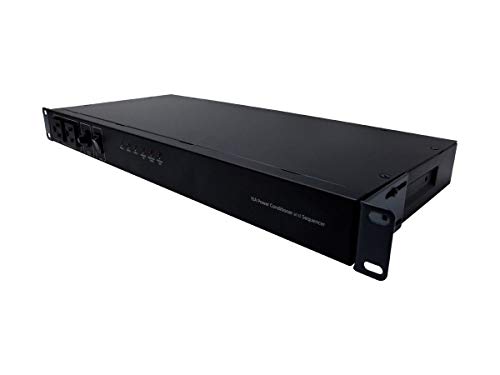
- Eight outlets with surge protection
- Three-zone power sequencing
- 1U metal rackmount design
Best For: Studios needing coordinated equipment startup and shutdown
Studio Power Monitoring

- PG-90 filtering technology
- LED voltage monitor display
- Eight rear outlets and pull-out lights
Best For: Studios wanting filtered power with rack visibility
Noise-Filtering Rack Protection

- Up to 90% average noise reduction
- Nine switched and filtered outlets
- Surge protection and front USB-A port
Best For: Studios needing filtered power without sequencing
Best Value Studio Power Sequencer
Pyle PCO875 10-Outlet Conditioner

- 2000W capacity with 10 total outlets
- 1U rack design with LCD voltage display
- Surge, spike, and overload protection
Best For: Home studios and compact recording racks
Most Feature-Rich Sequencer
Professional ST-368 10-Socket Conditioner

- Independent channel switches and sequential startup
- LCD, eight LED indicators, USB, and Type-C charging
- Noise filtering with a high-power design
Best For: Larger studio racks needing detailed outlet control
Best for Independent Control
MICNAUX 20A 10-Outlet Sequencer

- Eight independently controlled sequenced outlets
- Bypass mode and external remote-switch input
- 110–230V compatibility with LCD monitoring
Best For: Studios needing per-channel and remote power control
Studio Protection Pick – Furman PL-8C Classic
For recording studios building a rack of sensitive analog and digital equipment, the Furman PL-8C is a feature-rich choice among rack power conditioners for recording studios. Its 15-amp design combines SMP, LiFT, and EVS protection with isolated outlet banks and built-in rack lighting.
Best For: Studios that need advanced protection, separated power banks, and convenient rack illumination.
Pros:
- SMP, LiFT, and EVS technologies provide surge protection, linear filtering, and over-voltage shutdown.
- Nine outlets include two isolated rear banks to help separate digital and analog equipment.
- Dual dimmable pull-out LED lights and a BNC gooseneck-lamp connector improve rack visibility.
- 15-amp capacity, a magnetic breaker, and wall-wart spacing support substantial rack setups.
Cons:
- The 15-amp capacity may be less suitable than a 20-amp unit for exceptionally demanding racks.
- Its feature set may be more than needed for a basic studio power-distribution setup.
The PL-8C stands out when protection and usability matter equally. Isolated banks, front lighting, and multi-stage protection make it a strong all-around rack solution for a professional or project studio.
Simple Studio Power Hub – Radial Power-2
The Radial Power-2 offers a straightforward way to organize studio equipment in a rack. With nine outlets, surge protection, noise filtering, LED illumination, and a USB port, it covers the practical essentials for many recording setups.
Best For: Home and project studios seeking basic rack power distribution with filtering and convenient illumination.
Pros:
- Provides nine outlets for pro-audio equipment and other electronics.
- Includes noise filtering and surge protection for connected gear.
- LED illumination helps make the rack easier to use in dim spaces.
- A USB port adds convenient charging or connectivity for compatible USB devices.
Cons:
- The supplied notes do not specify advanced voltage-shutdown or isolated-bank protection.
- Its two-year warranty is shorter than the five-year warranty listed for the Furman PL-8C.
The Power-2 is a sensible, no-nonsense option for studios that prioritize outlet access, basic protection, and practical rack convenience over a longer list of specialized protection features.
Filtering-Focused Rack Choice – Black Lion Audio PG-X
The Black Lion Audio PG-X is a focused option for recording studios that want rackmount power distribution with dedicated filtering technology. It provides eight rear outlets, a front outlet, front-panel USB access, and PG-90 filtering with Panasonic and Wima capacitors.
Best For: Rack-based studios prioritizing power filtering, accessible outlets, and a front USB connection.
Pros:
- PG-90 filtering technology is designed specifically into the rack power conditioner.
- Eight rear-panel outlets plus one front-panel outlet accommodate multiple devices.
- Front-panel USB access is convenient for compatible devices.
- The rackmount form factor integrates cleanly into a studio equipment rack.
Cons:
- The supplied notes do not specify the unit’s amperage, voltage, or surge-protection features.
- It does not list built-in rack lights or a front convenience light.
The PG-X is best considered a filtering-centered rack accessory. Its outlet layout and front USB port are useful, but buyers who specifically need documented voltage shutdown or lighting may prefer a more feature-rich model.
High-Capacity Protection Pick – Furman P-8 PRO C
For larger recording racks, the Furman P-8 PRO C brings 20-amp capacity, a 12-gauge 10-foot power cord, and Furman’s SMP, LiFT, and EVS technologies. It offers nine outlets with wall-wart spacing and security strapping, but requires a compatible 20-amp receptacle or the specified adapter.
Best For: Higher-demand studio racks with access to a 20-amp circuit and a need for robust Furman protection.
Pros:
- 20-amp capacity and a 12-gauge, 10-foot cord support higher-demand rack systems.
- SMP absorbs damaging transients, while LiFT provides linear AC noise filtration.
- EVS shuts the unit down when voltage exceeds 137 volts.
- Nine outlets include wall-wart spacing, security strapping, and a front convenience outlet.
Cons:
- It requires a 20-amp female receptacle or the specified Furman adapter.
- It does not include pull-out rack lights.
- The supplied specifications list 230 volts, so buyers should verify electrical compatibility before purchase.
The P-8 PRO C is compelling for demanding installations, but its 20-amp requirement makes it less plug-and-play than a typical 15-amp conditioner. Confirm the studio’s receptacle and voltage before choosing it.
Sequenced Rack Control – 15A Power Conditioner
For recording studios that need organized rack power, the Monoprice Stage Right combines surge protection with three-zone sequencing. Its eight outlets and 15A capacity make it a practical choice for coordinating compatible studio and audio-visual equipment in a 1U rack space.
Best For: Studios needing outlet sequencing and centralized power control for amplifiers, speakers, computers, or other rack equipment.
Pros:
- Three-zone sequencing helps organize startup and shutdown order.
- Eight outlets provide centralized connection points.
- 15A capacity and surge protection support connected equipment.
- Metal enclosure suits rack-based installations.
Cons:
- The eight-outlet layout may be limiting for larger systems.
- Its Type B North American plug and 120V rating are not intended for every electrical setup.
The standout feature here is sequencing, which separates this unit from simpler rack power conditioners for recording studios. Choose it when coordinated power control matters as much as basic surge protection.
Studio Power Monitoring – PG-XLM Rack Conditioner
The Black Lion Audio PG-XLM is a focused option for recording studios that want rack power conditioning with filtering and front-panel monitoring. It provides eight rear outlets, an LED voltage display, and pull-out LED lights for visibility in a rack environment.
Best For: Rack-based studios that prioritize power filtering, voltage visibility, and convenient equipment lighting.
Pros:
- PG-90 filtering technology is designed for power conditioning.
- Eight rear-panel outlets accommodate connected rack equipment.
- LED voltage monitor provides at-a-glance power information.
- Two front-panel pull-out LED lights improve rack visibility.
Cons:
- No sequencing function is listed in the supplied specifications.
- The eight-outlet design may not meet the needs of unusually large rigs.
With its voltage display and built-in rack lighting, the PG-XLM emphasizes monitoring and day-to-day usability. It is a sensible fit when you want filtering without making sequencing the central feature.
Noise-Filtering Rack Protection – PMX-600 1U Power Conditioner
The Soundavo PMX-600 targets recording studios seeking rack power conditioners with noise filtering and surge protection, but without a sequencer. Its 1U chassis offers eight rear switched outlets, a front switched outlet, and a front USB-A charging port.
Best For: Studio and live-sound setups needing multiple switched, filtered outlets and stated noise reduction in a compact 1U chassis.
Pros:
- Filtering technology is specified to deliver average noise reduction of up to 90%.
- Nine total outlets include eight rear outlets and one front convenience outlet.
- Outlets are switched, filtered, and surge-protected.
- Front USB-A port provides device charging.
Cons:
- It does not include a sequencer function.
- The maximum output is limited to 15A at 120 VAC.
- The supplied notes specify a Type A two-pin North American plug.
The PMX-600 is especially compelling when noise filtering and outlet flexibility take priority over sequencing. Its front-access outlet and USB port also make it convenient for day-to-day studio use.
Best Value Studio Power Sequencer – Pyle PCO875 10-Outlet Conditioner
For recording studios needing practical rack power conditioners for recording studios, the Pyle PCO875 combines surge protection, sequencing, and basic power monitoring in a compact 1U chassis. Its 10 outlets and 2000W rating suit smaller studio racks and home production setups.
Best For: Home studios and compact racks that need straightforward power distribution, protection, and a voltage readout.
Pros:
- Provides eight rear outlets plus two always-on front outlets.
- Includes built-in spike, surge, overload, and noise-interference protection.
- Offers a digital LCD display, USB charging port, and one-button operation.
- Fits a standard 1U rack space and weighs about 5.95 pounds.
Cons:
- Its 2000W capacity is lower than the other listed options.
- The supplied information does not specify independent outlet controls.
The PCO875 is a sensible entry-level choice when you want rack-mount organization and essential protection without adding much complexity. Confirm that your connected equipment stays within its 13A and 2000W limits.
Most Feature-Rich Sequencer – Professional ST-368 10-Socket Conditioner
The ST-368 is one of the more feature-heavy rack power conditioners for recording studios, pairing a stated 3300W high-power design with AC noise filtering, channel sequencing, and front-panel monitoring. It is built for larger audio and electronic equipment setups that benefit from detailed control.
Best For: Multi-device studio racks that need independent channel switching, USB and Type-C charging, and real-time status information.
Pros:
- Provides eight rear sockets and two front normally open sockets.
- Includes independent switches for each channel alongside one-key sequential startup.
- Uses filtering intended to suppress RF and electromagnetic interference.
- Features an LCD voltage display, eight-channel LED indicators, USB, and Type-C charging.
Cons:
- The specifications describe conflicting power figures, including 3300W, 3000W total output, and 30A maximum output.
- At about 8.63 pounds, it is heavier than the Pyle option.
- The listed operating range is AC 100–125V, which may limit use outside compatible systems.
The ST-368 stands out for hands-on rack management and charging convenience, but buyers should verify the exact maximum load and electrical requirements before connecting a high-demand studio system.
Best for Independent Control – MICNAUX 20A 10-Outlet Sequencer
For studios that prioritize flexible power management, the MICNAUX is a strong contender among rack power conditioners for recording studios. It combines eight independently controlled sequenced outlets with surge protection, voltage monitoring, bypass mode, and remote-switch support.
Best For: Audio racks requiring per-channel control, remote operation, and compatibility with 110–230V systems.
Pros:
- Offers eight rear sequenced outlets with dedicated switches and indicators.
- Adds two always-on front outlets for continuously powered devices.
- Includes 2P surge protection, a large LCD voltage display, bypass mode, and an external dry-contact switch.
- Uses a metal rack-mount enclosure and lists UL, FCC, and RoHS compliance.
Cons:
- The maximum listed output is 2000W despite its 20A rating.
- The supplied specifications identify 110V output, so voltage compatibility should be checked carefully.
- Its advanced controls may be more than a simple home rack requires.
The MICNAUX is particularly appealing when sequencing individual devices and adding remote control are more important than simple plug distribution. Verify your regional voltage and total wattage before installation.
How We Picked the Best Rack Power Conditioners for Recording Studios
We evaluated these Rack Power Conditioners for Recording Studios by comparing the features that matter most in real studio installations: available outlets, current capacity, surge protection, noise filtering, rack-space requirements, sequencing controls, voltage displays, and overall practicality. We also considered whether each unit suits a small home setup, a larger control room, or a system with amplifiers and multiple outboard devices.
Because “power conditioner” can describe several different product types, this roundup includes straightforward filtered distribution units as well as models with sequenced switching, independent outlet controls, or front-panel monitoring. These features are useful, but they can also add cost and complexity, so the best choice depends on your equipment and workflow.
Quick Comparison
- Best for established studio racks: Choose a robust 1U unit with dependable filtering, surge protection, and a suitable outlet count.
- Best for controlled startup: Look for power sequencing when amplifiers, monitors, or large racks need to power on and off in stages.
- Best for visibility: A voltage readout or status display helps you identify unusual incoming power before it affects a session.
- Best for flexible layouts: Independent outlet banks or zones can make it easier to separate sensitive equipment from higher-draw devices.
- Best for basic distribution: A simpler conditioner may be all you need if your rack already has stable power and you mainly want organization and protection.
Key Buying Factors for Rack Power Conditioners for Recording Studios
Current Rating and Outlet Capacity
Check the unit’s amperage and total wattage against the combined demand of your equipment. Leave headroom rather than sizing the conditioner exactly to your normal load. Power amplifiers, powered monitors, and other high-draw devices deserve particular attention.
Filtering and Surge Protection
Noise filtering may help reduce interference caused by connected equipment or a problematic electrical environment, but it cannot eliminate every source of hum. Surge protection is useful for transient events, while a dedicated uninterruptible power supply or voltage regulator may be more appropriate for severe or unstable power problems.
Sequencing and Control
Sequenced outlets can reduce turn-on thumps and let equipment start in a safer order. Confirm how many outlet banks are controlled, how much delay is available, and whether the unit offers independent switches or only a fixed sequence.
Rack Fit and Studio Workflow
Most options use 1U of rack space, but front-panel depth, rear outlet placement, cable clearance, and switch accessibility still matter. If the conditioner will sit in a heavily populated rack, verify dimensions before buying.
Who Should Buy Which Rack Power Conditioners for Recording Studios?
Choose a straightforward filtered rack unit for a home studio that needs organized power and basic protection. A model with sequencing is better for larger systems with power amplifiers, active monitors, or several devices that should not start simultaneously. Pick a unit with voltage monitoring if your building has questionable power or you want a quick visual check before recording. For complex installations, prioritize higher current capacity, clearly separated outlet groups, and accessible controls over extra convenience features.