The best rackmount audio equalizers give you precise control over frequency balance while fitting neatly into a studio, DJ, home theater, or live-sound setup.
This roundup compares 10 options, from dual-channel graphic EQs and feedback processors to digital units with display and noise-reduction features.
Best 10 Rackmount Audio Equalizers Picks for 2026
Best Traditional Graphic EQ
dbx 1231 Dual 31-Band Equalizer

- Dual-channel 31-band graphic EQ
- Switchable boost/cut range
- Built for detailed manual tuning
Best For: Stereo and live sound setups needing extensive slider control
Best Sonic Enhancer
882i Professional Audio Exciter
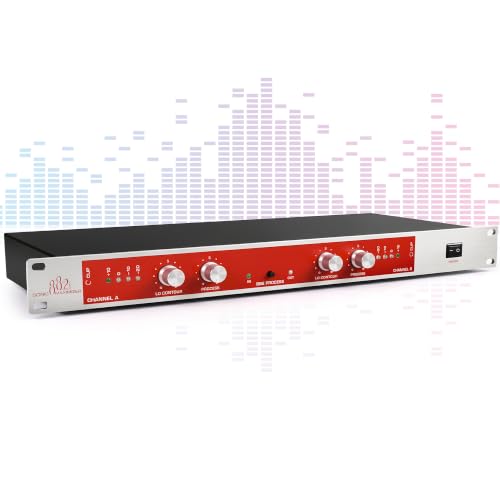
- Dual-channel independent rack control
- Balanced XLR and TRS connectivity
- Adds clarity, presence, and low-end depth
Best For: Studio, live, karaoke, and DJ signal chains
Best Budget Stereo Slider EQ
Rockville REQ20 Dual 10-Band EQ

- Dual 10-band graphic equalizers
- Blue-lit sliders and dual VU meters
- Stereo RCA input, output, and record output
Best For: RCA-based stereo and home audio rack systems
Best Feedback Control
dbx AFS2 Feedback Suppression Processor

- AFS2 Wizard simplifies setup
- 24 programmable filters per channel
- LCD, meters, XLR, and TRS connections
Best For: Live sound systems needing guided feedback suppression
Precision Control Pick
EQX-215S 15-Band Stereo Equalizer

- Dual 15-band graphic EQ control
- Adjustable low-cut and bass output
- XLR and 1/4-inch connectivity
Best For: Detailed stereo tuning with low-end management
Portable Modular Routing Pick
Midas LEGEND L6 500 Series Chassis

- Six-slot 500 Series chassis
- Advanced routing reduces cabling
- Portable design with carrying handle
Best For: Modular 500 Series processing setups
Low-Noise Rack Pick
EQ-215 15-Band Stereo Equalizer
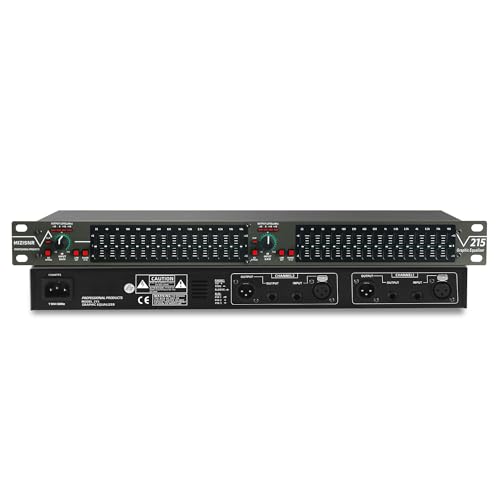
- Dual 15-band graphic equalization
- Low-cut switch for unwanted rumble and hum
- 1U rack-mount design with bypass
Best For: Practical stereo EQ and noise reduction
Peak-Control Rack Solution
EB831EQ Graphic Equalizer/Limiter
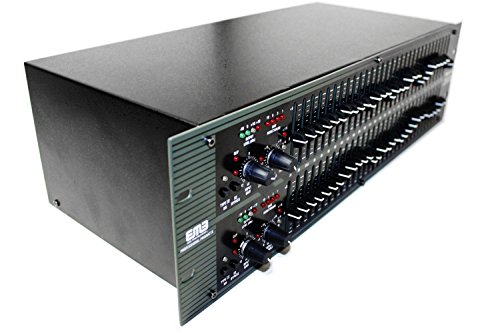
- Graphic EQ with integrated limiter
- Type 3 noise-reduction processing
- Rackmount design for varied audio systems
Best For: DJ, club, studio, stage, and home audio setups needing EQ and peak management
Flexible 15-Band Control

- Dual-channel 15-band graphic EQ
- Low-cut filter for unwanted low-frequency noise
- XLR and 1/4-inch input/output options
Best For: Home audio, live applications, installations, and studios needing practical stereo EQ
Visual Digital Processing
EQ315 31-Band Spectrum Equalizer

- 31-segment real-time LED spectrum display
- Bluetooth 5.2, USB playback, and 10 presets
- XLR, 1/4-inch, and adjustable bass output
Best For: Home theaters, KTV venues, studios, and DJs wanting visual EQ monitoring and flexible playback
Best Traditional Graphic EQ – dbx 1231 Dual 31-Band Equalizer
The dbx 1231 is a straightforward choice for rackmount audio equalizers when you want detailed, hands-on tone shaping. Its dual-channel, 31-band graphic layout provides extensive control, while the switchable boost/cut range lets you tailor how aggressively each band responds.
Best For: Stereo systems, live sound rigs, and users who prefer precise slider-based equalization.
Pros:
- Dual-channel design supports stereo signal processing.
- 31 bands per channel provide fine-grained frequency control.
- Switchable boost/cut range adds setup flexibility.
- Rack-oriented construction uses a stainless-steel material type.
Cons:
- Its 13.68-pound weight may be less convenient for highly portable rigs.
- Graphic sliders require more manual adjustment than automated processors.
Choose the 1231 if your priority is broad, visible control over two channels. It is a substantial rack unit, but its 31-band format is well suited to detailed system tuning.
Best Sonic Enhancer – 882i Professional Audio Exciter
The 882i takes a different approach to rackmount audio equalizers by combining harmonic enhancement with independent bass and treble controls. Its dual-channel 1U format, balanced connectivity, and low stated distortion make it suitable for adding presence and low-frequency depth in studio, live, karaoke, or DJ chains.
Best For: Users who want independent two-channel clarity, presence, and low-frequency enhancement rather than conventional multi-band graphic sliders.
Pros:
- Independent Channel A and Channel B controls.
- Provides treble, bass, and Lo Contour adjustments with processed/bypass switching.
- Balanced XLR and 1/4-inch TRS inputs and outputs support flexible integration.
- Standard 1U, 19-inch rack-mount metal enclosure.
Cons:
- It is a signal processor, not a power amplifier or standalone sound source.
- Its enhancement-focused controls are less granular than a 31-band graphic equalizer.
The 882i is a practical fit when you need fast, channel-independent tonal enhancement in a compact rack space. Plan the signal chain carefully, adding a power amplifier when driving passive speakers.
Best Budget Stereo Slider EQ – Rockville REQ20 Dual 10-Band EQ
Rockville REQ20 19" Rack Mount Pro Dual 10 Band Graphic Equalizer EQ w/VU Meters
Check Price On AmazonThe Rockville REQ20 is a practical option among rackmount audio equalizers for stereo systems that need visible, basic frequency adjustment. It offers two 10-band graphic equalizers, dual VU meters, and RCA connectivity for line-level sources, outputs, and recording.
Best For: Stereo RCA-based rack systems, home audio setups, and users who want simple visual level monitoring.
Pros:
- Dual 10-band layout provides 20 total bands of adjustment.
- 20Hz–20kHz frequency response covers the stated audio range.
- Blue LEDs illuminate each equalizer slide control.
- Includes stereo RCA input, output, and a separate record output.
Cons:
- RCA connectors may be less suitable for professional balanced installations.
- Ten bands per channel offer less detailed control than a 31-band equalizer.
The REQ20 makes sense when RCA compatibility and straightforward operation matter more than extensive professional connectivity. Its VU meters and illuminated sliders also make front-panel monitoring easy.
Best Feedback Control – dbx AFS2 Feedback Suppression Processor
The dbx AFS2 is a specialized choice among rackmount audio equalizers, focusing on feedback suppression rather than broad manual tone shaping. Its interactive LCD, setup wizard, input meters, and programmable filters help simplify feedback management in compatible professional audio systems.
Best For: Live sound users who need guided feedback suppression with visual monitoring and application-specific filter options.
Pros:
- AFS2 Wizard helps make setup more approachable.
- Provides 24 programmable filters per channel.
- Interactive LCD and filter metering make settings easier to monitor.
- XLR and 1/4-inch TRS connections support professional equipment integration.
Cons:
- It is designed for feedback suppression, not conventional graphic EQ control.
- The supplied dimensions list a 19-inch depth, which may require careful rack clearance planning.
Select the AFS2 when controlling unwanted feedback is the main priority. Its wizard and display make it a more guided solution than a traditional bank of manual EQ sliders.
Precision Control Pick – EQX-215S 15-Band Stereo Equalizer
For shoppers comparing rackmount audio equalizers, the EQX-215S combines dual-channel 15-band control with flexible connectivity and a dedicated subwoofer output. Its 1U rack-mount design suits home audio systems, DJ setups, live applications, studios, and installations.
Best For: Users who want detailed stereo tuning plus adjustable low-end management.
Pros:
- Provides 15 adjustable bands per channel with up to ±12dB of control.
- Includes low-cut control with an adjustable frequency knob for reducing unwanted low-end noise.
- Offers XLR balanced and 1/4-inch TRS unbalanced connections, plus a dedicated bass output.
- Fits a standard 1U rack space and includes a bypass-style EQ switch.
Cons:
- The supplied information does not specify frequency-band centers or detailed technical specifications.
- Its extensive controls may be more than needed for simple playback systems.
The EQX-215S is a feature-rich choice when connectivity and subwoofer control matter as much as graphic EQ adjustment. Consider it for systems that need flexible routing and hands-on stereo shaping in a compact rack format.
Portable Modular Routing Pick – Midas LEGEND L6 500 Series Chassis
Unlike a conventional graphic equalizer, the Midas LEGEND L6 is a portable 500 Series chassis for building a modular rackmount audio equalizer or processing setup. It holds six single-width modules and adds routing features designed to reduce cabling between compatible modules.
Best For: Engineers who need a portable six-slot 500 Series platform with flexible module routing.
Pros:
- Holds six single-width 500 Series modules.
- Advanced routing can reduce cabling complexity.
- Output Link switches support cable-free daisy-chain connections between modules.
- Compressor bus Link switches support stereo and multichannel dynamics side-chain linking.
Cons:
- It is a chassis, not a complete equalizer, so modules are required separately.
- The supplied notes do not list included modules or specific equalization controls.
- Its 9.7-pound weight may be less convenient than a smaller fixed-function unit.
The LEGEND L6 makes sense for modular users who want to choose their own 500 Series processing and simplify inter-module routing. Its carrying handle and free-standing chassis also support portable applications.
Low-Noise Rack Pick – EQ-215 15-Band Stereo Equalizer
The EQ-215 is a straightforward option for shoppers seeking rackmount audio equalizers with dual-channel graphic control. Its 15-band layout, low-cut switch, bypass switch, and 1U chassis make it suitable for home audio, DJ, live, studio, and installation use.
Best For: Users who want practical stereo EQ control and a simple way to reduce low-frequency noise.
Pros:
- Provides 15 bands per channel with an adjustable range of ±12dB.
- Low-cut switch helps attenuate wind noise, floor rumble, and electrical hum.
- Includes bypass for convenient system checks and comparison.
- Supports XLR balanced and 1/4-inch TRS unbalanced inputs and outputs.
Cons:
- The supplied details do not identify individual frequency centers.
- It does not list a dedicated bass or subwoofer output.
Choose the EQ-215 when you value essential graphic-EQ functions and noise reduction in a standard 1U format. It offers a focused feature set without the additional bass-output controls described for the EQX-215S.
Peak-Control Rack Solution – EB831EQ Graphic Equalizer/Limiter
The EMB Professional EB831EQ is a rackmount audio equalizer for systems that need hands-on tonal shaping plus basic peak management. Its graphic EQ, limiter, and Type 3 noise-reduction processing make it a practical fit for home audio, DJ rigs, studios, clubs, and live sound setups.
Best For: DJs, live sound operators, clubs, studios, and home systems needing EQ, limiter control, and noise reduction in one rack-format processor.
Pros:
- Combines graphic equalization and limiter processing.
- Type 3 NR processing helps reduce audible background noise in compatible signal chains.
- Rackmount design integrates with mixers, amplifiers, and other audio equipment.
- Useful across home, studio, club, stage, and DJ applications.
Cons:
- The unit weighs 13.67 pounds, making it heavier than the other listed options.
- Its feature set may be more extensive than needed for simple EQ-only setups.
Choose the EB831EQ when peak control and noise-reduction processing matter alongside frequency adjustment. It is especially suited to more demanding signal chains where a rackmount processor can serve several audio tasks.
Flexible 15-Band Control – EQ-215S Stereo Rack Equalizer
The EQ-215S is a straightforward rackmount audio equalizer for stereo systems that benefit from detailed, channel-by-channel adjustment. Its 15-band layout, low-cut filter, bypass switch, and multiple connection options support home audio, live applications, installations, and studio use.
Best For: Users who want dual-channel 15-band control, low-frequency noise attenuation, and flexible XLR or 1/4-inch connections in a 1U rack format.
Pros:
- Provides 15 adjustable bands on each stereo channel.
- Low-cut switch helps attenuate wind noise, floor rumble, and electrical hum.
- Includes bypass for convenient system debugging and comparison.
- Supports XLR balanced and 1/4-inch TRS unbalanced inputs and outputs.
Cons:
- It does not list built-in limiter processing or Bluetooth playback.
- Its 15-band layout offers less frequency segmentation than a 31-band equalizer.
The EQ-215S is a sensible choice when clean, manual stereo adjustment is the priority. The low-cut control and connection flexibility add practical value for installations and live signal chains without adding unnecessary complexity.
Visual Digital Processing – EQ315 31-Band Spectrum Equalizer
The EQ315 combines digital tone control with real-time LED spectrum display, making it a feature-rich rackmount audio equalizer for users who want to see frequency changes as they adjust them. Presets, bypass, Bluetooth 5.2, USB playback, and multiple outputs broaden its usefulness for home theaters, KTV venues, studios, and DJ equipment.
Best For: Home theater, KTV, studio, and DJ users who value visual frequency monitoring, preset modes, wireless playback, and detailed 31-band adjustment.
Pros:
- 31-segment LED spectrum indication provides real-time frequency-level feedback.
- Offers 10 preset modes, EQ bypass, and independent high, mid, and bass adjustment.
- Built-in Bluetooth 5.2 and USB playback support additional audio sources.
- Includes XLR and 1/4-inch connections plus an adjustable independent bass output.
Cons:
- The larger feature set may be unnecessary for users seeking only basic analog EQ.
- Wireless and USB functions add setup considerations beyond a simple rack equalizer.
The EQ315 stands out for its visual feedback and source flexibility. It is a strong match for systems where real-time monitoring, presets, and added playback options are as important as detailed frequency shaping.
How We Picked the Best Rackmount Audio Equalizers
We focused on practical features that matter in real installations: available frequency bands, channel configuration, rack compatibility, signal-routing flexibility, feedback control, metering, noise reduction, and ease of adjustment. We also considered whether each unit is better suited to live sound, DJ use, recording, home audio, or system tuning.
Because these products are not identical, the strongest choice depends on your signal chain. A traditional graphic equalizer offers immediate hands-on control, while a feedback suppressor or digital processor may be more useful when stability and automated correction are priorities.
Quick Comparison
| Best For | Features to Prioritize | Recommended Type |
|---|---|---|
| Live sound | Feedback control, clear metering, durable rack construction | Graphic EQ or feedback processor |
| DJ systems | Dual channels, simple sliders, subwoofer integration | 15- or 31-band stereo EQ |
| Recording studios | Low noise, accurate response, flexible routing | Professional graphic or modular processor |
| Home audio | Easy setup, noise reduction, display visibility | Stereo rackmount equalizer |
Key Buying Factors for Rackmount Audio Equalizers
Band Count and Control Resolution
More bands allow finer adjustments, but they also require more careful setup. A 31-band unit is useful for room correction and live-system tuning, while a 15-band model may be simpler for broad tonal shaping. Dual-channel designs are important for stereo systems.
Graphic EQ, Digital EQ, or Feedback Processor?
Graphic equalizers use dedicated sliders for fast, visual changes. Digital models may add displays, presets, spectrum analysis, and more precise adjustment. Feedback suppression processors are specialized tools that identify and reduce troublesome frequencies, making them particularly useful with microphones and powered speakers.
Connections, Rack Space, and Signal Flow
Check the input and output connectors against your mixer, amplifier, interface, or receiver. Confirm the unit’s rack width, mounting hardware, ventilation needs, and placement in the signal chain. A rackmount chassis is only convenient if its controls remain accessible and its connections match your system.
Noise, Metering, and Extra Processing
Noise reduction, limiters, exciters, VU meters, LCD screens, and subwoofer outputs can add value, but they should support—not complicate—the core job of equalization. Prioritize clean signal handling and useful monitoring over a long feature list.
Who Should Buy Which Rackmount Audio Equalizers?
Choose a classic dual-channel graphic EQ if you want direct, reliable control for a mixer or amplifier. Choose a 31-band model when you need detailed room or speaker tuning. DJs and home-audio users may prefer a 15-band stereo unit with straightforward controls and subwoofer support. For vocal-heavy live setups, a dedicated feedback suppression processor can be more practical than manual EQ alone. Finally, studios and modular-system users should prioritize low-noise operation, routing flexibility, and compatibility with existing rack or 500 Series equipment.