If you want to turn old 35mm slides and negatives into usable digital files on a Mac, the right scanner makes a big difference in image quality and workflow.
This roundup focuses on slide scanners for Mac that balance resolution, software compatibility, and ease of use so you can digitize family archives without unnecessary frustration.
Best 10 Slide Scanners for Mac Picks for 2026
Pro-Grade Detail

- 7200 dpi scanning for 35mm slides and negatives
- Infrared dust and scratch removal built in
- Mac OS 10.7 to 14.x support via downloadable driver
Best For: Mac users who want high-resolution 35mm slide and negative scanning with defect removal
All-in-One Convenience
Photo, Slide & Negative Scanner with 5" Large Screen

- Standalone scanning with no software or drivers needed
- 5-inch HD screen for previewing and basic edits
- Saves JPEGs to SD card for later Mac transfer
Best For: Families who want a simple standalone scanner for mixed memories
Big-Screen Simplicity
Magnasonic FS71 24MP Film Scanner

- 24MP scans of slides and multiple film formats
- 5-inch LCD with onboard image adjustments
- Saves to SD card for easy transfer to Mac
Best For: Users who want fast standalone scanning and simple Mac transfer
High-Capacity Standalone

- Supports 135mm, 110mm, and 126mm film and slides
- Saves directly to SD/SDHC cards up to 32GB
- 13MP sensor with 4208 x 3120 output
Best For: People who want quick standalone scanning with easy Mac transfer
Professional 35mm Detail Scanner

- 7200 DPI and 69 MP output
- Supports Mac OS 10.8.x through 13.x
- Includes SilverFast SE Plus software
Best For: Mac archiving of 35mm slides and negatives with maximum detail
Standalone Easy-Load Scanner
- 22MP scanner with 5-inch LCD
- Supports 135, 110, 126 film and 50mm slides
- Saves directly to SD card
Best For: Simple, self-contained scanning on Mac with minimal setup
Touchscreen Mac-Friendly Film Scanner
HP Film & Slide Scanner HPFS500
- Supports macOS 10.15 or later
- 5-inch touchscreen for preview and edits
- USB-C powered with SD card saving
Best For: Recent Mac users wanting a simple touchscreen scanner for mixed formats
Standalone Touch Scanner
13MP Slide Digitizer with 7-inch Touch LCD

- 7-inch touch LCD for preview and editing
- 13MP sensor handles color and black-and-white negatives
- USB and HDMI output for easy transfer or viewing
Best For: Mac users who want a simple, screen-based scanner for home archiving
High-Resolution Film Scanner
7200 dpi 35mm Slide Scanner with Mac Support

- Up to 7200 x 7200 dpi resolution
- Infrared dust and scratch removal included
- Bundled software supports Mac and Windows
Best For: Mac users who want higher-resolution 35mm slide and negative scanning
Easy-Use Home Digitizer
Compact 35mm Slide Scanner with 2.4-inch Screen

- Plug-and-play operation with no drivers required
- 2.4-inch screen for preview and basic edits
- USB transfer works with Mac and PC
Best For: Families or casual users who want a portable, no-software scanner for quick backups
Pro-Grade Detail – Plustek OpticFilm 8200i SE
If you’re comparing slide scanners for Mac and want maximum image quality, the Plustek OpticFilm 8200i SE is built for serious 35mm archiving. It scans mounted slides and negatives at 7200 dpi with 48-bit input, and its integrated infrared channel helps remove dust and scratches before you spend time retouching.
Best For: Mac users who want high-resolution 35mm slide and negative scanning with built-in defect removal.
Pros:
- 7200 x 7200 dpi output for 35mm film and mounted slides
- Integrated infrared dust and scratch removal
- 48-bit input with up to 3.6 dynamic range
- Supports Mac OS 10.7 to 14.x with driver download from Plustek
Cons:
- Focused on 35mm negatives and mounted slides, not broader film formats
- Requires driver/software setup from the manufacturer site
- Uses USB and desktop workflow rather than standalone scanning
For Mac users who care more about scan quality than convenience, this model offers a strong balance of resolution, correction tools, and software support. It is a better fit for restoration-minded archiving than for quick casual scans.
All-in-One Convenience – Photo, Slide & Negative Scanner with 5" Large Screen
This slide scanner for Mac is aimed at buyers who want a simple, standalone way to digitize older memories without installing software. It scans 35mm slides, 135 and 110 film negatives, printed photos, and business cards, then saves JPEGs to the included SD card for easy transfer later.
Best For: Families who want a no-computer, easy-to-use scanner for mixed photo and slide collections.
Pros:
- Standalone operation with no computer, apps, or drivers required
- Large 5-inch HD viewing screen for previewing and editing
- Handles slides, negatives, printed photos, and business cards
- Includes SD card, holders, trays, cleaning brush, and USB cable
Cons:
- Resolution is 1080P, so it is less detail-focused than higher-end scanners
- Best suited to convenient archiving rather than advanced editing workflows
- Mac use is mainly for USB transfer after scanning, not direct scanning control
If convenience matters more than absolute resolution, this is an easy pick. It is especially practical for people who want to scan at the device, then move files to a Mac afterward.
Big-Screen Simplicity – Magnasonic FS71 24MP Film Scanner
For Mac owners who want a straightforward slide scanner without a computer-heavy workflow, the Magnasonic FS71 keeps things simple. It converts several slide and film formats into 24MP JPEG files, lets you preview results on its 5-inch LCD, and saves directly to an SD card for easy moving to a Mac later.
Best For: Users who want fast, self-contained scanning for slides and film with simple file transfer to Mac.
Pros:
- Converts 35mm, 110, 126, Super 8 film and 135/126/110 slides
- 24MP output with onboard brightness, RGB correction, flip, and mirror controls
- 5-inch LCD for direct previewing and scanning without a computer
- SD card storage keeps the workflow portable and simple
Cons:
- Not designed for direct Mac-based scanning control
- Windows 7 is listed in the system requirements, but it is still primarily a standalone device
- 1-year warranty is shorter than some competing bundle options
This is a strong choice if your priority is fast digitizing rather than software-driven editing. It works well for users who want the scanner to do the heavy lifting and the Mac to handle storage and sharing afterward.
High-Capacity Standalone – KODAK Slide N Scan Max
The KODAK Slide N Scan Max is a practical slide scanner for Mac users who want a no-fuss way to digitize older film. It supports 135mm, 110mm, and 126mm film, saves directly to SD/SDHC cards, and uses a smooth-moving tray to reduce constant repositioning while you scan.
Best For: People who want quick, high-capacity standalone scanning with easy Mac file transfer.
Pros:
- Supports 135mm, 110mm, and 126mm slides and negatives
- Direct SD/SDHC saving keeps the workflow computer-free
- 13MP CMOS sensor with up to 4208 x 3120 output and 22MP interpolation
- Smooth-moving tray improves scanning efficiency
Cons:
- Not a Mac-tethered scanning solution; Mac use is mainly for transferring files
- SD/SDHC support is limited to 32GB cards
- Resolution is lower than dedicated high-end film scanners
This model makes sense if you want to process a lot of film without a complicated setup. It favors speed, convenience, and simple archiving over premium restoration features.
Professional 35mm Detail Scanner – Plustek OpticFilm 8100
If you want slide scanners for Mac with a more serious, detail-focused workflow, the Plustek OpticFilm 8100 is built for high-resolution 35mm film and slide digitizing. It supports Mac OS 10.8.x through 13.x and is aimed at users who want strong image quality, deep shadow and highlight capture, and software tools for careful post-processing.
Best For: Mac users archiving 35mm slides and negatives who want maximum scan quality and are comfortable using dedicated scanning software.
Pros:
- 7200 DPI / 69 MP resolution for high-detail 35mm scans
- 48-bit output and CCD sensor designed to capture shadow and light detail
- Includes Plustek QuickScan and SilverFast SE Plus software bundle
- Supports Mac OS 10.8.x through 13.x with downloadable driver
Cons:
- Limited to 35mm negatives and slides
- Requires software and driver setup, so it is less plug-and-play than LCD-based scanners
This is the strongest choice here for users who care more about scan quality than convenience. If your priority is pulling the most detail from old 35mm film on a Mac, this model is built for that job.
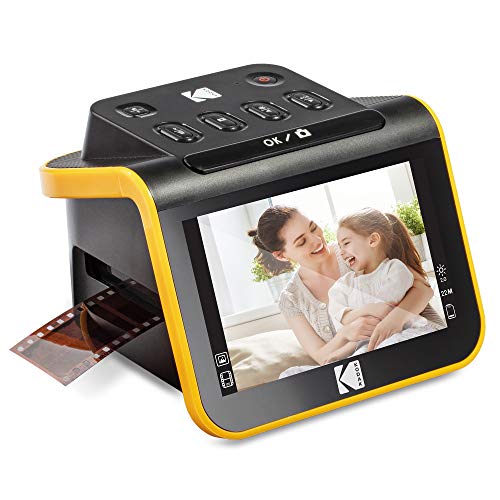
Standalone Easy-Load Scanner – KODAK Slide N Scan
The KODAK Slide N Scan is a practical pick if you want slide scanners for Mac that work more like a standalone photo appliance than a computer-driven workflow. It scans directly to an SD card, has a 5-inch LCD for previewing and editing, and connects to Type-C USB-enabled computers when needed.
Best For: Mac users who want a simple, self-contained scanner for converting old slides and negatives without dealing with complex software.
Pros:
- 22MP scanning with a 5-inch LCD for preview and editing
- Supports 135, 110, and 126 films plus 50mm slides
- Easy-load tray design speeds up batch scanning
- Can save scans directly to SD card and connects via USB or HDMI
Cons:
- Uses interpolation rather than a higher native-resolution film workflow
- SD card is not included
For Mac owners who value speed and simplicity, this model is easier to live with than a software-heavy scanner. It’s a solid fit when you want a compact, all-in-one way to digitize mixed film formats.
Touchscreen Mac-Friendly Film Scanner – HP Film & Slide Scanner HPFS500
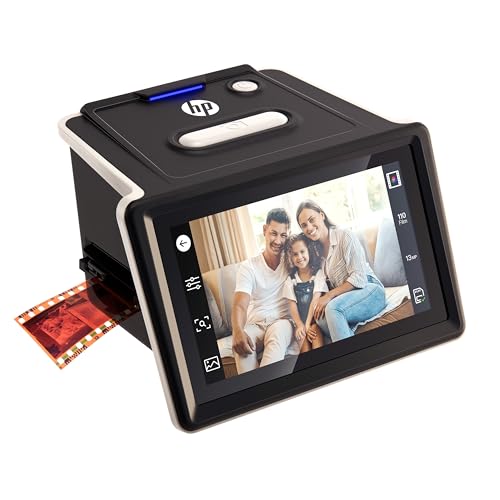
The HPFS500 is a convenient option in slide scanners for Mac if you want a compact, USB-C-powered unit that can preview and edit scans on the device itself. It supports macOS 10.15 or later, scans 135, 126, and 110 film and slides, and saves images directly to an SD card.
Best For: Mac users who want an easy touchscreen scanner for mixed slide and negative formats with modern USB-C power.
Pros:
- Supports macOS 10.15 or later
- 5-inch touch screen for previewing and editing on-device
- 13MP CMOS sensor with 22MP interpolation
- USB-C powered and compatible with SD card saving
Cons:
- Lower native resolution than higher-end film scanners
- Only covers 135, 126, and 110 formats
This model is best if you want a modern, straightforward scanner that works comfortably with a recent Mac. It prioritizes ease of use and quick digitizing over professional-level scan depth.
Standalone Touch Scanner – 13MP Slide Digitizer with 7-inch Touch LCD
If you want slide scanners for mac that also work as an all-in-one standalone workflow, the HP FilmScan is built for quick viewing, editing, and transfer without needing advanced setup. Its 7-inch touch LCD, 13MP sensor, and quick-feed tray make it practical for digitizing mixed 35mm-style collections at home.
Best For: Mac users who want a simple, screen-based scanner for old slides and negatives with easy on-device control.
Pros:
- 7-inch color touch display for previewing and editing scans directly on the scanner
- 13MP CMOS sensor for converting color and black-and-white negatives into digital files
- Quick-feed loading tray with 50mm adapter for 135, 126, and 110 formats
- USB and HDMI connections for computer transfer or TV viewing
Cons:
- Resolution is listed at 1200 dpi, which is lower than dedicated high-end film scanners
- Best suited to supported film formats rather than broader professional film workflows
Overall, this HP model is a convenient choice if you value speed and simplicity over deep software control. It works best as a straightforward digitizing tool for families and casual archivers who want their scans handled mostly on the device.
High-Resolution Film Scanner – 7200 dpi 35mm Slide Scanner with Mac Support
For buyers comparing slide scanners for mac, the Plustek OpticFilm 8300i SE stands out as a more advanced 35mm film and slide option with bundled software support. It offers high-resolution scanning, infrared dust and scratch removal, and Mac compatibility for users who want a more detailed archiving workflow.
Best For: Mac users who want higher-resolution 35mm slide and negative scanning with software tools included.
Pros:
- Up to 7200 x 7200 dpi resolution for detailed scans
- Infrared channel with SilverFast iSRD for dust and scratch removal
- Includes SilverFast SE Plus 9 and QuickScan Plus software
- Supports Mac OS 10.13 through 12.x and Windows systems
Cons:
- Designed for 35mm film strips and slides rather than larger formats
- Uses USB connection and software-based workflow, so it is less standalone than screen-equipped scanners
This Plustek is the most technical option in the group, making it a strong fit for users who care about scan quality and cleanup tools. If you want a Mac-compatible scanner with more serious digitizing features, it is the most specialized pick here.
Easy-Use Home Digitizer – Compact 35mm Slide Scanner with 2.4-inch Screen
If you need slide scanners for mac that are easy to use right out of the box, this DigitConvert model focuses on simple home archiving. It converts 35mm negatives and slides to JPEGs, shows previews on its built-in screen, and transfers files to a Mac over USB without requiring driver installation.
Best For: Families or casual users who want a portable, no-software scanner for quick slide-to-digital backups on Mac.
Pros:
- True plug-and-play operation with no complex software or drivers required
- Built-in 2.4-inch color screen for instant preview and basic edits
- USB transfer works with PC or Mac for easy backup and sharing
- Compact design with easy-load adapters for batch scanning
Cons:
- Requires a separate SD card up to 32GB for saving images
- Resolution is listed at 1800 dpi, which is modest compared with higher-end film scanners
- Supports 35mm negatives and slides rather than a wider range of film formats
As a budget-friendly, standalone digitizer, this scanner is all about convenience. It makes sense when you want a fast way to preserve old memories on a Mac without getting into a more complicated scanning setup.
How We Picked the Best Slide Scanners for Mac
We prioritized Slide Scanners for Mac that offer dependable Mac support, practical resolution for archival work, and simple scanning workflows. We also looked at whether each model is a true dedicated film scanner or a more convenient all-in-one unit, since that affects quality, speed, and long-term value.
Quick Comparison
Dedicated 35mm scanners are usually the best choice when maximum detail and color accuracy matter most. All-in-one scanners with a built-in screen are better if you want quick stand-alone operation and easier batch digitizing. If you are scanning a large family archive, speed and software efficiency matter just as much as headline DPI numbers.
Key Buying Factors for Slide Scanners for Mac
Mac Compatibility
Check for current macOS support, not just vague “Mac-compatible” claims. Some scanners rely on bundled software that may be limited on newer systems, while others work better with updated drivers or third-party scanning apps.
Resolution and Output Quality
For most users, real-world optical performance matters more than marketing numbers. Higher resolution helps with cropping and restoration, but 35mm slides usually benefit most from strong dynamic range, sharp optics, and consistent color handling.
Dust and Scratch Handling
Infrared dust removal can save a lot of editing time, especially for older slides and negatives. If your collection has visible wear, this feature is worth paying attention to.
Screen, Workflow, and Speed
Built-in displays make it easier to preview and scan without constantly switching back to your Mac. They are especially useful for casual users. Dedicated scanners may be slower to set up, but often deliver better detail for serious archiving.
Film Formats Supported
Make sure the scanner matches your collection. Some models focus on 35mm slides and negatives, while others also support 110, 126, and Super 8 formats. Buying the wrong format support is one of the easiest mistakes to avoid.
Who Should Buy Which Slide Scanners for Mac?
If you want the best image quality for a large archive, choose a dedicated 35mm scanner with strong software support. If you want the simplest experience and plan to digitize a mixed collection quickly, an all-in-one scanner with a display is usually the better fit. For users comparing Slide Scanners for Mac on a budget, the best value often comes from models that balance decent resolution, easy operation, and enough compatibility to avoid extra troubleshooting.