The best standalone DMX controllers make it easier to run lighting scenes, cues, and effects without relying on a computer during every performance. The right choice depends on your fixture count, required universes, programming workflow, and how much hands-on control you want.
This roundup covers compact scene recorders, traditional 192-channel consoles, advanced software-connected interfaces, and performance-focused controllers for clubs, stages, DJs, and small installations.
Best 10 Standalone Dmx Controllers Picks for 2026
Feature-Rich Choice

- Four-universe DMX support
- 37 backlit silicone buttons
- Four rotary encoders and four outputs
Best For: Multi-universe lighting operators who want dedicated physical controls
Software-Linked Pick
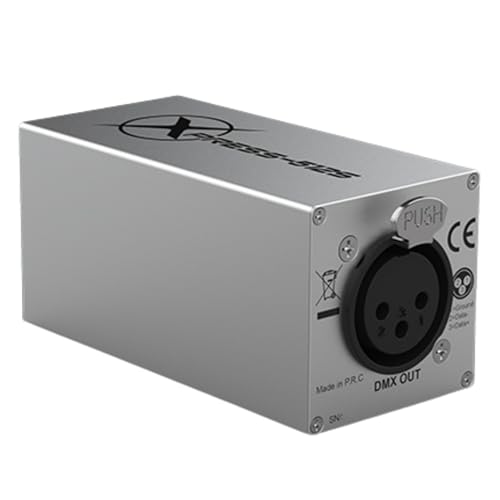
- Two-universe DMX and Art-Net control
- Standalone playback for one show
- Windows and Mac OS X compatibility
Best For: ShowXpress users needing portable control and backup playback
Traditional Console Value

- 192-channel lighting control
- Supports up to 240 scenes
- Controls up to 12 intelligent lights
Best For: Event and stage users who prefer physical scene controls
Playback Specialist

- Records up to 255 programs
- Removable 32GB microSD storage
- Packet-loss detection mode
Best For: Repeatable DMX playback, program backup, and signal testing
Best for DJ Lighting Control

- Two DMX universe inputs and outputs
- Tactile controls with touch strip and RGB pads
- Direct compatibility with Engine DJ devices
Best For: DJs and performers creating responsive SoundSwitch lighting shows
Best for Cue Playback
Pknight 5-Button Scene Recorder

- Five physical buttons for direct cue control
- Up to 10 actions using press and release triggers
- Records DMX512, Art-Net, and sACN signals
Best For: Venues needing simple, repeatable lighting scene playback
Best for Programmable DMX Scenes

- 384 DMX channels for stage-lighting control
- 30 banks with eight programmable scenes each
- LED gooseneck light and side handles included
Best For: Bars, clubs, and live stages using traditional DMX512 programming
Flexible Scene Control

- Controls up to 16 lights with 12 channels each
- Offers 240 scenarios and six chases
- Includes sound, MIDI, tap, and automatic modes
Best For: DJs, bands, venues, and event lighting setups
Compact Manual Control

- Manages up to 12 DMX512 channels
- Uses six sub-controls plus a master slider
- Portable aluminum design with 3-pin output
Best For: Small stages and portable low-channel lighting rigs
Beginner-Friendly Programming

- Controls 12 devices with 16 channels each
- Stores 240 scenes through programmable banks and chases
- Includes manual sliders and beginner-oriented controls
Best For: Beginners running small concerts, parties, and seasonal shows
Feature-Rich Choice – ADJ WMX1 Mk2
The ADJ WMX1 Mk2 is a practical pick among standalone DMX controllers for users who want dedicated hands-on control. It combines 37 backlit silicone buttons, four rotary encoders, and support for up to four universes in a compact controller.
Best For: DJs, performers, and lighting operators managing multi-universe setups without relying solely on a computer.
Pros:
- Supports up to four DMX universes.
- Provides four rotary encoders for control adjustments.
- Backlit buttons support operation in darker environments.
Cons:
- Its 37-button layout may require a learning period.
- The supplied details do not specify included lighting fixtures or software.
With four output sockets and a relatively compact 10-by-9.25-by-3.5-inch design, the WMX1 Mk2 offers substantial control in a manageable footprint. It is best suited to buyers who prioritize physical controls and expansion across multiple universes.
Software-Linked Pick – CHAUVET DJ Xpress-512S
The CHAUVET DJ Xpress-512S is a compact option among standalone DMX controllers, pairing ShowXpress software integration with standalone playback. Its self-contained aluminum interface supports two universes through DMX and Art-Net workflows.
Best For: ShowXpress users who need a lightweight interface with one-show playback when a computer is unavailable.
Pros:
- Supports two-universe control with DMX and Art-Net.
- Can store and play back one show without a connected computer.
- Works with Windows and Mac OS X and supports hot-swappable expansion.
Cons:
- Standalone playback is limited to one stored show.
- Its functionality is closely tied to ShowXpress software.
- It is a USB-powered interface rather than a full console-style controller.
At 2.9 inches and 3.2 ounces, the Xpress-512S is especially easy to transport. It makes the most sense for buyers already using ShowXpress who value portability and a backup playback mode.
Traditional Console Value – CO-Z 192 DMX Controller
The CO-Z 192 is a conventional choice among standalone DMX controllers, offering 192 channels for controlling up to 12 intelligent lights with as many as 16 channels each. Its physical controls are designed for scene-based operation across events and small-stage environments.
Best For: DJs, clubs, weddings, churches, and hobbyist lighting setups using multiple fixtures and programmed scenes.
Pros:
- Controls up to 12 fixtures and up to 240 scenes.
- Includes dedicated selection, scene, channel, speed, and function controls.
- Voice control is available for switching lighting scenes.
Cons:
- The console is relatively wide at 19.1 inches.
- Its plastic construction may feel less premium than metal-bodied alternatives.
- The supplied details do not specify computer or app control.
The CO-Z 192 emphasizes direct operation rather than compactness, with a 19.1-inch rectangular layout and upgraded buttons and control sticks. It is a sensible fit for buyers who prefer a traditional console and need generous scene capacity.
Playback Specialist – Pknight DMX Recorder
The Pknight DMX Recorder is a focused choice among standalone DMX controllers for capturing and replaying lighting programs. It records up to 255 programs, stores them on a removable 32GB microSD card, and supports standalone or external playback.
Best For: Installations, performers, and technicians who need repeatable DMX playback with portable storage and signal testing.
Pros:
- Records and plays back up to 255 programs.
- Includes removable 32GB microSD storage for backup and transfer.
- Offers packet-loss detection to help verify DMX signal reliability.
Cons:
- It is a recorder and playback unit rather than a full scene-programming console.
- The supplied details do not specify the number of physical DMX output connectors.
With an OLED screen, simple buttons, and support for external control from DMX consoles, software, or mobile apps, the Pknight is built around flexible playback. Its strengths are storage, repeatability, and troubleshooting rather than extensive live-mixing controls.
Best for DJ Lighting Control – SoundSwitch Control One
The SoundSwitch Control One is a strong option for DJs seeking standalone dmx controllers with hands-on control over programmed lighting effects. It also connects directly to compatible Engine DJ devices, while computer-based users can access broader software compatibility.
Best For: DJs and performers who want tactile control of SoundSwitch lighting, including mobile DJs, live audio users, and Engine DJ setups.
Pros:
- Provides two DMX universe inputs and outputs with a Thru option for installations.
- Offers dual USB ports for smoother DJ transitions and direct Engine DJ connectivity.
- Includes a touch strip, encoders, and customizable RGB performance pads for real-time adjustments.
- Supports live audio BPM detection and control of color, brightness, strobe, moving heads, and gobos.
Cons:
- Some expanded compatibility features require a laptop running SoundSwitch.
- Its feature set is closely tied to SoundSwitch workflows and compatible DJ hardware.
Control One is a versatile choice when you want performance-oriented lighting control rather than a basic scene-only console. Its tactile interface and broad lighting adjustments make it especially useful for DJs building dynamic shows.
Best for Cue Playback – Pknight 5-Button Scene Recorder
The Pknight 5-Button DMX Scene Recorder is designed for buyers who want standalone dmx controllers that simplify repeatable cue playback. After scenes are recorded, venue staff or performers can trigger them without keeping the original console, computer, or lighting software connected.
Best For: Clubs, bars, churches, weddings, exhibitions, small stages, and fixed installations needing straightforward scene recall.
Pros:
- Five physical buttons provide direct, tactile operation during live events.
- Each button can trigger a scene on press and another on release, allowing up to 10 programmable actions.
- Records DMX512, Art-Net, and sACN signals for compatibility with traditional and network-based workflows.
- Supports standalone playback for consistent repeated shows.
Cons:
- The five-button layout is intended for cue recall rather than broad, hands-on fixture programming.
- Scenes must be created and recorded from a console or software system before routine playback.
This controller is a practical bridge between professional lighting setup and simple day-to-day operation. It is most useful when a venue needs reliable cue access without assigning every operator a full lighting console.
Best for Programmable DMX Scenes – 384CH DJ DMX Controller
This 384-channel DMX controller suits buyers comparing standalone dmx controllers for programming scenes in bars, clubs, and live-show environments. Its bank-and-scene layout provides a structured way to build lighting looks and manage transitions without relying on a computer-based interface.
Best For: Stage-lighting operators who need 384-channel DMX512 control, multiple programmable banks, and scene playback for live shows.
Pros:
- Provides 384 DMX channels for control of larger lighting configurations.
- Offers 30 programmable banks with eight scenes each for organized show programming.
- Uses DMX512 control with a compact console design and side handles.
- Includes an LED gooseneck light to support operation in darker environments.
Cons:
- Its control system is based on DMX512 rather than the network protocols supported by some newer controllers.
- The console is relatively substantial, weighing about 6 pounds and measuring roughly 20.71 inches long.
For users who prefer a traditional lighting console, this model offers considerable scene capacity and channel control in a dedicated hardware format. It is a better fit for programmed stage looks than for software-driven or network-first lighting systems.
Flexible Scene Control – 192-Channel DMX Controller
For buyers comparing standalone dmx controllers, this 192-channel console offers broad fixture support with programmable scenes, chases, and several automatic control options. It can manage up to 16 lights with 12 channels each and connects through a standard 3-pin DMX cable.
Best For: DJs, bands, clubs, bars, weddings, and house parties needing multiple scenes and chase effects.
Pros:
- 192 channels can control up to 16 smart lights with 12 channels each.
- Provides 240 scenarios across 23 banks and six programmable chases.
- Supports microphone sound activation, MIDI beat activation, tap synchronization, and automatic operation.
- Compact aluminum housing supports wall or rack mounting.
Cons:
- Its extensive scene and chase features may require more setup than a basic controller.
- Designed for 3-pin DMX connections, so other connector types may need an adapter.
This is a versatile choice when you want standalone dmx controllers with substantial programming capacity and sound-responsive operation in a compact format.
Compact Manual Control – MAD OWL 12-Channel DMX Dimmer
This MAD OWL unit is a straightforward option among standalone dmx controllers for small lighting rigs. Its six sub-control sliders and one master slider provide manual control of up to 12 DMX512 channels through a standard 3-pin XLR output.
Best For: Small stages and portable setups using DMX512 fixtures with no more than 12 channels.
Pros:
- Simple layout with six sub-control push rods, a master control, and a blackout function.
- Compact, lightweight aluminum design is suited to travel and quick installation.
- Standard 3-pin DMX output connects easily to compatible equipment.
- Can serve as a permanent lighting control system when paired with a compatible DMX-controlled dimming power supply.
Cons:
- Cannot be used with stage lighting equipment requiring more than 12 channels.
- Provides manual channel control rather than the larger scene and chase capacity of 192-channel consoles.
Choose this controller if portability and uncomplicated slider-based operation matter more than advanced programming or high channel capacity.
Beginner-Friendly Programming – 192-Channel DMX Console
For shoppers seeking standalone dmx controllers for parties, shows, or small gatherings, this console combines 192 channels with programmable scenes and chases. Its labeled control areas, LED display, sliders, and 3-pin connection are designed to make basic programming accessible to beginners.
Best For: Beginners controlling up to 12 smart devices for concerts, festivals, parties, and seasonal displays.
Pros:
- Controls up to 12 devices with 16 channels each, totaling 192 channels.
- Includes 23 banks of eight programmable scenes and six programmable chases.
- Provides eight sliders for manual channel control plus speed and fade-time controls.
- Includes a 3-pin cable, power adapter, and stated 30-day return and 360-day repair support.
Cons:
- Its control capacity is limited to 12 devices and 192 channels.
- The listed warranty information is inconsistent: the notes state 360-day repair support while the product details list a 90-day manufacturer warranty.
This model is a practical entry point for users who want programmable lighting control without moving immediately to a more complex professional console.
How We Picked These Standalone Dmx Controllers
We focused on controllers that can create, store, trigger, or play back DMX lighting programs with minimal dependence on a computer. The selection spans simple 192-channel boards, compact dimming controllers, scene and cue recorders, and multi-universe systems. We considered channel capacity, fixture and scene support, playback controls, programming flexibility, portability, software compatibility, and suitability for common live-use environments.
Because DMX equipment varies widely in workflow, no single model is best for everyone. A small party setup may benefit from direct faders and simple scene buttons, while a club or production environment may need software integration, Art-Net, multiple universes, or more structured cue playback.
Quick Comparison
| Controller type | Best suited to | Main advantage | Potential limitation |
|---|---|---|---|
| 192-channel console | Small stages, DJs, and basic fixtures | Familiar fader-based operation | Limited fixture and programming flexibility |
| Scene recorder | Repeatable live shows | Fast playback of programmed looks | Less convenient for complex live edits |
| Software-connected interface | Clubs and production users | Advanced programming and multiple universes | Usually requires a computer for programming |
| Compact dimming controller | Small lighting rigs | Simple, portable control | Lower channel capacity |
Key Buying Factors for Standalone Dmx Controllers
Channel and Universe Capacity
Match the controller to the number of DMX channels your fixtures actually use. A 192-channel unit can be adequate for a few basic fixtures, but moving heads, pixel products, and complex LED fixtures may consume many channels each. If your system may grow, consider a higher-capacity controller or a two-universe option.
Programming and Playback
Check how scenes, chases, banks, and cues are stored and triggered. Faders offer direct adjustment, while dedicated buttons or playback controls are faster during a show. Confirm whether the controller can run programmed sequences independently after setup.
Fixture Compatibility
DMX512 compatibility does not guarantee an easy setup. Review the fixture’s channel map and determine whether the controller supports the required pan, tilt, color, gobo, dimmer, and effect channels. Controllers designed around generic channels may require more manual programming.
Connectivity and Software
For larger systems, look for DMX output count, USB or network connectivity, Art-Net support, and compatibility with the software you already use. A software interface can provide greater depth, but it may not be a truly computer-free solution for every task.
Portability and Live Usability
Mobile entertainers should prioritize a sturdy enclosure, clear controls, and quick access to blackout, scene, and chase functions. Rack or tabletop dimensions also matter when space is limited in a booth, rehearsal room, or small venue.
Who Should Buy Which Standalone Dmx Controllers?
Choose a basic 192-channel controller if you run a small rig of conventional lights or simple LED fixtures and want inexpensive, direct control.
Choose a scene or cue recorder if your shows follow repeatable lighting sequences and you need reliable playback without operating a computer throughout the event.
Choose a software-connected or multi-universe controller if you manage many fixtures, complex effects, or changing show designs and want room to expand.
Choose a compact dimming controller for a small stage, party setup, or straightforward dimmer-based system where portability and simplicity matter more than extensive programming.