Live streaming setups often need to send one camera or playback source to several destinations at once. The right distribution amplifier can preserve signal quality while feeding monitors, recorders, switchers, confidence displays, or capture equipment.
We selected 10 options spanning SDI, HDMI, composite video, and analog distribution. Use the guide below to match output count, signal format, resolution support, and installation needs to your production workflow.
Best 10 Video Distribution Amplifiers for Live Streaming Picks for 2026
Broadcast-Ready SDI Hub
Mini Converter SDI Distribution

- Eight re-clocked SDI outputs
- Supports SD, HD, and 3G-SDI
- Redundant input for critical setups
Best For: Professional SDI streaming and live-event systems
Compact Analog CCTV Splitter
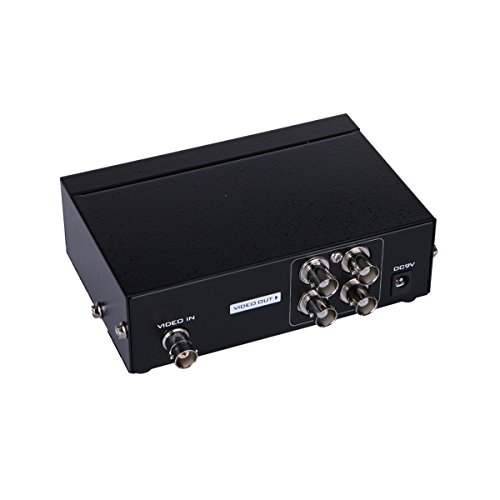
- One BNC input and four outputs
- Supports PAL, NTSC, and SECAM
- Plug-and-play metal housing
Best For: Analog CVBS monitoring and CCTV systems
HDMI Distribution Option

- Designed for HDMI distribution
- Compact 7.38-inch-wide form factor
- Lightweight at about 14.1 ounces
Best For: HDMI audio and video routing setups
Powered Composite AV Duplicator

- One RCA input to four outputs
- Amplifies analog A/V signals
- Includes AC 9V power adapter
Best For: Composite console, TV, projector, and capture-card setups
Best HDMI 2.1 Pick
AC-DA14-AUHD-GEN2 HDMI Distribution Amplifier

- 48 Gbps bandwidth for demanding HDMI 2.1 systems
- Custom EDID blending and extended EDID support
- Audio extraction up to 7.1 digital or 2-channel analog
Best For: HDMI 2.1 live streaming and next-generation displays
Best SDI Long-Distance Option
AVMATRIX SD1141 1×4 SDI Splitter

- Supports SD, HD, and 3G-SDI up to 1080p60
- Reclocks signals for extended cable runs
- Includes wall-mount bracket and three-year warranty
Best For: SDI live production and long-distance signal distribution
Best Basic Analog Video Splitter
Speco VIDDIST 1×4 Video Distribution Amplifier
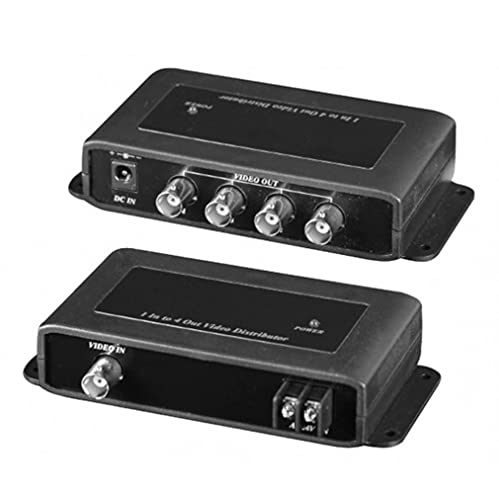
- Splits one video input to four outputs
- Supports 12V DC or 24V AC power
- Includes regulated 12V DC supply and red power indicator
Best For: Basic camera, DVR, multiplexer, and legacy video setups
Top SDI Pick
AVMATRIX SD1191 1×9 Distribution Amplifier

- 1 SDI input and 9 outputs
- Supports SD, HD, and 3G-SDI up to 1080p60
- Reclocking supports longer cable runs
Best For: Large SDI live-streaming and production setups
Compact Reclocking Choice
AJA D5DA 1×4 SDI Distribution Amplifier

- Compact 1×4 SDI design
- Automatic multi-standard operation
- Reclocking for signal repetition
Best For: Small SDI live-streaming and production systems
VGA Display Splitter
ConnectPRO VSE-105 5-Port VGA Amplifier

- One VGA input to 5 outputs
- Supports VGA, SVGA, and Multi-Sync
- Cascadable for more VGA outputs
Best For: Legacy VGA monitor distribution
Broadcast-Ready SDI Hub – Mini Converter SDI Distribution
For live streaming setups built around SDI, the Blackmagic Design Mini Converter SDI Distribution is a practical choice among video distribution amplifiers for live streaming. It accepts SD, HD, and 3G-SDI signals and distributes one input across eight re-clocked outputs.
Best For: Broadcast, live-event, and mission-critical SDI systems that need multiple stable outputs.
Pros:
- Supports SD, HD, and 3G-SDI with automatic format switching.
- Provides eight re-clocked SDI outputs for connecting multiple devices.
- Supports ASI, ancillary data, and embedded audio.
- Includes a redundant SDI input for critical applications.
Cons:
- Designed for SDI workflows rather than HDMI, RCA, or analog composite systems.
- Requires a 12-volt power supply.
Its broad SDI format support and redundant input make it especially well suited to professional streaming and event environments where signal continuity matters.
Compact Analog CCTV Splitter – 4-Port BNC Video Splitter
This 4-port BNC distributor is a straightforward option for analog video distribution amplifiers for live streaming when your source and displays use BNC composite connections. It splits one input to four outputs and supports resolutions up to 1080p at 60Hz according to the supplied notes.
Best For: Analog CCTV, monitoring, studio, and other CVBS systems using BNC connections.
Pros:
- Splits one BNC input to four outputs simultaneously.
- Plug-and-play installation requires no additional configuration.
- Metal housing is designed for stability, heat resistance, and continuous operation.
- Supports PAL, NTSC, and SECAM analog formats.
Cons:
- Not compatible with SDI or digital signals.
- Sources should be set to CVBS mode for compatibility.
Choose this model when your live video chain is analog and BNC-based. It is less suitable for modern digital streaming workflows that rely on SDI or HDMI.
HDMI Distribution Option – Kramer VM-2H2
The Kramer VM-2H2 is an HDMI distribution amplifier option for live streaming and video routing setups that use HDMI equipment. The supplied product information identifies it as an audio or video distribution product, making it worth considering when your workflow centers on HDMI connections.
Best For: HDMI-based audio and video distribution installations where a compact Kramer unit fits the system.
Pros:
- Designed for HDMI distribution applications.
- Compact dimensions of approximately 7.38 x 4.53 x 1 inches.
- Lightweight design at approximately 14.1 ounces.
Cons:
- The supplied notes do not specify output count, supported resolutions, or signal distance.
- Compatibility details beyond its HDMI distribution role are not provided.
Because the available specifications are limited, confirm the VM-2H2’s exact input/output configuration and format support before using it as the central splitter in a live streaming rig.
Powered Composite AV Duplicator – DTECH 4-Way RCA Splitter
The DTECH 4-Way RCA Splitter is a useful analog choice among video distribution amplifiers for live streaming when you need to send one composite video and stereo-audio source to several destinations. Its powered design amplifies the RCA signal for clearer long-distance connections.
Best For: Gaming consoles, TVs, projectors, speakers, and capture cards using three-RCA composite connections.
Pros:
- Splits one composite A/V input into four outputs.
- Powered signal amplification helps maintain video and audio over longer connections.
- Color-coded RCA ports and an LED indicator simplify setup.
- Durable metal housing with anti-skid feet supports stable placement and heat dissipation.
Cons:
- Limited to analog composite RCA connections.
- Does not include switches for selecting outputs.
- Requires the included AC 9V power adapter.
This is a practical fit for legacy or consumer AV gear, but digital HDMI and SDI workflows will need a different distribution format.
Best HDMI 2.1 Pick – AC-DA14-AUHD-GEN2 HDMI Distribution Amplifier
For live streaming setups built around newer HDMI sources and displays, the AC-DA14-AUHD-GEN2 is a strong choice among video distribution amplifiers for live streaming. Its 48 Gbps bandwidth, HDMI 2.1b gaming support, and EDID tools are suited to demanding signal chains.
Best For: HDMI 2.1 systems, next-generation displays, and setups that need flexible EDID management.
Pros:
- 48 Gbps bandwidth with Fixed Rate Link 6 support.
- Custom EDID blending and extended 4-block EDID support.
- Extracts audio as up to 7.1 digital or 2-channel analog audio.
Cons:
- Requires a 12V DC power supply.
- Designed for HDMI distribution rather than SDI workflows.
Choose this model when compatibility with high-bandwidth HDMI 2.1 sources is more important than supporting SDI equipment. The included mounting brackets also make it practical for a more permanent installation.
Best SDI Long-Distance Option – AVMATRIX SD1141 1×4 SDI Splitter
The AVMATRIX SD1141 is a practical option for SDI-based live streaming systems. This 1-input, 4-output distribution amplifier automatically detects SD, HD, and 3G-SDI signals and reclocks each output for more reliable long-distance transmission.
Best For: SDI camera workflows, production installations, and cable runs requiring extended transmission distances.
Pros:
- Supports SD, HD, and 3G-SDI signals up to 1080p at 60Hz.
- Signal reclocking supports transmission up to 400m for SD, 200m for HD, and 120m for 3G-SDI.
- Outputs 2 and 4 support DVB-ASI signals.
- Includes a detachable wall-mounting bracket and three-year warranty.
Cons:
- Uses SDI connectors rather than HDMI.
- Requires a 17V DC input.
For SDI-centered streaming and broadcast setups, the SD1141 offers useful signal conditioning and installation flexibility. It is especially well suited to distributed camera or production systems where cable distance matters.
Best Basic Analog Video Splitter – Speco VIDDIST 1×4 Video Distribution Amplifier
The Speco VIDDIST is a straightforward choice for simpler camera and recording installations. As one of the more basic video distribution amplifiers for live streaming, it can connect a video camera, multiplexer, VCR, or DVR to four outputs and includes a regulated 12V DC power supply.
Best For: Basic analog video distribution involving cameras, DVRs, multiplexers, or legacy video equipment.
Pros:
- Provides one input and four video outputs.
- Works with 12V DC or 24V AC power.
- Includes a regulated 12V DC power supply.
- RoHS compliant with a visible red power indicator.
Cons:
- Its notes do not specify HDMI, SDI, or modern high-bandwidth support.
- More suitable for basic or legacy video equipment than advanced streaming systems.
The VIDDIST makes the most sense when your workflow uses compatible conventional video hardware and you need a simple four-way split. For HDMI 2.1 or SDI production, one of the other purpose-built options is a better fit.
Top SDI Pick – AVMATRIX SD1191 1×9 Distribution Amplifier
For live-streaming setups that need to feed several SDI destinations, the AVMATRIX SD1191 is a practical choice among video distribution amplifiers for live streaming. It accepts one SDI input and provides nine outputs, with support for SD, HD, and 3G-SDI signals up to 1080p at 60 Hz.
Best For: Long-distance SDI distribution in broadcast, production, command-and-control, and medical-imaging environments.
Pros:
- One input and nine outputs for broad signal distribution.
- Automatic detection of HD-SDI, SD-SDI, and 3G-SDI signals.
- Built-in reclocking and equalization support longer cable runs.
- Detachable wall-mount bracket and stated technical support coverage.
Cons:
- Designed for SDI rather than VGA or other display interfaces.
- Requires the included 12V power adapter.
Choose the SD1191 when output count and signal integrity over longer SDI cable runs matter more than having a compact 1×2 or 1×4 design.
Compact Reclocking Choice – AJA D5DA 1×4 SDI Distribution Amplifier
The AJA D5DA is a compact option for video distribution amplifiers for live streaming when four SDI outputs are sufficient. Its 1×4 design, automatic multi-standard operation, and reclocking make it suitable for repeating an SDI feed to multiple destinations.
Best For: Compact SDI installations that need four outputs and signal repetition.
Pros:
- Compact 1×4 SDI distribution amplifier format.
- Reclocking helps repeat the SDI signal.
- Automatic multi-standard operation simplifies compatibility.
Cons:
- Provides fewer outputs than a 1×9 distribution amplifier.
- The supplied notes do not specify supported SDI resolutions or cable distances.
The D5DA is a straightforward fit when you want AJA’s compact, automatic multi-standard SDI repeater design without needing a larger output bank.
VGA Display Splitter – ConnectPRO VSE-105 5-Port VGA Amplifier
For older or VGA-based live-streaming and presentation systems, the ConnectPRO VSE-105 offers a simple alternative among video distribution amplifiers for live streaming. It duplicates one VGA input across five outputs and supports VGA, SVGA, and Multi-Sync monitors.
Best For: VGA display distribution across multiple monitors, especially where cable runs reach up to 65 meters.
Pros:
- Duplicates one VGA input to five outputs.
- Supports VGA, SVGA, and Multi-Sync monitors.
- Supports cascaded operation for additional VGA outputs.
- Includes an optimized port for DDC-compatible output.
Cons:
- Uses VGA rather than SDI or modern digital video connections.
- Its stated effective transmission distance is 65 meters.
The VSE-105 makes sense when the source and displays are VGA-based; it is less suitable for newer SDI-centered broadcast workflows.
How We Picked the Best Video Distribution Amplifiers for Live Streaming
We focused on signal-management needs that matter in real streaming and video-production environments: input and output format, output count, supported resolution and signal standards, connector type, power requirements, and suitability for rack, studio, mobile, or security-video installations. The selection includes compact splitters and professional distribution amplifiers for SDI, HDMI, composite video, and analog audio/video.
A distribution amplifier should do more than duplicate a signal. It should provide stable, simultaneous outputs without introducing unnecessary degradation, while fitting the cabling and equipment already in your workflow.
Quick Comparison
| Type | Typical Use | Output Range | Best For |
|---|---|---|---|
| SDI | Professional cameras and broadcast gear | 4 to 9 outputs | Longer cable runs and reliable studio distribution |
| HDMI | Modern cameras, switchers, displays, and capture devices | 2 to 4 outputs | Consumer and prosumer streaming systems |
| Composite video | Legacy cameras, gaming, and monitoring systems | 4 outputs | Standard-definition equipment |
| Analog video | CCTV and older production installations | Multiple outputs | Existing surveillance or analog infrastructure |
Key Buying Factors for Video Distribution Amplifiers for Live Streaming
Match the Signal Format
Choose an amplifier with the same format as your source and destination equipment. SDI models are generally the best fit for professional broadcast cameras and production hardware, while HDMI models suit many desktop, gaming, mirrorless-camera, and home-studio systems. Composite and analog units are useful only when your equipment uses those legacy connections.
Check Resolution and Standard Support
Confirm whether the unit supports SD, HD, 3G-SDI, or the HDMI resolution and refresh rate you plan to distribute. A splitter cannot increase the source resolution, and every connected device should be compatible with the distributed signal.
Count Outputs and Plan for Expansion
Four outputs cover many small studios, but nine-output models make more sense for larger control rooms, monitoring walls, and multi-destination feeds. Leave room for future displays or recorders if your setup is likely to grow.
Consider Cabling, Power, and Placement
Review connector type, cable length, power-adapter requirements, and enclosure size before buying. SDI is often preferable for longer professional runs, while HDMI installations may require shorter cables or additional signal-management hardware. For permanent systems, mounting and ventilation can be as important as the port count.
Who Should Buy Which Video Distribution Amplifiers for Live Streaming?
Choose an SDI distribution amplifier for broadcast cameras, live-event production, studio switchers, and workflows using 3G, HD, or SD-SDI. Models with four outputs suit compact rigs; nine-output options are better for multiple monitors and destinations.
Choose an HDMI model for streaming computers, game consoles, modern cameras, consumer displays, or HDMI capture devices. Pay particular attention to resolution compatibility and cable distance.
Choose a composite or analog splitter when working with older cameras, CCTV systems, legacy gaming hardware, or standard-definition monitors. These are practical for existing equipment but are not a substitute for an HD or SDI upgrade.
Before ordering, verify every connector, video standard, output count, and power requirement against your source and destination devices. That simple compatibility check is the best way to avoid adapters, signal failures, or an amplifier that cannot support your intended live-streaming workflow.