The best video switchers make multi-camera production faster, cleaner, and easier to manage. They let you cut between HDMI or SDI sources, monitor feeds, and send a polished program output to a display, recorder, or streaming platform.
This roundup compares 10 video switchers across portable streaming, classroom production, live events, and more demanding broadcast-style setups. Use the guide below to match inputs, resolution, audio features, recording, and workflow to your needs.
Best 10 Video Switchers Picks for 2026
Best All-Around HDMI Pick

- Four HDMI inputs with multiview
- Built-in streaming and recording
- Transitions, keying, and audio mixing
Best For: Compact HDMI multicamera productions
Best Integrated Production Console

- Six HDMI and USB video sources
- Studio-grade dual XLR audio inputs
- Scenes, overlays, streaming, and ISO recording
Best For: Video productions with serious audio needs
Best for Flexible Streaming

- Four HDMI inputs and dual HDMI outputs
- Streams to three platforms via Ethernet
- Recording, playback, keying, and T-bar control
Best For: Flexible events and social-media productions
Best Touchscreen Hybrid Switcher

- 10.1-inch touchscreen with T-bar control
- Four HDMI plus one SDI input
- Chroma key, logo overlay, and USB output
Best For: Mixed HDMI/SDI multicamera setups
Versatile Production Hub

- Four SDI and four HDMI inputs plus USB-C
- Supports NDI HX, portrait video, and media playback
- Streams to up to three platforms simultaneously
Best For: Mixed-camera live streams and flexible small-production setups
Compact Touchscreen Choice
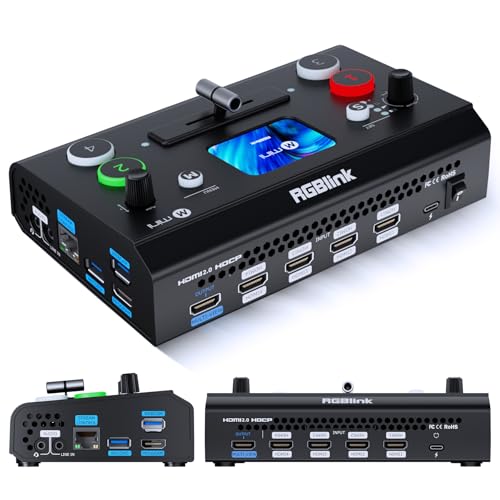
- Four HDMI inputs with dual 1080p outputs
- 2.1-inch touch screen and T-bar control
- UVC webcam mode and USB recording support
Best For: Entry-level HDMI multi-camera streaming
Professional Hybrid Recorder

- Four HDMI and four 3G-SDI inputs
- Records eight ISO feeds plus program output
- Built-in dual XLR audio and network streaming
Best For: Professional events, churches, podcasts, and multi-camera productions
Best Compact HDMI Pick

- Four HDMI inputs with up to 2K support
- USB 3.0 webcam output for streaming software
- Built-in transitions, PIP, and remote LAN control
Best For: Solo streamers using HDMI cameras and a computer
Best Portable Monitoring Pick

- Built-in 4-inch multiview display
- Four HDMI inputs with zero-latency switching
- PTZ control, keying, PIP, and customizable AUX output
Best For: Portable multi-camera events and online classes
Best Professional Hybrid Pick

- Combines four HDMI and four SDI inputs
- Supports network streaming, USB output, and dual recording
- Includes PTZ, NDI|HX3, and 5.5-inch monitoring
Best For: Professional events, churches, studios, and conferences
Best All-Around HDMI Pick – ATEM Mini Pro
The Blackmagic Design ATEM Mini Pro is one of the more feature-rich video switchers for compact multicamera productions. It combines four HDMI inputs with built-in streaming, recording, multiview monitoring, transitions, keying, and audio mixing in a small unit.
Best For: Education, business presentations, livestreamed esports, and other HDMI-based multicamera streams.
Pros:
- Four HDMI inputs support multicamera live production.
- Built-in streaming, recording, and four-camera multiview capabilities.
- Includes transitions, upstream and downstream keyers, and a six-input audio mixer.
- USB-C webcam output works with compatible streaming setups.
Cons:
- Inputs are HDMI only, with no SDI connection listed.
- Its feature set may be more than needed for simple single-camera streaming.
Choose this model if you want a compact HDMI switcher that can handle video switching, audio, monitoring, recording, and streaming without requiring a large production system.
Best Integrated Production Console – RØDECaster Video
The RØDE RØDECaster Video is a video switcher and audio interface designed for productions that need both video control and studio-style sound. It switches up to six sources, supports customizable scenes and overlays, and can stream or record directly from the unit.
Best For: Creators and production teams combining multicamera video with XLR microphones, instruments, scenes, and advanced audio control.
Pros:
- Supports four HDMI and two USB video sources.
- Includes seven customizable multi-source scenes, media playback, overlays, transitions, and automatic chroma keying.
- Two Neutrik combo inputs use high-gain Revolution Preamps for XLR sources.
- Supports direct streaming, external USB recording, and isolated recording for post-production.
Cons:
- It is a corded, dedicated production console rather than a minimal portable switcher.
- Its broad audio and scene features may be unnecessary for basic camera switching.
This is a strong choice when your video switcher also needs to serve as the central audio and streaming hub, especially for productions using microphones, scenes, and recorded source files.
Best for Flexible Streaming – Osee GoStream Deck
The Osee GoStream Deck is a versatile video switcher for users who want direct streaming, recording, playback, and hands-on control. Its four HDMI inputs, dual outputs, portrait and landscape support, and built-in audio controls make it suitable for a range of live productions.
Best For: Conferences, worship services, podcasts, weddings, education, and other streams needing flexible output and production controls.
Pros:
- Four HDMI inputs and two HDMI outputs support multicamera monitoring.
- Can stream to three platforms through Ethernet or connect to OBS and vMix through USB.
- Supports SD card or USB SSD recording and MP4 playback during production.
- Includes T-bar control, macros, chroma key, picture-in-picture, graphics overlays, and auto-switching.
Cons:
- The product’s many controls and functions may require a learning period.
- Its listed camera inputs are HDMI, so it is not intended for SDI-only cameras.
The GoStream Deck stands out among video switchers for built-in workflow flexibility. It is especially appealing if you need direct multistreaming, portrait video, playback, and physical production controls in one device.
Best Touchscreen Hybrid Switcher – FEELWORLD L4
The FEELWORLD L4 is a hybrid video switcher for operators who want touchscreen control alongside physical buttons and a T-bar. It supports four HDMI and one SDI input, real-time preview, chroma keying, logo overlays, and USB output for compatible streaming software.
Best For: Multicamera productions that mix HDMI and SDI sources and benefit from an integrated touchscreen interface.
Pros:
- Five camera inputs include four HDMI and one SDI connection.
- Large 10.1-inch touchscreen provides an intuitive menu and preview interface.
- Supports chroma keying, logo overlays, and T-bar switching.
- Offers HDMI, SDI, and USB 3.0 outputs for monitoring and streaming workflows.
Cons:
- The supplied notes do not list built-in direct internet streaming.
- Its format support should be checked carefully against the connected cameras and displays.
Consider the L4 if touchscreen operation and mixed HDMI/SDI connectivity matter more than having an all-in-one internet streaming platform. Its preview tools and keying features suit hands-on live production.
Versatile Production Hub – Osee GoStream Duet
Osee GoStream Duet Multiple Camera SDI and HDMI Live Stream Video Mixer Switcher
Check Price On AmazonThe Osee GoStream Duet is one of the more flexible video switchers for mixed-camera productions. It combines four SDI inputs, four HDMI inputs, USB-C, NDI HX sources, and media playback, while supporting both landscape and portrait workflows.
Best For: Creators and small production teams needing broad input compatibility, multiple control options, and direct streaming to several platforms.
Pros:
- Accepts SDI, HDMI, USB-C, NDI HX, and playback sources.
- Supports landscape and portrait inputs and outputs.
- Offers GUI, computer-software, and Bitfocus Companion control.
- Can stream to up to three platforms simultaneously.
Cons:
- Some NDI HX functionality requires downloading the latest firmware.
- Its extensive features may require setup time for new users.
With keying, picture-in-picture, layered effects, several transition styles, and direct or software-based streaming, the GoStream Duet is a strong all-around option for growing live productions.
Compact Touchscreen Choice – RGBlink Mini V3 4K Switcher
The RGBlink Mini V3 is a compact HDMI-focused option for live streaming and multi-camera work. Its four HDMI inputs, 2.1-inch touch screen, dual HDMI outputs, and UVC webcam mode make it practical for creators who want a straightforward video switcher with room to add features.
Best For: Entry-level creators and small setups using HDMI cameras, computers, or camcorders.
Pros:
- Provides four HDMI inputs and dual 1080p HDMI outputs.
- Includes a 2.1-inch touch screen and professional T-bar.
- Supports UVC webcam mode for compatible streaming platforms.
- Can record to USB drives up to 2TB.
Cons:
- Recording and selected advanced effects require optional TAO Cloud activation.
- Premium functions use monthly or lifetime licensing plans.
- A 35W or higher USB-C power adapter is recommended for stable operation.
The Mini V3 balances portability and control, but buyers should account for the activation process and potential licensing costs when comparing its feature set with other video switchers.
Professional Hybrid Recorder – Osee GoStream Duet 8 ISO
The Osee GoStream Duet 8 ISO is built for larger, more demanding productions that need HDMI and SDI connectivity in one chassis. Along with eight camera inputs, it adds XLR audio, ISO recording, network video support, and direct streaming to up to three RTMP destinations.
Best For: Churches, event crews, podcasts, panels, and production teams that need isolated recordings and professional audio control.
Pros:
- Combines four HDMI 2.0 inputs with four 3G-SDI inputs.
- Records eight ISO feeds plus the program output.
- Provides XLR and 3.5mm audio connections with processing tools.
- Supports NDI HX, SRT, RTMP, UVC, and up to three RTMP destinations.
Cons:
- Outputs are specified at 1080p despite HDMI input support up to 4K60.
- Its expanded recording, networking, and audio feature set may be more than basic streamers need.
For productions where recovery footage, flexible camera formats, and clean audio matter, the Duet 8 ISO offers a more complete workflow than a basic live-cut switcher.
Best Compact HDMI Pick – RGBlink Mini Video Mixer
For creators looking for approachable video switchers, the RGBlink Mini combines four HDMI inputs with USB 3.0 webcam output in a compact design. It supports 2K input and output, making it a practical fit for solo streaming and multi-camera setups using platforms or software such as OBS and vMix.
Best For: Solo streamers and creators who want simple four-camera HDMI switching with computer-based streaming.
Pros:
- Four HDMI inputs support multi-camera productions at up to 2K.
- USB 3.0 output is recognized as a webcam by streaming software.
- Includes 14 transition effects, nine picture-in-picture layouts, and LAN-based remote control.
- Supports audio embedding and de-embedding.
Cons:
- Onboard recording requires the Mini-Pro or a higher model.
- Its feature set is oriented toward HDMI sources rather than SDI workflows.
The RGBlink Mini is a sensible choice when portability and straightforward computer streaming matter most. Its four inputs and built-in production tools offer useful flexibility, while the lack of onboard recording may matter to users who need a self-contained recording workflow.
Best Portable Monitoring Pick – Mixer Plus Compact Switcher
The Mixer Plus is one of the more self-contained video switchers for portable productions, pairing four HDMI inputs with a built-in 4-inch screen. Its multiview monitoring, scene presets, keying tools, and customizable AUX output make it useful for live events, online classes, and multi-camera streaming.
Best For: Mobile production teams and streamers who want integrated monitoring and broadcast-style controls in a compact unit.
Pros:
- Built-in 4-inch display provides real-time multiview monitoring.
- Four HDMI inputs offer zero-latency switching and 30 transition effects.
- Includes chroma key, luma key, PIP, DSK, logo overlay, and four scene presets.
- Supports VISCA-over-IP PTZ control for up to four cameras.
Cons:
- It is limited to four HDMI inputs.
- The supplied notes do not specify onboard recording or direct streaming capabilities.
The built-in screen is the main advantage of the Mixer Plus, reducing the need for a separate multiview monitor. Its extensive switching and compositing tools suit more involved productions, although buyers should confirm their preferred streaming and recording workflow before choosing it.
Best Professional Hybrid Pick – Tenveo PC500 Video Switcher
For demanding productions, the Tenveo PC500 is a professional-class option among video switchers, combining HDMI and SDI connectivity with a 5.5-inch display, streaming, recording, and PTZ control. It supports up to 4K60 input on designated HDMI connections while producing 1080p60 output, making it suitable for larger live-production workflows.
Best For: Churches, studios, conferences, events, and production teams needing hybrid HDMI/SDI connectivity, streaming, and recording.
Pros:
- Provides four SDI inputs, four HDMI inputs, USB input, and NDI|HX3 support.
- Supports UVC, SRT, RTMP, RTSP, and NDI|HX3 streaming, including two platforms simultaneously.
- Offers USB and SD-card or USB-disk recording with separate recording and streaming bitrates.
- Includes PTZ control for up to four cameras, presets, cruise tracks, and AI-tracking triggers.
Cons:
- Maximum output is 1080p60 even though selected inputs support 4K60.
- The broad feature set may be more than small or simple streaming setups require.
- Its hybrid SDI/HDMI workflow may involve more setup than an HDMI-only switcher.
The PC500 stands out when a production needs connectivity, recording, network streaming, and camera control in one device. It is a strong fit for professional environments, but smaller creator setups may prefer a simpler switcher with fewer configuration demands.
How We Picked the Best Video Switchers
We focused on the features that have the greatest effect on real-world production: input type and count, supported resolutions and frame rates, preview and program monitoring, streaming or recording options, audio connectivity, portability, and ease of operation. The list includes compact HDMI switchers for creators and classrooms, as well as larger HDMI/SDI models for events and professional multi-camera systems.
Because specifications and included accessories can vary, confirm the current manufacturer listing before buying—particularly for 4K support, ISO recording, USB output, SDI standards, and audio connections.
Quick Comparison
| Best For | Prioritize | Typical Input Choice |
|---|---|---|
| Solo creators and basic streams | Simple controls, USB output, built-in streaming | HDMI |
| Classrooms and presentations | Quick switching, multiview, reliable preview | HDMI |
| Live events and venues | More inputs, scaling, audio flexibility | HDMI or mixed HDMI/SDI |
| Professional post-production | ISO recording, time-saving workflows, robust I/O | SDI or mixed HDMI/SDI |
Key Buying Factors for Video Switchers
Inputs, Formats, and Scaling
Count the cameras, computers, and playback devices you expect to connect, then leave room for expansion. HDMI is common and convenient for cameras and laptops, while SDI is better suited to long cable runs and production environments. If sources use different resolutions or frame rates, look for a switcher with input scaling and format conversion.
Resolution and Frame Rate
A switcher marketed as 4K may support 4K only on certain inputs or outputs, while the live-stream output may remain 1080p. Check the exact limits for HDMI, SDI, USB, recording, and program output. For fast motion, sports, and gaming, verify whether 60 frames per second is supported throughout your workflow.
Monitoring and Operation
A multiview display showing preview, program, audio meters, and source labels can prevent mistakes during a live show. Touchscreens are convenient in compact setups, while physical buttons, faders, and dedicated transition controls may be faster under pressure.
Audio, Streaming, and Recording
Consider whether you need HDMI-embedded audio, microphone or XLR inputs, audio mixing, direct network streaming, USB webcam output, or recording to removable media. ISO recording is especially useful when you want separate camera files for editing, but it generally increases storage requirements and workflow complexity.
Who Should Buy Which Video Switchers?
Choose a compact HDMI model if you stream from a desk, teach online, present from multiple computers, or use a small number of consumer cameras. Move to a switcher with more inputs and stronger monitoring for houses of worship, conferences, school productions, and recurring events. Mixed HDMI/SDI models make the most sense when you combine consumer cameras with professional cameras or need dependable long-distance cabling. If you regularly edit live productions afterward, prioritize ISO recording and flexible audio over the smallest footprint.