Wireless video can simplify a home studio by connecting cameras, preview monitors, projectors, and capture setups without running long HDMI or SDI cables across the room. The right transmitter depends on more than advertised range: resolution, latency, signal stability, compatibility, and receiver capacity all affect the real-world experience.
We selected 10 systems spanning basic 1080p home use, multi-monitor workflows, live streaming, and professional camera production. Use the guide below to narrow the choices by your equipment, room layout, and budget.
Best 10 Video Transmitters for Home Studios Picks for 2026
Best Overall
Hollyland Pyro H Wireless HDMI System

- 4K30 dual-band transmission
- Up to four receivers
- UVC streaming and HDMI loop-out
Best For: Multi-person monitoring and studio streaming
Best for Legacy TV Distribution
Srliya Home TV Analog Transmitter

- Accepts 1080P HDMI input
- Outputs through AV connections
- Adjustable VHF and UHF frequencies
Best For: Short-range HDMI-to-analog TV distribution
Best All-in-One Monitoring
Wireless HDMI System with 7-Inch Monitor
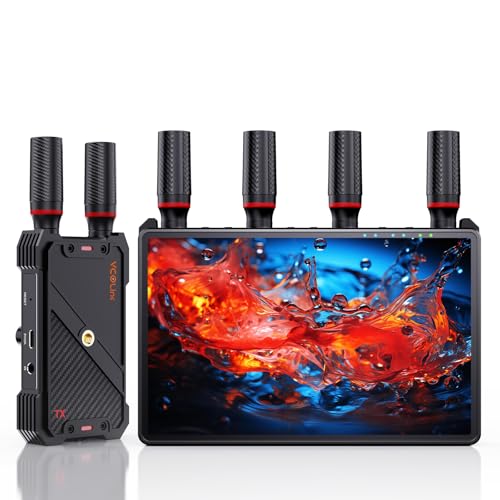
- Built-in 7-inch receiver screen
- 1080P60 transmission up to 1,312 feet
- Supports up to five receivers
Best For: Portable monitoring and small production crews
Best for Long-Range 4K Workflows
SVBONY ST1 Wireless Video System

- Advertised 4K transmission
- Up to 1,000-foot range
- 5.8GHz link with 0.06-second latency
Best For: Long-range DSLR-to-projector transmission
Best Dual-Band Stability
CineView HE Wireless Video Transmitter

- 2.4GHz and 5GHz dual-band transmission
- 1080p 60fps with under 0.06s stated latency
- Sends to up to four receivers or mobile devices
Best For: Stable multi-device monitoring in HDMI-based home studios
Best Plug-and-Play Setup
SVBONY TransAir3 Wireless HDMI Kit

- Factory-paired for software-free setup
- 1080p 60fps output with up to 1,000-foot stated range
- Includes HDMI output and loop-out
Best For: Simple wireless HDMI connections for 1080p studio or home-theater setups
Best 4K and SDI Flexibility
Hollyland Mars 4K Transmission System

- 4Kp30 transmission with HDMI and 3G-SDI support
- Up to four app monitoring options
- 450-foot stated line-of-sight range and 66ms latency
Best For: Advanced studios using both HDMI and SDI equipment
Best Long-Range Value

- 4K decoding with 1080p@60Hz output
- Dual-band 2.4GHz/5.8GHz transmission
- Plug-and-play mirror or extend modes
Best For: Cable-free studio displays and presentations
Best for Multi-Display Monitoring

- 1080p@60Hz transmission with low claimed latency
- Loop-out plus dual HDMI receiver output
- IR support and flexible power options
Best For: Camera and live-production monitoring setups
Best for Expandable Studios

- 4K decode with 1080p@60Hz output
- Supports up to eight transmitters per receiver
- LED display and cooling-focused design
Best For: Growing studios with multiple HDMI sources
Best Overall – Hollyland Pyro H Wireless HDMI System
For home studios that need flexible crew monitoring, the Hollyland Pyro H is a strong choice among video transmitters for home studios. It supports 4K30 transmission, dual-band operation, UVC streaming, loop-out monitoring, and connections to up to four receivers.
Best For: Multi-person monitoring, studio streaming, and camera-to-monitor workflows.
Pros:
- Transmits up to 4K30 with 2.4GHz and 5GHz support.
- Offers a stated 1,300-foot range and 60ms latency.
- Supports up to four receivers, Hollyview app monitoring, and UVC live streaming.
- Includes HDMI input, output, and loop-out connections.
Cons:
- The listed kit includes only one transmitter and one receiver.
- Its professional feature set may be more than a simple single-monitor setup requires.
The Pyro H stands out for studios that may expand into collaborative production. Its receiver scalability and UVC support make it particularly versatile for monitoring and streaming.
Best for Legacy TV Distribution – Srliya Home TV Analog Transmitter
The Srliya transmitter takes a different approach to video transmitters for home studios by converting HDMI sources to analog AV output. It is suited to basic in-home distribution where compatibility with older televisions or AV equipment matters more than long wireless range.
Best For: Connecting modern HDMI sources to compatible analog TV or AV systems.
Pros:
- Accepts 1080P HD input and provides AV output.
- Supports HDMI and RCA/AV connectivity.
- Offers adjustable VHF and UHF transmission frequencies.
- Can convert between N and P systems according to the supplied specifications.
Cons:
- The stated transmission range is approximately 10 to 20 meters.
- Its analog output focus is less suitable for modern high-resolution wireless monitoring.
- The supplied notes do not specify detailed setup or compatibility requirements for every display.
This model is best viewed as a format-conversion and short-range distribution tool. Choose it when analog compatibility is central to your studio setup, rather than when you need a contemporary camera-monitoring link.
Best All-in-One Monitoring – Wireless HDMI System with 7-Inch Monitor
This wireless HDMI kit is a practical option among video transmitters for home studios when you want a receiver with its own display. Its built-in 7-inch monitor, HDMI output, loop-out support, and expandable receiver setup can reduce the amount of separate monitoring equipment required.
Best For: Portable studio monitoring, small production crews, and live-streaming setups.
Pros:
- Includes a built-in 7-inch receiver monitor with brightness, volume, and sleep controls.
- Supports 1080P at 60Hz with a stated 1,312-foot line-of-sight range.
- Allows one transmitter to connect with up to five receivers.
- Provides HDMI loop-out, IR remote control, and multiple power options.
Cons:
- The external HDMI cable is not included.
- Smartphone and tablet use requires a Type-C-to-HDMI cable.
- Its stated video capability is 1080P rather than 4K.
The integrated screen is the main reason to consider this system. It is especially convenient for a home studio that needs a self-contained monitor while retaining the option to feed a larger display or add more viewers.
Best for Long-Range 4K Workflows – SVBONY ST1 Wireless Video System
The SVBONY ST1 is a straightforward long-range option for video transmitters for home studios. Designed for DSLR-to-projector use, it emphasizes real-time lossless transmission, a 5.8GHz band, and low stated latency for synchronized viewing and operation.
Best For: DSLR-to-projector links and setups where long-range real-time transmission is important.
Pros:
- Advertises 4K wireless video transmission.
- Provides a stated range of up to 1,000 feet.
- Uses a 5.8GHz high-speed band.
- Lists ultra-low latency of 0.06 seconds.
Cons:
- The supplied notes provide fewer connection and expansion details than the other systems.
- The listed 5.8GHz operation may offer less band flexibility than dual-band alternatives.
- The product is specifically described for DSLR-to-projector use, so broader compatibility should be checked before purchase.
The ST1 is worth considering when range and real-time performance are the priorities. Because the available specifications are limited, verify the required inputs, outputs, and display compatibility for your particular studio.
Best Dual-Band Stability – CineView HE Wireless Video Transmitter
For home studios seeking dependable video transmitters for home studios, the Accsoon CineView HE combines 2.4GHz and 5GHz transmission with 1080p at 60fps support. Its HDMI loop-through, low stated latency, and multi-device transmission make it practical for monitoring while recording or streaming.
Best For: Home studios that need stable wireless monitoring across several phones, tablets, or receivers.
Pros:
- Dual-band 2.4GHz and 5GHz transmission is designed to improve stability and reduce interference.
- Supports 1080p 60fps transmission with stated latency below 0.06 seconds.
- One transmitter can send video and audio to up to four receivers or mobile devices.
- HDMI input and output allow camera connection with monitor loop-through.
Cons:
- This listing includes only the transmitter, so a compatible receiver may be needed for some setups.
- It is limited to HDMI connectivity rather than offering SDI.
The CineView HE is a strong fit when stability, low latency, and flexible multi-device monitoring matter more than 4K resolution. Confirm receiver compatibility and your studio’s HDMI requirements before buying.
Best Plug-and-Play Setup – SVBONY TransAir3 Wireless HDMI Kit
The SVBONY TransAir3 is a straightforward option for home studios that want video transmitters for home studios without software installation. The factory-paired transmitter and receiver support 1080p at 60fps, HDMI loop-out, and a stated range of up to 1,000 feet.
Best For: Users who prioritize simple setup and wireless HDMI connections for a home theater or studio display.
Pros:
- Factory-paired transmitter and receiver provide plug-and-play operation.
- Supports 1080p 60fps HD video output.
- Offers a stated range of up to 1,000 feet.
- Includes dual HDMI output and loop-out functionality.
Cons:
- The supplied notes do not specify a latency figure.
- It uses 5.8GHz transmission rather than dual-band operation.
- Its listed compatible-device focus is home theater, so verify suitability for specialized studio equipment.
TransAir3 is appealing for a clean, uncomplicated wireless HDMI installation. It makes the most sense for 1080p workflows where quick pairing and cable reduction are more important than advanced production features.
Best 4K and SDI Flexibility – Hollyland Mars 4K Transmission System
For creators building a more advanced studio workflow, the Hollyland Mars 4K offers both HDMI and SDI connectivity alongside 4Kp30 transmission. Among video transmitters for home studios, it stands out for supporting professional frame rates, app monitoring, and multiple power options.
Best For: 4K-capable studios and production setups that need HDMI, SDI, and multi-viewer monitoring options.
Pros:
- Supports up to 3840×2160 at 24, 25, or 30fps through HDMI.
- Provides HDMI and 3G-SDI input/output options, including several decimal-point SDI frame rates.
- Supports up to four app monitoring options and additional wired monitor configurations.
- Offers a stated 450-foot line-of-sight range and 66ms latency in interference-free conditions.
Cons:
- The stated 450-foot range and 66ms latency are laboratory, interference-free figures.
- It is limited to 4K at up to 30fps rather than 4K60.
- QC/PD charging is not supported according to the supplied notes.
The Mars 4K is the most versatile choice here for studios mixing consumer HDMI gear with professional SDI equipment. Its 4K support and monitoring flexibility are valuable, but the larger feature set may be unnecessary for basic 1080p streaming.
Best Long-Range Value – 328ft Wireless HDMI Extender
For home studios that need a simple way to send video without running HDMI cable, this wireless HDMI transmitter and receiver offers plug-and-play setup, dual-band connectivity, and up to 328 feet of range in open conditions. It decodes 4K sources but outputs at 1080p up to 60Hz, making it a practical choice for displays, projectors, presentations, and monitoring.
Best For: Home studios, presentations, classrooms, home theaters, streamers, and users who prioritize a compact, cable-free setup.
Pros:
- Supports 4K decoding with 1080p@60Hz output.
- Uses 2.4GHz and 5.8GHz bands for improved signal stability.
- Supports mirror and extended display modes.
- Compact design includes Micro HDMI and Mini HDMI adapters.
Cons:
- Both the transmitter and receiver must be connected to power.
- Walls and obstacles can reduce transmission range and speed.
- Output is limited to 1080p rather than 4K.
This is a well-rounded option among video transmitters for home studios when ease of use, portability, and broad source compatibility matter more than native 4K output.
Best for Multi-Display Monitoring – 1300ft Wireless HDMI System
This wireless HDMI system is designed for home studios that need flexible monitoring from cameras, laptops, or other HDMI sources. It combines 1080p@60Hz transmission with loop-out, dual HDMI output, IR control, and multiple power options, although its advertised 1300-foot range applies to open areas without interference.
Best For: Camera-based studios, live production, sports or gaming monitoring, and setups that need local and remote displays.
Pros:
- Supports 1080p@60Hz with claimed 0.05-second latency.
- Transmitter loop-out supports a local monitoring display.
- Receiver can connect to two HDMI displays simultaneously.
- Supports IR extension and several power methods, including USB-C and NP-F batteries.
Cons:
- NP-F batteries are not included.
- Walls, metal, brick, and glass can substantially reduce coverage.
- Additional receivers can reduce transmission distance.
Choose this model if your studio workflow benefits from source-side monitoring, remote control, and multiple displays. Its feature set is more production-oriented than a basic point-to-point extender.
Best for Expandable Studios – 360ft Dual-Band HDMI Kit
For home studios that may grow to include several HDMI sources, this wireless kit offers 4K decoding, 1080p@60Hz output, dual-band transmission, and support for multiple transmitters. Its LED display and cooling design also make status checking and extended operation more convenient.
Best For: Expandable studios, streamers, presenters, event setups, and users connecting multiple source devices.
Pros:
- Supports 4K decoding and smooth 1080p@60Hz output.
- Advertised range reaches 360 feet in open spaces and 165 feet indoors.
- One receiver can support up to eight transmitters, with up to three sets used simultaneously.
- Includes LED status monitoring and Micro HDMI/Mini HDMI adapters.
Cons:
- Indoor range is lower than the open-space figure.
- Walls can affect transmission speed and distance.
- It does not provide native 4K output.
This is the strongest fit for a flexible studio that may add sources over time. Its multi-transmitter support is especially useful when switching among computers, cameras, and other HDMI equipment.
How We Picked These Video Transmitters for Home Studios
We compared the listed systems by their stated resolution, wireless bands, transmission distance, latency, input and output formats, receiver capacity, and studio-oriented features such as loop-out, IR control, SDI support, UVC output, and included monitors. We also considered setup simplicity, because a transmitter that requires extensive configuration can be frustrating in a compact home workspace.
Advertised range is measured under ideal conditions. Walls, neighboring Wi-Fi networks, metal equipment, and crowded 2.4GHz or 5GHz environments can reduce usable distance, so reliability and compatibility matter as much as the headline number.
Quick Comparison
- Best for professional camera workflows: Hollyland Mars 4K, with HDMI and SDI support.
- Best for flexible 4K wireless monitoring: Hollyland Pyro H, with dual-band operation and support for multiple receivers.
- Best for live streaming: Accsoon CineView HE, particularly if UVC output fits your computer-based setup.
- Best for multi-screen viewing: The 1-to-5 receiver system with included 7-inch monitors.
- Best for straightforward home use: SVBONY TransAir3 or one of the plug-and-play 1080p HDMI extenders.
Key Buying Factors for Video Transmitters for Home Studios
Resolution and Frame Rate
Confirm that the transmitter supports the output your camera or source device actually produces. Some systems accept 4K input but transmit or decode at 1080p, while others support 4K at 30 frames per second. For smooth previews, also check whether 60fps is supported at your desired resolution.
Latency and Signal Stability
Low latency is important for recording, live presentations, gaming, and camera operation where the monitor must respond quickly. Dual-band systems may handle interference better, but performance still depends on placement and local network congestion. Keep antennas clear and avoid placing the units behind dense equipment.
Connections and Workflow Compatibility
Check for HDMI input and output, SDI support, loop-out, IR pass-through, and USB or UVC connectivity before buying. Loop-out is useful when one source must feed both a wireless monitor and a wired display. UVC output can allow a computer to recognize the wireless feed as a camera source for streaming or conferencing.
Range, Receivers, and Power
Choose a system based on the distance and number of displays you need, not only the maximum advertised range. Multi-receiver support is valuable for director monitors, confidence screens, and client viewing. Also verify power requirements and whether the transmitter uses batteries, USB power, or a dedicated adapter.
Who Should Buy Which Video Transmitters for Home Studios?
Choose a basic 1080p extender if you need to send a laptop, media player, or camera feed to a nearby television or monitor at the lowest cost. Pick a system with multiple receivers when several people need simultaneous viewing. A dual-band 4K model is a better fit for creators who want flexible wireless monitoring while preserving higher-resolution sources.
For professional cameras, studio switching, or longer-term production work, prioritize SDI or dependable HDMI connectivity, frame-rate compatibility, and low latency over maximum range claims. Streamers should look for UVC support and straightforward computer integration. Before ordering, match every port and supported format to your camera, capture device, monitor, and intended distance.