If you want whole-home WiFi without the usual speed loss that can happen between mesh nodes, dedicated backhaul is the feature to look for. It helps keep traffic between the nodes separate from your device connections.
Below, we focus on mesh systems that are built to deliver stronger performance, easier expansion, and better results in real homes with walls, distance, and many connected devices.
Best 10 Mesh Wifi Systems with Dedicated Backhaul Picks for 2026
Premium Wi‑Fi 7 Whole-Home Mesh

- Wi‑Fi 7 tri-band mesh with Enhanced Backhaul
- Up to 8,000 sq. ft. coverage and 100 devices
- Up to 11 Gbps and Orbi app setup
Best For: Large homes that want premium Wi‑Fi 7 mesh performance
Balanced Tri-Band Mesh Value

- 6 GHz band can serve as backhaul by default
- Up to 7,200 sq. ft. and 200 devices
- Wi‑Fi 6E with 5,400 Mbps combined speed
Best For: Homes wanting stable Wi‑Fi 6E mesh coverage and easy setup
Compact Wi‑Fi 7 Mesh Starter Kit

- Wi‑Fi 7 tri-band mesh with Enhanced Backhaul
- Up to 5,500 sq. ft. coverage and 100 devices
- Up to 11 Gbps plus Orbi app management
Best For: Medium-to-large homes that want a smaller Wi‑Fi 7 mesh
Multi-Gig Wi‑Fi 6E Mesh With Backhaul

- 6 GHz band acts as dedicated backhaul by default
- 2.5 Gbps port plus two Gigabit ports per unit
- Up to 7,200 sq. ft. and 200 devices
Best For: Gigabit-plus homes that want Wi‑Fi 6E mesh with multi-gig ports
Editor’s Pick

- Wi‑Fi 7 dual-band system with up to 5 Gbps-class speeds
- Covers up to 6,600 sq. ft. and supports 150+ devices
- Traffic balancing between Deco units for stable whole-home coverage
Best For: Large homes wanting easy-to-manage Wi‑Fi 7 mesh coverage
Value Mesh Pick

- Wi‑Fi 6 dual-band mesh up to 3.0 Gbps
- Supports Ethernet backhaul for stronger performance
- Covers up to 5,000 sq. ft. and 256+ devices
Best For: Homes or small offices wanting wired-backhaul mesh on a budget
Premium Backhaul Pick

- Wi‑Fi 7 mesh with simultaneous wireless and wired backhaul
- Up to 6,500 sq. ft. coverage for 150 devices
- Two 2.5 Gbps ports per unit for multi-gig wired gear
Best For: Buyers who want the strongest backhaul-focused Deco mesh option
Wired Backhaul Pick
Tenda BE5100 3-Pack Mesh WiFi 7
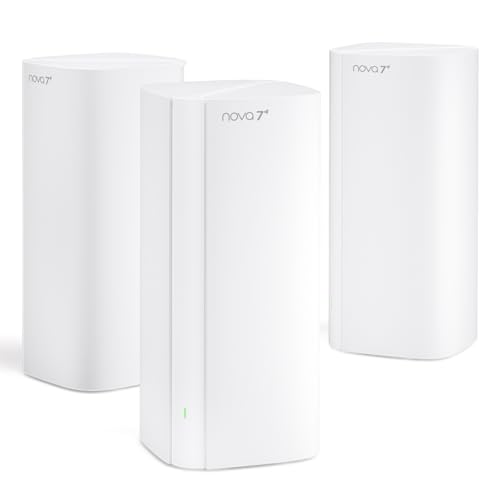
- Ethernet backhaul improves mesh stability
- Wi-Fi 7 with MLO and dual-band design
- Covers up to 6,600 sq. ft.
Best For: Large homes that can wire nodes for the most stable mesh setup
Expandable Backhaul Choice
TP-Link Deco BE25 Wi-Fi 7 Mesh

- Wired backhaul supports more stable mesh traffic
- 2.5G Ethernet and Wi-Fi 7
- Works with the Deco app and AI-Roaming
Best For: Expandable homes that want an easy-to-manage wired-backhaul mesh
Compact Starter Pick
Tenda ME3 Pro Wi-Fi 7 Mesh Node

- Ethernet backhaul support in a single node
- Wi-Fi 7 with MLO and 4K-QAM
- Three gigabit ports for wired devices
Best For: Smaller homes or starter mesh setups with wired-backhaul plans
Premium Wi‑Fi 7 Whole-Home Mesh – NETGEAR Orbi 770 3-Pack
If you want mesh wifi systems with dedicated backhaul for a large home, the NETGEAR Orbi 770 Series is built for broad coverage and fast, stable performance. This Wi‑Fi 7 tri-band kit uses Enhanced Backhaul to keep traffic moving smoothly across the network, while supporting up to 8,000 sq. ft. and 100 devices.
Best For: Large homes, multi-floor layouts, and households that want top-tier Wi‑Fi 7 performance with easy app-based management.
Pros:
- Tri-band Wi‑Fi 7 with Enhanced Backhaul for stronger node-to-node connections.
- Large coverage claim up to 8,000 sq. ft. and support for up to 100 devices.
- Up to 11 Gbps speeds for 8K streaming, gaming, VR, and video calls.
- Orbi app setup and management plus automatic firmware updates.
Cons:
- Best value only if you can use Wi‑Fi 7 features or need the extra capacity.
- Armor security is a separate subscription after the free trial.
- Coverage can still vary based on layout, materials, and satellite placement.
Overall, this Orbi system is a strong fit if you want a premium mesh that prioritizes speed, coverage, and backhaul performance in a busy home.
Balanced Tri-Band Mesh Value – TP-Link Deco XE75 3-Pack
The TP-Link Deco XE75 is a practical choice if you want mesh wifi systems with dedicated backhaul without jumping all the way to Wi‑Fi 7 pricing. Its 6 GHz band can act as backhaul by default, helping the three-node system keep connections stable across up to 7,200 sq. ft. and 200 devices.
Best For: Households that want strong whole-home coverage, Wi‑Fi 6E, and an easy setup experience at a more approachable tier.
Pros:
- Tri-band Wi‑Fi 6E with a 6 GHz band that can work as backhaul by default.
- Coverage up to 7,200 sq. ft. and support for up to 200 devices.
- Up to 5,400 Mbps combined speeds for modern streaming and multitasking.
- Deco app setup and management with Alexa guest Wi‑Fi controls.
Cons:
- Not as future-focused as Wi‑Fi 7 systems.
- Wired multi-gig options are not as robust as the Pro model.
- Some advanced security features require TP-Link’s paid HomeShield Pro.
For most homes, the XE75 hits a strong balance of coverage, stability, and simplicity, especially if you want 6 GHz backhaul to help reduce congestion.
Compact Wi‑Fi 7 Mesh Starter Kit – NETGEAR Orbi 770 2-Pack
The NETGEAR Orbi 770 2-pack is a smaller option for buyers looking at mesh wifi systems with dedicated backhaul in a more compact setup. It still uses tri-band technology with Enhanced Backhaul, offers up to 11 Gbps Wi‑Fi 7 speeds, and covers up to 5,500 sq. ft. for homes that don’t need the larger three-pack.
Best For: Medium to large homes that want Wi‑Fi 7 performance but only need a two-piece mesh to start.
Pros:
- Wi‑Fi 7 tri-band system with Enhanced Backhaul.
- Up to 11 Gbps speeds and support for up to 100 devices.
- Coverage up to 5,500 sq. ft. in a two-pack.
- Orbi app setup, device management, and guest Wi‑Fi controls.
Cons:
- Less total coverage than the 3-pack version.
- Armor security still requires a separate subscription after the trial.
- Best fit depends on your home’s layout and where satellites can be placed.
This version makes sense if you want the same high-end Orbi feature set in a smaller package, with room to expand later if coverage needs grow.
Multi-Gig Wi‑Fi 6E Mesh With Backhaul – TP-Link Deco XE75 Pro 3-Pack
If you want mesh wifi systems with dedicated backhaul and wired speed flexibility, the TP-Link Deco XE75 Pro is worth a close look. Its 6 GHz band works as a powerful dedicated backhaul by default, and the 2.5 Gbps port helps it make better use of faster broadband plans while still covering up to 7,200 sq. ft.
Best For: Users with gigabit-plus internet who want Wi‑Fi 6E mesh performance, multi-gig ports, and stable backhaul.
Pros:
- 6 GHz band works as dedicated backhaul by default.
- 2.5 Gbps port plus two Gigabit ports per unit for faster wired connections.
- Up to 7,200 sq. ft. coverage and support for up to 200 devices.
- Deco app setup with AI-driven mesh and HomeShield security options.
Cons:
- It is a renewed unit, which may matter for buyers who prefer new-in-box hardware.
- Some advanced HomeShield protections require a paid subscription.
- Wi‑Fi 6E is less future-proof than Wi‑Fi 7 systems.
For fast internet plans and homes that can benefit from multi-gig wiring, this Pro model adds useful flexibility without changing the core Deco simplicity.
Editor’s Pick – Deco 7 BE5000 WiFi 7 Mesh
If you want mesh wifi systems with dedicated backhaul-style stability for a busy home, the Deco 7 Dual-Band BE5000 is built around Wi‑Fi 7 performance, whole-home coverage, and traffic balancing between Deco units. It supports up to 6,600 sq. ft. and over 150 devices, making it a strong fit for large households that need fast roaming and dependable coverage.
Best For: Large homes that want Wi‑Fi 7 mesh coverage with easy app-based management and multi-unit expansion.
Pros:
- Wi‑Fi 7 with up to 4,324 Mbps on 5 GHz and 688 Mbps on 2.4 GHz
- Supports up to 6,600 sq. ft. and over 150 devices
- Wi‑Fi 7 and 2.5G Ethernet work together to balance traffic between Deco units
- Deco App setup, firmware updates, AI-Roaming, and unified network name
Cons:
- Backhaul requires at least two Deco units
- Requires a separate modem
- Full benefit depends on placement, distance, and home layout
Overall, this is a practical pick if you want a newer mesh system that emphasizes easy expansion, strong roaming, and stable whole-home performance. It is especially appealing when you plan to scale the system over time with additional Deco units.
Value Mesh Pick – WAVLINK AX3000 Mesh 2-Pack
The WAVLINK AX3000 is a straightforward option for buyers comparing mesh wifi systems with dedicated backhaul options, since it supports Ethernet backhaul for better performance and lower latency. It pairs Wi‑Fi 6 dual-band speeds with app or web setup, making it a sensible fit for homes or small offices that want flexible placement and simple expansion.
Best For: Budget-conscious buyers who want a Wi‑Fi 6 mesh system with wired backhaul support and easy setup.
Pros:
- Wi‑Fi 6 dual-band speeds up to 3.0 Gbps
- Supports Ethernet backhaul to improve speed and reduce latency
- Covers up to 5,000 sq. ft. and supports 256+ devices
- App/web setup with Mesh Router or AP mode
Cons:
- Wireless backhaul is still the everyday default unless you wire the nodes
- Only a 2-pack, so larger homes may need more units
- Specs and coverage are strongest on paper when conditions are ideal
This model makes sense if you want a flexible mesh kit that can run wired for better stability without paying for a more complex system. It gives you a practical mix of coverage, security, and simple controls.
Premium Backhaul Pick – Deco 7 BE23 Wi‑Fi 7 Mesh
If wired stability matters, the Deco 7 BE23 stands out among mesh wifi systems with dedicated backhaul options because it supports simultaneous wireless and wired backhaul with Wi‑Fi 7 MLO. That makes it a strong choice for larger homes that want better stability, multi-gig wired performance, and smooth roaming across multiple nodes.
Best For: Users who want Wi‑Fi 7 mesh coverage with simultaneous wired and wireless backhaul support.
Pros:
- Wi‑Fi 7 with Multi-Link Operation, Multi-RUs, and 4K-QAM
- Simultaneous wireless and wired backhaul for stronger stability
- Up to 6,500 sq. ft. coverage and support for 150 devices
- Two 2.5 Gbps WAN/LAN ports per unit for multi-gig wired devices
Cons:
- Premium features are only fully useful if your network gear can keep up
- Requires a modem for most internet service providers
- Coverage and speeds depend on placement and home construction
For shoppers focused on stronger backhaul options, this Deco 7 BE23 is the most performance-oriented option in the group. It combines modern Wi‑Fi 7 features with wired flexibility, which is useful for homes that want a more stable mesh backbone.
Wired Backhaul Pick – Tenda BE5100 3-Pack Mesh WiFi 7
If you want mesh wifi systems with dedicated backhaul for a large home, this Tenda BE5100 3-pack is built around wired Ethernet backhaul to help keep mesh performance fast and stable. It also adds Wi-Fi 7 features like MLO and supports up to 160+ devices, making it a practical fit for busy homes that need broad coverage and smoother roaming.
Best For: Large households that can wire nodes and want dependable whole-home coverage.
Pros:
- Supports wired Ethernet backhaul for faster, more reliable mesh performance
- Wi-Fi 7 with MLO for lower latency and smoother connections
- Covers up to 6,600 sq. ft. with a 3-pack
- Includes 1×2.5G and 2×1G ports for flexible wired connections
Cons:
- Dual-band only; it does not support the 6GHz band
- Not compatible with older MW3/MW6 systems
- Best results depend on wiring the nodes for backhaul
Overall, this is the strongest pick here if dedicated wired backhaul is a priority and you need wide-area coverage. It focuses on practical performance and multi-device stability rather than extra bands or legacy compatibility.
Expandable Backhaul Choice – TP-Link Deco BE25 Wi-Fi 7 Mesh
For shoppers comparing mesh wifi systems with dedicated backhaul, the Deco BE25 stands out for combining Wi-Fi 7 with 2.5G Ethernet and wired backhaul support across a scalable mesh platform. It’s aimed at homes that want strong whole-home coverage, easy app setup, and the flexibility to grow the network over time.
Best For: Homeowners who want an expandable mesh system with strong wired-backhaul potential.
Pros:
- Supports wired backhaul for faster, more stable whole-home coverage
- Wi-Fi 7 dual-band performance with up to 5,000 Mbps class speeds
- 2.5G Ethernet port support for high-speed wired connections
- AI-Roaming and Deco app management make it easy to use
Cons:
- Backhaul requires at least two Deco units
- Dual-band only, so there is no 6GHz band
- May be more system than small apartments need
This is a well-rounded option if you want a mesh platform that can take advantage of wired backhaul without making setup complicated. It balances speed, security features, and scalability better than a basic single-router replacement.
Compact Starter Pick – Tenda ME3 Pro Wi-Fi 7 Mesh Node
If you need a simpler mesh starting point among mesh wifi systems with dedicated backhaul, the Tenda ME3 Pro gives you Wi-Fi 7 speed, MLO, and support for wired Ethernet backhaul in a compact 1-pack. It is a solid choice for adding a node or building a smaller setup where you still want smooth roaming and stable wired performance.
Best For: Smaller homes or buyers who want a single Wi-Fi 7 mesh unit with wired-backhaul support.
Pros:
- Wi-Fi 7 with MLO and 4K-QAM support
- Supports wired Ethernet backhaul for better mesh stability
- 3 gigabit ports for flexible wired device hookups
- Handles 160+ devices and includes app control
Cons:
- Single-pack coverage is limited to 2,500 sq. ft.
- Dual-band only and no 6GHz band support
- Best for smaller or expandable setups, not the largest homes
As a standalone unit, this is the most compact option in the group and makes sense if you’re starting small or planning to add more nodes later. It keeps the focus on practical mesh performance, wired backhaul, and straightforward setup.
How We Picked These Mesh Wifi Systems with Dedicated Backhaul
We prioritized systems that support dedicated wireless backhaul, strong multi-band designs, and modern WiFi 6E or WiFi 7 hardware where available. We also looked at coverage claims, port options, ease of setup, and how well each system fits different home sizes and internet plans.
Quick Comparison
For speed and long-term headroom, WiFi 7 models are the most future-ready. For value, WiFi 6E systems can still deliver excellent performance for many homes. If you have a gigabit-plus internet plan, look closely at 2.5G ports and stronger backhaul options. If your home is large or has several floors, coverage and node placement matter as much as raw specs.
Key Buying Factors for Mesh Wifi Systems with Dedicated Backhaul
Backhaul Type
Dedicated wireless backhaul reduces congestion by reserving a link for node-to-node communication. Tri-band systems typically handle this best, while some dual-band systems rely more heavily on Ethernet backhaul or advanced wireless features to maintain performance.
WiFi Standard
WiFi 7 is the newest option and can improve capacity, latency, and efficiency in busy homes. WiFi 6E remains a strong choice if you want 6 GHz support at a lower price. WiFi 6 is still fine for many households, especially if your internet speeds are moderate.
Coverage and Node Count
Match the system size to your floor plan, not just the square-footage claim. Thick walls, multi-level layouts, and basement setups usually need an extra node more than open-plan homes do.
Ports and Wired Expansion
If you have a fast fiber plan, gaming setup, NAS, or office gear, look for 2.5G WAN/LAN ports and Ethernet backhaul support. Wired backhaul can dramatically improve consistency.
Who Should Buy Which Mesh Wifi Systems with Dedicated Backhaul?
Choose a WiFi 7 mesh system if you want the best performance and plan to keep the system for years. Pick a WiFi 6E model if you want strong all-around speed and better value. Go with a two-pack for medium homes, a three-pack for larger or more complicated layouts, and prioritize Ethernet-capable systems if your house is already wired.
For most shoppers, the best choice comes down to balancing backhaul quality, coverage, and port speed with the needs of your home and internet plan.