Sharing one stereo source with several listeners is easier with the right headphone amplifier. These compact units can distribute audio to multiple headphones while giving each listener a dedicated volume control, making them useful for home studios, rehearsals, classrooms, and media setups.
Our selection includes four-, six-, eight-, and ten-output models, along with options using 3.5mm, 6.35mm, or both connector types. The best choice depends on the number of listeners, your available cables, monitoring needs, and how much space you have.
Best 10 Headphone Amplifier with Multiple Outputs Picks for 2026
Simple Session Splitter

- Four independent headphone outputs
- Individual volume controls
- Compact metal construction
Best For: Tracking sessions and rehearsals
Studio Monitoring Value
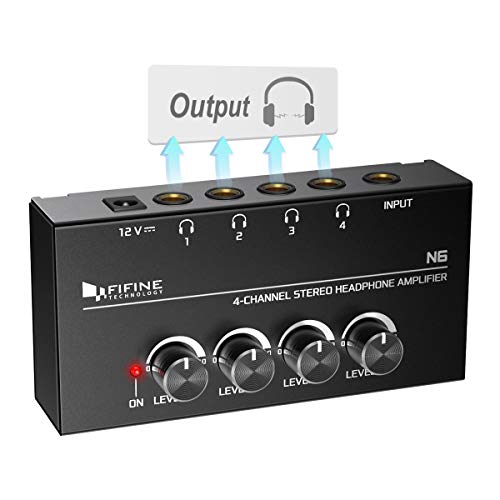
- Four 1/4-inch stereo outputs
- Separate volume knobs
- 12V adapter included
Best For: Studio, stage, and shared-source monitoring
Feature-Rich Monitoring
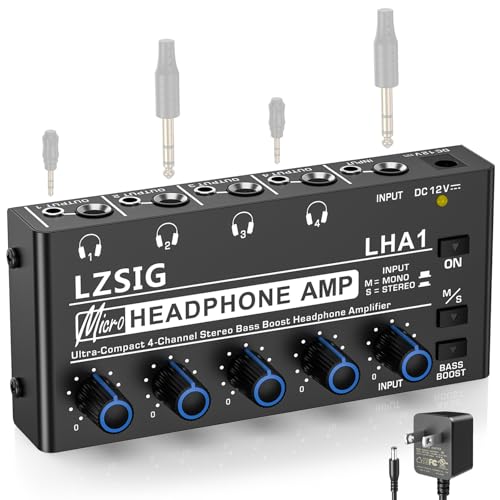
- Four independently controlled outputs
- 3.5mm and 6.35mm support
- Bass boost and stereo/mono modes
Best For: Flexible home-studio and stage monitoring
Portable Four-Listener Setup
Pyle PHA40 Compact Headphone Amp

- Powers four headphones
- Independent volume controls
- Compact portable design
Best For: Portable studio and on-stage monitoring
Best Compact 8-Output Pick

- Eight outputs across 3.5mm and 6.35mm connections
- Mono/stereo switching for flexible monitoring
- Compact metal housing with illuminated volume control
Best For: Small rehearsals, podcasts, and home studios
Best Individual-Volume Option
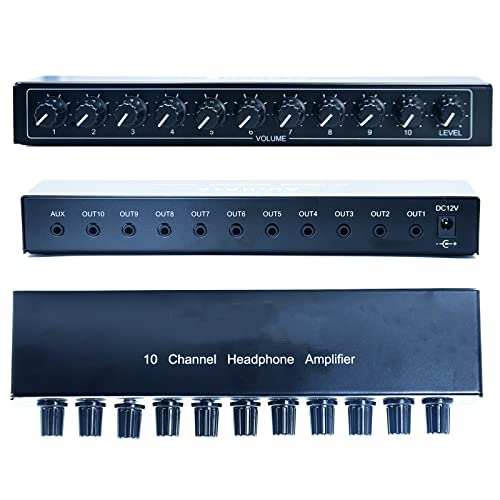
- Dedicated volume control for each output
- Powers up to four pairs of headphones
- Compact metal design for studio and stage use
Best For: Sessions with several listeners needing separate volume levels
Best for Larger Groups

- Sixteen outputs for band and studio monitoring
- Supports 3.5mm and 6.35mm headphones
- Drives headphones up to 250Ω with mono/stereo switching
Best For: Bands, live performances, and larger recording sessions
Best Compact 4-Output Pick
Mini 4-Channel Headphone Amplifier

- Four 1/4-inch stereo outputs
- Independent volume for each listener
- Compact metal design with 12V adapter
Best For: Small studios, rehearsals, podcasts, and shared monitoring
Best Value 4-Channel Option

- Supports four headphone pairs
- Independent volume controls
- Portable metal housing with low-noise chip
Best For: Studio monitoring, stage use, karaoke, and band practice
Best Flexible 6-Output Pick
Stereo Headphone Amp and Splitter

- Six independent stereo output channels
- 3.5mm and 6.35mm connectivity
- Mono/stereo mode and audio distribution
Best For: Recording studios, stages, and larger monitoring groups
Simple Session Splitter – Compact 4-Channel Monitoring
The Mackie HM-4 is a straightforward headphone amplifier with multiple outputs for tracking sessions, rehearsals, and other setups where four listeners need to monitor one source. Its four independent level controls make shared listening practical without requiring a mixer.
Best For: Recording sessions and rehearsals that need compact, plug-and-play headphone distribution.
Pros:
- Drives up to four headphones from a 1/4-inch or 1/8-inch source output.
- Provides independent volume control for each listener.
- Compact metal build can be attached to a desk, rack, or stand.
- Plug-and-play operation avoids complicated setup.
Cons:
- All four outputs use 1/4-inch connections, so adapters may be needed for some headphones.
- The supplied notes do not specify compatible devices.
The HM-4 focuses on the essentials: four outputs, individual volume adjustment, and a small footprint. It is a practical choice when you want reliable multi-listener monitoring without extra features.
Studio Monitoring Value – FIFINE N6 4-Channel Amplifier
The FIFINE N6 is a headphone amplifier with multiple outputs designed to distribute one stereo source to four listeners. Separate volume knobs, a metal chassis, and low-noise operation suit studio monitoring, live applications, and shared TV listening.
Best For: Users who need four 1/4-inch headphone outputs and a supplied power adapter for studio or stage monitoring.
Pros:
- Shares one stereo source across four outputs without reported signal loss when all are connected.
- Offers separate volume control for each channel.
- Uses a rugged metal construction with smoothly operating knobs.
- Includes a 12V DC power adapter and power indicator light.
Cons:
- All input and output ports are 1/4-inch connections.
- The required TRS/TS cables are not included.
- It is a 1-input, 4-output amplifier, not a mixer with four inputs.
The N6 is a focused distribution amp rather than a mixing device. Its included adapter and four independent controls make it convenient, but buyers should plan for the correct 1/4-inch cables and connectors.
Feature-Rich Monitoring – LZSIG LHA2 4-Channel Amp
The LZSIG LHA2 is a headphone amplifier with multiple outputs that adds bass boost and stereo/mono switching to four-channel monitoring. It supports 1/8-inch and 1/4-inch plugs, with independent level controls for each output and a metal chassis for regular studio or stage use.
Best For: Home-studio and stage users who want flexible connections, individual volume control, and selectable bass enhancement.
Pros:
- Supports up to four pairs of 32–100Ω headphones.
- Accepts both 3.5mm and 6.35mm TS/TRS connections.
- Includes independent volume controls for all four outputs.
- Offers bass boost plus stereo/mono switching.
Cons:
- The supplied notes identify it as a 4-channel amplifier, not a mixer.
- Bass boost changes the sound profile and may not suit neutral monitoring.
- Its stated headphone support is limited to the 32–100Ω range.
The LHA2 stands out for connection flexibility and extra sound-shaping controls. It is a strong fit when a basic splitter is not enough, provided your headphones fall within the stated impedance range.
Portable Four-Listener Setup – Pyle PHA40 Compact Headphone Amp
The Pyle PHA40 is a compact headphone amplifier with multiple outputs for powering up to four headphones from one source. Its individual rotary controls and small footprint make it suited to portable studio, rehearsal, and on-stage monitoring setups.
Best For: Buyers seeking a small four-channel monitor distribution amp with separate listener volume controls.
Pros:
- Powers up to four headphones simultaneously.
- Provides dedicated volume controls for each output.
- Includes four 1/4-inch stereo headphone outputs and a 1/4-inch source input.
- Compact design is easy to carry for road or studio use.
Cons:
- The supplied notes specify 1/4-inch connections, so smaller headphone plugs may require adapters.
- Its enclosure is listed as plastic rather than metal.
- The supplied specifications list a corded power source without providing further power-adapter details.
The PHA40 keeps the layout simple and portable while giving each listener control over their own level. It is best suited to basic shared monitoring where compact size matters more than advanced routing features.
Best Compact 8-Output Pick – Bolanle PH400
If you need a headphone amplifier with multiple outputs for a small rehearsal, podcast, or home studio, the Bolanle PH400 provides eight wired headphone connections in a compact metal enclosure. It combines four 3.5mm and four 6.35mm outputs with individual volume control and mono/stereo switching.
Best For: Small bands, duos, podcasters, home studios, and personal monitoring setups that need flexible headphone connectivity.
Pros:
- Eight total outputs: four 3.5mm and four 6.35mm.
- Mono/stereo switch supports different monitoring workflows.
- Compact metal housing measures approximately 5.75 × 3.11 × 0.98 inches.
- Illuminated seven-color volume knob provides visual feedback.
Cons:
- Its eight-output capacity may be limiting for larger recording sessions.
- It uses a wired connection and requires the included DC 5V/3A power supply.
The PH400 is a practical choice when desk space matters but you still need both 3.5mm and 6.35mm headphone support. Its output count suits smaller groups better than full-band or larger studio applications.
Best Individual-Volume Option – Arklove HP10
The Arklove HP10 is a headphone amplifier with multiple outputs designed for shared monitoring during studio and stage sessions. It can power up to four pairs of headphones while providing dedicated output-level controls, so each listener can set a preferred volume.
Best For: Recording sessions and stage setups where up to four listeners need independent volume adjustment.
Pros:
- Supports up to four pairs of headphones from a compact unit.
- Dedicated output volume controls let listeners adjust levels independently.
- Works with 3.5mm headphones and 6.35mm headphones using an adapter.
- Includes a power switch, 12V DC adapter, and 18-month warranty.
Cons:
- The supplied unit has a 3.5mm headphone output, while 6.35mm headphones require an adapter.
- Its four-headphone capacity is smaller than the other multi-output options here.
The HP10 focuses on straightforward monitoring control rather than a large number of physical headphone sockets. Choose it when independent volume adjustment for several performers is more important than maximum output capacity.
Best for Larger Groups – Bolanle PH800
For larger rehearsals and recording environments, the Bolanle PH800 is a headphone amplifier with multiple outputs that expands the setup to 16 individual headphone connections. It offers eight 3.5mm and eight 6.35mm outputs, along with mono/stereo switching and high output power for headphones up to 250Ω.
Best For: Bands, recording sessions, live performances, and studios that need many simultaneous headphone connections.
Pros:
- Sixteen total outputs: eight 3.5mm and eight 6.35mm.
- Designed to drive professional headphones up to 250Ω.
- Mono/stereo switching accommodates rehearsal, live, and recording needs.
- Rugged metal housing and DC 12V/2A power supply suit regular studio use.
Cons:
- The larger capacity comes with a listed weight of approximately 1.2 pounds.
- It is a wired amplifier with no wireless headphone functionality.
The PH800 is the strongest fit for groups that regularly need more than a handful of monitoring connections. Its mix of 3.5mm and 6.35mm outputs also reduces the need to standardize headphone plug sizes across a larger setup.
Best Compact 4-Output Pick – Mini 4-Channel Headphone Amplifier
If you need a headphone amplifier with multiple outputs for shared monitoring, this compact 4-channel model provides one 1/4-inch stereo input and four 1/4-inch headphone outputs. Its independent volume controls make it practical for recording, rehearsals, podcasts, and other group listening setups.
Best For: Small studios, band practice, podcast recording, stage monitoring, and home audio sharing.
Pros:
- Four stereo headphone outputs share one audio source.
- Independent volume control for every channel.
- Compact metal housing measures 90 × 55 × 40 mm.
- Includes a 12V DC power adapter and uses a low-noise JRC4580 chip.
Cons:
- Uses 1/4-inch connections, so other plug sizes may require adapters.
- The supplied information recommends headphones in the 32–100Ω range.
- Warranty coverage is listed as 30 days.
This is a straightforward choice when four listeners need separate level control without taking much room. Its fixed 1/4-inch stereo connectivity is best suited to conventional studio and professional audio equipment.
Best Value 4-Channel Option – HA400 Metal Stereo Amplifier
For shoppers seeking a headphone amplifier with multiple outputs at a compact size, this HA400-style unit supports up to four pairs of headphones from one 1/4-inch TRS source. Each channel has its own volume control, making it useful when several people are monitoring the same performance or recording.
Best For: Studio and stage use, band practice, karaoke, conferences, and group gaming.
Pros:
- Drives up to four pairs of headphones simultaneously.
- Four independent volume controls let listeners set their own levels.
- Low-noise, high-gain JRC4580 operational chip supports stereo output.
- Small 90 × 55 × 40 mm metal design is easy to transport.
Cons:
- The source connects through a 1/4-inch TRS input.
- Headphones without compatible plugs may need converter adapters.
- The listed impedance suitability is 32–100Ω, limiting some headphone pairings.
This model focuses on the essentials: four outputs, per-channel control, and portable construction. It is a sensible fit for users who already work with 1/4-inch audio connections and need a simple multi-listener monitoring solution.
Best Flexible 6-Output Pick – Stereo Headphone Amp and Splitter
When four outputs are not enough, this six-channel headphone amplifier offers a headphone amplifier with multiple outputs plus both 3.5mm and 6.35mm input and output options. Six independently controlled stereo channels, audio distribution capability, and a mono/stereo switch give it broader flexibility for studio and stage setups.
Best For: Recording studios, stage applications, and multi-person monitoring with mixed plug sizes.
Pros:
- Six high-power stereo amplifier channels with separate volume controls.
- Supports both 3.5mm and 6.35mm TS/TRS connections.
- Offers one input and six corresponding audio outputs for distribution.
- Includes mono/stereo switching and an aluminium-alloy CNC unibody design.
Cons:
- It is heavier and larger than the compact four-channel options, weighing 1.28 pounds.
- Requires the included 12V AC adapter for power.
- The product notes do not specify a headphone impedance range.
This is the most versatile option of the three for larger monitoring groups or setups using both headphone plug sizes. Choose it when six independently adjustable outputs and connection flexibility matter more than minimal size.
How We Picked the Best Headphone Amplifier with Multiple Outputs
We focused on the practical features that matter when several people need to monitor the same stereo source. The lineup covers common channel counts, including compact four-channel amplifiers and higher-capacity models for larger groups. We also considered output connector formats, separate volume controls, metal construction, portability, power requirements, and compatibility with typical mixers, interfaces, phones, and playback devices.
Because specifications and included accessories can vary by seller or revision, confirm the listing before buying. In particular, check whether the unit includes the required power adapter and whether its input and outputs match your headphones and source equipment.
Quick Comparison
| Best For | What to Look For |
|---|---|
| Small recording setups | Four outputs, individual level controls, and a compact metal enclosure |
| Band rehearsals or classrooms | Six to eight outputs and easy access to front-panel volume knobs |
| Large shared listening groups | Eight or ten outputs, reliable power, and sufficient output headroom |
| Mixed headphone collections | Both 3.5mm and 6.35mm connections, or appropriate adapters |
| Portable setups | Small dimensions, low weight, and a convenient power arrangement |
Key Buying Factors for a Headphone Amplifier with Multiple Outputs
Output Count and Layout
Choose more outputs than your normal headcount if you expect to add listeners or connect alternate headphones. A four-output model is usually sufficient for a home studio, while eight- and ten-output units are better for group monitoring. Make sure the ports are positioned where cables will not obstruct controls.
Connector Compatibility
Most studio headphones use 6.35mm plugs or adapters, while consumer headphones commonly use 3.5mm plugs. A Headphone Amplifier with Multiple Outputs may offer one format or both. Verify the input connector as well: an amplifier cannot connect directly to a source without the correct cable or adapter.
Independent Volume Control
Individual level knobs let each listener set a comfortable volume without changing everyone else’s mix. Look for clearly marked controls with enough adjustment range for sensitive in-ear headphones and higher-impedance studio headphones.
Power, Impedance, and Audio Use
Check the required adapter and voltage before placing the unit in a permanent setup. For studio monitoring, consider whether the amplifier is intended for your headphones’ impedance range, including models rated around 250 ohms. These units distribute the source signal; they do not replace a mixer, interface, or headphone mix system when listeners need different audio.
Who Should Buy Which Headphone Amplifier with Multiple Outputs?
Choose a four-channel model for solo production, podcasting, small rehearsals, or occasional shared movie and music listening. These are typically the simplest and most space-efficient choices.
Choose a six- or eight-channel model when several musicians need simultaneous monitoring or when you want spare outputs for future expansion. Separate level controls are especially useful in group settings.
Choose a ten-output model for classrooms, training rooms, larger rehearsals, or installations where many listeners share one source. Confirm that the power supply and output level remain suitable for all connected headphones.
Before buying, count your listeners, identify every plug type, measure the available space, and confirm the source connection. That quick checklist will usually narrow the options more effectively than choosing by output count alone.