Choosing among video switchers with HDMI can be confusing because compact models range from simple source selectors to full live-production mixers. The right option depends on how many devices you connect, the resolutions you need, and whether you want built-in streaming tools.
We compared 10 HDMI switchers and video mixers for gaming, classrooms, events, content creation, and professional-looking broadcasts, with attention to input options, output quality, controls, portability, and workflow flexibility.
Best 10 Video Switchers with Hdmi Picks for 2026
Versatile Production Hub

- Four HDMI inputs with dual HDMI outputs
- Three-platform streaming and portrait mode
- Recording, overlays, audio tools, and auto-switching
Best For: Multicamera live events and full-featured streaming setups
High-Bandwidth Source Selector

- Handles up to 8K at 60Hz and 4K at 120Hz
- Supports VRR, ALLM, and QFT
- Remote and automatic switching with surround audio support
Best For: Gaming and home entertainment with multiple HDMI 2.1 sources
Streaming Workhorse
Blackmagic ATEM Mini Pro HDMI Switcher

- Four HDMI inputs for multicamera production
- Built-in streaming, multiview, recording, and audio mixing
- Transitions and multiple keying options for polished broadcasts
Best For: Multicamera livestreams, presentations, and education
Integrated Multiview Mixer
CineTreak Mixer Plus HDMI Switcher

- Built-in 4.5-inch multiview display
- Four HDMI inputs with transitions and production effects
- USB 3.0 UVC streaming plus PTZ control
Best For: Compact studios and OBS or vertical-content production
Best All-Around HDMI Switch

- Connects four HDMI sources to one display
- Supports 4K at 60Hz with HDR and 3D
- Includes remote-controlled switching
Best For: Multi-device home entertainment and work setups
Best for Live Production
Osee GoStream Duet HDMI and SDI Mixer

- Combines four HDMI and four SDI inputs
- Includes live effects, transitions, and PIP
- Streams to up to three platforms
Best For: Multi-camera events and professional live streaming
Best Compact Option

- Connects two HDMI sources to one display
- Supports up to 4K at 60Hz
- Uses simple physical-button switching
Best For: Small desks and two-device entertainment setups
Best Portable Pick
Mixer Plus Compact 4-Channel Switcher

- Four HDMI inputs with zero-latency switching
- Built-in 4-inch multiview display
- PTZ control, keying, PIP, DSK, and AUX routing
Best For: Portable multi-camera HDMI streaming and event production
Best Compact 4K Option
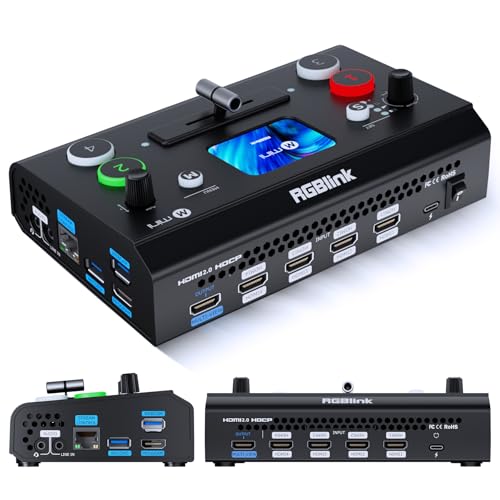
- Four HDMI inputs with 4K support
- Dual HDMI outputs and UVC webcam mode
- Touch screen, T-bar, recording, and creative effects
Best For: Compact 4K-input streaming and computer-based production
Best Professional Hybrid Pick
Tenveo PC500 HDMI/SDI Switcher

- Four HDMI and four SDI inputs with 4K60 input support
- Streams to two platforms through multiple protocols
- Integrated recording, PTZ control, monitoring, and browser control
Best For: Professional hybrid HDMI/SDI live production and streaming
Versatile Production Hub – Osee GoStream Deck HDMI Pro
For buyers comparing video switchers with HDMI for multicamera streaming, the Osee GoStream Deck stands out as a full production console rather than a basic input selector. It combines four HDMI inputs with recording, audio controls, graphics tools, multiview output, and direct streaming features.
Best For: Live events, podcasts, education, worship, conferences, and wedding productions that need integrated switching and streaming.
Pros:
- Four HDMI inputs, two HDMI outputs, USB-C connectivity, Ethernet, audio inputs, and SD card support.
- Streams to up to three platforms and supports landscape or portrait production.
- Includes T-Bar control, macros, chroma key, picture-in-picture, graphics overlays, and auto-switching.
- Can record to an SD card or USB SSD while playing back MP4 files.
Cons:
- Its broad feature set may be more than needed for simple HDMI source switching.
- Advanced production functions may require time to learn.
The GoStream Deck is a strong choice when you want a compact, PC-independent workflow with serious live-production capabilities. Its multiple outputs and extensive audio and overlay tools make it especially flexible for polished broadcasts.
High-Bandwidth Source Selector – 8K HDMI 2.1 4-in-1 Switch
If you need video switchers with HDMI for a gaming or home-entertainment setup, this four-input HDMI 2.1 model focuses on high-resolution source selection. It connects up to four devices to one display and supports formats up to 8K at 60Hz, subject to compatible hardware and cables.
Best For: Gamers and home-theater users switching among PS5, Xbox, computers, streaming devices, and other HDMI sources.
Pros:
- Supports up to 8K@60Hz, 4K@120Hz, and 2K@240Hz.
- Compatible with VRR, ALLM, and QFT for responsive gaming.
- Supports HDR, 3D, DTS, Dolby Digital, and LPCM audio formats.
- Offers remote control and automatic source switching.
Cons:
- 8K and 4K/120Hz operation requires compatible HDMI 2.1 devices and certified cables.
- Recommended cable lengths are limited for the highest bandwidth modes.
- Standby devices may interfere with automatic switching.
This switcher is best viewed as a high-performance HDMI source selector, not a live-production mixer. It is a practical fit when resolution, refresh rate, and gaming features matter more than camera transitions or streaming controls.
Streaming Workhorse – Blackmagic ATEM Mini Pro HDMI Switcher
The Blackmagic Design ATEM Mini Pro is a streamlined option among video switchers with HDMI for multicamera internet streaming and broadcast-style presentations. Its four HDMI inputs pair with transitions, keying, multiview, audio mixing, Ethernet streaming, and USB-C recording or webcam output.
Best For: Education, business presentations, esports, and multicamera livestreams that need dependable production controls.
Pros:
- Four HDMI camera inputs with 10-bit 4:2:2 video support.
- Includes cut, mix, dip, wipe, DVE, chroma, luma, linear, and pattern keying tools.
- Built-in six-input, two-channel audio mixer with two analog audio inputs.
- Provides Ethernet streaming, four-camera multiview, and USB-C webcam or recording output.
Cons:
- It has one HDMI output, which may limit more complex display arrangements.
- Its feature set is focused on live production rather than high-refresh gaming or 8K video.
The ATEM Mini Pro offers a focused balance of physical production controls and connectivity in a compact chassis. Choose it when you want a recognized live-streaming workflow with strong switching, keying, audio, and multiview features.
Integrated Multiview Mixer – CineTreak Mixer Plus HDMI Switcher
For compact productions, the CineTreak Mixer Plus is one of the more self-contained video switchers with HDMI. It combines four-channel HDMI switching with a built-in 4.5-inch multiview display, USB 3.0 UVC streaming, PTZ control, portrait mode, and live-production effects.
Best For: Small studios, churches, live events, vertical social content, and OBS-based streaming without a separate capture card.
Pros:
- Built-in display shows inputs, program, preview, resolution, and audio levels.
- Offers four HDMI inputs and 30 adjustable transition effects.
- Supports PTZ control over IP, chroma key, luma key, PIP, DSK, and logo overlays.
- USB 3.0 UVC output sends uncompressed HD video to OBS and compatible software.
Cons:
- The supplied notes do not specify maximum supported resolution or frame rates.
- PTZ control requires compatible cameras using VISCA over IP.
- The four-channel design may be limiting for larger productions.
The integrated screen is the main practical advantage: it reduces the need for a separate monitoring display while keeping key production information visible. Its UVC output and portrait mode also make it appealing for streamlined computer-based and vertical-video workflows.
Best All-Around HDMI Switch – Anker 4-in-1 4K HDMI Switcher
For shoppers comparing video switchers with hdmi, this Anker model is a straightforward way to connect up to four HDMI sources to one display. It supports 4K at 60Hz and includes remote-controlled switching for convenient use with laptops, consoles, projectors, and other compatible devices.
Best For: Home entertainment or workspaces with several HDMI sources and one display.
Pros:
- Connects four HDMI inputs to one HDMI output.
- Supports 4K at 60Hz, HDR, 3D, Dolby, and DTS.
- Includes a remote control and one-click switching.
- Backed by an 18-month warranty.
Cons:
- HDMI cables are not included.
- Charger and batteries are not included.
- Does not support HDMI CEC.
This is a practical choice when you want multiple HDMI devices connected at once without frequently swapping cables. Its remote adds convenience, while the lack of HDMI CEC means switching is handled manually.
Best for Live Production – Osee GoStream Duet HDMI and SDI Mixer
Osee GoStream Duet Multiple Camera SDI and HDMI Live Stream Video Mixer Switcher
Check Price On AmazonAmong video switchers with hdmi, the Osee GoStream Duet is designed for more advanced live production rather than simple source switching. It combines four HDMI and four SDI inputs with USB-C, NDI HX, media playback, built-in controls, and streaming support for multi-camera events.
Best For: Live streamers, event producers, and multi-camera setups using HDMI and SDI sources.
Pros:
- Offers four HDMI and four SDI inputs, plus USB-C and other source options.
- Supports key effects, picture-in-picture, DSK, and multiple transitions.
- Can stream to up to three platforms at once.
- Supports control through its built-in GUI, Mac and Windows software, or Bitfocus Companion.
Cons:
- Its professional feature set may be more than needed for basic HDMI switching.
- The free NDI HX license requires downloading the latest firmware to unlock it.
- A one-year manufacturer warranty is specified.
The GoStream Duet stands out when a production requires live mixing, effects, varied inputs, and direct or software-based streaming. It is less suitable if you only need to alternate between two consumer HDMI devices.
Best Compact Option – Anker 2-in-1 4K HDMI Switcher
This compact Anker unit is one of the simpler video switchers with hdmi, letting you connect two HDMI sources to one display and change between them with a physical button. It supports 4K at 60Hz when used with suitable short cables and works with laptops, consoles, displays, and VR headsets.
Best For: Users who need a small, manual switch for two HDMI sources and one display.
Pros:
- Switches between two HDMI inputs with one button.
- Supports resolutions up to 4K at 60Hz.
- Compatible with laptops, desktops, game consoles, TVs, and VR headsets.
- Lightweight design weighs 30 grams.
Cons:
- Manual switching is supported; automatic signal detection is not.
- Supports one display at a time and cannot provide simultaneous dual output.
- Does not support HDMI CEC.
This model makes sense for a desk or entertainment setup where two sources share one screen. For reliable 4K60 performance, the listed cable-length and 30AWG requirements should be followed.
Best Portable Pick – Mixer Plus Compact 4-Channel Switcher
If you need video switchers with hdmi for a compact multi-camera setup, the Mixer Plus combines four HDMI inputs with a built-in 4-inch multiview screen. Its portable design and live-production tools make it practical for streaming, online classes, events, and mobile productions.
Best For: Creators and small production teams that want four-camera HDMI switching with onboard monitoring.
Pros:
- Built-in 4-inch screen provides real-time multiview monitoring.
- Four HDMI inputs support multi-camera switching with zero-latency switching and 30 transition effects.
- Includes PTZ control, chroma key, luma key, PIP, DSK, logo overlay, and customizable AUX output.
Cons:
- Its HDMI-focused design may be less suitable for productions requiring SDI inputs.
- Compact controls and a 4-inch display may feel limiting for larger, more complex productions.
The Mixer Plus is a strong choice when portability and straightforward HDMI connectivity matter most. The integrated display reduces the need for a separate monitoring screen, while the AUX routing and production effects provide room to create more polished broadcasts.
Best Compact 4K Option – RGBlink Mini V3 HDMI Switcher
The RGBlink Mini V3 is one of the more flexible video switchers with hdmi for compact 4K-oriented setups. It offers four HDMI inputs, a 2.1-inch touch screen, dual HDMI outputs, UVC webcam mode, and optional recording and creative features through TAO Cloud activation.
Best For: Entry-level streamers and multi-camera creators who value 4K input support, touch control, and computer-friendly UVC connectivity.
Pros:
- Four HDMI inputs accept 4K video signals, with dual 1080p HDMI outputs for program and preview.
- UVC webcam mode supports direct recognition by platforms such as YouTube and Facebook.
- Offers a touch screen, T-bar control, PIP layouts, chroma key, transitions, PTZ control, and USB recording options.
Cons:
- Recording and selected advanced features require optional TAO Cloud licensing.
- Activation requires a firmware update, Ethernet connection, and account binding.
- A 35W-or-higher USB-C power adapter is recommended for stable performance.
The Mini V3 balances a small footprint with useful streaming features, especially for users who want to connect it directly to a computer as a webcam source. Buyers should account for the licensing process if they need recording, chroma key, PTZ, or logo functions.
Best Professional Hybrid Pick – Tenveo PC500 HDMI/SDI Switcher
For larger productions that need more than basic HDMI switching, the Tenveo PC500 combines four HDMI inputs with four SDI inputs, a 5.5-inch screen, PTZ control, recording, and built-in streaming. It is designed for live events, worship services, conferences, classrooms, studios, and other demanding multi-camera applications.
Best For: Professional or institutional teams that need HDMI and SDI connectivity, network streaming, recording, and integrated PTZ management.
Pros:
- Supports four HDMI inputs, four SDI inputs, USB input, NDI|HX3, and 4K60 input with 1080p60 output.
- Streams to up to two platforms using UVC, SRT, RTMP, RTSP, or NDI|HX3.
- Provides a 5.5-inch monitoring screen, dual recording, AUX routing, PTZ presets, and browser-based control.
Cons:
- Its extensive feature set may be more than casual streamers need.
- Although it accepts 4K60 input, the listed output is up to 1080p60.
- The professional input and networking options may require more setup than a simple HDMI switcher.
The PC500 is the most production-oriented option in this group. Its combination of HDMI, SDI, NDI, network streaming, recording, and PTZ tools makes it well suited to complex workflows where expansion and operational flexibility are more important than simplicity.
How We Picked These Video Switchers with Hdmi
We selected products covering several common use cases rather than treating every HDMI switcher as interchangeable. The lineup includes straightforward 2- or 4-input selectors for TVs and consoles, HDMI video mixers for multi-camera streaming, and hybrid models with SDI connectivity, multiview screens, recording, or direct streaming support.
Our comparisons focus on connection standards, supported resolutions and frame rates, switching controls, monitoring, portability, and the practical setup requirements buyers are likely to encounter. We also considered whether each model is better suited to live production or simple source selection.
Quick Comparison
- Basic source switching: Choose a compact 2-in/1-out or 4-in/1-out switch when you only need to change between consoles, streaming devices, or computers.
- Gaming at high refresh rates: Look for HDMI 2.1 support, 4K at 120Hz, and 8K compatibility if your console, display, and cables support those standards.
- Multi-camera streaming: A video mixer with multiple HDMI inputs, preview tools, transitions, and USB or network output is more suitable than a basic selector.
- Professional production: Models with SDI and HDMI inputs, multiview monitoring, and more robust control options offer greater flexibility for events and studio work.
Key Buying Factors for Video Switchers with Hdmi
Inputs, Outputs, and Signal Compatibility
Count the sources you plan to connect now, then allow room for expansion. Confirm whether the switcher accepts HDMI, SDI, or both, and check input and output versions carefully. A device advertised as 4K may support 4K only at a particular frame rate, while some HDMI 2.1 models are designed primarily for high-refresh gaming rather than live production.
Resolution, Frame Rate, and HDR
Match the switcher to the weakest part of your setup. Verify support for 1080p60, 4K60, 4K120, HDR, HDCP, and any desired passthrough mode. If you are switching cameras for streaming, reliable 1080p60 may matter more than headline 8K support.
Controls and Monitoring
Physical buttons are useful for fast source changes, while a preview screen or multiview output helps when managing several cameras. Touchscreens, remote controls, software panels, and cloud configuration can make advanced workflows easier, but they may add setup complexity.
Streaming and Audio Features
For live broadcasts, check for USB webcam output, network streaming, recording, chroma key, picture-in-picture, audio mixing, and headphone monitoring. A basic HDMI selector typically handles video routing only and will not replace a production mixer.
Who Should Buy Which Video Switchers with Hdmi?
Console and home-theater users should favor a simple Anker-style 2- or 4-input HDMI switch if they mainly need convenient source selection. Competitive gamers should prioritize HDMI 2.1 and verified 4K120 passthrough.
Solo creators, teachers, and small streamers will benefit from compact mixers with HDMI inputs, built-in displays, USB output, and direct streaming features. Event teams and advanced video producers should consider models combining HDMI and SDI, multiple monitoring options, and more extensive switching controls.
Before buying, confirm every source and display specification, including cable bandwidth, HDCP behavior, audio routing, and required output format. Those details determine whether a switcher works smoothly in your setup or creates avoidable compatibility problems.