Choosing among power amplifiers with XLR inputs means balancing output power, speaker compatibility, connectivity, and the type of system you are building. The right amplifier should deliver clean, reliable power without adding unnecessary complexity.
We selected 10 models spanning compact stereo systems, home theater, DJ setups, live sound, and rack-mounted installations. Use the guide below to narrow the field by performance needs, features, and budget.
Best 10 Power Amplifiers with Xlr Inputs Picks for 2026
Best Professional Value

- Two-channel Class D design with 350W per channel at 4 ohms
- Balanced XLR, TRS, and RCA inputs
- DSP, Peakx Limiters, crossover, and sleep mode
Best For: Portable professional sound systems and installations
Best Audiophile Compact Amp

- Fully balanced XLR input with 116dB claimed SNR
- Adjustable 60–200Hz high-pass filter and subwoofer output
- 12V trigger, bypass mode, and swappable op-amps
Best For: Compact home stereo and 2.1 systems
Best High-Power PA Output

- 2 x 3,000W at 4 ohms and 2 x 1,600W at 8 ohms
- Lightweight Class D design under 13 pounds
- Built-in crossover and SmartSense impedance compensation
Best For: High-output PA and sound reinforcement systems
Best Home Theater Integration

- Two channels rated at 90 watts per channel
- Includes both RCA and XLR inputs
- Designed for home theater and stereo integration
Best For: Modest home theater and stereo systems
High-Output Rack Power

- 1,400W RMS at 4 ohms
- Stereo, parallel, and bridged modes
- Crossover, limiter, and LCD monitoring
Best For: DJs, live events, and passive-speaker systems
Compact Hi-Fi Flexibility

- XLR input for mono mode
- RCA stereo input and direct mode
- PGA2311 volume control
Best For: Compact high-fidelity audio systems
Gig-Ready Balanced Power
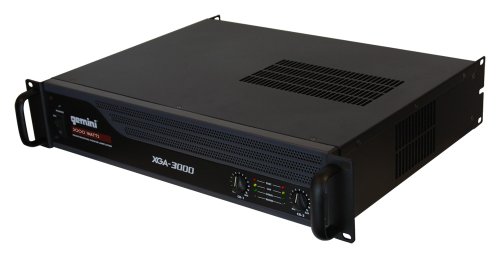
- 3,000W listed output
- XLR, 1/4-inch, and RCA inputs
- Speakon outputs and protection circuits
Best For: Mobile DJs, PA systems, and venue installations
Best Lightweight DSP Amp
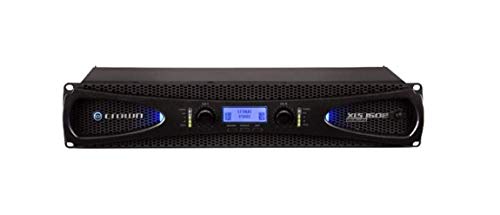
- 525W per channel at 4 ohms
- XLR, TRS, and RCA inputs
- DSP filters and Peakx limiters
Best For: Portable PA and rack systems needing efficient, controllable amplification
Best Feature-Packed Budget Amp

- 2,000W bridged maximum output
- XLR, TRS, Speakon, and binding posts
- Bluetooth and USB MP3 playback
Best For: DJs and events needing flexible playback and speaker connections
Best High-Power Rack Amp

- Up to 3,000W RMS bridged
- Combo XLR/1/4-inch inputs
- Crossover, limiter, and LCD monitoring
Best For: Large venues, DJ rigs, touring, and subwoofer systems
Best Professional Value – Crown XLS1002
The Crown XLS1002 is a practical choice among power amplifiers with XLR inputs for live sound, studio, and installed systems. Its two-channel Class D design delivers 350 watts per channel at 4 ohms, while DSP features, selectable input sensitivity, and flexible balanced inputs make system setup straightforward.
Best For: Professional users who need a lightweight, rack-mountable stereo amplifier with DSP and reliable speaker protection.
Pros:
- Balanced XLR inputs, plus TRS and RCA connectivity
- 350 watts per channel at 4 ohms and up to 1100 watts bridged at 4 ohms
- Peakx Limiters, PureBand crossover, sleep mode, and forced-air cooling
- Weighs less than 11 pounds and includes an authorized-dealer warranty
Cons:
- Its professional feature set may be more than a basic home setup needs
- Cooling fans may be less suitable for noise-sensitive listening spaces
With broad input compatibility and useful onboard processing, the XLS1002 is a well-rounded option when portability, output flexibility, and installation-friendly features matter.
Best Audiophile Compact Amp – AIYIMA A20
The AIYIMA A20 is a compact home-audio pick among power amplifiers with XLR inputs. Its fully balanced Class D design combines a claimed 116dB signal-to-noise ratio with 0.002% THD+N, while the adjustable high-pass filter and subwoofer output support flexible 2.1 system building.
Best For: Home listeners and enthusiasts assembling a compact, configurable stereo or 2.1 system.
Pros:
- Fully balanced XLR design with selectable XLR/RCA input mode
- Adjustable 60–200Hz high-pass filter and dedicated subwoofer output
- Bypass mode, +3dB gain switch, swappable op-amps, and 12V trigger
- Compact 1kg design with internal air-convection cooling
Cons:
- It is intended for home audio rather than high-output professional reinforcement
- The supplied notes do not specify its power delivery by impedance
The A20 stands out for system-integration features rather than sheer output. Its balanced connectivity and adjustable filtering make it especially appealing for a carefully configured desktop or home 2.1 setup.
Best High-Power PA Output – Behringer NX6000
The Behringer NX6000 is designed for demanding sound reinforcement applications and belongs on the shortlist of power amplifiers with XLR inputs when maximum output is the priority. Its two channels produce 3,000 watts each at 4 ohms, with built-in crossover modes and SmartSense impedance compensation.
Best For: Large PA systems and users who need very high two-channel output in a relatively lightweight chassis.
Pros:
- Delivers 2 x 3,000 watts at 4 ohms and 2 x 1,600 watts at 8 ohms
- Class D architecture and switch-mode power supply keep the unit under 13 pounds
- Built-in low-cut, high-cut, and full-range crossover modes
- SmartSense compensation is designed to maintain linear response across speaker loads
Cons:
- Its very high output is excessive for many small rooms and home systems
- The supplied notes do not detail the rear-panel XLR input configuration
For large speakers and high-demand venues, the NX6000 offers substantial headroom without the weight of a comparable conventional amplifier. It is best matched with appropriately rated speakers and a properly configured PA system.
Best Home Theater Integration – Monolith M2100X
The Monolith M2100X is a straightforward two-channel home theater amplifier for buyers seeking power amplifiers with XLR inputs and RCA compatibility. It provides 90 watts per channel and keeps connectivity simple for integrating balanced or unbalanced sources.
Best For: Home theater users who want a dedicated two-channel amplifier with both RCA and XLR inputs.
Pros:
- 90 watts per channel across two channels
- Supports both RCA and XLR inputs
- Simple fit for home theater and stereo system integration
Cons:
- The supplied notes provide few details about processing, protection, or cooling
- Its output is more suited to modest home systems than high-power PA use
The M2100X is appealing when you need uncomplicated two-channel amplification and flexible source connections. Buyers wanting detailed power ratings by impedance or extensive onboard features may need to verify those specifications before purchase.
High-Output Rack Power – Rockville D12
The Rockville D12 is a practical choice among power amplifiers with XLR inputs for DJs, live events, and passive-speaker systems that need substantial output. Its two-channel design supports stereo, parallel, and bridged operation, while the crossover, limiter, LCD monitoring, and rack-mount chassis add useful installation flexibility.
Best For: DJ rigs, live sound setups, passive speakers, and subwoofer systems requiring high output.
Pros:
- Offers 1,400W RMS at 4 ohms and 700W RMS at 8 ohms, with a listed 5,000W peak rating.
- XLR and 1/4-inch inputs support common professional audio sources.
- Switchable 80Hz and 160Hz crossover settings accommodate subwoofer or full-range use.
- LCD monitoring shows channel volume in dB and operating temperature.
Cons:
- The high-output design may be more amplifier than smaller home systems need.
- It is a rack-mount professional unit rather than a compact desktop amplifier.
Choose the D12 when power, flexible speaker configuration, and live-use monitoring matter most. Its lightweight 1.5U chassis and quiet cooling fans make it easier to transport and install than many higher-output alternatives.
Compact Hi-Fi Flexibility – SMSL PA200
The SMSL PA200 stands out among power amplifiers with XLR inputs for listeners building a compact high-fidelity system. It supports XLR input in mono mode, RCA input for stereo operation, and a direct post-stage mode, giving system builders several ways to pair it with a compatible preamp or decoder.
Best For: Compact hi-fi systems, SMSL-based setups, and users who want mono-mode expansion with XLR connectivity.
Pros:
- XLR input enables mono-mode use and potential power expansion with two units.
- RCA input supports stereo operation for conventional system layouts.
- PGA2311 volume control is designed for precise adjustment and low distortion.
- Includes overheating and overcurrent protection circuits.
Cons:
- The listed output is 35 watts, so it is not intended for high-power PA applications.
- Its mono expansion approach may require purchasing a second amplifier for a fourfold power gain.
The PA200 is best evaluated as a focused hi-fi component rather than a stage amplifier. Its XLR mono mode, RCA stereo input, compact 1.88 kg build, and included remote make it particularly suited to carefully assembled home audio systems.
Gig-Ready Balanced Power – Gemini XGA-3000
The Gemini XGA-3000 is a strong option among power amplifiers with XLR inputs for mobile DJs, PA systems, and venue installations. It combines 3,000 watts of listed output with balanced XLR and 1/4-inch inputs, RCA connectivity, bridgeable operation, and protection features for demanding live-use environments.
Best For: Working DJs, live sound systems, clubs, venues, and rack-mounted PA installations.
Pros:
- Provides 3,000 watts of listed output with stereo and mono bridge modes.
- Balanced XLR and 1/4-inch inputs plus RCA accept a broad range of sources.
- Speakon and five-way binding-post outputs support flexible speaker connections.
- DC, short-circuit, and limiter protection help safeguard connected equipment.
Cons:
- The 2U rack chassis is larger and heavier than compact home audio amplifiers.
- Its professional output level may be excessive for modest speaker systems.
For users who need a versatile amplifier for gigs or installations, the XGA-3000 offers a well-rounded connection and protection package. Front-panel controls, status LEDs, variable-speed cooling, and a ground-lift switch further support practical day-to-day operation.
Best Lightweight DSP Amp – Crown XLS1502
If you need power amplifiers with XLR inputs for a portable PA, installation, or rack setup, the Crown XLS1502 combines balanced connectivity with efficient Class D operation. It delivers 525 watts per channel at 4 ohms, includes onboard DSP, and weighs less than 11 pounds.
Best For: Portable professionals and system builders who want lightweight amplification, flexible input options, and built-in speaker-control features.
Pros:
- Offers 525W per channel at 4 ohms, 300W per channel at 8 ohms, and up to 1,550W bridged at 4 ohms.
- Includes balanced XLR, 1/4-inch TRS, and RCA inputs for broad source compatibility.
- Provides DSP features including per-channel band-pass filters, PureBand crossover control, and Peakx limiters.
- Lightweight rack-mount design with sleep mode, menu lock, and forced-air cooling.
Cons:
- Its maximum output is lower than the high-power models in this roundup.
- Advanced settings may take more time to configure than a basic amplifier.
The XLS1502 is a strong choice when portability and control matter as much as output. Its XLR connectivity, DSP, and selectable input sensitivity make it adaptable to different professional audio sources and setups.
Best Feature-Packed Budget Amp – Pyle PTA1000BT
For buyers comparing power amplifiers with XLR inputs for flexible event or home audio use, the Pyle PTA1000BT adds Bluetooth, USB MP3 playback, and bridgeable two-channel operation. It supports stereo or bridged configurations and provides connections for multiple speaker types.
Best For: DJs, event users, and small sound systems that want wireless playback and varied input/output options in a rack-mountable amplifier.
Pros:
- Provides up to 2,000 watts in bridged mode or 1,000 watts per channel in stereo, for 4- to 8-ohm speakers.
- Includes two XLR inputs, two 1/4-inch TRS inputs, and multiple Speakon and binding-post outputs.
- Supports Bluetooth streaming from smartphones, tablets, laptops, and computers.
- Front-panel LCD and LED indicators display playback and channel-status information.
Cons:
- The supplied notes specify peak and maximum output, but do not provide detailed continuous RMS ratings.
- At 6.94 kg, it is less portable than the lightweight Crown model.
The PTA1000BT prioritizes convenience and connectivity. Its Bluetooth and USB features can simplify playback, while bridge mode and multiple speaker outputs give it flexibility for basic event and installation systems.
Best High-Power Rack Amp – Rockville RPA16
The Rockville RPA16 is designed for demanding sound reinforcement applications where power amplifiers with XLR inputs need substantial output and flexible routing. Its two channels deliver up to 1,500 watts RMS each at 4 ohms, while bridge mode provides 3,000 watts RMS at 8 ohms.
Best For: Large venues, DJ systems, touring setups, rental companies, and subwoofer applications requiring high output and rack-based control.
Pros:
- Delivers 2 x 1,000W RMS at 8 ohms, 2 x 1,500W RMS at 4 ohms, or 3,000W RMS bridged at 8 ohms.
- Provides combo XLR/1/4-inch inputs plus XLR line outputs for linking additional equipment.
- Includes crossover settings, limiter protection, stereo/parallel/bridged modes, and independent channel controls.
- LCD monitoring shows volume and temperature in a rugged 2U steel rack chassis.
Cons:
- Its 40.8-pound weight makes it considerably less portable than compact Class D alternatives.
- The high-power 2U chassis may be more amplifier than small systems require.
Choose the RPA16 when output headroom and configuration options take priority over portability. Its XLR connectivity, bridge mode, crossover, and high-power ratings suit larger speaker systems and low-frequency applications.
How We Picked These Power Amplifiers with Xlr Inputs
We focused on amplifiers that offer XLR connectivity alongside practical system features such as RCA or TRS inputs, bridge operation, DSP, protection circuits, rack-mount compatibility, and support for common speaker impedances. The list includes both professional Class-D designs and compact stereo amplifiers so buyers can compare options for different environments.
Rated wattage is only one consideration. Actual suitability depends on whether the amplifier can deliver that power at your speakers’ impedance, whether the inputs match your source equipment, and whether cooling, noise, and controls fit your installation.
Quick Comparison
| Best For | What to Prioritize |
|---|---|
| Home stereo | Low noise, balanced inputs, manageable output, and compact size |
| Home theater | Multiple channels, stable impedance handling, and clean sustained power |
| DJ and mobile rigs | Rack mounting, durable construction, flexible inputs, and easy controls |
| Live sound | High output, protection features, efficient cooling, and dependable connectors |
| Fixed installations | Reliable operation, impedance flexibility, and appropriate long-term ventilation |
Key Buying Factors for Power Amplifiers with Xlr Inputs
Power and Speaker Impedance
Check the amplifier’s continuous output at the impedance your speakers require, commonly 4 or 8 ohms. Avoid choosing based only on a headline peak or bridged rating. A little headroom can help prevent clipping, but excessive power can damage speakers if the system is mismanaged.
Input and Output Connections
XLR inputs are useful for balanced signal runs because they can reduce hum and interference, especially with longer cables. Confirm whether the amplifier also accepts RCA or TRS sources. For speaker connections, check for binding posts, Speakon outputs, or other connectors that match your existing cables.
Channels, Bridge Mode, and Controls
A two-channel amplifier can run stereo speakers or sometimes be bridged for a single higher-power channel. Verify the manufacturer’s impedance requirements before bridging. Front-panel gain controls, signal indicators, limiters, and protection circuitry can make setup and troubleshooting easier.
DSP, Cooling, and Installation
Built-in DSP may provide crossover, band-pass, limiter, or equalization tools, reducing the need for external equipment. For rack installations, confirm chassis depth, ventilation clearance, fan noise, and available power. Efficient Class-D designs generally reduce weight and heat, but every amplifier still needs adequate airflow.
Who Should Buy Which Power Amplifiers with Xlr Inputs?
Choose a compact balanced stereo model for desktop or small-room listening where low noise and simple operation matter most. Home theater buyers should prioritize stable multi-channel performance and clean power over inflated maximum-watt figures. DJs and mobile performers will usually benefit from rack-friendly construction, flexible inputs, bridge capability, and robust protection features.
For live venues or demanding installations, select a model with substantial continuous output, reliable cooling, impedance compensation, and clearly documented protection systems. If you are uncertain, match the amplifier to the speaker manufacturer’s recommended power range and leave enough ventilation around the chassis.