The best network audio player with balanced outputs can bring streaming services, local music, and high-resolution playback into a cleaner, more flexible hi-fi system. Balanced connectivity is especially useful when you want longer cable runs, reduced noise, or a better match with balanced amplifiers and powered speakers.
This roundup compares 10 selected models across premium streamers, DAC-equipped players, CD and network components, stereo receivers, and portable or desktop options. Use the guide below to narrow your choice by connectivity, source support, system role, and overall value.
Best 10 Network Audio Player with Balanced Outputs Picks for 2026
Flagship Control Center

- Fully balanced preamp with XLR and RCA inputs
- ES9039PRO DAC, room correction, and isolation
- Built-in access to major streaming services
Best For: Audiophiles seeking an all-in-one balanced streamer, DAC, and preamp
Balanced Streaming Upgrade

- Balanced XLR output for compatible systems
- ESS Sabre ES9028Q2M DAC
- HDMI eARC, USB, optical, coaxial, and Bluetooth
Best For: Listeners wanting balanced output with broad digital connectivity
Radio-Focused Component
Ocean Digital WR-50 Internet Radio Tuner

- Over 30,000 internet radio stations and podcasts
- Wi-Fi, Ethernet, FM, Bluetooth, UPnP/DLNA, and USB
- RCA, optical, and coaxial outputs—but no balanced output
Best For: Radio-first stereo systems that do not require balanced connections
Compact Hi-Res Streamer
Arcam Radia ST5 Streaming Player

- Supports up to 24-bit/192kHz, MQA, and DSD128
- Wi-Fi, Ethernet, USB, and UPnP playback
- RCA, coaxial, and optical outputs; no balanced output listed
Best For: Arcam Radia owners seeking coordinated high-resolution streaming
Best Digital Transport

- Balanced AES/EBU XLR digital output
- Dual femtosecond clocks and isolated outputs
- Supports TIDAL, Qobuz, Roon Ready, and high-resolution formats
Best For: Separate DAC-based systems needing balanced digital connectivity
Best Network CD Player

- Combines CD playback and network streaming
- Supports PCM 384kHz/32-bit and DSD 128
- Adds HDMI ARC and digital volume control
Best For: Stereo systems needing CDs, streaming, and TV connectivity
Best All-in-One Stereo Receiver

- Two-channel receiver with 100-watt-class output
- Wi-Fi, Roon, TIDAL, Deezer, and Bluetooth support
- Includes phono input, HDMI, and Dirac Full Band
Best For: Complete stereo systems with streaming, vinyl, and TV audio
Reference-Ready Choice

- AK4191+AK4499EX DAC architecture
- XLR balanced output and broad I/O
- Android 12 with extensive network playback
Best For: Dedicated hi-fi systems needing balanced connectivity
Portable Balanced Pick

- 4.4mm balanced headphone output
- Wi-Fi DLNA/AirPlay and Bluetooth 5.2
- Compact 116g design with coaxial output
Best For: Portable balanced headphone listening with network features
System Integration Pick
- XLR balanced output with comprehensive I/O
- HDMI ARC for compatible TV systems
- Roon Ready, NAS, and Android playback
Best For: Full-size systems combining music and television audio
Flagship Control Center – EVERSOLO DMP-A10
The EVERSOLO DMP-A10 is a premium network audio player with balanced outputs for listeners building a serious digital system. Its ES9039PRO DAC, fully balanced preamplifier circuit, direct streaming-service access, room correction, and dual-subwoofer controls make it more than a basic streamer.
Best For: Audiophiles who want a network streamer, DAC, preamp, and room-tuning features in one component.
Pros:
- Fully balanced analog preamp circuit with XLR and RCA inputs.
- Supports TIDAL, Qobuz, Amazon Music, and several other streaming services.
- Includes room correction, electrical isolation, and dual-subwoofer output controls.
- Large 6.5-inch touchscreen plus iOS, Android, and iPad app control.
Cons:
- Its extensive feature set may be more than needed for a simple streaming setup.
- Subwoofer functionality is limited to PCM signals below 192kHz.
Choose the DMP-A10 if you want balanced connectivity and extensive system control without adding separate streaming, DAC, and preamp components. It is especially compelling for a refined, customizable two-channel or subwoofer-equipped system.
Balanced Streaming Upgrade – Cambridge Audio EXN100
The Cambridge Audio EXN100 is a network audio player with balanced outputs designed to add high-quality streaming to an existing stereo system. It combines an ESS Sabre ES9028Q2M DAC with Ethernet, HDMI eARC, USB, optical, coaxial, and Bluetooth connectivity.
Best For: Stereo listeners who want balanced XLR output and flexible connections for music and home cinema.
Pros:
- Provides a balanced XLR output for premium system connectivity.
- Uses an ESS Sabre ES9028Q2M DAC for digital-to-analog conversion.
- Includes HDMI eARC for integration with compatible home cinema setups.
- Supports Ethernet, USB, optical, coaxial, and Bluetooth 5 with aptX HD.
Cons:
- The supplied notes do not specify supported streaming services or maximum resolution.
- Bluetooth and HDMI features may be unnecessary in a minimalist two-channel system.
The EXN100 makes sense when balanced analog output is important but system flexibility matters too. Its broad input selection lets it serve as a central digital source for both a stereo setup and a compatible television-based system.
Radio-Focused Component – Ocean Digital WR-50 Internet Radio Tuner
The Ocean Digital WR-50 is a full-size network tuner rather than a conventional balanced network audio player. It offers Wi-Fi and Ethernet access to more than 30,000 internet radio stations and podcasts, plus FM, Bluetooth, UPnP/DLNA, and USB playback, but its listed outputs are RCA, optical, and coaxial rather than balanced.
Best For: Traditional stereo systems that prioritize internet radio, podcasts, FM, and convenient physical controls.
Pros:
- Accesses more than 30,000 internet radio stations and podcasts.
- Supports Wi-Fi, wired Ethernet, FM, Bluetooth 5.0, UPnP/DLNA, and USB playback.
- Offers optical, coaxial, stereo RCA, and front-panel headphone outputs.
- Includes a 2.4-inch color display, remote control, and up to 150 presets.
Cons:
- Does not provide balanced outputs, so it is not a direct match for this keyword.
- It is focused on radio and convenience features rather than a high-end balanced DAC stage.
The WR-50 is worth considering only if balanced output is not essential. Its wide component-style chassis and easy station access make it a practical source for listeners who want radio and network playback in an existing stereo stack.
Compact Hi-Res Streamer – Arcam Radia ST5 Streaming Player
The Arcam Radia ST5 is a compact streaming network audio player for upgrading a stereo system with high-resolution playback. It supports Wi-Fi or Ethernet, USB media playback, and UPnP, with analog RCA and digital coaxial and optical outputs; however, it does not list balanced outputs.
Best For: Owners of compatible Arcam Radia amplifiers who want coordinated control and high-resolution network playback.
Pros:
- Supports streaming and playback up to 24-bit/192kHz, plus MQA and DSD128.
- Offers Wi-Fi, Ethernet, USB media playback, and UPnP support.
- Provides stereo RCA, coaxial, and optical outputs.
- Comms/control link integration works with compatible Radia A5+ and A15+ amplifiers.
Cons:
- Does not list balanced XLR outputs.
- Its control-link advantages are primarily relevant to compatible Arcam Radia systems.
The ST5 is a strong fit for an Arcam-centered setup where matching design and coordinated operation matter. For a system specifically requiring balanced connections, look elsewhere or plan to use its RCA or digital outputs instead.
Best Digital Transport – Eversolo T8 Network Transport
The Eversolo T8 is a strong choice if you need a network audio player with balanced outputs and plan to connect it to a separate DAC or digital audio system. Its balanced AES/EBU XLR output, electrical isolation, dual femtosecond clocks, and support for TIDAL, Qobuz, Roon Ready, and other platforms make it especially suited to high-resolution digital playback.
Best For: Audiophiles building a separate DAC-based system who want balanced digital connectivity and extensive streaming support.
Pros:
- Balanced AES/EBU XLR output supports noise-resistant, long-distance digital transmission.
- Dual femtosecond clocks are designed to reduce clock jitter at the source.
- Electrical isolation is provided across the listed digital outputs to help reduce ground-loop noise.
- Supports high-resolution formats up to DSD512 Native and PCM 768kHz/32-bit through IIS and USB Audio.
Cons:
- It is a transport rather than a complete amplifier or analog playback system.
- SFP modules are sold separately and must be compatible with the selected switch.
- The supplied notes do not identify a built-in analog balanced output.
The T8 is the most specialized option here for a digital-first setup. Choose it when balanced AES/EBU connectivity, isolation, and format support matter more than integrated amplification or CD playback.
Best Network CD Player – Marantz CD 50n
The Marantz CD 50n combines CD playback with network audio streaming, making it a practical network audio player with balanced outputs for listeners who want physical and streamed music in one component. It supports PCM up to 384kHz/32-bit and DSD 128, while HDMI ARC adds a straightforward connection for a TV.
Best For: Stereo listeners who want CD playback, network streaming, and TV audio in a single high-resolution component.
Pros:
- Combines a CD player with network audio streaming.
- Supports high-resolution playback up to PCM 384kHz/32-bit and DSD 128.
- HDMI ARC enables a single-cable connection for TV, movies, and games.
- Built-in digital preamp functionality allows volume adjustment through HEOS or the remote when driving a power amplifier.
Cons:
- The supplied notes do not specify the exact balanced-output implementation.
- It is a two-channel component, so it is not intended for multichannel surround systems.
- Its 3.5mm headphone jack may not suit users seeking a dedicated high-end headphone output.
The CD 50n makes sense when convenience and format flexibility are priorities. It is less focused than the Eversolo as a pure digital transport, but it adds CD playback and HDMI ARC for a broader stereo setup.
Best All-in-One Stereo Receiver – Onkyo TX-8470
Onkyo TX-8470 2 Channel Stereo Receiver with Wi-Fi, Bluetooth, Phono, Hi-Res Audio and Roon Ready
Check Price On AmazonThe Onkyo TX-8470 is a network audio player with balanced outputs for buyers who also need a complete two-channel receiver. It combines Wi-Fi streaming, Roon Ready and TIDAL support, 100-watt-class stereo output, HDMI connectivity, Bluetooth, and a dedicated MM/MC phono board in one chassis.
Best For: Stereo listeners who want network streaming, vinyl support, TV connectivity, and speaker amplification without adding a separate power amplifier.
Pros:
- Combines network audio features with a two-channel stereo amplifier.
- Supports Roon, TIDAL, Deezer, Wi-Fi, Bluetooth, and voice-control integration.
- Includes an isolated MM/MC phono board for turntable compatibility.
- Provides four HDMI ports and Dirac Full Band room correction.
Cons:
- The supplied notes do not identify the exact balanced-output connector or configuration.
- Its two-channel design is not intended for multichannel home theater.
- It is less specialized as a standalone digital transport than the Eversolo T8.
The TX-8470 is the practical choice for a complete stereo system. It trades the T8’s transport-focused design for built-in amplification, phono support, HDMI, and broad everyday connectivity.
Reference-Ready Choice – FiiO S15 Silver
The FiiO S15 is a full-size network audio player with balanced outputs for listeners building a serious desktop or hi-fi system. Its AKM DAC architecture, broad network support, large touchscreen, and XLR output make it suited to both streaming and local playback.
Best For: Dedicated home audio systems needing extensive connectivity and XLR balanced line output.
Pros:
- Supports Roon Ready, AirPlay, DLNA, Bluetooth, UPnP, SMB, and WebDAV streaming.
- Includes XLR balanced line output plus I2S, AES, coaxial, HDMI ARC, RCA, and optical connections.
- Uses an AK4191+AK4499EX DAC combination and dual low-phase-noise femtosecond oscillators.
- Offers Android 12, a 7.84-inch display, app control, remote control, and local playback options.
Cons:
- Its approximately 430mm-wide chassis and 5-6kg weight are better suited to a stationary system than a compact desk.
- The feature-rich interface may be more than needed for basic streaming.
Choose the S15 when connection flexibility and balanced integration matter more than portability. It is especially compelling for systems that can take advantage of XLR, HDMI ARC, or multiple digital inputs and outputs.
Portable Balanced Pick – Shanling M1 Plus
The Shanling M1 Plus is a compact network audio player with balanced outputs that bridges portable listening and desktop use. It combines Wi-Fi streaming, DLNA and AirPlay support, a 4.4mm balanced headphone output, and a 3.5mm coaxial digital output in a small player.
Best For: Portable listeners who want balanced headphone output and occasional network or desktop playback.
Pros:
- Provides 4.4mm balanced and 3.5mm single-ended headphone outputs.
- Supports Wi-Fi DLNA/AirPlay streaming, Bluetooth 5.2, and two-way USB connection.
- Includes a 3.5mm coaxial S/PDIF output for connecting to desktop systems.
- Compact 116-gram aluminum-and-glass design offers approximately 12.5 hours of playback.
Cons:
- It has a smaller 3.2-inch screen and less system connectivity than a full-size streamer.
- MicroSD storage is expandable, but the card is not included.
- The balanced output is a headphone connection rather than an XLR line output.
The M1 Plus makes the most sense when portability is central and balanced headphone listening is the priority. Its network features and coaxial output add useful flexibility, but it is not a substitute for a full-width streamer with balanced line outputs.
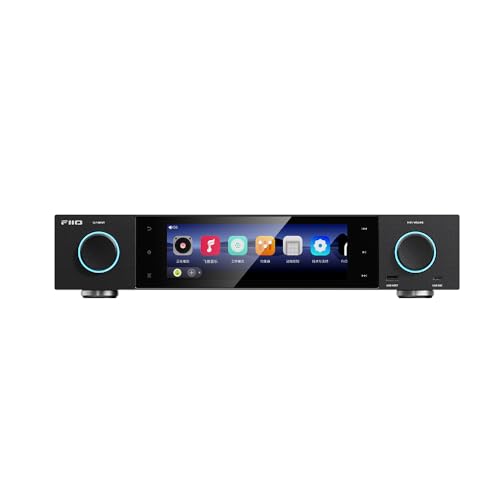
System Integration Pick – FiiO S15 Black
The black FiiO S15 is a versatile network audio player with balanced outputs for a coordinated home system. It pairs a large touchscreen and Android-based app support with Roon Ready, NAS, HDMI ARC, and XLR connectivity, making it useful as both a streamer and desktop DAC.
Best For: Full-size audio setups that need network streaming, television connectivity, and balanced analog output.
Pros:
- Offers XLR balanced line output alongside RCA, AES, I2S, coaxial, optical, and HDMI connections.
- Supports Roon Ready, AirPlay, DLNA, Bluetooth, UPnP, SMB, and WebDAV playback.
- HDMI ARC supports integration with compatible televisions and system components.
- Large 7.84-inch display, dual knobs, remote control, and app control simplify operation.
Cons:
- The full-size 430mm chassis requires suitable rack or desktop space.
- Its extensive input, output, and streaming options may be unnecessary for a simple music-only setup.
Consider this version when the system needs to handle music libraries, streaming services, and TV audio from one substantial component. The black finish is the main distinction from the silver S15 listing; the supplied specifications otherwise describe the same core platform.
How We Picked the Best Network Audio Player with Balanced Outputs
We selected models that cover the main ways listeners use modern network audio: streaming Tidal, Qobuz, Amazon Music, and internet radio; playing local files; connecting digital sources; and integrating with amplifiers, receivers, powered speakers, or desktop systems. We also considered balanced-output availability or system compatibility, DAC implementation, wired and wireless networking, control options, display quality, room correction, physical media support, and upgrade flexibility.
Because product designs vary, check the specifications carefully before buying. Some models are complete preamp or DAC solutions, while others are transports, receivers, or compact players that require additional equipment.
Quick Comparison
| Best For | Look For | Typical System Role |
|---|---|---|
| Premium two-channel setups | High-quality DAC, balanced outputs, clocking, isolation | Streamer, DAC, and preamp |
| Flexible streaming systems | Broad service support, app control, Ethernet, USB | Network source component |
| CD and streaming listeners | Disc playback, digital inputs, high-resolution support | All-in-one source player |
| Simple stereo systems | Amplification, phono input, HDMI ARC, Bluetooth | Stereo receiver |
| Desktop or portable listening | Compact design, headphone output, battery or USB use | Personal audio source |
Key Buying Factors for a Network Audio Player with Balanced Outputs
Outputs and System Matching
Confirm whether the balanced connection is a true line-level XLR output and whether the player also provides RCA, digital, or headphone outputs. Match output level and volume-control behavior to your amplifier or powered speakers. A streamer with a preamp can connect directly to a power amplifier, while a transport generally needs a separate DAC.
Streaming and Network Support
Check native support for your preferred services, gapless playback, multiroom platforms, Roon compatibility, AirPlay or Chromecast needs, and whether Ethernet is available. Wired networking is usually the safer choice for large libraries and high-resolution files, while Wi-Fi improves installation flexibility.
DAC, File Formats, and Inputs
Higher specifications do not automatically guarantee better sound, but they can provide useful headroom for demanding libraries. Review PCM and DSD support, USB audio, optical and coaxial inputs, HDMI ARC, Bluetooth codecs, and compatibility with your existing digital sources.
Control and Long-Term Usability
A responsive app, readable display, physical remote, and reliable firmware support matter during everyday use. Consider whether you prefer a touchscreen component, phone-based control, or a traditional receiver interface.
Who Should Buy Which Network Audio Player with Balanced Outputs?
Choose a premium streamer or DAC-equipped model if you are building a revealing two-channel system and want balanced connectivity, extensive format support, and room to upgrade. A network transport makes more sense when you already own a preferred DAC or preamp. A CD/network player suits listeners who want physical discs and streaming in one component.
Choose a stereo receiver if you want amplification, phono playback, Bluetooth, and network audio without assembling multiple boxes. Desktop and portable models are better for headphones, nearfield speakers, or secondary systems, but verify their output types before expecting full balanced integration. Finally, prioritize Ethernet, service compatibility, and control quality over headline specifications if dependable daily streaming is your main goal.