Printing in an enclosed workspace can expose you to odors and airborne particles from resin, plastics, and heated materials. The best HEPA 3D printer air purifiers combine particle filtration with activated carbon to help improve air quality around your printer.
This roundup compares 10 options for resin and FDM workflows, including compact printer-mounted units, replacement filter systems, and enclosures with built-in purification.
Best 10 Hepa 3d Printer Air Purifiers Picks for 2026
Best for Resin Crafting

- H13 True HEPA filtration for 0.3-micron particles
- Real-time TVOC display with auto mode
- Compact, portable design for small workspaces
Best For: Resin artists and small-space crafters
Best Compact Pair
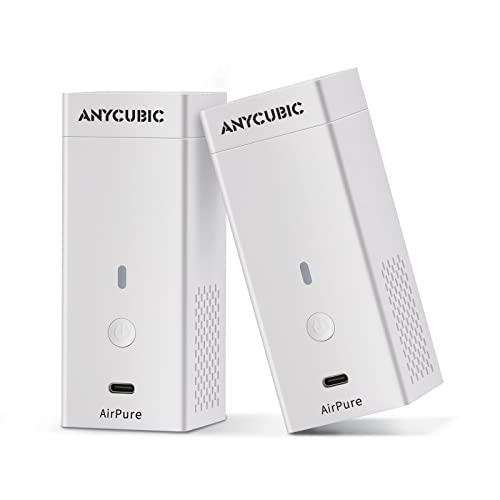
- Two compact units for resin-printer placement
- High-density activated carbon targets odors
- Replaceable filters last about three to six months
Best For: Localized resin odor control
Best for Creality K2

- Four-stage HEPA and activated-carbon filtration
- Designed for CREALITY K2 and K2 Pro
- Includes extractor, pipe, hoods, and pre-filters
Best For: Enclosed CREALITY K2 and K2 Pro printers
Best Resin Printer Ventilation

- HEPA plus 4.4-pound activated carbon filtration
- Stepless speed control with included exhaust accessories
- Designed for select ELEGOO and ANYCUBIC resin printers
Best For: Compatible resin-printing setups needing dedicated exhaust capture
Best FDM Filtration System

- Five-stage filtration with HEPA and dense carbon
- 250 m³/h airflow and 1,700 Pa suction rating
- Touchscreen PM2.5 and filter-status monitoring
Best For: FDM workspaces prioritizing monitoring and long filter intervals
Best Bambu Lab Compatibility
Four-Stage HEPA Printer Purifier

- Four-stage HEPA and activated-carbon filtration
- Includes five pre-filters and magnetic suction hoods
- Supports select Bambu Lab and ELEGOO printers
Best For: Bambu Lab and ELEGOO users needing printer-connected filtration
Best Overall
Creality 5-Stage HEPA Air Purifier

- H13 HEPA plus dual activated-carbon filtration
- PM2.5 monitoring with smart touch controls
- Works with most desktop FDM and resin printers
Best For: Dedicated resin or FDM printing workspaces
Best Enclosure System
BD-60A 3D Printer Enclosure Purifier
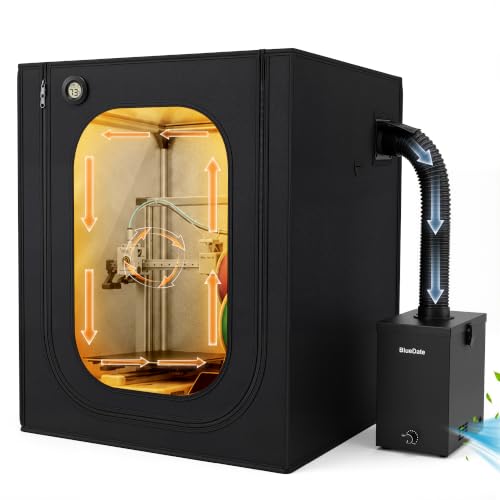
- Enclosure contains dust, odors, and fumes
- Multi-stage HEPA and activated-carbon filtration
- Adjustable speed with included extraction accessories
Best For: Open-style printers and contained printing setups
Best Compact Option
ELEGOO Mini Carbon Purifier 2-Pack

- Two rechargeable units for flexible placement
- Targets resin odors with activated carbon
- Quiet 10 dB operation and 24-hour battery runtime
Best For: Small LCD, DLP, or MSLA resin printing stations
Best for Resin Crafting – Resiners Purair Lite
For small resin workspaces, the Resiners Purair Lite is a compact option among HEPA 3D printer air purifiers. Its H13 True HEPA filtration, pre-filter, TVOC monitoring, and automatic fan adjustment make it suited to resin mixing, pouring, and curing on a desk or crafting table.
Best For: Resin artists and crafters who want a portable purifier with visible TVOC readings and simple touch controls.
Pros:
- H13 True HEPA filtration is rated for particles as small as 0.3 micron.
- Real-time TVOC display uses green, yellow, and red indicators.
- Auto mode, three fan speeds, and a timer simplify operation.
- Compact, portable design works well in small personal workspaces.
Cons:
- The product is intended for small workspaces rather than large rooms.
- The supplied details do not specify a warranty.
This is a practical choice when portability and monitoring matter more than whole-room coverage. It is especially appealing for resin projects, nail art, and other detailed indoor crafts.
Best Compact Pair – ANYCUBIC Mini Purifier
The ANYCUBIC Mini Purifier is a tiny, quiet accessory for LCD and DLP 3D printers. While its supplied filtration is centered on high-density activated carbon rather than a conventional standalone HEPA system, it is a useful option for shoppers comparing compact HEPA 3D printer air purifiers for resin odor control.
Best For: Resin-printer users who want two lightweight, low-profile odor filters that can sit directly beside a printer.
Pros:
- Pack includes two compact purifiers for flexible placement.
- High-density activated carbon is designed to absorb resin odors.
- Fan operation is rated at 40 dB or less, with up to 30,000 hours of operating life.
- Replaceable filter elements are designed to last approximately three to six months.
Cons:
- Activated carbon is the primary listed filter type, so this is not a full HEPA room purifier.
- Its compact design is intended for localized printer use rather than broad room coverage.
- The supplied details list a 45 dB noise level, so published noise figures vary.
Choose this pair when space is limited and resin odor adsorption is the priority. Buyers seeking strong particulate filtration should verify the exact filter specification before purchase.
Best for Creality K2 – BD-60C Printer Air Purifier
BlueDate 3D printer Air Purifier Compatible With CREALITY K2,K2 Pro FDM 3D Printer
Check Price On AmazonThe BD-60C is a dedicated exhaust and filtration system for CREALITY K2 and K2 Pro FDM printers. Its staged HEPA and activated-carbon setup is a strong fit for shoppers seeking HEPA 3D printer air purifiers that connect directly to an enclosed printer and address both particles and odors.
Best For: CREALITY K2 or K2 Pro owners who want a ready-to-use extractor with included ducting and magnetic hoods.
Pros:
- Four-stage design combines pre-filter, HEPA, and activated carbon layers.
- Claims capture of 99.97% of particles as small as 0.3 micron.
- Stepless speed control lets users balance airflow and noise.
- Includes an extractor, smoke pipe, two magnetic suction hoods, power supply, and replacement pre-filters.
Cons:
- It is compatible with K2 and K2 Pro, but not K2 Plus.
- Other printer models require a separately printed exhaust-port adapter.
- At 55 dB and 10.6 pounds, it is less lightweight and quiet than mini units.
This is one of the more complete printer-specific kits in the group, particularly for K2-series owners. Confirm compatibility before buying, and plan for filter replacement as the included filters become used.
Best for Enclosed Printers – H13 Filter System
This dedicated filtration system combines a pre-filter, HEPA H13 filter, and thick activated-carbon bed for enclosed 3D printers. It stands out among HEPA 3D printer air purifiers for supporting both ultrafine-particle capture and VOC or odor adsorption across materials such as PLA, PETG, ABS, ASA, and Nylon.
Best For: Owners of enclosed Bambu Lab, Creality, Prusa, Elegoo, or Anycubic printers who want a compact system with adapter flexibility.
Pros:
- Triple-layer filtration targets dust, ultrafine particles, VOCs, and odors.
- H13 HEPA filtration is specified at 99.97% for ultrafine particles.
- Centrifugal fan provides listed airflow of 60 m³/h and 10 m/s outlet velocity.
- Quick-swap filter modules support tool-free maintenance.
Cons:
- It is not recommended for open-frame printers without an enclosure.
- Some printer models require printable adapters rather than the default connector.
- The product reduces emissions but does not replace room ventilation.
This is a versatile pick for users with an enclosed printer fleet and varied filament choices. Its adapter approach broadens compatibility, but buyers should confirm the connector and maintain separate room ventilation for higher-temperature materials.
Best Resin Printer Ventilation – Compact HEPA Fume Extractor
If you use an ELEGOO or ANYCUBIC resin printer, this compact option is a focused choice among HEPA 3D printer air purifiers. It combines HEPA filtration for fine particles with 4.4 pounds of activated carbon for gaseous pollutants and includes an exhaust hose for directing printer fumes into the unit.
Best For: Resin-printing setups using compatible ELEGOO Saturn, Mars, or Jupiter models and select ANYCUBIC Photon printers.
Pros:
- Dual HEPA and activated-carbon filtration targets particles and VOCs.
- Stepless speed control lets you balance airflow and noise.
- Plug-and-play kit includes the extractor, hose, connectors, power supply, and filter.
- Compact metal housing measures 5.9 by 10.3 by 9.8 inches.
Cons:
- Compatibility is model-specific; other printers may require a custom 3D-printed adapter.
- Rated noise level is 55 dB.
- It weighs 10.6 pounds, so it is not especially lightweight.
The BD-60E is most useful when you want dedicated resin-printer exhaust capture rather than a general room purifier. Confirm your exact printer model and available connection point before buying.
Best FDM Filtration System – Creality Smart Air Purifier
For FDM users comparing HEPA 3D printer air purifiers, this Creality model emphasizes high airflow, layered filtration, and easy monitoring. Its five-stage system combines a pre-filter, HEPA filtration, and dense activated carbon, while the touchscreen shows PM2.5 readings and filter status.
Best For: Desktop FDM printers and users who want touchscreen controls, air-quality feedback, and extended filter life.
Pros:
- Five-stage filtration is designed to address particles, dust, odors, and VOCs.
- 360-degree airflow is rated at 250 m³/h with 1,700 Pa suction.
- Touchscreen displays real-time PM2.5 levels and filter status.
- Standard filters are rated for up to 1,000 hours, or up to 1,500 hours with the V-IFold carbon filter.
Cons:
- At 34.4 pounds, it is considerably heavier than the other listed units.
- The supplied details do not specify individual printer-model compatibility.
- Its large package dimensions may require more workspace.
This is the feature-rich pick for FDM workspaces where airflow data and filter-life tracking matter. Its substantial weight and footprint make it better suited to a permanent workstation than a portable setup.
Best Bambu Lab Compatibility – Four-Stage HEPA Printer Purifier
This BD-60B is a targeted choice for Bambu Lab and ELEGOO owners seeking HEPA 3D printer air purifiers. Its four-stage arrangement uses a pre-filter, HEPA layers, and activated carbon to capture fine particles and odors from materials including PET, PETG, ABS, PC, and PP.
Best For: Bambu Lab X1, P1, and H2-series printers plus compatible ELEGOO Centauri Carbon and 2 Series machines.
Pros:
- Four-stage pre-filter, HEPA, and activated-carbon design targets particles and odors.
- Includes five replacement pre-filters, a hose, magnetic suction hoods, and connection hardware.
- Stepless speed adjustment accommodates different airflow and noise preferences.
- Metal housing and plug-and-play setup avoid printing custom parts for most listed models.
Cons:
- The Bambu Lab P2S requires a separately printed riser bracket.
- Compatibility is limited to the listed Bambu Lab and ELEGOO models.
- Noise is rated at 55 dB and the unit weighs 10.6 pounds.
Choose the BD-60B when your printer is on its compatibility list and you want both odor adsorption and fine-particle filtration in a dedicated enclosure-connected unit. P2S owners should account for the required riser bracket before ordering.
Best Overall – Creality 5-Stage HEPA Air Purifier
For shoppers comparing hepa 3d printer air purifiers, the Creality model stands out as a feature-rich option for both resin and FDM workspaces. Its five-stage system combines a pre-filter, H13 HEPA filtration, and dual activated-carbon layers, while smart touch controls provide real-time PM2.5 monitoring.
Best For: Resin and FDM printing setups that need broad filtration, odor control, and air-quality monitoring.
Pros:
- H13 HEPA filtration is rated to capture 99.97% of 0.3-micron particles.
- Dual high-density activated-carbon layers target VOCs and resin odors.
- 360-degree airflow, up to 250 m³/h airflow, and a PM2.5 display support active workspace monitoring.
- Designed for most desktop FDM and LCD/DLP resin printers, with filters rated for up to 1,000 or 1,500 hours depending on the filter.
Cons:
- At 30.9 pounds, it is substantially heavier than compact printer-mounted purifiers.
- The supplied notes do not specify a noise rating.
This is the most comprehensive choice of the three when you want particle filtration, carbon-based odor and VOC adsorption, and visible air-quality feedback in one unit. Its larger size and weight make it better suited to a dedicated printing workspace than a highly portable setup.
Best Enclosure System – BD-60A 3D Printer Enclosure Purifier
The BD-60A combines a 3D printer enclosure with a smoke and fume purifier, making it a practical alternative to standalone hepa 3d printer air purifiers. Its enclosure helps contain dust, odors, and particulate matter, while the multi-stage filter system is designed for common materials including PET, PETG, ABS, PC, and PP.
Best For: Users who want printer containment, noise reduction, and adjustable fume extraction in one setup.
Pros:
- Enclosure helps retain heat, reduce noise, and limit the release of printing pollutants.
- Pre-filter, HEPA, and activated-carbon stages are rated to capture 99.97% of particles as small as 0.3 microns.
- Stepless speed control and a brushless DC motor allow adjustment for different printers and noise preferences.
- Includes an enclosure, smoke pipe, extractor, LED light, power supply, and replacement pre-filters.
Cons:
- The enclosure has a large footprint of approximately 29.5 by 25.6 by 31.5 inches.
- Its listed noise level is 55 dB, which may be noticeable in quiet rooms.
- Setup requires accommodating the enclosure and extraction hose rather than simply placing a small purifier beside the printer.
Choose this model if containment matters as much as filtration. It is especially appealing for open-style printers and users who want flexible airflow control, though its size makes it less suitable for compact desks.
Best Compact Option – ELEGOO Mini Carbon Purifier 2-Pack
For a small resin-printing station, the ELEGOO two-pack offers a simpler approach than full-size hepa 3d printer air purifiers. Each rechargeable unit uses an activated-carbon block to target resin odor and can run for at least 24 hours per charge, making the pair easy to position around compatible printers.
Best For: Compact LCD, DLP, and MSLA resin printer setups focused primarily on odor control.
Pros:
- Two compact purifiers can be positioned separately around a printer or workspace.
- Activated carbon targets irritant resin odors.
- Rechargeable 2,000mAh battery provides at least 24 hours of continuous operation after charging.
- Low listed noise level of 10 dB and compatibility with LCD, DLP, and MSLA resin printers.
Cons:
- Uses activated carbon only; the supplied specifications do not list HEPA or particle filtration.
- Each carbon block is expected to last three to six months and must be purchased separately for replacement.
- It is intended for resin odor control rather than broad workspace air purification.
This is the most convenient pick for buyers who need quiet, portable odor absorption near a resin printer. However, shoppers specifically seeking HEPA particle filtration should consider one of the larger systems instead.
How We Picked These Hepa 3d Printer Air Purifiers
We focused on the features that matter most in a real printing workspace: filtration type, activated-carbon capacity, printer compatibility, airflow, noise, size, filter replacement, and ease of installation. Products labeled with HEPA or H13 filtration are suited to capturing fine particles, while activated carbon is important for reducing odors and some gaseous compounds. Because printer designs vary, we also considered whether each purifier is intended for resin machines, FDM printers, enclosed systems, or a particular brand.
Performance claims should be treated as manufacturer specifications rather than a guarantee of complete contaminant removal. Use these purifiers with ventilation, printer enclosure doors, and appropriate resin-handling practices.
Quick Comparison
| Best For | Look For | Why It Matters |
|---|---|---|
| Resin printing | Activated carbon and suitable mounting | Helps manage strong resin odors near the printer |
| Fine particle filtration | HEPA or H13 filter | Captures airborne particles more effectively than carbon alone |
| FDM printing | Printer-specific fit or enclosure compatibility | Improves airflow control around the machine |
| Small workspaces | Compact, quiet design | Less disruptive on a desk or shelving unit |
| Long-term use | Replaceable, readily available filters | Keeps filtration effective over time |
Key Buying Factors for Hepa 3d Printer Air Purifiers
Filtration Design
A purifier with both HEPA filtration and activated carbon provides broader coverage than either filter type alone. HEPA handles particles; carbon helps address odors and certain vapors. For resin printing, do not choose a carbon-only model unless its limited filtration is acceptable for your setup.
Compatibility and Airflow
Check the listed printer families, mounting points, power requirements, and available clearance. A purifier that fits inside or beside an enclosure may work better than a generic unit placed across the room. Adequate airflow is also essential: an extremely quiet purifier may move less air, while a high-output model may be more noticeable.
Noise, Maintenance, and Running Cost
Look for published noise ratings if the printer operates near your desk or living area. Confirm how often filters should be replaced and whether replacement cartridges are easy to find. A low purchase price can become expensive if proprietary filters are difficult to source.
Who Should Buy Which Hepa 3d Printer Air Purifiers?
Choose a compact resin-printer purifier if you mainly use an LCD, DLP, or MSLA machine and want localized odor control. A HEPA H13 and carbon filter system is the stronger choice when fine-particle filtration is a priority. FDM owners should favor a model designed for their printer or enclosure, especially when the manufacturer specifies compatibility with Creality, Bambu Lab, or another ecosystem.
If you need the broadest setup, consider an enclosure with integrated purification. It can help contain emissions and simplify airflow management, but it requires more space and careful cable placement. Whichever option you choose, keep the printer enclosed when appropriate, ventilate the room, follow resin safety guidance, and replace filters on schedule.