The best DI boxes with speaker simulation help you send instrument signals to mixers, interfaces, and recording systems while preserving useful tone-shaping options. They can also solve hum, impedance, and connection problems in live and studio setups.
This roundup compares 10 options across passive and active designs, stereo and dual-channel formats, power requirements, and practical features such as ground lifts and reamp support. Use the guide below to match the right DI box to your instrument, signal chain, and intended workflow.
Best 10 Di Boxes with Speaker Simulation Picks for 2026
Premium Stereo Choice

- Passive two-channel stereo DI
- 10Hz–40kHz listed response
- Speaker simulation not specified
Best For: Stereo studio and pro-audio setups
Flexible Active Workhorse

- Battery or phantom powered
- Phase, ground-lift, and level controls
- Speaker simulation not specified
Best For: Flexible live or studio signal routing
Transformer-Toned Stereo Option

- Two-channel active design
- Variable pad control
- Cinemag transformers; speaker simulation not specified
Best For: Stereo setups seeking adjustable padding and transformer hardware
Compact Passive Stereo Pick
Radial ProD2 Passive 2-Channel DI

- Passive two-channel design
- Isolation transformer, lift switch, and 15dB pad
- Speaker simulation not specified
Best For: Compact stereo isolation and attenuation
Best Stereo Passive Pick

- Dual 1/4-inch stereo inputs
- Ground lift and 15 dB pads
- Passive, power-free steel construction
Best For: Stereo keyboards, DJ rigs, and backing-track setups
Best Simple Instrument DI
- Single-channel passive transformer DI
- Handles line or instrument signals
- Compact, economical, durable design
Best For: Mono guitar, bass, or line-level connections
Best Flexible Active Stereo DI
Dual-Input Active Stereo Direct Box

- Dual inputs with stereo or mono mixing
- Thru and XLR outputs for flexible routing
- USB-C or 9V battery power options
Best For: Instruments, keyboards, processors, and stereo sources
Best Passive Stereo Pick
Bolanle DB2 2-Channel Passive DI Box

- Dual-channel passive design for stereo sources
- Ground lift and -20/-40 dB attenuation controls
- Balanced XLR outputs with durable metal construction
Best For: Guitar, bass, synth, and studio/live signal routing
Best Budget Dual-Channel Option
Pyle-Pro PDC22 Passive Direct Box

- Dual-channel passive format for flexible routing
- Ground lift and hum cancellation for cleaner audio
- Steel chassis supports regular live use
Best For: Affordable instrument, keyboard, and line-level connections
Best Active Power Flexibility
Bolanle J22 Active Stereo DI Box

- Supports phantom, 9V battery, and USB power
- Dual-channel stereo routing with balanced XLR outputs
- Ground lift and polarity reversal for stage control
Best For: Stereo keyboards, synths, DJs, and power-flexible live rigs
Premium Stereo Choice – Radial JDI Stereo
The Radial JDI Stereo is a passive stereo DI option for setups seeking broad frequency coverage and two-channel operation. Its listed 10Hz–40kHz response makes it worth considering when comparing di boxes with speaker simulation, although the supplied specifications do not indicate a built-in speaker-simulation feature.
Best For: Stereo studio and pro-audio setups that prioritize passive operation and wide listed frequency response.
Pros:
- Passive stereo DI design.
- Two speakers and stereo output are listed.
- Frequency response is specified from 10Hz to 40kHz.
Cons:
- No speaker-simulation function is identified in the supplied notes.
- Its 1.8-pound size may be less convenient than a compact single-channel box.
The JDI Stereo is a focused choice for stereo signal handling and wide-range response. Choose it when those priorities matter more than confirmed speaker simulation.
Flexible Active Workhorse – BOSS DI-1 Direct Box
The BOSS DI-1 is an active direct box built for adaptable live or studio routing. Its battery or phantom-power operation, input-level switches, phase reversal, and ground lift make it a practical contender among di boxes with speaker simulation, though the supplied notes do not confirm speaker simulation.
Best For: Players and engineers who need flexible power, level control, and grounding options in a compact metal enclosure.
Pros:
- Runs on a 9-volt battery or mixer phantom power.
- Includes phase-reversal and ground-lift switches.
- Offers three input-level switches and 1/4-inch/XLR connectivity.
- Compact metal construction.
Cons:
- Speaker simulation is not listed in the supplied specifications.
- It is an active design rather than a passive DI.
The DI-1 stands out for routing flexibility rather than confirmed cabinet processing. Its switchable controls and dual powering options can simplify varied signal-chain requirements.
Transformer-Toned Stereo Option – Warm Audio Active Stereo DI
The Warm Audio Active Stereo DI is a two-channel active DI with variable pad control and Cinemag transformers. For shoppers comparing di boxes with speaker simulation, it offers useful stereo and level-management features, but the supplied notes do not state that speaker simulation is included.
Best For: Stereo users who want an active DI with adjustable pad control and Cinemag transformer hardware.
Pros:
- Two-channel active DI configuration.
- Variable pad supports level adjustment.
- Uses Cinemag transformers.
Cons:
- Speaker simulation is not identified in the supplied notes.
- At 2.43 pounds, it is heavier than some compact DI options.
This model is best evaluated as a stereo active DI centered on variable padding and transformer-equipped signal handling. Confirm any speaker-simulation requirement separately before buying.
Compact Passive Stereo Pick – Radial ProD2 Passive 2-Channel DI
The Radial ProD2 is a passive two-channel direct box with an isolation transformer, lift switch, and 15dB pad. It fits shoppers exploring di boxes with speaker simulation who also need straightforward stereo conversion, although speaker simulation is not listed in the supplied details.
Best For: Stereo users wanting passive isolation, a ground-lift function, and additional attenuation in a compact enclosure.
Pros:
- Passive two-channel stereo design.
- Isolation transformer helps define its signal-routing approach.
- Includes lift switch and 15dB pad.
- Provides 1/4-inch and XLR connectivity.
Cons:
- Speaker simulation is not specified.
- The fixed 15dB pad may be less adjustable than a variable pad.
The ProD2 is a practical passive stereo choice when isolation and simple attenuation are the priority. It is not a confirmed speaker-simulation solution based on the supplied information.
Best Stereo Passive Pick – Mackie MDB-2P
For stereo keyboards, DJ controllers, and backing-track rigs, the Mackie MDB-2P is a practical choice among DI boxes with speaker simulation. Its passive two-channel design accepts dual 1/4-inch inputs and sends balanced XLR output to help integrate stereo sources with a mixer.
Best For: Stereo keyboards, DJ rigs, and line-level stereo sources that need hum reduction without external power.
Pros:
- Dual 1/4-inch high-impedance inputs support stereo setups.
- Ground lift helps address ground-loop buzz.
- 15 dB pads accommodate hot signals.
- Passive design requires no power and uses a steel case.
Cons:
- Passive operation may be less suitable when active DI features are required.
- The supplied notes do not specify a speaker-simulation feature.
The MDB-2P stands out when your priority is simple, road-ready stereo signal conversion and noise control. Confirm that its passive feature set matches your particular speaker-simulation workflow.
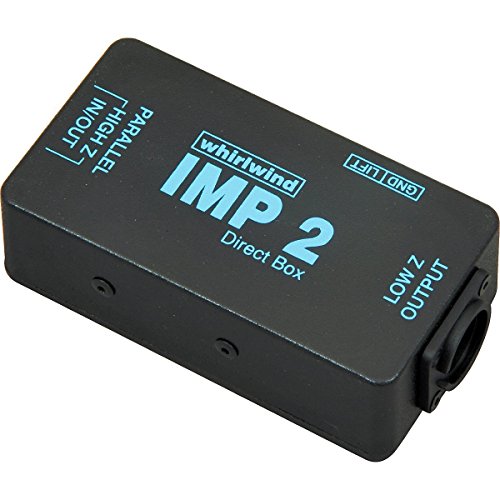
Best Simple Instrument DI – Whirlwind IMP 2
The Whirlwind IMP 2 is a straightforward option for buyers comparing DI boxes with speaker simulation but primarily needing dependable instrument-to-mixer conversion. Its single-channel passive transformer converts an unbalanced line- or instrument-level signal into a balanced, low-impedance mic-level signal.
Best For: Guitar, bass, or line-level sources needing an economical single-channel passive direct box.
Pros:
- Converts unbalanced instrument or line signals to balanced mic level.
- Compact footprint suits simple setups.
- Uses a TRHL transformer riveted to the chassis.
- Designed for professional durability at an economical price.
Cons:
- One channel limits it to mono applications.
- The supplied notes do not mention speaker simulation, ground lift, or a pad.
The IMP 2 makes sense when you want a compact, no-frills passive DI for one source. It is less compelling for stereo rigs or applications specifically requiring documented speaker-simulation controls.
Best Flexible Active Stereo DI – Dual-Input Active Stereo Direct Box
This dual-input active direct box is aimed at musicians and recording setups that need flexible stereo or summed-mono routing. For shoppers exploring DI boxes with speaker simulation, it offers active operation, dual 1/4-inch inputs, thru outputs, XLR outputs, ground-lift support, and hum cancellation, although the supplied information does not confirm a speaker-simulation function.
Best For: Guitar, bass, keyboards, effects processors, and consumer stereo sources requiring stereo or mono DI connectivity.
Pros:
- Supports stereo input or mixed-mono operation.
- Provides dual 1/4-inch thru outputs and dual XLR outputs.
- Offers ground lift and buzz/hum cancellation.
- Can use USB-C charging or a 9V GF22 battery, which is not included.
Cons:
- The 9V battery is not included.
- Its larger 2.01-pound enclosure may be less convenient for minimal rigs.
- Speaker simulation is not identified in the supplied notes.
This model is the most flexible choice of the three for active stereo routing and varied source connections. Choose it for its I/O and power options, but verify speaker-simulation requirements before buying.
Best Passive Stereo Pick – Bolanle DB2 2-Channel Passive DI Box
For musicians comparing DI boxes with speaker simulation, the Bolanle DB2 is a straightforward passive option for converting high-impedance instrument signals to balanced, low-impedance XLR outputs. Its dual-channel layout suits stereo sources, while the ground lift and attenuation controls help manage noise and signal level in studio or live setups.
Best For: Guitarists, bassists, keyboard players, and engineers needing a dual-channel passive DI or reamp-style box.
Pros:
- Two channels support stereo instruments and dual signal paths.
- Ground lift helps reduce ground-loop hum and interference.
- Three attenuation settings accommodate different signal levels.
- Balanced XLR outputs support longer cable runs.
Cons:
- Passive design does not offer the multiple powering options of an active DI.
- The supplied notes do not specify speaker-simulation features.
The DB2 is a practical choice when you want simple, road-ready passive signal conversion with useful noise and level controls. Choose it for DI and reamp duties rather than as a confirmed speaker-simulation solution.
Best Budget Dual-Channel Option – Pyle-Pro PDC22 Passive Direct Box
The Pyle-Pro PDC22 is a compact dual-channel passive direct box for connecting unbalanced instruments, keyboards, effects processors, or consumer audio sources to a PA or recording mixer. For shoppers researching DI boxes with speaker simulation, it is better viewed as a basic impedance transformer and hum-reduction tool.
Best For: Musicians and home or live-sound users who need affordable dual-channel connectivity for guitars, basses, keyboards, or line-level sources.
Pros:
- Two channels handle multiple instruments or stereo sources.
- Ground lift and hum-cancellation functions help clean up noisy connections.
- Works with instruments, submixers, effects processors, and consumer stereo outputs.
- Steel chassis is designed for durable use.
Cons:
- The supplied notes do not mention speaker simulation.
- Power requirements and detailed output specifications are not provided.
The PDC22 makes sense when the priority is inexpensive, flexible DI connectivity rather than advanced tone-shaping features. It can simplify routing to a PA or mixer, but buyers specifically seeking speaker simulation should verify that capability separately.
Best Active Power Flexibility – Bolanle J22 Active Stereo DI Box
The Bolanle J22 is an active stereo DI box with three powering methods: 48V phantom power, a 9V battery, or 5V USB. While researching DI boxes with speaker simulation, consider this model for reliable stereo signal delivery and stage-friendly control; the supplied information does not identify a built-in speaker-simulation function.
Best For: Keyboard players, synth users, DJs, and performers who need stereo outputs and flexible power options on stage or in the studio.
Pros:
- Runs from 48V phantom power, a 9V battery, or 5V USB.
- Dual inputs and balanced XLR outputs preserve stereo separation.
- Ground lift helps address hum from lighting, power, and long cable runs.
- Metal housing and polarity reversal provide practical live-use control.
Cons:
- Batteries are not included.
- The supplied notes do not specify speaker-simulation features.
- Active circuitry and multiple power options may be more than needed for a simple passive setup.
The J22 stands out for performers who cannot rely on one power source and need clean stereo routing. Its flexible operation makes it particularly useful for keyboards and synths, but confirm compatibility if speaker simulation is essential to your setup.
How We Picked the Best Di Boxes with Speaker Simulation
We focused on DI boxes that fit common guitar, bass, keyboard, playback, and recording applications. The selection includes passive models for simple, dependable signal conversion; active models for higher input impedance and added headroom; and stereo or dual-channel units for keyboards, effects, and other two-output sources.
We also considered balanced XLR outputs, input and output flexibility, ground-lift controls, power options, build practicality, and compatibility with speaker-simulation or amp-modeling workflows. A DI box does not automatically provide cabinet emulation, so confirm whether speaker simulation is built in, supplied elsewhere in your rig, or expected from a pedal, amplifier, interface, or software plug-in.
Quick Comparison
Passive options such as the Radial ProD2, Mackie MDB-2P, Whirlwind IMP 2, Bolanle DB2, and Pyle-Pro PDC22 are appealing when you want straightforward operation and no battery or phantom-power dependency. Active models such as the BOSS DI-1, Warm Audio Active Stereo DI, and Bolanle J22 can offer more input flexibility for passive instruments and complex signal chains.
Stereo and dual-channel choices are best for keyboards, stereo effects, and playback devices. A single-channel DI is usually the simpler choice for one guitar, bass, or mono source. The Radial JDI Stereo and other two-channel models make more sense when preserving left-right information is important.
Key Buying Factors for Di Boxes with Speaker Simulation
Passive or Active Design
Passive DI boxes are typically easy to deploy and can handle strong signals without requiring power. Active designs often provide higher input impedance, which can better preserve the tone of passive pickups, but they may need phantom power, a battery, USB power, or an external supply.
Speaker Simulation and Signal Flow
Check where cabinet or speaker emulation occurs. If you are connecting an amp-modeling pedal, preamp, or load box, the simulation may already be part of that device. For a raw amplifier or pedal output, choose a DI solution that explicitly supports the required speaker-simulation workflow rather than assuming every balanced output includes it.
Channels and Connectivity
Choose mono for a single instrument and stereo or dual-channel operation for keyboards, stereo pedals, mixers, and playback gear. Look for suitable 1/4-inch inputs, balanced XLR outputs, link or thru connections, and ground lifts that fit your stage or studio routing.
Noise Control and Durability
Transformer isolation and a ground-lift switch can reduce hum caused by interconnected equipment. For frequent gigs, prioritize sturdy enclosures, secure jacks, clear controls, and a layout that is easy to operate in low light.
Who Should Buy Which Di Boxes with Speaker Simulation?
Choose a passive single-channel model for a dependable guitar or bass connection with minimal setup. Pick an active DI when pickup loading, phantom-power compatibility, or broader input handling matters. Select a stereo DI for keyboards, stereo effects, and playback sources, and consider a dual-channel unit when you need two independent mono paths.
For home recording, prioritize clean balanced outputs and compatibility with your interface and speaker-simulation software. For live work, ground lift, rugged construction, and predictable cabling may matter more than extra features. Before buying, map the complete chain from instrument or amp-modeling device to mixer or interface so the DI box adds the connection and isolation you actually need.