The right DI box can make an acoustic-electric guitar sound clearer, more balanced, and easier to manage through a PA, mixer, or recording interface. It can also help reduce hum, preserve your instrument’s character, and provide useful tone-shaping controls when a basic passive box is not enough.
These 10 picks cover practical options for gigging musicians, home recordists, and players who need a dependable connection between an acoustic guitar and professional audio equipment. Use the guide below to match features, connectivity, and budget to your setup.
Best 10 Di Boxes for Acoustic Electric Guitars Picks for 2026
Flexible Acoustic Control

- Gain for passive and active pickups
- Five-band EQ with tunable filters
- Battery or phantom powered
Best For: Detailed acoustic guitar tone shaping and feedback control
Simple Passive Signal Conversion
- One-channel passive operation
- Converts unbalanced to balanced signal
- Compact stainless-steel build
Best For: Economical live signal conversion without external power
Stage-Ready Acoustic Preamp
- Five-band EQ and feedback filter
- Built-in chromatic tuner and mute
- Footswitchable volume boost
Best For: Live acoustic players needing integrated performance controls
Road-Ready Passive Connection
Hosa DIB-443 Sidekick Passive DI

- 1/4-inch TS to balanced XLR3M
- No external power required
- Metal construction for live use
Best For: Basic guitar-to-mixer or PA connections
Warmth & Feedback Control

- Adds analog warmth, compression, and EQ
- Notch and high-pass filters help control feedback
- Mute footswitch supports 1/4-inch and XLR outputs
Best For: Tone shaping and feedback management for acoustic-electric guitar
Simple Hum-Free Signal Matching

- Passive transformer design supports clean signal matching
- Ground Lift helps address hum and buzz
- Thru output feeds an amp while XLR feeds the PA
Best For: Basic stage and studio signal routing
Compact Acoustic Preamp
- Purpose-built preamp DI for acoustic guitar
- True-bypass anti-feedback footswitch
- Higher boost in a compact 9-volt pedal
Best For: Streamlined live acoustic-guitar rigs
Best Stereo Pick

- Passive two-channel stereo design
- Isolation transformer and ground lift
- 15 dB pad with 1/4-inch and XLR connectors
Best For: Players needing stereo DI flexibility for acoustic-electric guitar setups
Best Compact Hum Eliminator

- Compact passive single-channel design
- 1/4-inch to balanced or unbalanced XLR connectivity
- Input attenuation and buzz/hum cancellation
Best For: Portable guitar-to-PA or mixer connections
Best Dual-Channel Value
Pyle-Pro PDC22 Dual Passive DI

- Two-channel passive direct box
- Hum cancellation with ground-lift function
- All-steel chassis for heavy-duty use
Best For: Multi-source live rigs needing two DI channels
Flexible Acoustic Control – LR Baggs Para Acoustic D.I.
For players comparing DI boxes for acoustic electric guitars, the LR Baggs Para Acoustic D.I. combines pickup-compatible gain adjustment with hands-on tone shaping. Its five-band EQ, tunable notch and midrange bands, and phase inversion give you useful tools for shaping a balanced signal and managing feedback.
Best For: Acoustic guitarists who need detailed EQ and feedback-control options in a compact DI.
Pros:
- Adjustable gain works with passive and active pickups.
- Five-band EQ includes tunable notch and midrange bands.
- Offers phase inversion plus balanced XLR and unbalanced 1/4-inch outputs.
- Runs on a 9V battery or 48V phantom power.
Cons:
- Its broader control set may be more than players seeking a basic DI need.
- It requires either battery power or phantom power.
The Para Acoustic D.I. is a strong choice when acoustic-electric tone shaping and feedback management matter more than a minimal signal-conversion setup.
Simple Passive Signal Conversion – Whirlwind IMP 2 Passive DI
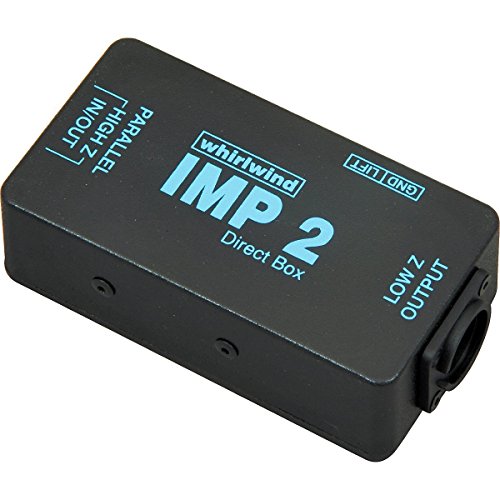
The Whirlwind IMP 2 is a straightforward option among DI boxes for acoustic electric guitars. Its passive transformer converts an unbalanced instrument-level signal to a low-impedance, balanced mic-level signal, making it suitable for feeding a mixer or similar balanced input without external power.
Best For: Players and live setups that need an economical, durable one-channel passive DI.
Pros:
- Passive design does not require external power.
- Converts unbalanced instrument or line signals to balanced mic level.
- Uses a TRHL transformer riveted to the chassis.
- Compact footprint and stainless-steel construction suit practical live use.
Cons:
- Provides one channel.
- Does not include onboard EQ, notch filtering, or other acoustic-specific controls.
The IMP 2 focuses on reliable core DI duties, making it a sensible pick when you want simple connectivity and professional-grade construction without added processing.
Stage-Ready Acoustic Preamp – L.R. Baggs Venue DI
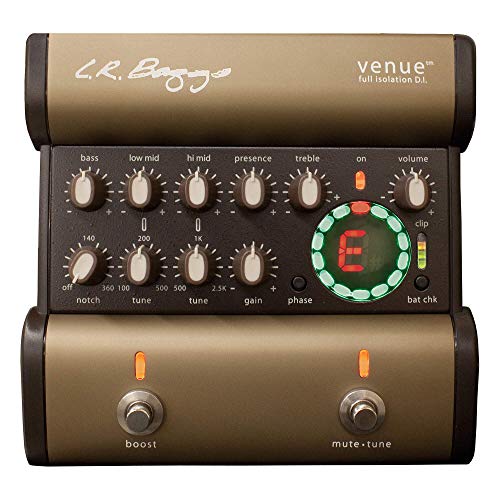
The L.R. Baggs Venue DI adds extensive performance controls to the category of DI boxes for acoustic electric guitars. Along with adjustable gain and a five-band EQ, it includes a feedback-control notch filter, chromatic tuner with footswitch mute, and a footswitchable volume boost.
Best For: Performing acoustic guitarists who want DI, tone shaping, tuning, and footswitch control in one unit.
Pros:
- Gain adjustment supports passive and active pickups.
- Five-band EQ includes tunable low-mid and high-mid bands.
- Garret Null notch filter is designed for feedback control.
- Footswitches provide mute/tune and adjustable volume boost functions.
Cons:
- Its 9V battery-powered design requires attention to power.
- The 9-by-9-by-2-inch enclosure and 1.2 kg weight make it less minimal than a basic passive DI.
With its tuner and footswitch features, the Venue DI is better suited to active stage use than to players who only need basic balanced signal conversion.
Road-Ready Passive Connection – Hosa DIB-443 Sidekick Passive DI
The Hosa DIB-443 Sidekick offers a no-frills approach to DI boxes for acoustic electric guitars. It converts an unbalanced 1/4-inch TS signal to a balanced XLR3M output, helping connect an instrument to a mixer or PA system while reducing unwanted noise over long cable runs.
Best For: Guitarists and small live setups seeking simple, passive instrument-to-mixer connectivity.
Pros:
- Converts 1/4-inch TS signals to balanced XLR3M.
- Passive operation requires no external power.
- Metal construction is intended for live-performance use.
- Works with guitars, basses, and keyboards.
Cons:
- Does not provide EQ, gain adjustment, or acoustic-specific feedback controls.
- Its passive design is focused on signal conversion rather than added processing.
The Sidekick is a practical choice when your priority is a lightweight, power-free connection from an acoustic-electric guitar to balanced mixer or PA inputs.
Warmth & Feedback Control – Session DI
The L.R. Baggs Session DI is a feature-rich option for players comparing DI boxes for acoustic electric guitars. It combines analog saturation, compression, EQ, feedback control, and direct outputs in a metal enclosure.
Best For: Acoustic guitarists who want tone shaping, compression, and feedback management in one DI pedal.
Pros:
- Analog saturation adds warmth and harmonic content.
- Compression and EQ help smooth common problem frequencies.
- Notch filter and variable high-pass filter support feedback and low-frequency control.
- Mute footswitch works with both 1/4-inch and XLR outputs.
Cons:
- More specialized than a simple passive direct box.
- Its feature set may be unnecessary for users who only need signal conversion.
The Session DI is a strong choice when acoustic-electric tone shaping matters as much as sending a balanced signal to a PA. Its controls make it particularly useful for live setups where feedback and uneven frequencies need attention.
Simple Hum-Free Signal Matching – Donner Special-I DI Box
The Donner Special-I is a straightforward choice among DI boxes for acoustic electric guitars, especially when you need to connect an instrument to a mixer or amplifier. Its passive design uses transformer isolation for signal matching and hum reduction.
Best For: Players and small setups needing an affordable passive DI with ground-loop protection and a thru output.
Pros:
- Converts an unbalanced instrument or line signal to a balanced, low-impedance mic-level signal.
- Transformer isolation helps reduce ground-loop hum and buzz.
- Ground Lift switch provides additional hum-control flexibility.
- Thru output allows connection to an amplifier while sending the main output to a PA.
Cons:
- Passive design does not provide preamp, EQ, or acoustic-specific feedback controls.
- Plastic construction may feel less substantial than a metal DI enclosure.
The Special-I focuses on clean routing rather than sound shaping. Choose it when reliable impedance matching, balanced output, and hum reduction are more important than onboard acoustic-guitar processing.
Compact Acoustic Preamp – Caline CP-40 DI Box
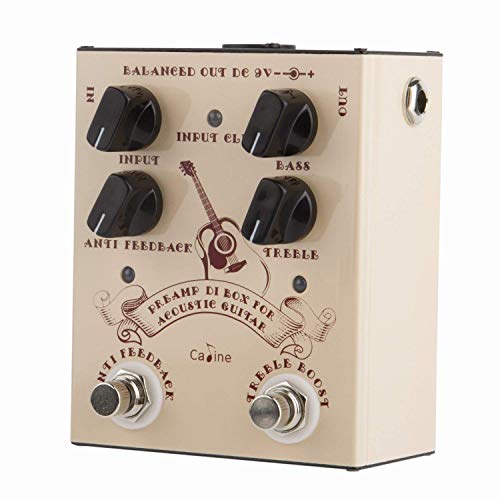
The Caline CP-40 is a compact preamp DI option for players comparing DI boxes for acoustic electric guitars. It is designed specifically for acoustic guitar and adds a true-bypass anti-feedback footswitch plus higher boost.
Best For: Acoustic guitarists who want a small pedal-format DI with boost and basic anti-feedback functionality.
Pros:
- Designed specifically as a preamp DI box for acoustic guitar.
- True-bypass anti-feedback footswitch supports live performance use.
- Higher boost can help increase the guitar signal when needed.
- Compact format uses a 9-volt power supply and 1/4-inch audio connection.
Cons:
- Supplied notes list fewer controls than more comprehensive acoustic preamp DIs.
- Its listed connector is a 1/4-inch audio jack, so confirm compatibility with the rest of your signal chain.
The CP-40 suits players who want a focused acoustic-guitar pedal rather than a full-featured processing unit. Its compact footprint, boost, and anti-feedback switching make it practical for streamlined live rigs.
Best Stereo Pick – Radial ProD2 Passive DI
The Radial ProD2 is a practical choice for players comparing DI boxes for acoustic electric guitars and needing a passive stereo setup. Its two-channel design, isolation transformer, ground-lift switch, and 15 dB pad provide useful signal-management options for live sound or recording.
Best For: Acoustic-electric guitarists and musicians who need two channels with flexible attenuation and isolation controls.
Pros:
- Passive stereo, two-channel design
- Isolation transformer and ground-lift switch
- 15 dB pad for managing stronger signals
- Compact stainless-steel build with 1/4-inch and XLR connectors
Cons:
- Passive design does not provide onboard power
- Stereo capability may be unnecessary for simple mono guitar setups
Choose this model when stereo connectivity and isolation features matter more than keeping the setup as basic as possible. Its compact dimensions and 1.2-pound weight also suit portable rigs.
Best Compact Hum Eliminator – Pyle Premium Passive DI
For shoppers seeking DI boxes for acoustic electric guitars on a budget-conscious setup, the Pyle Premium Direct Injection Audio Box offers a compact passive solution. It connects 1/4-inch instrument sources to balanced or unbalanced XLR equipment and includes attenuation and hum-cancellation functions.
Best For: Guitarists who want a small passive DI for connecting instruments to PA systems or mixers while addressing buzz and hum.
Pros:
- Compact 13.4-ounce design
- 1/4-inch input with balanced and unbalanced XLR compatibility
- Input attenuator and hum-cancellation capability
- Suitable for guitars, basses, keyboards, and other unbalanced sources
Cons:
- Single-channel design
- Supplied notes describe it as passive, so it lacks active DI features
This is a straightforward option when portability and basic signal conversion are the priorities. Its broad source compatibility makes it useful beyond acoustic-electric guitar, though players needing multiple channels should look elsewhere.
Best Dual-Channel Value – Pyle-Pro PDC22 Dual Passive DI
The Pyle-Pro PDC22 is worth considering among DI boxes for acoustic electric guitars when two channels are more useful than a minimal single-channel unit. Its passive design supports 1/4-inch instrument connections, clean routing to a PA or mixer, and hum reduction through its ground-lift function.
Best For: Musicians who need an affordable dual-channel DI for guitars, keyboards, processors, or other unbalanced sources.
Pros:
- Two-channel passive direct box
- 1/4-inch device connectivity for instruments and processors
- Hum-cancellation and ground-lift functionality
- All-steel chassis for a durable, heavy-duty enclosure
Cons:
- Bulkier than the smaller single-channel Pyle unit
- Passive design may not suit users specifically seeking active DI circuitry
The PDC22 makes the most sense for setups that regularly handle two sources or stereo-style routing. Its steel chassis favors durability, while the added channel count improves flexibility for live rigs and broader instrument use.
How We Picked the Best Di Boxes for Acoustic Electric Guitars
We focused on signal reliability, input and output flexibility, noise control, portability, and suitability for piezo-equipped acoustic-electric guitars. The selection includes passive DI boxes for straightforward impedance matching and balanced output, as well as acoustic preamp/DI units with EQ, gain, notch filtering, or other tools for shaping a stage-ready sound.
We also considered whether each model fits common use cases: connecting directly to a mixer, sending a clean signal to a front-of-house system, splitting signals, reducing ground-loop hum, or adding more control before the signal reaches amplification.
Quick Comparison
| Type | Best For | Main Advantage |
|---|---|---|
| Passive single-channel DI | Simple live and studio connections | Reliable operation with no battery or power supply |
| Passive dual-channel DI | Stereo sources or multiple instruments | Two balanced signal paths in one box |
| Acoustic preamp and DI | Players needing tone control | EQ and signal shaping before the PA |
| Compact budget DI | Backups, rehearsals, and basic rigs | Low cost and easy transport |
Key Buying Factors for Di Boxes for Acoustic Electric Guitars
Passive or Active Design
Passive models are simple, durable, and usually do not require batteries or external power. They work well when your guitar has a healthy output and you mainly need balanced XLR connectivity. Active preamp/DI units generally offer more gain and tonal control, but they may require batteries or phantom power.
EQ and Acoustic-Guitar Controls
If your pickup sounds thin, boomy, harsh, or prone to feedback, an acoustic preamp/DI can be worth the added cost. Look for useful controls such as bass, middle, treble, notch filtering, phase switching, or gain adjustment. These features are especially valuable for live performance.
Connections and Channel Count
Check that the box has the inputs and outputs your rig requires. A standard 1/4-inch instrument input and balanced XLR output cover most mono setups. Dual-channel units are useful for stereo instruments, two pickups, or handling more than one source without carrying separate boxes.
Noise, Ground Lift, and Headroom
Ground-lift switching can help address hum caused by interconnected equipment, while a pad or input attenuator can prevent clipping from strong signals. For active acoustic electronics, prioritize a DI with enough headroom and a clear, low-noise signal path.
Who Should Buy Which Di Boxes for Acoustic Electric Guitars?
Choose a passive single-channel model if you want the simplest dependable connection for rehearsals, gigs, or recording. A compact budget unit makes sense as an emergency backup or for occasional use. Choose a dual-channel DI when you need stereo operation or want to connect multiple sources. For regular acoustic-guitar performance, especially in challenging rooms, an acoustic preamp and DI is the better choice because its EQ and feedback-control features can save time during soundcheck.