Choosing the right printer for miniatures can make the difference between crisp facial details and endless cleanup. The best options balance resolution, reliability, build volume, and ease of use.
Whether you want a beginner-friendly starter machine or a high-detail resin printer for display-quality figures, this roundup focuses on practical picks that suit real hobby workflows.
Best 10 3d Printers for Miniatures Picks for 2026
Ultra-Fine Resin Detail

- 7-inch 10K LCD with 17 x 17μm pixels
- LighTurbo light source for smoother surfaces
- 4-point leveling and improved adhesion platform
Best For: Miniature makers who want high detail in a compact resin printer
Large-Format 12K Detail

- 10-inch 12K LCD with 19 x 24μm XY resolution
- Uniform Fresnel light source for consistent prints
- Large build volume for bigger models and batch jobs
Best For: Users who want miniature detail with room for larger resin prints
Compact Beginner Resin

- 8K mono LCD with 22μm XY resolution
- Compact tabletop size for miniature printing
- Compatible with Lychee, Chitubox, and Tango
Best For: Beginners who want a compact resin printer for miniatures
Fast FDM Alternative

- One-click auto leveling for easy setup
- Up to 600mm/s printing speed with Core XY motion
- Power-loss recovery and filament run-out sensor
Best For: Makers who want a fast FDM printer for hobby projects
Fast-detail resin starter
ELEGOO Mars 5 4K Resin Printer
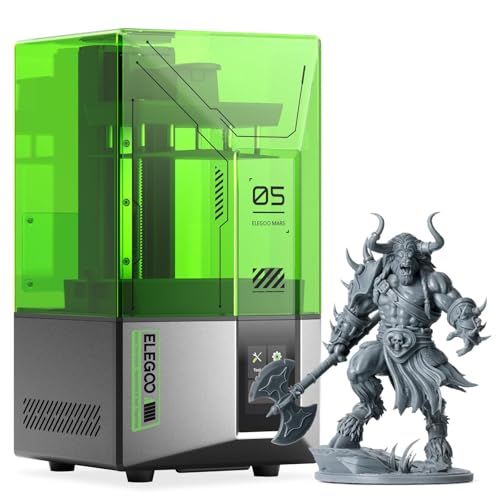
- One-click automatic leveling simplifies setup.
- 4K mono LCD targets crisp miniature detail.
- Self-check and alerts help prevent common print issues.
Best For: Miniature makers who want sharp detail and simple resin printing
Beginner-friendly compact pick
Bambu Lab A1 mini + LED Lamp Kit

- Automatic calibration keeps setup simple for beginners.
- Compact and quiet design fits home or studio use.
- LED Lamp Kit adds extra creative project options.
Best For: Beginners who want a quiet, compact printer for creative projects
High-detail resin powerhouse

- 16K resin output is built for fine miniature detail.
- Tank heating helps improve fluidity and layer adhesion.
- AI camera and auto-leveling add convenience and monitoring.
Best For: Experienced miniature makers who want top-tier detail and faster resin printing
High-Speed FDM Pick

- Automatic bed leveling for easier first layers
- CoreXY speed up to 600mm/s travel
- Optional 0.25mm to 0.8mm nozzles
Best For: Makers wanting a fast, easy-to-use FDM printer
Detail-Focused Resin Pick

- 14K resin detail with 16.8×24.8 μm XY resolution
- Up to 170mm/h printing with high-speed resin
- Auto-fill and detection features reduce mistakes
Best For: Miniature makers prioritizing crisp detail
Beginner Mini Pick

- Fully assembled and starts in about 8 minutes
- Auto leveling and app guidance simplify use
- Compact 3.9 × 3.9 × 3.9 inch build area
Best For: Beginners, kids, and compact hobby spaces
Ultra-Fine Resin Detail – ANYCUBIC Photon Mono 4
If you’re shopping for 3d printers for miniatures, the ANYCUBIC Photon Mono 4 is built around detail. Its 7-inch 10K LCD, 17 x 17μm pixel size, and stable LighTurbo light source are aimed at producing crisp, smooth resin prints with strong surface quality. The build volume is still practical for day-to-day miniature batches and small display models.
Best For: Hobbyists who want high-detail resin printing with a beginner-friendly setup and a compact footprint.
Pros:
- 7-inch 10K screen with very fine 17 x 17μm pixel size
- LighTurbo matrix light source helps reduce layer lines and rasterization
- Laser-engraved platform is designed to improve adhesion and reduce warping
- 4-point leveling is simple for first-time setup
Cons:
- Anycubic APP service is not supported
- Build volume is smaller than larger-format resin printers
For miniature makers who care more about crisp detail than large build size, this is a very focused resin option. The Mono 4 emphasizes ease of use, stable exposure, and clean surface results, which is exactly what most tabletop and display miniatures need.
Large-Format 12K Detail – ELEGOO Saturn 3
Among 3d printers for miniatures, the ELEGOO Saturn 3 stands out if you want fine detail plus room to grow. Its 10-inch 12K mono LCD, 19 x 24μm XY resolution, and Fresnel collimating light source are designed for highly detailed resin prints with consistent clarity. The larger build volume also gives you more flexibility for bigger terrain pieces or batch printing.
Best For: Makers who want miniature-level detail with extra build space for larger resin projects.
Pros:
- 10-inch 12K mono LCD with 19 x 24μm XY resolution
- Fresnel collimating light source supports uniform lighting and accuracy
- Large build volume for bigger models and more ambitious projects
- Laser-carved build plate improves adhesion
Cons:
- Larger and heavier than compact mini-focused printers
- May be more machine than needed if you only print very small batches
This is a strong pick if your miniature workflow includes larger pieces or multiple models at once. It keeps the fine-resin detail that miniatures demand while giving you the flexibility of a much more generous build area.
Compact Beginner Resin – Phrozen Sonic Mini 8K
If you’re comparing 3d printers for miniatures and want a compact resin machine, the Phrozen Sonic Mini 8K is tuned for fine detail. It uses a 7.1-inch monochrome LCD and 22μm XY resolution to capture intricate textures, while keeping the printer small enough for a tabletop setup. The open compatibility with popular slicers also makes it easier to start printing without a steep learning curve.
Best For: Beginners and hobbyists who want a small resin printer for detailed miniatures and action figures.
Pros:
- 8K mono LCD with 22μm XY resolution for detailed output
- Compact tabletop footprint with a practical miniatures-focused build volume
- Works with Lychee, Chitubox, and Tango slicers
- Positioned as beginner friendly and easy to use
Cons:
- Build volume is limited compared with larger resin printers
- Not aimed at users who need large-format prints
The Sonic Mini 8K is a sensible entry point if miniature detail matters more than capacity. It balances precision, size, and software flexibility in a way that should appeal to first-time resin users and experienced hobbyists alike.
Fast FDM Alternative – FLASHFORGE Adventurer 5M
Not every buyer looking for 3d printers for miniatures wants resin, and the FLASHFORGE Adventurer 5M is the speed-focused filament option here. It offers one-click fully auto leveling, high-speed Core XY motion up to 600mm/s, and quick startup, so it’s built for fast, smooth printing rather than ultra-fine resin detail. The 220 x 220 x 220mm build size gives plenty of room for parts, accessories, and larger print jobs.
Best For: Makers who prefer a fast, easy-to-use FDM printer for hobby prints and general mini-related projects.
Pros:
- One-click full-auto leveling helps deliver a strong first layer
- Core XY system reaches up to 600mm/s for very fast printing
- Vibration compensation is designed to reduce ghosting
- Filament run-out sensor and power-loss recovery add convenience
Cons:
- FDM printing is less detail-oriented than resin for tiny miniatures
- Open-frame design needs a well-ventilated environment
If your priority is speed, ease, and low-friction setup, this printer is a practical alternative. It won’t match resin machines for the smallest miniature details, but it brings strong automation and fast turnaround for hobby printing.
Fast-detail resin starter – ELEGOO Mars 5 4K Resin Printer
If you’re comparing 3d printers for miniatures, the ELEGOO Mars 5 is a practical resin option for users who want detailed prints without a complicated setup. Its one-click automatic leveling, 4K mono LCD, and smart checks are aimed at making the process easier from unboxing through printing.
Best For: Miniature makers who want sharp detail and a simple resin printing workflow.
Pros:
- One-click automatic leveling helps reduce setup friction.
- 4K mono LCD with COB light source is built for fine detail reproduction.
- Self-check, residue detection, and resin shortage alerts add useful print safeguards.
- Overheat protection and cooling system support safer long print sessions.
Cons:
- Resin printing still requires more post-processing than FDM machines.
- The unit is designed around convenience, but it is still a resin printer and not a plug-and-forget appliance.
Overall, the Mars 5 is a solid fit if your priority is miniature detail and you want a resin printer that tries to remove common beginner pain points. It leans toward ease of use while still focusing on the crisp output resin buyers usually want.
Beginner-friendly compact pick – Bambu Lab A1 mini + LED Lamp Kit
For shoppers looking at 3d printers for miniatures, the Bambu Lab A1 mini stands out as an easy entry point with a compact footprint and beginner-focused setup. It uses automatic calibration, aims for a smooth first-print experience, and also includes an LED Lamp Kit for compatible decorative projects.
Best For: Beginners who want a quiet, compact printer for creative home projects and small models.
Pros:
- Automatic calibration and simple setup are designed to reduce early frustration.
- Compact, quiet operation suits home, studio, or workspace use.
- MakerWorld access and Bambu Handy app support make it easier to find and manage prints.
- Included LED Lamp Kit adds a creative project path beyond basic printing.
Cons:
- The included lamp kit is tied to compatible lamp models, so it is not a universal add-on.
- It is positioned as a beginner printer, so users seeking resin-level miniature detail may want to compare other options.
In practical terms, the A1 mini is a strong choice if you want a friendly, fast, and quiet printer that helps you get started quickly. It is especially appealing if your goals include toys, decor, gifts, and other everyday creative prints.
High-detail resin powerhouse – ELEGOO Saturn 4 Ultra 16K
If your shortlist of 3d printers for miniatures is focused on maximum detail, the ELEGOO Saturn 4 Ultra 16K is built around high-resolution resin output and workflow automation. It combines 16K resolution, auto-leveling, tank heating, and fast tilt-release printing to support precise models with less hassle.
Best For: Experienced or ambitious miniature makers who want top-tier detail and faster resin printing.
Pros:
- 16K resolution is aimed at extremely fine, smooth miniature surfaces.
- Tank heating maintains resin at 30°C to improve fluidity and layer adhesion.
- Auto-leveling and plug-and-play workflow reduce setup effort.
- AI camera, chamber light, and residue detection add monitoring and protection features.
Cons:
- The printer is large and heavy, so it needs more dedicated space than compact options.
- Its speed and monitoring features are most useful if you print often enough to benefit from them.
As a miniature-focused resin printer, the Saturn 4 Ultra 16K is the most feature-rich option in this group. It makes the most sense if you want ultra-fine detail, easier operation, and extra print monitoring in one machine.
High-Speed FDM Pick – FLASHFORGE Adventurer 5M
If you want one of the faster 3d printers for miniatures in an FDM setup, the Flashforge Adventurer 5M focuses on speed, auto leveling, and easy first-layer success. Its CoreXY frame, 600mm/s travel speed, and direct drive extruder make it a practical choice for hobbyists who want to prototype quickly and experiment with miniature-scale parts without constant setup hassle.
Best For: Makers who want a fast, low-fuss FDM printer with auto leveling and flexible nozzle options.
Pros:
- Fully automatic bed leveling helps produce consistent first layers with no manual adjustment.
- CoreXY design with up to 600mm/s travel speed and 20000mm/s² acceleration for rapid printing.
- 280°C direct drive extruder and optional nozzle sizes from 0.25mm to 0.8mm for different detail needs.
- Quick 3-second nozzle changes and 35-second warm-up to 200°C support efficient workflows.
Cons:
- Build volume is 220x220x220mm, so larger terrain pieces may need to be split up.
- Default setup includes a 0.4mm nozzle, which may not be the finest option for highly detailed miniature work.
- Best results still depend on dialing in settings for small-scale prints.
Overall, the Adventurer 5M is a speed-first FDM printer that removes a lot of beginner friction. If your priority is efficient printing with strong automation and the option to choose finer nozzles, it is a solid fit.
Detail-Focused Resin Pick – ANYCUBIC Photon Mono M7 PRO
For buyers comparing 3d printers for miniatures, the Anycubic Photon Mono M7 Pro is the most detail-oriented option here thanks to its 14K resin system and very fine XY resolution. It is built for small features, tiny holes, and smooth surface detail, while the fast resin workflow and assisted features help keep the process efficient.
Best For: Miniature makers who want very fine detail and fast resin printing.
Pros:
- 14K monochrome LCD with 13312×5120 resolution and 16.8×24.8 μm XY resolution for fine detail.
- High print speeds of up to 170mm/h with high-speed resin, or 130mm/h with standard resin.
- COB LighTurbo 3.0 light system with over 90% uniformity for more consistent exposure.
- Helpful automation features include resin auto-fill, temperature control, and multiple detection systems.
Cons:
- Resin printing requires more post-processing than typical FDM printers.
- The machine is larger and heavier than compact beginner models.
- Its feature set is advanced, so it may be more than casual users need.
In short, the M7 Pro is the strongest choice here when detail matters most. If your miniature work depends on crisp textures and tiny printed features, this resin printer is the most specialized fit.
Beginner Mini Pick – Entina Tina2C Starter Printer
If you are shopping for a simple entry point into 3d printers for miniatures, the Entina Tina2C is designed to make first prints easy. Its fully assembled design, auto leveling, app guidance, and compact footprint are aimed at beginners, kids, and classrooms that want a low-stress way to learn without a complicated setup.
Best For: Beginners, kids, and small spaces that need a compact, easy-start printer.
Pros:
- Fully assembled and can start printing in as fast as 8 minutes.
- Auto leveling helps improve first-layer adhesion and reduces manual setup.
- Compact 3.9 × 3.9 × 3.9 inch build volume suits small projects and starter models.
- App, WiFi, TF card support, and a 3000+ model library make it easy to get going.
Cons:
- Very small build volume limits the size of terrain and larger display pieces.
- Designed mainly for beginners, so it lacks the higher-end capabilities of more advanced printers.
- Not the best match if your main goal is highly detailed resin-style miniature output.
The Tina2C is best viewed as an easy learning machine rather than a specialist detail printer. For small, simple miniature projects and beginner-friendly printing, it offers a very approachable path into the hobby.
How We Picked These 3d Printers for Miniatures
We focused on the factors that matter most for miniature printing: fine detail, consistent layer quality, dependable leveling, and a setup that matches the user’s experience level. We also considered build volume, printer type, speed, and how much post-processing each machine typically demands.
Quick Comparison: Resin Vs. FDM for Miniatures
For the sharpest miniatures, resin models are usually the better choice because they capture small textures, thin weapons, and facial features more accurately. FDM printers can still work well for larger terrain pieces, prototypes, or hobbyists who want lower mess and simpler handling. If your goal is display-grade figures, resin should be your first stop.
Key Buying Factors for 3d Printers for Miniatures
Resolution and Detail
Higher XY resolution and smaller layer heights help preserve tiny edges, cloth folds, armor rivets, and other miniature details. For resin printers, look closely at LCD resolution and the printer’s advertised pixel size.
Build Volume
A larger build plate is useful if you print squads, terrain, or batch jobs, but it can also mean more resin use and longer exposure times. Solo figure painters may prefer a smaller machine with excellent detail.
Ease of Setup
Auto leveling, guided calibration, and beginner-friendly software can save time and reduce failed prints. This matters even more if you are new to 3D printing or planning a shared family setup.
Speed and Workflow
Fast printers are helpful, but speed should not come at the cost of consistency. For miniatures, dependable print quality and repeatability are often more valuable than raw throughput.
Post-Processing
Resin prints need washing, curing, and more careful handling, so plan for that workflow. If you want a cleaner, simpler process, an FDM printer may fit better even if the detail level is lower.
Who Should Buy Which 3d Printers for Miniatures?
If you want the most detail for tabletop miniatures, choose a resin printer with high resolution and strong Z-axis stability. If you are a beginner or want a family-friendly setup, a ready-to-use FDM model can be easier to learn. For hobbyists printing both minis and terrain, a fast, auto-leveling printer offers the best balance of convenience and versatility.
In short, the best choice depends on whether you value micro-detail, ease of use, or a broader hobby workflow. Match the machine to the kind of miniatures you print most often, and you will get better results with less frustration.