Choosing the right printer for prototyping is about more than print speed. You need consistent first layers, dependable dimensional accuracy, and a setup that matches your workflow.
This roundup of the best 3D printers for prototypes in 2026 focuses on practical picks for quick iteration, functional parts, and easier day-to-day use.
Best 10 3d Printers for Prototypes Picks for 2026
Speed-First Prototype Workstation
Bambu Lab P2S Combo with AMS 2 Pro

- Prints up to 600 mm/s with flowrate compensation.
- Auto calibration and AI failure detection simplify setup.
- AMS 2 Pro adds multi-color printing and filament drying.
Best For: Rapid prototyping and multi-material workflow
Budget-Friendly Prototype Starter
Creality Ender 3 V3 SE with Auto Leveling

- Prints up to 250 mm/s with 2500 mm/s² acceleration.
- CR Touch auto leveling and auto Z-offset simplify setup.
- Direct drive extruder handles PLA, PETG, and TPU.
Best For: Beginners and budget-minded prototype printing
Enclosed High-Speed Prototype Maker
Bambu Lab P1S enclosed fast printer

- Prints up to 500 mm/s with 20,000 mm/s² acceleration.
- Enclosed design improves performance for advanced filaments.
- Automatic bed leveling and AMS support streamline use.
Best For: Fast enclosed prototyping with optional color printing
Ultra-Fast Rapid Prototyper
FLASHFORGE Adventurer 5M fast CoreXY printer

- Up to 600 mm/s travel speed with CoreXY motion.
- Auto leveling and quick nozzle swaps simplify workflow.
- 280 °C direct drive extruder supports varied print needs.
Best For: Fast prototype turnaround and compact production runs
Kid-Friendly Creative Starter
AOSEED AI 3D Printer for Kids, Fast 400mm/s, 8000+ Models

- AI-assisted model creation with voice, text, or image prompts
- Enclosed, quiet, and leveling-free for safer beginner use
- Includes 8 PLA rolls and a full starter kit
Best For: Families and beginners creating toys, simple mockups, and guided projects
Professional Multi-Material Workhorse
Original Prusa XL 2-Toolhead Multi-Material Large-Format CoreXY 3D Printer
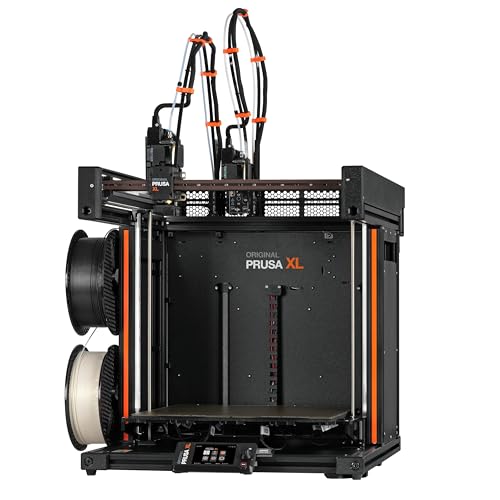
- Dual toolheads support multi-material prints and soluble supports
- Large 14.17 in cube build volume for big prototypes
- Segmented heated bed helps reduce warping on large parts
Best For: Engineering teams and advanced makers needing large, multi-material prototypes
Fast Multicolor Prototype Maker

- Up to 500 mm/s printing speeds up prototype turnaround.
- 4-color printing adds visual detail to concept models.
- Auto leveling and print protection features improve reliability.
Best For: fast prototype prints with multicolor presentation
Compact Beginner Prototype Printer

- Fully assembled and ready to print in as fast as 8 minutes.
- Auto leveling and WiFi/app control simplify beginner use.
- 3.9 x 3.9 x 3.9 inch volume fits small prototype parts.
Best For: kids, beginners, and small educational prototype projects
Speed-First Prototype Workstation – Bambu Lab P2S Combo with AMS 2 Pro
If you’re shopping for 3D printers for prototypes, the Bambu Lab P2S Combo is built for fast turnaround without giving up surface quality. It prints up to 600 mm/s, includes active flowrate compensation, and adds auto calibration plus AI failure detection to streamline everyday prototype runs.
Best For: Rapid prototyping teams and creators who want speed, consistency, and multi-color capability in one setup.
Pros:
- Up to 600 mm/s printing with active flowrate compensation for sharp, consistent layers.
- Ready to print in about 15 minutes with quick-swap nozzles and automatic calibration.
- AMS 2 Pro supports multi-color and multi-material printing.
- Built-in filament drying up to 65 °C helps keep spools ready for reliable output.
Cons:
- The printer itself does not support multi-color printing without the Combo setup.
- Feature-rich system may be more than needed for simple one-off prints.
The P2S Combo is a strong fit when prototype cycles are short and print quality still matters. Its speed, automation, and enclosed airflow system make it especially appealing for users moving between concept parts and more polished presentation models.
Budget-Friendly Prototype Starter – Creality Ender 3 V3 SE with Auto Leveling
The Creality Ender 3 V3 SE is a practical choice for 3D printers for prototypes when you want approachable setup and solid everyday speed. It reaches up to 250 mm/s, uses CR Touch auto leveling, and adds automatic Z-offset calibration to help get reliable first layers with less manual tuning.
Best For: Beginners and budget-conscious makers who need a straightforward printer for everyday prototype parts.
Pros:
- Up to 250 mm/s printing with 2500 mm/s² acceleration for faster prototype turnaround.
- CR Touch auto leveling and automatic Z-offset calibration reduce setup hassle.
- Sprite direct drive extruder supports PLA, PETG, and TPU.
- Dual Z-axis lead screws and precision Y-axis linear shafts help improve consistency.
Cons:
- Speed is lower than the fastest CoreXY-style printers in this roundup.
- Best suited to everyday materials rather than more advanced setups.
For users who want a simpler entry into prototyping, the Ender 3 V3 SE covers the essentials well. It focuses on easy setup, dependable feeding, and stable motion rather than premium automation extras.
Enclosed High-Speed Prototype Maker – Bambu Lab P1S enclosed fast printer
The Bambu Lab P1S is a strong pick for 3D printers for prototypes if you want a fast, enclosed machine with easy setup. It prints up to 500 mm/s, includes automatic bed leveling, and supports advanced filaments more comfortably thanks to its fully enclosed design.
Best For: Makers who want quick prototype prints, enclosed printing, and optional multi-color output with AMS.
Pros:
- Up to 500 mm/s speed and 20,000 mm/s² acceleration for fast iteration.
- Fully enclosed body helps improve print performance for advanced filaments.
- Automatic bed leveling supports more reliable first layers.
- Can reach up to 16 colors when paired with Bambu Lab AMS.
Cons:
- Multi-color printing requires a separate AMS connection.
- Carbon/glass fiber reinforced polymer is not recommended.
The P1S sits in a useful middle ground for prototype work: fast enough for active iteration, but enclosed for users who need more material flexibility. It’s a versatile option when you want speed and a cleaner workflow in one machine.
Ultra-Fast Rapid Prototyper – FLASHFORGE Adventurer 5M fast CoreXY printer
For buyers comparing 3D printers for prototypes, the FLASHFORGE Adventurer 5M emphasizes speed and automation in a compact package. It offers fully automatic bed leveling, a CoreXY structure with 600 mm/s travel speed, and a quick 3-second nozzle change system that helps keep jobs moving.
Best For: Rapid prototyping, short production runs, and users who want fast setup with app-based monitoring.
Pros:
- CoreXY design with up to 600 mm/s travel speed and 20,000 mm/s² acceleration.
- Automatic bed leveling helps produce reliable first layers.
- 3-second detachable nozzle changes and 35-second warm-up to 200 °C improve workflow speed.
- 280 °C direct drive extruder with vibration compensation supports quality at speed.
Cons:
- Build volume is 220 x 220 x 220 mm, which may feel limiting for larger prototypes.
- Best results still depend on tuning nozzle size and settings for the job.
The Adventurer 5M is clearly aimed at fast iteration, with enough automation to reduce friction during repeat prototype runs. It’s a smart option when you care more about throughput and convenience than a larger print area.
Kid-Friendly Creative Starter – AOSEED AI 3D Printer for Kids, Fast 400mm/s, 8000+ Models
If you’re looking at 3d printers for prototypes in a home or classroom setting, this AOSEED model is more about fast idea-to-object learning than engineering-grade output. It stands out with AI-assisted model creation, a large library of 8,000+ print-tested designs, and an enclosed, beginner-friendly design that makes quick creative builds easier to manage.
Best For: Families, kids, and beginners who want a safe, guided printer for creative mockups, toys, and simple prototype concepts.
Pros:
- AI Doodle, AI MiniMe, and MINIMAKIE help create custom models without design skills
- Enclosed, pinch-resistant, quiet, and leveling-free for easier home use
- Fast printing up to 400 mm/s with small projects as quick as 20 minutes
- Includes 8 PLA rolls, tools, build plate, and stickers for immediate setup
Cons:
- Supports single-color printing only
- Primarily geared toward kids and creative projects rather than serious functional prototyping
This is a strong pick if your priority is simple, engaging creation rather than technical part development. It offers a complete starter experience, but advanced prototype makers will likely want more material flexibility and build capacity.
Fast Workshop Performer – Creality K2 SE 3D Printer, 500mm/s High-Speed Printing
Among 3d printers for prototypes, the Creality K2 SE is built for users who care about speed, stability, and room to grow. Its CoreXY motion system, rigid metal frame, and auto leveling make it a practical choice for quickly turning prototype concepts into physical parts with less setup friction.
Best For: Makers and small teams that need a fast, stable printer for functional prototypes and larger parts, with room for future multicolor expansion.
Pros:
- Up to 500 mm/s printing with vibration reduction for smoother results
- Solid metal frame improves rigidity and dimensional accuracy
- Fully automatic leveling and quick 5-minute assembly simplify setup
- Compatible with Creality CFS for optional multicolor printing later
Cons:
- CFS multicolor system is sold separately
- Large, advanced feature set may be more than casual users need
The K2 SE is a good fit when prototype speed and repeatability matter more than keeping things basic. It brings a stronger hardware foundation than entry-level machines, while still being approachable enough for first-time setup.
Professional Multi-Material Workhorse – Original Prusa XL 2-Toolhead Multi-Material Large-Format CoreXY 3D Printer
If you need 3d printers for prototypes that can handle complex assemblies and material changes, the Original Prusa XL is aimed squarely at advanced workflows. Its dual toolhead system, large build volume, and segmented heated bed are designed for reliable large-format output with less waste during multi-material jobs.
Best For: Engineering teams, studios, and advanced makers producing large prototypes, functional parts, and multi-material prints.
Pros:
- Two-toolhead system enables multi-material printing and soluble supports
- Large 14.17 × 14.17 × 14.17 in build volume suits big prototypes
- Segmented heated bed helps improve adhesion and reduce warping
- Tool switching is designed to minimize purge waste
Cons:
- Large footprint and 63.4 lb weight make it a substantial machine
- Advanced capability may be excessive for simple everyday prints
This is the most capable option here for serious prototype work, especially when part size and material complexity are both important. It trades simplicity for professional flexibility, which is exactly what many advanced users need.
Reliable Everyday Prototype Printer – ELEGOO Neptune 3 Pro
If you want one of the more practical 3d printers for prototypes, the ELEGOO Neptune 3 Pro is built for dependable day-to-day use. Its 225 x 225 x 280 mm build volume is a solid fit for common prototype parts, while the direct drive extruder, auto leveling, and resume features help reduce setup friction and failed prints.
Best For: Makers who want a quiet, reliable printer for everyday prototype parts, functional test pieces, and materials like PLA, TPU, PETG, and ABS.
Pros:
- 36-point auto bed leveling helps make first-layer setup easier.
- Direct drive extruder supports PLA, TPU, PETG, and ABS with fewer clogs.
- Silent stepper motors keep noise as low as 47 dB.
- Power-loss resume and filament runout sensor add print security.
Cons:
- Build volume is standard rather than oversized for larger prototypes.
- Not aimed at multicolor printing workflows.
Overall, the Neptune 3 Pro is a straightforward choice if your prototype work values consistency, easier calibration, and material flexibility more than raw speed or advanced extras.
Fast Multicolor Prototype Maker – Creality K2 SE 4C
The Creality K2 SE 4C is a strong pick if you need 3d printers for prototypes that can also handle fast turnaround and multicolor presentation pieces. With up to 500 mm/s speed, CoreXY motion, and auto bed leveling, it is geared toward quicker iteration while keeping setup simple.
Best For: Teams, makers, and educators who want fast prototype production with multicolor output and beginner-friendly setup.
Pros:
- 4-color printing lets you produce more visual prototype detail without extra setup.
- Up to 500 mm/s print speed with 20,000 mm/s² acceleration helps shorten turnaround.
- Auto leveling and a rigid all-metal frame support consistent first layers and stability.
- Runout, tangle detection, power loss recovery, and skip partial failure features protect long prints.
Cons:
- It is more focused on speed and multicolor output than compact simplicity.
- May be more printer than you need for very basic prototype jobs.
For prototype work where speed and presentation both matter, the K2 SE 4C stands out as a versatile machine that can move from concept to finished sample quickly.
Compact Beginner Prototype Printer – Entina Tina2C
The Entina Tina2C is a compact option among 3d printers for prototypes when your priority is simple learning and small-scale builds. Its fully assembled design, app guidance, auto leveling, and quiet operation make it easier to get started, especially for home, classroom, or STEM use.
Best For: Kids, beginners, and classrooms that need an easy-to-use mini printer for small prototype parts and educational projects.
Pros:
- Fully assembled and designed to start printing in as fast as 8 minutes.
- App, WiFi, and TF card support make it flexible for beginner workflows.
- Auto leveling, power-loss recovery, and self-cleaning nozzle design help simplify use.
- Compact body and low-noise operation suit home and classroom spaces.
Cons:
- Very small 3.9 x 3.9 x 3.9 inch build volume limits prototype size.
- Best suited to small, simple models rather than larger functional parts.
If you want an approachable starter machine for learning and tiny prototype projects, the Tina2C keeps the experience low-stress and easy to manage.
How We Picked These 3d Printers for Prototypes
We prioritized machines that support fast iteration without making reliability an afterthought. That means stable motion systems, strong auto-leveling, usable build volumes, and features that reduce failed prints. We also weighed ease of setup, material flexibility, and whether a printer is better suited to casual concept models or more demanding prototype work.
Quick Comparison
If you want the fastest path to usable prototypes, enclosed high-speed models are ideal for repeated functional parts. If you need larger parts or multi-material workflows, look at machines with more advanced tool or color systems. Entry-level printers can still work well for rough mockups and fit checks, especially when budget matters more than throughput.
Key Buying Factors for 3d Printers for Prototypes
Print Speed and Real-World Throughput
High advertised speeds matter less than consistent acceleration, clean corners, and low rework. For prototyping, a printer that produces dependable parts at moderate speed is often more valuable than one that only shines in demos.
Accuracy and Repeatability
Prototypes should match your CAD dimensions closely enough to test fit, assembly, and function. Look for solid frame construction, good bed leveling, and a motion system that keeps layers aligned over longer prints.
Material Support
PLA is fine for concept models, but many prototypes need PETG, ABS, ASA, or composite filaments for strength and heat resistance. An enclosed printer with a capable hotend gives you more flexibility as project complexity grows.
Build Volume and Workflow
Choose a bed size that matches the parts you print most often. Larger volumes help with fewer splits and less post-processing, while multi-color or multi-material support can speed up visual prototypes and assembly checks.
Who Should Buy Which 3d Printers for Prototypes?
Engineers and product teams who print frequently should favor enclosed, faster, more capable systems with strong repeatability. Makers and small businesses may prefer a balanced printer that is easy to maintain and versatile across materials. Beginners or classrooms can start with simpler machines for concept models, then move up when part quality, size, or material demands increase.
If your goal is dependable iteration, prioritize stability and workflow over headline specs. The best 3d Printers for Prototypes are the ones that help you move from design to physical test piece with fewer delays and fewer failed prints.