Choosing a 3D scanner for jewelry means prioritizing fine-detail accuracy, stable tracking, and reliable capture of reflective surfaces. The right model can save hours in CAD prep, prototyping, and custom design work.
Below, we focus on scanners that balance precision, ease of use, and value for jewelers, makers, and small studios.
Best 10 3d Scanner for Jewelry Picks for 2026
High-Precision Pick
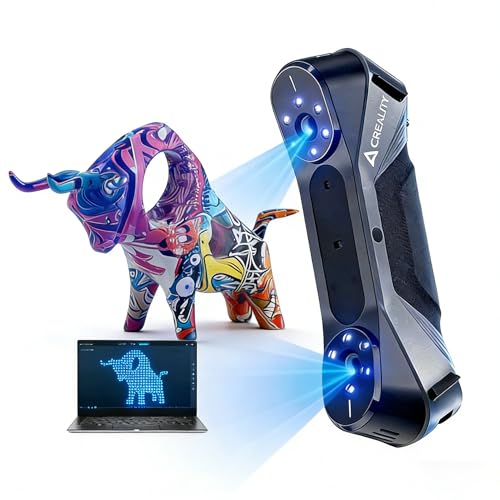
- 0.02 mm max accuracy for fine detail
- Blue laser and 2.3MP imaging
- Works on black and metal objects with less powder
Best For: Precise jewelry scans and other detailed small objects
All-Purpose Detail Choice

- 0.033 mm accuracy for detailed scans
- Dual 13MP autofocus cameras
- No tracking dots and broad OS support
Best For: Clean, accurate jewelry scanning across many devices
Industrial Speed Option

- Up to 0.01 mm single-frame precision
- Five scan modes for small to medium objects
- No-spray scanning for black and shiny surfaces
Best For: Fast, high-precision jewelry and small-part scanning
Beginner-Friendly Pick
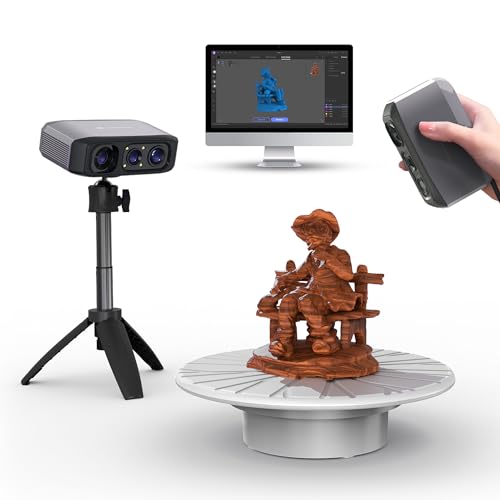
- AI tracking and automated model repair
- Anti-shake support for steadier handheld scanning
- Marker-free workflow with free OTA software
Best For: Beginners scanning jewelry with a simpler workflow
Portable Precision Pick
Creality Pika Portable 3D Scanner for Jewelry

- 0.03mm accuracy with 0.1mm resolution
- Blue laser mode for small, detailed objects
- Wireless, marker-free, and portable
Best For: Detailed jewelry scanning plus flexible use on larger objects
Micro-Detail Specialist

- Up to 0.02mm precision for tiny details
- Blue light system built for small objects
- USB and Wi-Fi 6 scanning options
Best For: High-precision jewelry scans when you want maximum detail on small parts
Budget-Friendly Starter
3DMakerpro Fox 3D Scanner for Jewelry

- Up to 0.07mm accuracy with NIR light
- Markerless tracking and anti-shake support
- Good for small-to-medium objects
Best For: Entry-level jewelry scanning with a more affordable, learning-friendly workflow
Precision Pick
Revopoint POP3 Plus 3D Scanner for Detailed Models
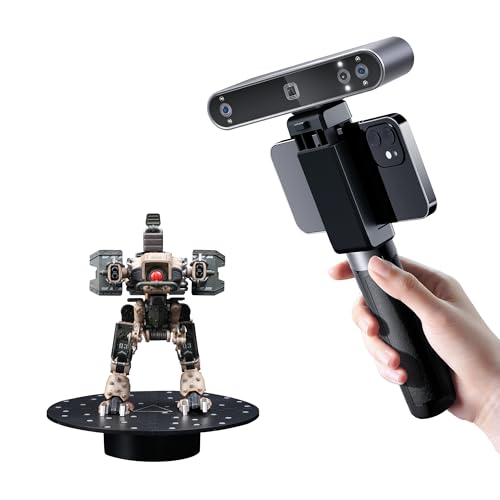
- 20-micron accuracy with optical zoom detail boost
- Full-color scans with HD RGB camera and Flash LED
- Wi-Fi 6, USB-C, and broad file export support
Best For: Portable detailed scanning and scan-to-CAD workflows
Beginner Wireless Pick
Creality CR-Scan Ferret Pro Handheld Scanner

- Wireless WiFi 6 scanning across major platforms
- 24-bit color capture with anti-shake tracking
- Portable 105g design with included travel kit
Best For: Entry-level users scanning larger objects on the go
Ultra-Precision Pick
Revopoint MetroX Pro Blue Laser Scanner

- Up to 0.01 mm precision for high-detail capture
- Laser modes handle shiny and dark surfaces
- Auto turntable plus real-time streaming workflow
Best For: Professional precision scanning and reflective-surface capture
High-Precision Pick – Creality CR-Scan Raptor
If you want a 3d scanner for jewelry with metrology-level detail, the Creality CR-Scan Raptor is built for precise capture on very small objects. Its 0.02 mm maximum accuracy, blue laser mode, and high-resolution imaging make it a strong option for rings, pendants, and other detailed pieces where edge clarity matters.
Best For: Buyers who need very fine detail and want a scanner that can also handle other small-to-large items.
Pros:
- Up to 0.02 mm accuracy for highly detailed scans
- Blue parallel 7-line laser and 2.3MP camera for sharper edges and richer detail
- Can scan black and metal objects with low dependence on powder coating
- Works with Windows and macOS, plus built-in tutorials in the software
Cons:
- Requires a relatively strong computer by the listed system requirements
- Best results may depend on choosing the right scan mode for the object
Overall, this is a capable pick if precision is your top priority in jewelry scanning. It offers professional-grade capture features, but it makes the most sense for users who can meet the hardware requirements and want more advanced scanning control.
All-Purpose Detail Choice – Matter and Form THREE
The Matter and Form THREE is a practical 3d scanner for jewelry if you want detailed captures without adding tracking dots. Its dual 13MP autofocus cameras and 0.033 mm accuracy are aimed at clean, accurate scans of small items like jewelry, while still giving you enough range for much larger objects.
Best For: Users who want a clean workflow, strong accuracy, and easy compatibility across many devices.
Pros:
- Dual 13MP autofocus cameras help maintain sharp focus on small objects
- 0.033 mm accuracy supports detailed, professional-style scans
- No tracking dots needed, which keeps the workflow cleaner
- Compatible with Windows, Mac, Linux, iOS, Android, and Chromebooks
Cons:
- Capture range is broad, so small jewelry may still require careful setup
- Heavier than some handheld scanners at 9.46 pounds
This scanner stands out for convenience as much as precision. If you want a reliable jewelry scanning setup that does not rely on markers or platform restrictions, it offers a very flexible path.
Industrial Speed Option – Revopoint MetroY Ultra
For shoppers looking for a 3d scanner for jewelry with very fine detail and fast capture, the Revopoint MetroY Ultra brings industrial-style specs to small-object scanning. Its up to 0.01 mm single-frame precision, multiple laser and structured-light modes, and marker-free workflow make it a strong fit for detailed pieces and mixed materials.
Best For: Users who want fast, high-precision scanning for jewelry and other small parts.
Pros:
- Up to 0.01 mm single-frame precision for intricate detail
- Five scanning modes, including marker-free and turntable options
- Can scan black, glossy, and metallic surfaces without spray
- Supports Wi-Fi 6, battery grip power, and outdoor scanning
Cons:
- Listed system requirements are fairly demanding
- Advanced features may be more than casual users need
This is a strong choice if you want speed and precision in one package. It is especially appealing for users who scan jewelry along with other small components and want a flexible, professional workflow.
Beginner-Friendly Pick – 3DMakerpro Moose Lite Premium
If you want a 3d scanner for jewelry that is easier to live with day to day, the 3DMakerpro Moose Lite Premium focuses on beginner-friendly scanning tools. Its AI visual tracking, anti-shake module, and marker-free operation help simplify the process when working with small items that can be hard to hold steady.
Best For: Beginners who want a simpler scanning workflow for jewelry and other small objects.
Pros:
- AI visual tracking helps with automated model repair
- Anti-shake module makes handheld scanning more forgiving
- Marker-free technology reduces setup steps
- Free lifetime OTA software upgrades are included
Cons:
- 10 FPS scanning speed is slower than some competing models
- Supplied notes do not list a fine accuracy figure
This model is best viewed as a usability-first option rather than a speed champion. For users who want to get started with jewelry scanning without a lot of setup friction, it offers a straightforward path.
Portable Precision Pick – Creality Pika Portable 3D Scanner for Jewelry
If you want a 3d scanner for jewelry that can also handle other detailed work, the Creality Pika stands out for its 0.03mm accuracy and dual-mode scanning. The blue laser mode is the main draw for small, intricate pieces, while NIR structured light gives you more flexibility when you need to scan larger objects or capture color.
Best For: Jewelers and makers who want a portable scanner for fine detail capture on small parts, collectibles, and mixed-size scanning jobs.
Pros:
- Up to 0.03mm accuracy and 0.1mm resolution for intricate detail capture
- Blue laser mode is well suited to small, detailed objects and dark or metallic surfaces without spray
- Marker-free scanning in wired PC mode can simplify workflow on many surfaces
- Wireless PC mode, dual batteries, and a 3-inch touchscreen support mobile use
Cons:
- NIR structured light is aimed more at larger scans, so jewelry work will rely heavily on the laser mode
- To use the software ecosystem, you need compatible Windows, macOS, iOS, or Android devices
- The broad feature set may be more than needed if you only scan very small objects
Overall, the Pika is a strong choice if you want a compact scanner that can cover precision jewelry detail without giving up flexibility for other scanning tasks. Its mix of accuracy, portability, and dark-surface handling makes it especially appealing for creators who move between bench work and broader scanning projects.
Micro-Detail Specialist – Revopoint MINI 2 for Jewelry
The Revopoint MINI 2 is a compelling 3d scanner for jewelry if your priority is tiny features and high precision. Its blue light system is built for fine detail, and the scanner’s small-object focus makes it a practical fit for rings, settings, and other compact pieces.
Best For: Users who need very high precision on small jewelry items and are comfortable with a scanner that rewards careful setup.
Pros:
- Up to 0.02mm single-frame precision for very fine detail
- Designed for small objects with a larger capture range for improved tracking
- RGB camera, flash LEDs, and marker recognition help with texture and featureless objects
- USB and Wi-Fi 6 options add flexibility for desk or mobile scanning
Cons:
- Blue light scanning can vary by material and color, and scanning spray may help
- Best results may take some practice and careful handling
- Revo Design is paid software and Windows-only
For jewelry-focused scanning, the MINI 2 is the most precision-oriented option in this group. It favors small-object work and fine geometry capture, but it is also the product here that most clearly expects a careful workflow to get the best output.
Budget-Friendly Starter – 3DMakerpro Fox 3D Scanner for Jewelry
If you need a 3d scanner for jewelry on a more approachable budget, the 3DMakerpro Fox offers a practical entry point. It uses NIR light, supports markerless scanning, and is designed for small-to-medium objects, which makes it a workable choice for jewelry and other compact items.
Best For: Entry-level users who want an affordable scanner for jewelry and small objects, and who are willing to learn the workflow.
Pros:
- Up to 0.07mm accuracy for essential structural detail
- NIR technology is safe for human eyes and supports direct face/body scanning
- Markerless tracking and anti-shake features reduce setup friction
- Designed for objects from 40mm to 1200mm, including desktop miniatures and parts
Cons:
- Results depend on a learning curve and some basic CAD or 3D modeling experience
- A capable PC with a dedicated GPU is strongly recommended
- Accuracy and workflow are less specialized than higher-end fine-detail scanners
The Fox is a sensible starter option if you want to get into jewelry scanning without jumping straight to a premium setup. It gives you useful features and decent accuracy, but it’s best viewed as a learning-friendly tool rather than a plug-and-perfect solution.
Precision Pick – Revopoint POP3 Plus 3D Scanner for Detailed Models
If you want a versatile 3d scanner for jewelry-related work and other small-object workflows, the Revopoint POP3 Plus is built around finer detail capture and easy portability. Its 20-micron accuracy claim, optical zoom, and color scanning make it a practical option for creators who need compact objects reproduced with strong fidelity, though it is more of an all-purpose scanner than a jewelry-only tool.
Best For: Makers and designers who need a portable scanner for medium-sized objects, detailed models, and scan-to-CAD prep.
Pros:
- Up to 20-micron accuracy with a refined calibration board
- Optical zoom adds 1.5x and 2x magnification for more point cloud detail
- 18 fps scanning and 9-axis IMU help stabilize frames
- Full-color capture with HD RGB camera and Flash LED lighting
Cons:
- Software is only compatible with x86_64 architecture
- Best suited to medium-sized objects rather than ultra-small precision parts
For buyers comparing a 3d scanner for jewelry against broader creative or reverse-engineering use, the POP3 Plus stands out for its accuracy, color capture, and file support. It is a strong portable choice if you need detailed scans and a smooth path into editing or CAD workflows.
Beginner Wireless Pick – Creality CR-Scan Ferret Pro Handheld Scanner
The Creality CR-Scan Ferret Pro is an easy-to-start handheld scanner for users who want wireless flexibility and full-color capture. As a 3d scanner for jewelry it is not the right fit, since the supplied notes say it is not suitable for very small or highly detailed items, but it can still be a solid choice for larger objects when portability and simple setup matter.
Best For: Beginners and mobile creators scanning larger objects with wireless convenience.
Pros:
- WiFi 6 wireless scanning for flexible use across devices
- 24-bit full-color scanning with anti-shake tracking
- Lightweight 105g body for travel-friendly scanning
- Includes useful accessories like tripod, power bank, and carrying case
Cons:
- Not suitable for very small or highly detailed items like jewelry
- Best results depend on practice and proper technique
If your priority is a beginner-friendly, wireless handheld scanner, the Ferret Pro is easy to recommend for general object capture. Just note its own guidance excludes jewelry-scale precision, so shoppers seeking fine detail should look higher up the precision ladder.
Ultra-Precision Pick – Revopoint MetroX Pro Blue Laser Scanner
If you need a premium 3d scanner for jewelry or other precision work, the Revopoint MetroX Pro is the most capable option in this group. Its blue laser and structured-light modes are designed for high-detail capture, including shiny or dark surfaces, with industrial-grade accuracy that fits demanding modeling, inspection, and prototyping tasks.
Best For: Precision-focused users scanning small, detailed, or reflective objects for professional workflows.
Pros:
- Single-frame precision up to 0.01 mm and accuracy up to 0.02 mm
- Cross-line and parallel laser modes handle shiny or dark surfaces without spray
- Full-field structured light reaches up to 7 million points per second
- Auto turntable and real-time PC-to-mobile streaming improve workflow efficiency
Cons:
- Heavier and more industrial than entry-level handheld scanners
- Revo Design and Revo Measure are sold separately and support Windows only
For buyers who care most about fine detail, the MetroX Pro is the strongest match here by a wide margin. It is the clear choice when accuracy, surface handling, and automation matter more than price or simplicity.
How We Picked the Best 3d Scanner for Jewelry
We looked for scanners that are well suited to small, detailed objects where edge fidelity matters more than raw speed. For a 3d Scanner for Jewelry, the most important factors are claimed accuracy, ability to handle tiny geometry, scan stability, and whether the workflow supports clean mesh output with minimal cleanup.
We also weighed practical buying factors like software compatibility, handheld versus desktop scanning, color capture, and whether the scanner is better for rings and gemstones, wax models, or larger jewelry props and display pieces.
Quick Comparison
If you need the most detail for very small items, look first at high-precision desktop and laser-focused options. If you want flexibility for larger pieces or mixed use, handheld scanners are easier to move around the object. Full-color support can help with presentation and reference capture, but it is less important than geometry accuracy for most jewelry workflows.
Key Buying Factors for a 3d Scanner for Jewelry
Accuracy and Resolution
Jewelry demands tight tolerances. Look for sub-0.1 mm accuracy when possible, especially if you plan to reverse-engineer settings, prongs, or custom-fit components.
Object Size and Scan Range
Some scanners excel at tiny items like rings and charms, while others are better for larger pieces or entire busts and displays. Make sure the scanner’s optimal scan size matches your main work.
Reflective Surface Handling
Polished metal and gemstones can be difficult to scan. Laser scanning, matte spray compatibility, and strong tracking performance can make a big difference.
Workflow and Software
Fast export, clean stitching, and easy mesh cleanup matter as much as hardware specs. If you work across Windows, Mac, or mobile devices, compatibility can also influence productivity.
Portability Versus Control
Handheld scanners offer flexibility for studios that scan different objects all day. Desktop scanners can be easier for repeatable, highly detailed jewelry captures.
Who Should Buy Which 3d Scanner for Jewelry?
Choose a high-accuracy desktop-style scanner if your priority is small parts, repeatable results, and precise CAD-ready geometry. Choose a handheld model if you need to scan a wider range of object sizes or want more freedom around awkward angles.
If you are a jeweler, custom designer, or repair specialist, the best 3d Scanner for Jewelry is usually the one that gives you the cleanest data with the least post-processing, not simply the highest advertised speed.