Choosing a 3D scanner for large objects is all about balancing capture range, tracking stability, and workflow speed. The best models can handle everything from furniture and body parts to car panels and full-size props without constant re-scanning.
In this roundup, we focus on scanners that make large-format capture practical, whether you want high precision for engineering work or a simpler setup for creative projects.
Best 10 3d Scanner for Large Objects Picks for 2026
Precision Laser Pick

- Scans from 5 mm to 4,000 mm objects
- 22 blue lasers plus NIR for flexible capture
- No spray needed for black, metallic, or glass-like surfaces
Best For: industrial design, reverse engineering, and large-object scanning
All-Weather Multi-Mode Pick

- Scans objects up to 2 x 2 x 2 m
- Five modes for laser, NIR, and structured-light capture
- Handles dark, reflective, and outdoor scans well
Best For: mixed indoor/outdoor scanning and larger scenes
Portable Wireless Choice

- Wireless scanning with up to 3 hours battery life
- VCSEL mode captures large objects and works outdoors
- Blue laser mode helps on reflective, metallic, and deep areas
Best For: portable scanning, outdoor work, and cable-free operation
Metrology Kit Pick

- Photogrammetric kit improves large-object measurement
- Quad depth cameras cover small details and big surfaces
- All-in-one scanner with onboard processing and 48MP color
Best For: measurement-oriented scanning of large objects
Premium Handheld Pick
3DMakerpro Moose for Medium-Size Scans

- Up to 0.03mm accuracy with 24-bit color capture
- Scans objects from 15mm to 1500mm
- JMStudio supports alignment, tracking, and correction
Best For: medium-size objects, detailed 3D printing scans, and color capture
Industrial Speed Pick
Revopoint MetroY Ultra for Fast Precision

- Up to 90 FPS with 0.01 mm single-frame precision
- Five modes handle fine detail, holes, and turntable scans
- Scans dark, shiny surfaces and works outdoors
Best For: industrial inspection, reverse engineering, and fast technical scans
Budget-Friendly Starter Pick
3DMakerpro Fox for Easy Entry Scanning
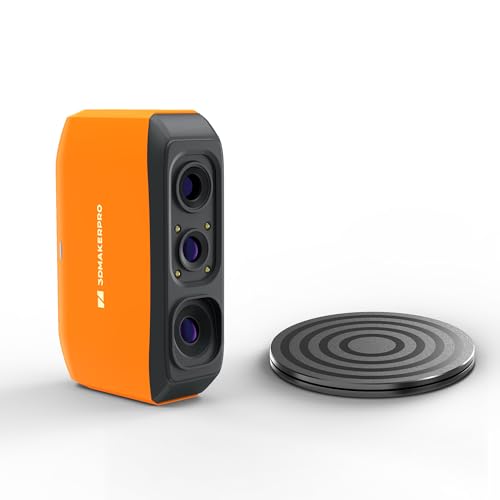
- Markerless tracking and anti-shake simplify setup
- Up to 0.07mm accuracy with NIR light
- Scans objects from 40mm to 1200mm
Best For: beginners, DIY prototyping, and entry-level scanning
Industrial Precision Pick
Creality CR-Scan Raptor 3D Scanner for 3D Printing
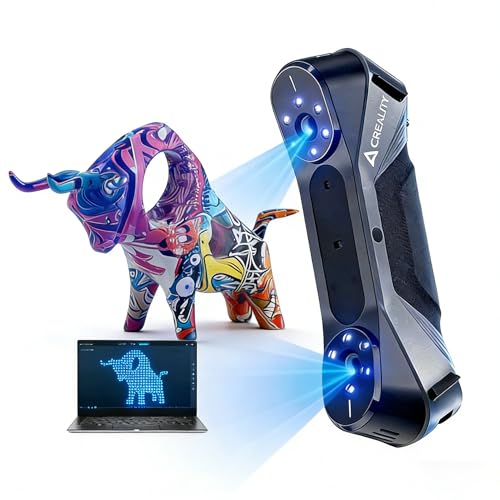
- 0.02mm max accuracy
- Scans 5mm to 2000mm objects
- Blue laser plus infrared modes
Best For: Precision scanning of small parts and large components
Advanced Workflow Pick
Revopoint MetroX Pro 3D Scanner

- Up to 0.01mm single-frame precision
- Four modes for different surfaces
- Auto turntable and live streaming
Best For: Industrial measurement and adaptable scanning workflows
Wireless Speed Pick
Creality Raptor Pro with Scan Bridge

- 0.02mm lab accuracy
- Up to 60 FPS scanning
- Wireless accessory support
Best For: Fast scanning with wireless convenience for larger objects
Precision Laser Pick – Creality CR-Scan Raptor Pro
If you need a 3d scanner for large objects, the Creality CR-Scan Raptor Pro is built for fast capture across a very wide size range, from tiny parts to objects up to 4 meters long. Its mix of blue laser and NIR modes makes it a strong fit for users who want detailed scans without spray powder, even on black, metallic, or semi-transparent surfaces.
Best For: industrial design, reverse engineering, and large-object scanning where speed and surface flexibility matter.
Pros:
- Scans objects from 5 mm up to 4000 mm, making it highly versatile for small-to-large projects.
- Uses 22 crossed blue lasers, 7 parallel blue lasers, and NIR structured light for detailed, high-speed capture.
- Handles black, metallic, and 71% transparent glass surfaces without spray powder.
- Includes 24-bit RGB color scanning and works with major professional software tools.
Cons:
- Windows system requirements are fairly demanding for best performance.
- Outdoor and wireless scanning support depends on the right setup and compatible devices.
Overall, the Raptor Pro is a serious option if your priority is accurate, fast scanning of large objects with minimal prep. It stands out most when you need professional-grade results across difficult materials and varied working environments.
All-Weather Multi-Mode Pick – Revopoint POP 4 Standard
The Revopoint POP 4 is a practical 3d scanner for large objects when you want a compact tool with strong speed, multiple scan modes, and good outdoor tolerance. It combines blue laser and NIR options, so it can handle everything from small precision parts to large industrial components while keeping background noise under control with AI segmentation on Windows.
Best For: mixed indoor/outdoor scanning, larger scenes, and users who want flexible modes in one scanner.
Pros:
- Supports objects up to 2 x 2 x 2 m, covering large and small scanning jobs.
- Offers five scan modes, including blue laser, structured light, and VCSEL options.
- High frame rates and point output help capture large objects efficiently.
- Works on dark and reflective surfaces, and supports reliable outdoor scanning in bright light.
Cons:
- Some outdoor features, such as the filter and battery grip, are sold separately.
- AI object segmentation is Windows only.
For buyers who want one scanner that can move between workshop, field, and larger-object work, the POP 4 offers a strong balance of speed and versatility. Its multiple modes make it easier to adapt to different materials and environments without changing tools.
Portable Wireless Choice – EINSTAR 2 Wireless 3D Scanner
The EINSTAR 2 is a handy 3d scanner for large objects if you want wireless freedom and simple field use without giving up material flexibility. Its VCSEL infrared mode is designed to capture large objects in a single scan with good outdoor performance, while the blue laser mode adds higher-detail capture for smaller areas and difficult surfaces.
Best For: portable scanning sessions, outdoor work, and users who want cable-free operation.
Pros:
- Wireless design with a swappable battery for up to 3 hours of scanning.
- VCSEL infrared mode is aimed at large objects and works in bright conditions.
- Blue laser mode supports reflective and metallic surfaces without spray.
- Supports deep-hole scanning and runs up to 90 fps in laser mode.
Cons:
- IR rapid mode is slower than the top laser-speed figure and is more about large-object coverage than fine detail speed.
- Wi-Fi interference may require switching to cable connection.
In practice, the EINSTAR 2 is a flexible choice for people who need mobility first and can benefit from a scanner that handles both outdoor and indoor work. It is especially appealing if you value wireless convenience while still needing respectable performance on dark or reflective surfaces.
Metrology Kit Pick – Revopoint MIRACO Plus
If you’re shopping for a 3d scanner for large objects with measurement-focused features, the Revopoint MIRACO Plus brings photogrammetric metrology into an all-in-one handheld package. The included kit is designed to improve accuracy on large items while still preserving fine detail, making it a useful fit for everything from small parts to machinery.
Best For: measurement-oriented scanning of large objects, product design, and reverse engineering.
Pros:
- Photogrammetric kit adds scale bars and coded targets for large-object measurement.
- Quad depth camera system handles both tiny details and large surfaces.
- 0.04 mm single-point cloud accuracy and improved calibration board performance.
- All-in-one design includes a 48MP RGB camera, flip screen, and onboard processing hardware.
Cons:
- Battery life is limited to up to 2 hours of continuous scanning.
- Revo Design software is sold separately.
The MIRACO Plus is best viewed as a portable measurement tool rather than a simple consumer scanner. If your large-object workflow depends on better scale control and cleaner metrology data, it offers a more specialized path than standard handheld models.
Premium Handheld Pick – 3DMakerpro Moose for Medium-Size Scans
If you’re shopping for a 3d scanner for large objects, the 3DMakerpro Moose is a practical handheld option for medium-size items up to 1500mm. It combines blue LED structured light, up to 0.03mm accuracy, and 24-bit color capture, making it a strong fit when detail matters and the object is still manageable indoors.
Best For: Users who want a high-precision handheld scanner for medium-size objects, 3D printing, and color scans.
Pros:
- Up to 0.03mm accuracy with 0.07mm resolution for detailed scans.
- Scans objects from 15mm to 1500mm, covering a wide medium-size range.
- 24-bit color capture helps preserve realistic tones and textures.
- JMStudio software adds automatic alignment, visual tracking, and error correction.
Cons:
- Best performance is recommended indoors, so it is not the most flexible outdoor choice.
- As a handheld scanner, it may take some practice to use smoothly.
- Needs a capable computer for the best experience.
The Moose stands out for buyers who want precision and color in a compact workflow, but it is still a tool that rewards patience and setup. If your priority is detailed scanning for medium-size objects rather than ultra-portable simplicity, this is a compelling pick.
Industrial Speed Pick – Revopoint MetroY Ultra for Fast Precision
For a 3d scanner for large objects that also needs speed and inspection-grade detail, the Revopoint MetroY Ultra brings up to 90 FPS scanning, blue laser modes, and marker-free structured light. It is built for fast capture on small to medium-sized objects, with the flexibility to handle dark, shiny, and even outdoor conditions.
Best For: Industrial users who need fast, accurate scanning for inspection, reverse engineering, and field work.
Pros:
- Up to 0.01 mm single-frame precision for fine geometric detail.
- Five scanning modes cover rapid scans, deep holes, turntable use, and marker-free capture.
- Can scan black, glossy, and metallic surfaces without spray.
- Works outdoors in sunlight up to 100,000 lux and includes Wi-Fi 6 plus a battery grip.
Cons:
- Minimum system requirements are demanding, especially on Windows.
- It is aimed more at small to medium objects than very large items.
- Higher-end capabilities may be more than casual users need.
This scanner is strongest when speed, surface flexibility, and industrial workflow matter more than simple plug-and-play use. If you need a performance-focused option for technical scanning jobs, the MetroY Ultra is the most advanced model in this group.
Budget-Friendly Starter Pick – 3DMakerpro Fox for Easy Entry Scanning
If you want a 3d scanner for large objects without jumping straight into a high-end setup, the 3DMakerpro Fox is an accessible entry-level choice for small to medium projects up to 1200mm. Its NIR light, markerless tracking, and anti-shake support make it approachable for beginners who are willing to learn the workflow.
Best For: Beginners and DIY users who want an easier starting point for small to medium scanning projects.
Pros:
- Markerless tracking simplifies setup by removing the need for target dots.
- Up to 0.07mm accuracy is solid for an entry-level scanner.
- Safe NIR light supports direct face and body scanning.
- JMStudio handles scanning, editing, fusion, and export.
Cons:
- It still has a learning curve and works best with some CAD or modeling experience.
- Requires a capable PC and dedicated GPU for smooth performance.
- Designed for 40mm to 1200mm objects, so it is not the largest-range option here.
The Fox is a sensible starting point if you want an affordable scanner that can grow with your skills. It is not the easiest path to perfect results, but it offers helpful automation and broad enough object support for many beginner projects.
Industrial Precision Pick – Creality CR-Scan Raptor 3D Scanner for 3D Printing
If you need a 3d scanner for large objects that still delivers fine detail, the Creality CR-Scan Raptor is built around high-precision capture and flexible scanning modes. It can handle objects from 5mm to 2000mm, making it a practical option for everything from small parts to larger components, while the blue laser and infrared structured light modes broaden what it can scan well.
Best For: Users who want a versatile scanner for both large objects and detailed industrial-style scans.
Pros:
- Maximum accuracy up to 0.02mm for metrological-style work.
- Scans objects from 5mm to 2000mm, covering small parts through large components.
- Blue parallel 7-line laser and 2.3MP camera help capture sharper edges and richer detail.
- Infrared structured light supports unmarked scanning for faces, human bodies, and cultural relics.
Cons:
- Requires a fairly capable computer, including at least 8 cores, 16 threads, and a 2.4GHz base frequency.
- Outdoor scanning is supported, but only up to 30000 lux.
This is a strong pick if your priority is precision plus range, especially when you need one scanner that can move between small and large subjects without sacrificing usability.
Advanced Workflow Pick – Revopoint MetroX Pro 3D Scanner
The Revopoint MetroX Pro is a strong 3d scanner for large objects when you also care about industrial accuracy and workflow flexibility. It combines multiple scan modes, including cross-line lasers, parallel lines, and full-field blue structured light, so you can adapt the capture method to the object instead of forcing one approach.
Best For: Buyers who want a highly configurable scanner for industrial measurement, prototyping, and detailed object capture.
Pros:
- Single-frame precision up to 0.01mm and accuracy up to 0.02mm.
- Four scanning modes cover shiny, dark, flat, and feature-rich objects.
- Marker-free full-field mode can capture up to 7 million points per second.
- Auto turntable and PC-to-mobile streaming support a smoother workflow.
Cons:
- Revo Design and Revo Measure are sold separately.
- Revo Design and Revo Measure support Windows only.
If you want broad scanning flexibility rather than a single-use setup, the MetroX Pro stands out for its mode selection and workflow tools. It is especially appealing when your projects include inspection, modeling, or prototyping alongside large-object scanning.
Wireless Speed Pick – Creality Raptor Pro with Scan Bridge
For buyers looking for a 3d scanner for large objects with faster handling and added mobility, the Creality Raptor Pro pairs high-speed scanning with the Scan Bridge wireless accessory. It supports objects from 5mm to 2000mm and offers marker-based alignment, which helps when stitching together multiple scans of bigger subjects.
Best For: Users who want wireless convenience and fast scanning for medium-to-large objects.
Pros:
- Scans objects from 5mm to 2000mm, with a 270mm x 170mm single-capture range at 300mm.
- Up to 0.02mm accuracy in laboratory conditions.
- Scans at up to 60 FPS and 660,000 points per second.
- Includes Scan Bridge wireless scanning support for added convenience.
Cons:
- Maximum accuracy is specified under laboratory conditions.
- Wireless scanning depends on compatible accessories.
The Raptor Pro is a practical choice if you value speed, wireless flexibility, and broad object size support in one package. Its marker-based alignment and full-color scanning support make it a capable option for users who need efficient capture without giving up detail.
How We Picked the Best 3d Scanner for Large Objects
We prioritized scanners that are well-suited to larger subjects, with a strong mix of scanning range, frame rate, object-size flexibility, and real-world ease of use. For a 3d Scanner for Large Objects, stable tracking and enough working distance matter just as much as raw accuracy. We also favored models that offer multiple scan modes or light sources, since large items often have varied surface finishes and geometry.
Quick Comparison
If you want the simplest shortlist: choose a high-precision laser scanner for detailed industrial parts, a hybrid handheld scanner for mixed-size projects, or a wireless all-in-one model if portability matters most. Faster scanners are better for larger items because they reduce drift and save time during long passes.
Key Buying Factors for a 3d Scanner for Large Objects
Capture Range and Working Distance
Large objects need a scanner that can maintain tracking from a comfortable distance. A wider capture range helps with big surfaces, while a longer working distance reduces the need to move too close to the subject.
Accuracy Vs. Speed
Higher accuracy is useful for parts that must fit or assemble precisely, but speed becomes critical when scanning large items. For oversized subjects, a scanner with good frame rate and reliable alignment often produces better results than one that is technically sharper but slow and fragile.
Light Source and Surface Compatibility
Blue laser systems are often strong for detail and textured surfaces, while structured light or infrared options can be better for certain finishes and larger areas. If you plan to scan dark, reflective, or matte surfaces, check whether the scanner handles them well without excessive spray or prep.
Software and Export Workflow
Good software can make a big difference when stitching large scans, cleaning mesh data, and exporting to CAD or 3D printing apps. Look for clean alignment tools, easy editing, and broad file support.
Who Should Buy Which 3d Scanner for Large Objects?
If you need the most detail for technical parts, prioritize a high-accuracy laser model. If you want a versatile option for mixed projects, a hybrid handheld scanner is usually the safest choice. If you value convenience and mobility over advanced controls, a wireless all-in-one scanner can be the easiest way to work on large items without a complicated setup.
For hobbyists and first-time buyers, choose a scanner that emphasizes easy tracking and forgiving software. For professionals, the best 3d Scanner for Large Objects is usually the one that minimizes rescans, handles difficult surfaces, and fits cleanly into your post-processing workflow.