Traveling fiber technicians need test equipment that is compact, dependable, and versatile enough to handle common field faults without filling a tool bag. The best fiber optic testers for travel combine useful functions such as optical power measurement, visual fault location, and network cable testing in a portable design.
This roundup compares 10 travel-friendly options across basic VFL tools, integrated OPM/VFL meters, and broader kits with adapters and rechargeable batteries. Use the buying guide below to match features, connector support, measurement range, and portability to your typical work.
Best 10 Fiber Optic Testers for Travel Picks for 2026
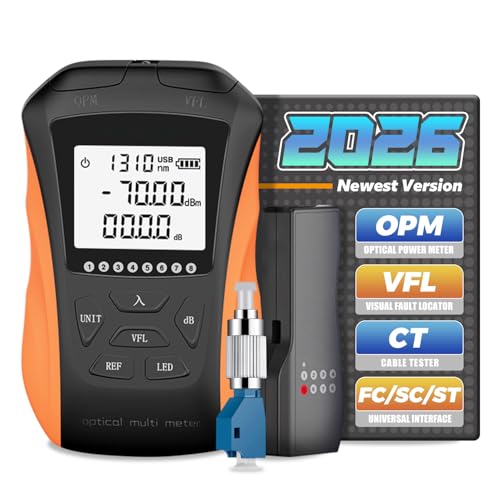
Travel-Ready All-in-One

- Eight wavelength settings with -70 to +6 dBm range
- Integrated OPM, VFL, and RJ45 testing
- 140 g design with FC/SC/ST support
Best For: Compact multi-function field testing
Field Fault-Finding Kit

- Detects breaks, bends, cracks, and poor connections
- Includes five adapters and three patch cords
- Compact design supports ST, SC, FC, and LC testing
Best For: Portable visual fault troubleshooting
High-Capacity Pocket Tester

- Tests 10 wavelengths from 850 to 1650 nm
- Stores up to 500 measurement sets
- Adds 10 mW VFL, RJ45 testing, and LED lighting
Best For: Data-focused mobile fiber technicians
Rechargeable Travel Tester
- 1100 mAh Li-ion battery with USB charging
- Combines OPM, VFL, LAN testing, and flashlight
- LCD displays readings and battery status
Best For: Rechargeable fiber and LAN field testing
Quick Signal Check

- Detects 850–1625 nm optical signals
- Light and sound alerts need no interpretation
- Ultra-light non-contact design with auto shutoff
Best For: Fast signal-presence checks on fiber ports and patch cords
Multi-Function Travel Meter
Mini 4-in-1 Optical Power Meter

- Measures -70 to +6 dBm across 800–1700 nm
- Adds 650 nm visual fault locating
- Supports SC, FC, and ST connectors
Best For: Travel kits needing power measurement plus basic fault testing
Rechargeable Field Kit

- Combines fiber, VFL, and RJ45 testing
- Supports six wavelengths from 850–1625 nm
- USB-C charging and 500-record storage
Best For: Mobile fiber and Ethernet installation or maintenance
Rugged Field Tracer

- Finds breaks, bends, cracks, and poor connections
- Works with common SC, ST, FC, and LC interfaces
- Rugged AA-battery design for field use
Best For: Traveling technicians who need basic fiber tracing and continuity checks
All-in-One Network Tester
- Combines optical power measurement with VFL testing
- Supports up to eight wavelengths and dBm/mW readings
- Adds RJ45 testing for copper network work
Best For: Traveling installers handling both fiber and RJ45 diagnostics
Two-Pen Maintenance Kit
Portable Red-Light Fiber Testers

- Includes two compact VFL pens and a carrying pouch
- Tests single-mode and multimode fiber continuity
- Aluminum housing and one-button operation simplify field use
Best For: Traveling crews needing lightweight visual fault tools or a spare unit
Travel-Ready All-in-One – Portable OPM-VFL Tester
For shoppers comparing fiber optic testers for travel, this compact yellow unit combines optical power measurement, a visual fault locator, and RJ45 testing in one device. It supports eight wavelengths, FC/SC/ST interfaces, and weighs 140 g, making it practical for field bags and on-site troubleshooting.
Best For: Technicians who want one lightweight tester for fiber power checks, visible fault tracing, and RJ45 testing.
Pros:
- Measures eight standard wavelengths from 850 to 1650 nm.
- Combines OPM, VFL, and RJ45 functions.
- Supports automatic shutdown, backlight selection, wavelength memory, and user calibration.
- Displays linear mW and dBm readings simultaneously.
Cons:
- Requires two AA batteries, which are not included.
- Its test range ends at +6 dBm, lower than some listed alternatives.
Its broad interface support and three-in-one design make it a convenient travel tester, especially when reducing the number of tools in a kit matters.
Field Fault-Finding Kit – Visual Fault Locator Set
This visual fault locator kit is a practical option for fiber optic testers for travel when the priority is locating breaks, bends, cracks, and poor connections. It includes multiple adapters and patch cords, allowing troubleshooting at distribution panels without removing the fiber from the panel.
Best For: Field technicians who need a portable VFL kit with adapter and patch-cord flexibility.
Pros:
- Designed to locate breaks, poor connections, bends, and cracks.
- Supports ST, SC, and FC interfaces, with LC testing through the included adapter.
- Includes five adapters and three 3.2-foot patch cords.
- Compact and lightweight for field testing.
Cons:
- Two AA batteries are not included.
- It is focused on visual fault locating rather than optical power measurement.
The included accessories make this a useful travel troubleshooting kit for connection-level diagnosis, but buyers needing measured optical loss should consider an OPM-equipped model instead.
High-Capacity Pocket Tester – M70-10 OPM & VFL
For fiber optic testers for travel, the M70-10 offers a strong mix of measurement coverage and portability. It combines an optical power meter, 10 mW visual fault locator, RJ45 sequence tester, and LED light, while storing up to 500 measurement sets for later review.
Best For: Mobile technicians who need broad wavelength coverage, data storage, and several field-test functions in a pocket-sized unit.
Pros:
- Measures 10 standard wavelengths with a -70 to +10 dBm range.
- Provides OPM, 10 mW VFL, RJ45 testing, and LED lighting.
- Measurement error is specified as less than ±0.2 dB.
- Stores up to 500 data sets and includes an FC-LC adapter.
Cons:
- Two AAA batteries are required and not included.
- The supplied notes do not specify a rechargeable battery.
Its wider wavelength list, data memory, and multi-function design make it one of the more capable choices for technicians who want to keep travel equipment compact.
Rechargeable Travel Tester – USB-Charged Fiber Meter
This rechargeable model suits shoppers seeking fiber optic testers for travel without relying on replaceable batteries. It combines an optical power meter, visual fault locator, LAN cable tester, and flashlight, with a 1100 mAh Li-ion battery and USB charging port.
Best For: Travelers who want a rechargeable tester for fiber, LAN cable, and low-light field work.
Pros:
- Combines OPM, VFL, cable testing, and an LED flashlight.
- Supports a broad selection of wavelengths from 850 to 1625 nm.
- Uses a 1100 mAh Li-ion battery with USB charging.
- LCD shows power loss, wavelength, frequency, battery capacity, and charge status.
Cons:
- The supplied notes do not list included charging accessories.
- Its VFL output is specified as 5 mW, which may be less powerful than the 10 mW option listed for another model.
USB charging and battery-status information are practical advantages for travel, while LAN testing and the built-in flashlight broaden its usefulness beyond fiber measurements.
Quick Signal Check – Fluke FiberLert-125
For travelers who need a fast way to confirm whether a fiber link is carrying light, the Fluke FiberLert-125 is a particularly simple option among fiber optic testers for travel. It detects optical signals without requiring setup or meter interpretation.
Best For: Technicians who want a lightweight, quick signal detector for ports and patch cords.
Pros:
- Detects single-mode and multimode signals from 850 to 1625 nm.
- Uses light and sound indicators, so readings require no interpretation.
- Non-contact detection works with SM, MM, UPC, and APC connections.
- Compact 6.26 g design, included batteries, and automatic five-minute shutoff.
Cons:
- It indicates the presence of an optical signal rather than providing a detailed power reading.
- Runs on two AAA batteries instead of rechargeable power.
The FiberLert-125 is best when speed, simplicity, and minimal packing space matter more than advanced measurement features. Its two-year warranty is an additional advantage for frequent field use.
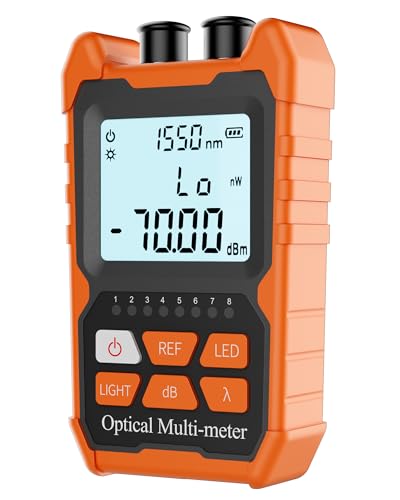
Multi-Function Travel Meter – Mini 4-in-1 Optical Power Meter
This mini 4-in-1 unit suits travelers who need more than signal detection from their fiber optic testers for travel. It combines optical power measurement, a visual fault locator, and network cable testing in a 200 g handheld package.
Best For: Field users who need optical power readings and basic fault-location functions in one compact tester.
Pros:
- Measures optical power from -70 dBm to +6 dBm across an 800–1700 nm range.
- Includes a 650 nm visual fault locator with 2 mW output.
- Supports SC, FC, and ST connectors; LC use requires an SC male-to-LC female adapter.
- Provides linear and logarithmic display resolution for power readings.
Cons:
- Requires two AA batteries rather than USB-C charging.
- The listed 200 g weight is heavier than the smallest signal-only testers.
- LC connections require an additional adapter.
This orange mini meter is a practical compromise for travel kits that need actual dBm or milliwatt measurements, visual fault location, and cable testing without carrying separate tools.
Rechargeable Field Kit – 6-in-1 Fiber Optic Tester
For technicians who want broad testing capability without packing several devices, this 6-in-1 model is one of the more versatile fiber optic testers for travel. It combines optical power measurement, visual fault indication, RJ45 cable testing, rechargeable power, and onboard data storage.
Best For: Mobile installation and maintenance work requiring fiber, Ethernet, and repeatable field measurements.
Pros:
- Combines an optical power meter, VFL, and RJ45 cable tester.
- Supports 850, 1300, 1310, 1490, 1550, and 1625 nm wavelengths.
- Offers a -50 to +30 dBm range, ±0.2 dB accuracy, and 0.01 dB resolution.
- Uses Type-C charging, stores up to 500 records, and includes a backlight.
Cons:
- Its broad feature set may be unnecessary for simple signal-presence checks.
- The supplied notes list connector compatibility as FC/SC/ST, so other connector types may require accessories.
At approximately 95 g, this rechargeable tester offers a strong feature-to-weight balance for field travel. Data storage and a backlit display are especially useful when testing repeatedly or working in low-light locations.
Rugged Field Tracer – Compact Visual Fault Locator
For shoppers comparing fiber optic testers for travel, this visual fault locator is a practical choice for tracing fibers and locating breaks in the field. Its 2.5mm universal connector supports common SC, ST, FC, and LC connections, while the aluminum body and stainless steel head are designed to handle transport and job-site use.
Best For: Fiber tracing, continuity checks, and field troubleshooting where durability and broad connector compatibility matter.
Pros:
- Helps identify breaks, poor connections, bends, and cracks with a visible glow.
- Supports SC, ST, FC, and LC fiber interfaces through its universal connector design.
- Offers constant output, low-battery warning, long battery life, and long-distance detection.
- Uses convenient AA batteries and has a crash-resistant, dust-resistant housing.
Cons:
- It is a visual fault locator rather than a combined optical power meter.
- Requires two AA batteries, so spare batteries may be useful for extended travel.
This Moocci tester suits technicians who need a straightforward, rugged tool for quickly tracing and checking fiber connections without carrying a larger test setup.
All-in-One Network Tester – OPM and VFL Fiber Meter
Among fiber optic testers for travel, this portable unit stands out by combining an optical power meter with a visual fault locator. It measures optical signal strength in dBm and mW, supports up to eight wavelengths, and adds RJ45 testing for technicians working across both fiber and copper networks.
Best For: Network installers and troubleshooters who want optical power measurements, visible fault detection, and RJ45 testing in one device.
Pros:
- Combines OPM and VFL functions in a single compact tester.
- Measures optical power in dBm and mW and supports up to eight wavelengths.
- Provides a bright red laser for locating cable, splice, and connector faults.
- Supports FC, SC, and ST interfaces plus RJ45 network testing.
Cons:
- Uses non-rechargeable batteries rather than an integrated rechargeable power source.
- Its broader functionality may be more than needed for simple visual continuity checks.
This is the most versatile option of the three for travel kits, especially when one job may involve optical signal verification and copper-network diagnostics.
Two-Pen Maintenance Kit – Portable Red-Light Fiber Testers
This two-piece kit is a convenient option for anyone seeking fiber optic testers for travel and routine maintenance. The compact VFL pens use visible red light to trace fiber paths, check continuity, and locate breaks or sharp bends across single-mode and multimode cables.
Best For: Installers, technicians, and maintenance teams who want lightweight visual fault locators with a carrying pouch and simple operation.
Pros:
- Includes two visual fault locator pens for shared use or backup coverage.
- Works with SC, ST, and FC connectors through a universal 2.5mm interface.
- Supports single-mode and multimode fiber for routing, continuity, and fault checks.
- Compact aluminum construction, pouch, and one-button operation suit transport.
Cons:
- It focuses on visual fault and continuity testing rather than optical power measurement.
- The supplied connector compatibility is described around SC, ST, and FC via the 2.5mm interface; adapter needs may vary by setup.
With two pens, a carrying pouch, and a simple control layout, this kit is a practical choice when portability, redundancy, and quick visual checks are more important than advanced measurements.
How We Picked the Best Fiber Optic Testers for Travel
We focused on the features that matter most when testing on-site: portability, measurement capability, connector compatibility, power options, and versatility. The selection includes simple visual fault locators for quick red-light checks, optical power meters for signal-level measurements, and combination testers that add RJ45 cable testing. We also considered whether each tool supports common FC, SC, ST, or LC connections through built-in interfaces or included adapters.
Travel equipment should be practical rather than merely feature-heavy. A compact tester with a clear display, straightforward controls, durable housing, and USB or rechargeable power can be more useful than a larger unit with functions you rarely need.
Quick Comparison
- Best for basic fault tracing: A dedicated visual fault locator is compact and quick for identifying breaks, sharp bends, and poor terminations.
- Best for signal verification: An optical power meter provides quantitative readings to help confirm whether a link meets expected levels.
- Best all-around field tool: An integrated OPM and VFL combines fault location and power measurement in one device.
- Best for mixed cabling: Models with RJ45 testing are useful for technicians who handle both fiber and copper network connections.
- Best for connector flexibility: Look for FC/SC/ST support plus an FC-to-LC adapter or interchangeable interfaces.
Key Buying Factors for Fiber Optic Testers for Travel
Functions and Measurement Range
Choose a VFL for basic continuity and fault-location work, but select an OPM if you need to measure optical power. Multi-function models may support several wavelengths, including common 850, 1300, 1310, 1490, 1550, and 1625 nm ranges. Confirm that the tester’s range suits the networks you service.
Size, Battery, and Durability
For travel, prioritize a lightweight body, protected controls, a readable screen, and a battery that lasts through a workday. USB or Type-C charging is convenient when you are away from a dedicated outlet. A protective case, dust cap, and sturdy connector ports are also valuable for mobile work.
Connector Compatibility
FC, SC, ST, and LC are common, but not every tester supports all four directly. Check the included adapters before buying, especially if you work with patch panels, single-mode links, and multimode installations.
Who Should Buy Which Fiber Optic Testers for Travel?
Choose a dedicated VFL pen or kit if you mainly locate visible breaks and need the smallest possible tool. Pick a basic OPM/VFL combination for routine installation and maintenance. Technicians who troubleshoot both fiber and Ethernet should choose a model with RJ45 testing. For varied professional fieldwork, a multi-wavelength tester with rechargeable power and multiple adapters offers the best balance of coverage and portability.