Choosing the right scanner can make or break a reverse-engineering workflow. If you need accurate point clouds, reliable tracking, and clean meshes for CAD reconstruction, the details matter.
This roundup focuses on 10 practical options built for real-world part capture, from small components to larger objects, with an eye toward precision, speed, and ease of use.
Best 10 3d Scanner for Reverse Engineering Picks for 2026
Metrology-Grade Flagship
Creality Raptor Pro for high-precision reverse engineering

- 0.02mm+0.08mm/m metrology-grade accuracy
- Blue laser plus marker-free NIR scanning
- Scans from 5 mm up to 4000 mm
Best For: industrial users scanning parts, molds, and larger objects
All-Round Precision Pick
Creality CR-Scan Raptor for versatile reverse engineering
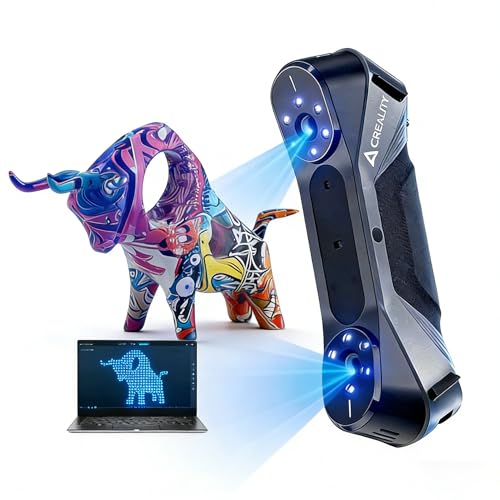
- Up to 0.02mm industrial-style accuracy
- Blue laser and infrared structured light modes
- 24-bit RGB color with 12 white LED fill lights
Best For: users needing a versatile scanner for parts, faces, and color models
Portable Starter Choice
Creality Otter Lite Basic for portable reverse engineering

- 0.05mm resolution with dual-range scanning
- RGB and infrared cameras for full-color models
- Lightweight 235g body with carrying case
Best For: portable scanning and smaller reverse-engineering projects
Speed-Focused Precision
Creality CR-Scan Raptor 60fps for fast reverse engineering

- Up to 0.02mm accuracy with 7 blue laser lines
- Blue-light capture up to 60fps
- NIR mode handles faces, bodies, and artifacts
Best For: buyers who want fast, accurate scans across mixed object types
Metrology-Grade Speed for Large Projects
Creality Raptor Pro for automotive and engineering scans

- 22 cross laser lines for medium to large objects
- 7 parallel blue lasers with 0.02mm accuracy
- Up to 60fps scanning with anti-shake capture
Best For: Automotive and engineering reverse engineering on larger parts
Fast Multi-Mode Capture
Creality Raptor with blue laser, IR, and full color

- Up to 0.02mm accuracy for industrial-level detail
- Triple-mode scanning with blue laser and IR structured light
- True 24-bit full color with strong texture capture
Best For: Versatile reverse engineering with color and marker-free scanning
Lightweight Reverse Engineering Tool
Creality CR-Scan Raptor handheld scanner with laser and IR

- 0.02mm precision with a 7-line blue laser
- Marker-free infrared mode for flexible scanning
- Lightweight 372g body for easier handheld use
Best For: Portable reverse engineering and detailed part capture
Compact Portable 0.05mm Scanner

- 0.05mm resolution for detailed reverse engineering
- Dual-mode scanning covers small and larger objects
- 235g portable kit with turntable and case
Best For: DIY users and small shops needing a lightweight scanner with color capture
Metrology-Grade Blue Laser Scanner

- 0.02mm accuracy with 22+7 blue lasers
- Scans black, reflective, and metal surfaces without spray
- Works with Geomagic, SolidWorks, ZBrush, Maya, and Verisurf
Best For: Industrial and automotive reverse engineering with professional software workflows
Portable Color Texture Scanner

- 0.05mm resolution with dual-range scanning
- RGB and infrared cameras support textured models
- 235g handheld kit with turntable and carry case
Best For: Hobbyists and small teams needing a lightweight, easy-to-use reverse engineering scanner
Metrology-Grade Flagship – Creality Raptor Pro for high-precision reverse engineering
If you need a 3d scanner for reverse engineering that can handle both small engineering parts and much larger objects, the Creality Raptor Pro is built for that mixed workload. It combines blue laser and NIR scanning, claims metrology-grade accuracy up to 0.02mm+0.08mm/m, and supports wireless use for a more flexible setup.
Best For: users who want high-precision scanning across industrial parts, automotive components, and larger objects with minimal friction.
Pros:
- Up to 0.02mm+0.08mm/m accuracy for detailed reverse engineering work
- Dual blue laser mode with 22 cross lines and 7-line partial HD scanning
- NIR structured light supports marker-free scans on feature-rich objects
- Wide scan range from 5 mm to 4000 mm for small parts through full-body scans
Cons:
- Requires a relatively strong Windows or macOS system for best results
- Advanced capabilities may be more than casual users need
- Software workflow may take time to learn if you are new to 3D scanning
This is a strong choice if precision and range matter more than simplicity. The Raptor Pro is aimed at serious scanning jobs where speed, detail, and flexibility all matter.
All-Round Precision Pick – Creality CR-Scan Raptor for versatile reverse engineering
The Creality CR-Scan Raptor is a practical 3d scanner for reverse engineering when you want metrology-level accuracy without moving up to the more complex flagship tier. It offers up to 0.02mm accuracy, blue laser and infrared modes, and support for objects from 5 mm to 2000 mm.
Best For: buyers who want a capable all-around scanner for small parts, medium components, and color capture.
Pros:
- Up to 0.02mm accuracy for industrial measurement-style work
- Blue 7-line laser plus infrared structured light for different scanning needs
- 24-bit RGB color and 12 white LED fill lights for textured scans
- Supports Windows and macOS with guided software workflows
Cons:
- Requires a fairly capable computer with at least 8 cores and 16 threads
- Maximum size range tops out at 2000 mm, below larger-scene scanners
- Best results will depend on using the right mode for the object
If you want a versatile scanner that stays focused on precision, this model makes a lot of sense. It is especially appealing for users who value color output and straightforward software support.
Portable Starter Choice – Creality Otter Lite Basic for portable reverse engineering
The Creality Otter Lite Basic is a compact 3d scanner for reverse engineering that leans into portability and ease of setup. With 0.05mm resolution, dual-range scanning modes, and full-color texture mapping, it is suited to users who want solid detail capture without a heavier workstation-style package.
Best For: mobile users and hobbyists who need a lightweight scanner for smaller parts and everyday modeling tasks.
Pros:
- 0.05mm resolution with close-range and long-range scanning modes
- RGB and infrared cameras support full-color 3D models
- Only 235g and includes a turntable, markers, and carrying case
- Compatible with Windows and macOS via Creality Scan software
Cons:
- Less precise than the 0.02mm scanners in this roundup
- Best for smaller objects rather than the largest industrial parts
- May require more hands-on setup than a fully automated workflow
This is the most travel-friendly option here, and that matters if you scan in different locations. It trades some precision for a simpler, lighter kit that is easier to carry and set up.
Speed-Focused Precision – Creality CR-Scan Raptor 60fps for fast reverse engineering
If your priority is a fast 3d scanner for reverse engineering with strong edge definition, the Creality CR-Scan Raptor is built around speed and precision. It combines 7 blue laser lines, NIR scanning, and up to 60fps blue-light capture while covering objects from 5 mm to 2000 mm.
Best For: users who want high-speed scanning for precision parts, color capture, and mixed object sizes.
Pros:
- Up to 0.02mm accuracy with 7 parallel blue laser lines
- Blue-light mode reaches up to 60fps for faster capture
- NIR mode supports marker-free scanning of faces, bodies, and artifacts
- 24-bit color support and anti-shake tracking improve usability
Cons:
- Needs a strong PC or Mac to meet the listed system requirements
- Not as wide-ranging as the larger Raptor Pro model
- Advanced feature set may be more than some users need
This model makes sense if you want a speed-oriented scanner without giving up precision. It is a good fit for users who expect to scan a variety of subjects and want fast capture times.
Metrology-Grade Speed for Large Projects – Creality Raptor Pro for automotive and engineering scans
If you need a 3d scanner for reverse engineering on larger parts, the Creality Raptor Pro is built around fast capture and metrology-grade detail. Its 22 cross laser lines help cover medium to large objects quickly, while the 7 parallel blue laser lines focus on smaller parts with 0.02mm accuracy. That makes it a practical fit when you want both scale and precision in one handheld scanner.
Best For: Automotive and engineering users scanning medium to large parts who want fast, accurate reverse engineering workflows.
Pros:
- 22 cross laser lines improve coverage on larger objects and reduce the need for repeated passes.
- 7 parallel blue laser lines support small-part scanning with very fine 0.02mm accuracy.
- Blue laser mode reaches up to 60fps and 660,000 points per second for faster workflows.
- One-Shot 3D imaging and anti-shake features help maintain stable handheld scanning.
Cons:
- NIR mode is slower than blue laser mode at 30fps.
- Its strongest advantages are tied to professional scanning tasks rather than casual use.
The Raptor Pro stands out when scan speed, stability, and range all matter in the same project. If your reverse engineering work spans engine parts, modified components, or custom body panels, this model is set up for that kind of demanding capture.
Fast Multi-Mode Capture – Creality Raptor with blue laser, IR, and full color
This 3d scanner for reverse engineering is aimed at users who want a flexible balance of precision, color capture, and scanning speed. The Creality Raptor combines 7 blue laser lines, infrared structured light, and a 2.3MP camera to handle everything from small objects to larger components. With up to 0.02mm accuracy and 60fps scanning, it is designed for efficient capture in both industrial and creative workflows.
Best For: Users who need a versatile scanner for precision reverse engineering, color scans, and marker-free capture.
Pros:
- Up to 0.02mm accuracy supports professional measurement standards.
- Triple-mode scanning includes blue laser and infrared structured light for different scan scenarios.
- True 24-bit full color helps capture vivid textures, even in outdoor light up to 30,000 lux.
- Compatible with Windows and macOS, with guided software tools for easier setup.
Cons:
- Requires a fairly capable computer, including an 8-core/16-thread CPU and dedicated graphics on Windows.
- Infrared mode runs slower than blue laser scanning at up to 20fps.
For reverse engineering projects that need both detail and flexibility, the Raptor offers a well-rounded feature set. It is especially appealing if you want color capture and marker-free scanning in the same platform.
Lightweight Reverse Engineering Tool – Creality CR-Scan Raptor handheld scanner with laser and IR
The Creality CR-Scan Raptor is a handheld 3d scanner for reverse engineering that focuses on precision, portability, and easy setup. It uses a blue parallel 7-line laser and a 2.3MP camera to produce industrial-grade scans with 0.02mm precision, while also supporting infrared structured light for marker-free scans. If you need one device for parts, miniatures, or larger assemblies, this model is built to handle that range.
Best For: Engineers and makers who want a portable scanner for detailed part capture and marker-free scanning.
Pros:
- 0.02mm precision and 0.1mm resolution support detailed reverse engineering work.
- Blue laser and infrared structured light modes cover both industrial parts and marker-free subjects.
- No spray is needed for black, glossy, or metallic components, which can save prep time.
- At 372g, it is lightweight and designed for longer handheld scanning sessions.
Cons:
- Windows and macOS system requirements are fairly demanding.
- Blue laser mode is faster than NIR, so some scans will take longer in infrared mode.
This model makes sense if you want a more portable scanner without giving up professional-grade detail. It is especially useful when you need to move between parts, materials, and scan styles in one workflow.
Compact Portable 0.05mm Scanner – Creality Otter Lite Basic
If you want a 3d scanner for reverse engineering that is easy to move around but still aims at fine detail, the Creality Otter Lite Basic is built around portability and high-precision capture. It supports close-range and long-range modes, can scan very small objects, and includes color texture support for usable model output in OBJ, STL, or PLY.
Best For: DIY users and small shops needing a lightweight scanner for reverse engineering, 3D printing, and color model capture.
Pros:
- 0.05mm resolution with dual-range scanning modes for small to larger objects
- RGB and infrared cameras support full-color texture mapping at up to 30 fps
- Very portable at 235g and comes with a turntable, markers, and carrying case
- Works with Windows and macOS through Creality Scan software
Cons:
- Requires a capable computer, especially for the recommended configuration
- Best fit is for users comfortable with PC or Mac software workflow
Overall, this is a practical entry point if you need a compact scanner that balances detail, color capture, and convenience. It is especially appealing when your reverse engineering work happens in mixed environments or on the go.
Metrology-Grade Blue Laser Scanner – Creality CR-Scan Raptor Pro
The Creality CR-Scan Raptor Pro is a stronger choice if you need a 3d scanner for reverse engineering on demanding parts, because it combines blue laser scanning, infrared scanning, and professional software support. Its advertised accuracy, speed, and surface-handling ability make it suitable for workflows that involve detailed parts, black or reflective materials, and larger objects.
Best For: Industrial, automotive, and professional reverse engineering projects that need high speed and broad material compatibility.
Pros:
- Claims 0.02mm accuracy and up to 660,000 points per second
- Blue laser system is designed for black, reflective, and metal surfaces without spray
- Handles very small parts through large objects, including faces and full-body scans
- Integrates with tools like Geomagic, SolidWorks, ZBrush, Maya, and Verisurf Inspect
Cons:
- More specialized than a basic handheld scanner, so it may be more than casual users need
- Professional capability likely makes it better suited to users with matching software and workflow needs
For users focused on serious reverse engineering, this model stands out for speed, laser coverage, and no-spray scanning on difficult surfaces. It looks best suited to teams that want a scanner that can slot into a more advanced CAD or inspection workflow.
Portable Color Texture Scanner – Creality Otter Lite Basic
This Otter Lite Basic version is another compact option if you need a 3d scanner for reverse engineering with simple setup and color texture capture. It offers the same practical focus on handheld portability, dual scanning ranges, and export formats that support 3D printing and model refinement.
Best For: Hobbyists and small teams wanting a lightweight scanner for quick reverse engineering and textured model capture.
Pros:
- 0.05mm resolution with close-range and long-range scan modes
- RGB and infrared cameras capture color textures at up to 30 fps
- Lightweight 235g design makes it easy to carry and use on location
- Includes calibration board, turntable, markers, adapters, cloth, and case
Cons:
- Needs compatible Windows or macOS hardware to run the software properly
- More of a portable general-use scanner than a heavy industrial system
For buyers who want a straightforward portable scanner, this package covers the basics well and keeps the workflow approachable. It is a sensible fit when reverse engineering needs to be fast, compact, and easy to deploy.
How We Picked the Best 3d Scanner for Reverse Engineering
For a 3d Scanner for Reverse Engineering, we prioritized accuracy, repeatability, tracking stability, and how well each model fits common capture tasks like mechanical parts, housings, brackets, and prototypes. We also looked for scanner ranges that make sense for both small and medium-size objects, plus features that reduce rescans and cleanup time.
We favored models with strong metrology-style claims, fast capture rates, support for multiple scanning modes, and practical usability features such as handheld operation, color capture, and wireless or portable designs.
Quick Comparison
Think of the lineup in three groups: high-precision picks for dimensional work, versatile midrange scanners for mixed object sizes, and simpler portable models for buyers who want an easier entry point. If your work depends on tighter tolerances, accuracy and tracking should outweigh cosmetic extras.
Key Buying Factors for a 3d Scanner for Reverse Engineering
Accuracy and Repeatability
Published accuracy numbers matter, but repeatability is just as important. For reverse engineering, consistent scans often matter more than one perfect pass, especially when you need to rebuild geometry in CAD.
Object Size and Scan Range
Make sure the scanner fits the parts you actually work with. Small parts need fine detail and close-range stability; larger parts benefit from broader capture ranges and smoother tracking over longer surfaces.
Tracking and Surface Handling
Good tracking reduces drift and alignment errors. If you scan reflective, dark, or feature-poor surfaces, look for scanners with laser modes, anti-shake support, or capture methods designed to improve stability.
Workflow and Output
Reverse engineering is not just about the scan itself. File export options, software cleanup tools, and color or texture support can all affect how quickly you move from scan data to CAD-ready reference geometry.
Speed Versus Detail
Faster scanning saves time, but not if it sacrifices detail on edges, holes, or critical surfaces. The best choice depends on whether you need manufacturing-grade measurement work or faster concept capture.
Who Should Buy Which 3d Scanner for Reverse Engineering?
Buy a higher-precision model if your goal is dimensional inspection, fitting parts, or rebuilding geometry for engineering use. Choose a versatile handheld scanner if you need to handle different part sizes and want a simpler everyday workflow. If you are new to scanning or mainly need a portable option for occasional projects, a more approachable model with solid auto-scanning and color support may be the better fit.
In short, the best 3d Scanner for Reverse Engineering is the one that balances accuracy, object size, and workflow speed for your specific parts and budget. Focus on the scan tasks you perform most often, not just the highest headline spec.