Choosing among camera cages for beginners can feel complicated when listings mix half cages, full rigs, handles, rods, and phone or action-camera mounts. The right setup should make your camera easier to hold and expand without adding unnecessary weight or awkward controls.
This roundup focuses on practical options for first-time filmmakers, vloggers, and hybrid shooters. Use the guide below to compare compatibility, ergonomics, mounting points, and upgrade potential before buying.
Best 10 Camera Cages for Beginners Picks for 2026
Best All-Around Rig

- Complete cage, handle, and dual-grip setup
- Multiple ARRI, thread, and cold-shoe mounts
- Arca-type base supports tripod transitions
Best For: Beginners building a flexible handheld or tripod rig
Best Camera-Specific Fit

- Formfitting protection for supported Sony cameras
- Keeps dials, buttons, and grip access available
- Adds ARRI, threaded, and cold-shoe mounts
Best For: Sony Alpha users wanting a lightweight half cage
Best Rod-Based Starter Kit

- Includes handle, dual grips, and two 15mm rods
- Supports follow focus, lens support, and monitors
- Tool-free 1/4-inch camera mounting
Best For: DSLR and camcorder users building a rod-based rig
Best for Easy Setup
NEEWER Aluminum Alloy Camera Cage

- Aluminum cage with top handle and dual grips
- 15mm rods and extensive accessory mounting points
- Tool-free installation with handheld or tripod use
Best For: Beginners building a versatile, expandable camera rig
Best Lightweight Starter
fantaseal 3-Shoe Expansion Cage
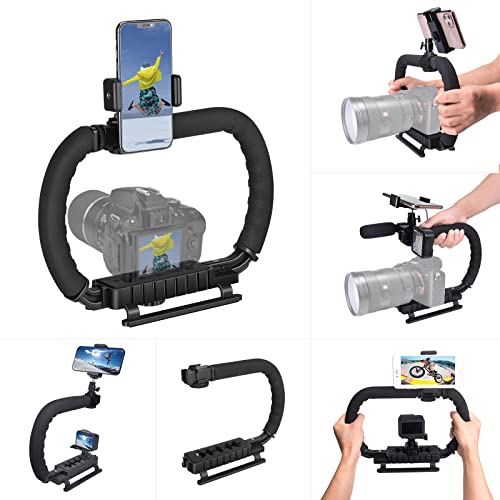
- Lightweight ABS design for cameras, phones, and action cameras
- Detachable handle doubles as a low-position stabilizer
- Three shoe mounts plus a phone monitor clip
Best For: Beginners making lightweight vlogs and mobile video setups
Best Simple Aluminum Cage

- Lightweight CNC-milled aluminum construction
- Top handle with 1/4-inch and 3/8-inch mounting points
- Fits most cameras under 124mm in height
Best For: Beginners wanting a straightforward compact camera cage
Versatile Starter Rig

- Broad compatibility across popular DSLR and mirrorless cameras
- Dual grips, Arca base, and 15mm rods included
- Many mounting points for lights, mics, and monitors
Best For: Beginners building a flexible handheld or tripod-ready rig
Adjustable DSLR Pick
CAMVATE Adjustable Camera Cage
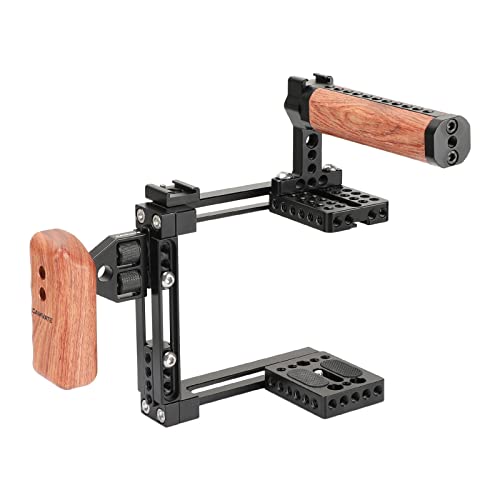
- Sliding bars fit two broad camera-height ranges
- Multiple 1/4-inch and 3/8-inch mounting threads
- Compatible with many Canon, Nikon, Sony, and Panasonic models
Best For: Beginners needing an adjustable cage for compatible DSLR bodies
Low-Angle Filmmaking Kit

- Top handle and two 15mm rod guides included
- Three cold shoes for lights, microphones, and more
- Aluminum construction with a stated 20kg load capacity
Best For: Beginners planning low-angle filmmaking and accessory expansion
Best All-Around Rig – NEEWER CA016T Universal Cage
For beginners comparing camera cages for beginners, the NEEWER CA016T is a versatile starting point when you want a complete handheld rig rather than a bare cage. It combines a universal cage, top handle, dual grips, accessory mounts, and an Arca-type base for tripod transitions.
Best For: Beginners building a flexible handheld, tripod, or vlogging setup.
Pros:
- Includes a silicone-grip top handle and two ergonomic handgrips.
- Offers 1/4-inch threads, 3/8-inch ARRI locating holes, and multiple cold shoes.
- Supports tripod mounting through its Arca-type base and bottom screw holes.
- Includes a magnetically stored flat screwdriver for tension adjustments.
Cons:
- Its broad compatibility still requires checking your exact camera and lens setup.
- It is not suitable for a lens with a tripod collar mount ring unless the ring is removed.
- At about 2.2 pounds, it is heavier than a minimal cage.
The CA016T is a practical all-in-one option for creators who want stability and mounting flexibility immediately. Its extra grips and handle add capability, though a smaller setup may suit travelers better.
Best Camera-Specific Fit – SmallRig 3639 Half Cage
Among camera cages for beginners, the SmallRig 3639 is a straightforward choice if you use one of its supported Sony Alpha cameras. Its formfitting half-cage adds protection and mounting points while preserving access to the camera controls and the feel of the original grip.
Best For: Sony Alpha users who want lightweight protection and accessory expansion.
Pros:
- Formfitting aluminum design protects the camera while retaining bare-camera grip access.
- Locking side plates and a bottom 1/4-inch screw help prevent deflection.
- Provides 1/4-inch, 3/8-inch ARRI, and cold-shoe mounting points.
- Built-in screwdriver and Allen wrench simplify installation and adjustments.
Cons:
- Compatibility is limited to specified Sony Alpha models.
- Some cameras have cable-clamp or side-lock limitations noted by the manufacturer.
- A half cage provides less coverage than a full cage.
The 3639 makes sense when a precise fit matters more than universal compatibility. Confirm your exact Sony model and the listed interface limitations before buying.
Best Rod-Based Starter Kit – NEEWER Film Making Cage Kit
If you want camera cages for beginners with traditional filmmaking accessories included, this NEEWER kit is a useful entry point. It pairs a cage with a top handle, dual grips, and two 15mm rods, giving you a foundation for adding supports such as a follow focus, lens support, or monitor.
Best For: DSLR and camcorder users starting a more traditional shoulder-rig or rod-based setup.
Pros:
- Includes the cage, dual handgrips, silicone top handle, and two 15mm rods.
- Dual-rod base allows camera positioning and accessory mounting.
- Built-in 1/4-inch thumbscrew enables tool-free camera mounting.
- Aircraft-grade aluminum alloy and CNC machining provide a durable build.
Cons:
- Its stated compatibility is broad but does not provide a model-specific fit list for every camera.
- The rod-based design is less compact than a simple half cage.
- The setup is aimed at larger DSLR or camcorder rigs rather than the lightest travel configuration.
This kit is appealing for beginners who expect their rig to grow into a more accessories-focused system. The included rods add useful flexibility, but they also make the package bulkier than newer compact designs.
Best Portable Design – ULANZI XJ01 Uka Foldable Cage
For beginners prioritizing portability, the ULANZI XJ01 is one of the more travel-friendly camera cages for beginners. Its foldable 2-in-1 design can switch between half-cage and L-plate modes, while sliding adjustments help it fit a range of mirrorless and compact cinema cameras.
Best For: Travel creators and mobile shooters who need a compact, adaptable grip system.
Pros:
- Combines a top handle and cage in one foldable tool.
- Tri-fold design reduces the unit to a compact folded size for carrying.
- Sliding horizontal and vertical adjustments support a range of cameras.
- Includes 1/4-inch mounts, cold shoes, NATO rails, and ARRI locating pins.
Cons:
- Universal adjustability means buyers should still verify fit for their camera.
- It offers less full-camera coverage than a dedicated full cage.
- Quick-release workflow is tied to the Uka ecosystem for its stated system benefits.
The XJ01 is a strong choice when storage space and fast reconfiguration matter. It gives beginners several mounting options without requiring a larger, permanently assembled rig.
Best for Easy Setup – NEEWER Aluminum Alloy Camera Cage
For beginners comparing camera cages for beginners, the NEEWER VS107 offers a sturdy aluminum build, a top handle, dual handgrips, and extensive mounting options. Its broad compatibility and tool-free camera installation make it a flexible starting point for building a handheld or tripod-mounted setup.
Best For: Beginners who want a versatile cage with handles, 15mm rails, and plenty of accessory mounts.
Pros:
- CNC aluminum alloy construction supports cameras and camcorders up to 33 pounds.
- Includes a top handle, two ergonomic handgrips, and a dual-rod base.
- Offers 1/4-inch and 3/8-inch threads, cold shoes, and ARRI locating holes.
- Tool-free thumb-screw installation and two tripod-mounting methods simplify setup.
Cons:
- Its 1.14-kilogram build is heavier than simpler plastic or basic cages.
- It is not suitable for lenses with a support ring unless the ring is removed.
The NEEWER is a strong choice if you expect your beginner setup to grow. The rails and mounting points support additional accessories, while the grips and handle provide more stable handheld shooting.
Best Lightweight Starter – fantaseal 3-Shoe Expansion Cage
The fantaseal expansion cage is a lightweight option for beginners exploring camera cages for beginners across cameras, action cameras, phones, and camcorders. Its detachable handle can serve as a low-position stabilizer, while three shoe mounts provide space for basic video accessories.
Best For: New videographers who want an affordable, lightweight holder for microphones, lights, or a phone monitor.
Pros:
- Lightweight ABS construction weighs about 15.84 ounces.
- Detachable handle can convert into a C-type low-position-shooting stabilizer.
- Three top shoes accommodate accessories such as microphones and fill lights.
- Includes a detachable ball-head phone clip for using a phone as an app-based monitor.
Cons:
- ABS construction may feel less substantial than an aluminum cage.
- The design is more focused on basic expansion and stabilization than advanced rigging.
This is a practical entry-level choice for run-and-gun video, vlogging, and action-camera work. Its broad device compatibility and phone-monitor option are especially useful when keeping a beginner kit simple.
Best Simple Aluminum Cage – CAMVATE Basic Camera Cage Rig
For beginners who prefer a straightforward setup, the CAMVATE C1897 keeps camera cages for beginners uncomplicated. This lightweight CNC-milled aluminum cage includes a top handle and a selection of mounting points for adding essential accessories.
Best For: Beginners who want a basic aluminum cage for a compact camera under 124mm in height.
Pros:
- Simple, lightweight design is easy to handle.
- High-quality aluminum alloy construction provides a durable cage frame.
- Multiple 1/4-inch-20 and 3/8-inch-16 mounting points support accessories.
- Universally compatible with most cameras less than 124mm tall.
Cons:
- It has fewer described features than more elaborate cages with rails or dual grips.
- Compatibility depends on keeping the camera below the 124mm height limit.
The CAMVATE makes sense when you want the protection and mounting flexibility of an aluminum cage without a more complicated rig. It is a sensible foundation for adding only the accessories you actually need.
Versatile Starter Rig – NEEWER CA016 Camera Cage
For beginners comparing camera cages for beginners, the NEEWER CA016 is a flexible option for building a DSLR or mirrorless rig. Its dual grips, Arca-type base, 15mm rods, and broad camera compatibility make it practical for handheld video, vlogging, and gradual accessory upgrades.
Best For: Beginners who want a lightweight cage with grips, tripod compatibility, and room for microphones, lights, and monitors.
Pros:
- Compatible with many Sony, Canon, Nikon, Fujifilm, Blackmagic, and other DSLR or mirrorless cameras.
- Includes dual ergonomic grips and an Arca-type base for handheld shooting and tripod changes.
- Offers 1/4-inch and 3/8-inch threads, cold shoes, ARRI locating holes, and 15mm rods.
- Provides access to camera buttons and ports without removing the cage.
Cons:
- Accessories such as the top handle, monitor, microphone, and lights are not included.
- Not suitable for lenses with a tripod collar mount ring unless the ring is removed.
The CA016 is a strong all-around starting point when you want more than a basic protective frame. Its accessory mounting and comfortable grips support future upgrades, while the relatively low 650-gram weight keeps the rig manageable.
Adjustable DSLR Pick – CAMVATE Adjustable Camera Cage
The CAMVATE adjustable cage is worth considering among camera cages for beginners who use a range of older or full-size DSLR and mirrorless bodies. Sliding bars accommodate different camera heights, while numerous threaded holes support additional rig components.
Best For: Beginners using compatible Canon, Nikon, Sony, or Panasonic cameras who need an adjustable fit and a left-hand grip.
Pros:
- Adjusts for camera heights from 68 to 105mm or 105 to 145mm using the included sliding bars.
- Includes many 1/4-inch-20 and 3/8-inch-16 threaded mounting holes.
- Lists compatibility with a wide selection of Canon, Nikon, Sony, and Panasonic models.
Cons:
- Only a left handle grip is included.
- Its listed compatibility is model-specific, so beginners should verify camera dimensions before buying.
- The supplied specifications include an unusually low 0.01kg maximum-weight recommendation.
This cage’s main advantage is adjustability, making it useful when a fixed-size cage would be limiting. However, the single included grip and unusual weight specification make careful compatibility and setup checks especially important.
Low-Angle Filmmaking Kit – Zeadio Video Rig Cage
For beginners exploring camera cages for beginners, the Zeadio video rig provides a ready-made foundation for low-angle filmmaking. It combines an aluminum cage with a top handle, Arca-type base, 15mm rod guides, and several accessory mounts.
Best For: New filmmakers and DSLR or camcorder users who want a top handle and rod-based expansion for follow-focus, matte-box, or lens-support accessories.
Pros:
- Includes a top handle for low-angle shots and two 15mm rod guides.
- Provides three cold-shoe mounts for accessories such as lights and microphones.
- Offers 1/4-inch and 3/8-inch threads plus ARRI locating holes for rig expansion.
- Uses an aluminum-alloy construction with a stated 20kg load capacity.
Cons:
- The listed kit does not state that 15mm rods or other accessories beyond the top handle and rod guides are included.
- Its accessory-focused design may be more equipment than a beginner needs for simple handheld recording.
The Zeadio is a practical choice if you already expect to add cinema-style accessories. Its included handle and rod guides make it more immediately useful for filmmaking than a bare cage, while the multiple cold shoes leave room for a growing setup.
How We Picked These Camera Cages for Beginners
We prioritized cages and rig kits that are approachable for first-time users while still offering useful room to grow. Selection factors included camera compatibility, access to essential controls and ports, handle design, mounting options, included accessories, and the balance between portability and support.
Universal designs can be convenient, but fit is not automatically guaranteed. Before ordering, confirm your camera’s body dimensions, tripod socket position, battery-door clearance, lens size, and whether the cage blocks a screen, card slot, microphone, or HDMI port.
Quick Comparison
| Best For | Look For | Most Suitable Design |
|---|---|---|
| Simple handheld video | Top handle, comfortable grip, low weight | Basic half cage or compact universal cage |
| More stable movement | Dual grips, rods, and a balanced base | Full cage rig with 15mm rod support |
| Expanding a small setup | Multiple 1/4-inch and 3/8-inch mounting points | Modular aluminum cage |
| Travel and quick storage | Foldable or detachable components | Portable foldable cage or half cage |
| Phone or action-camera use | Broad device compatibility and shoe mounts | Multi-device expansion cage |
Key Buying Factors for Camera Cages for Beginners
Camera Fit and Access
A secure fit matters more than the number of accessories included. Check for padding, adjustable contact points, and unobstructed access to batteries, memory cards, ports, and controls. A cage that requires frequent removal may become frustrating in everyday use.
Handling and Balance
A top handle is useful for low-angle shots and carrying the rig, while dual side grips can improve control during longer takes. Consider the camera’s weight, lens size, and where accessories will sit; an overloaded top-heavy rig is harder to steady.
Mounting and Expansion
Look for 1/4-inch and 3/8-inch threads, cold shoes, ARRI-style locating points, or 15mm rod compatibility if you expect to add a monitor, microphone, light, follow focus, or matte box. Do not pay for rod support unless you plan to use it.
Portability and Durability
Aluminum cages generally offer a useful mix of strength and manageable weight. Full rigs provide more mounting flexibility but take up more space. Foldable and half-cage designs are often better for travel, run-and-gun filming, and smaller camera bags.
Who Should Buy Which Camera Cages for Beginners?
Choose a compact half cage if you mainly need extra mounting points and modest protection without changing your camera’s handling. A top-handle cage is a sensible first upgrade for handheld video, interviews, and low-angle work.
Choose a dual-grip rig with 15mm rods if you already expect to use a monitor, follow-focus system, or other larger accessories. For travel or mixed-device shooting, a foldable universal cage can be more practical than a full cinema-style setup. Phone, action-camera, and camcorder users should favor dedicated multi-device mounts and verify clamping security before adding weight.
Finally, remember that a cage improves mounting and handling; it does not replace a gimbal or tripod. Buy the lightest configuration that supports your current camera and accessories, then expand only when your workflow requires it.