The best DMX controllers with joystick-style control make it easier to position moving heads, shape beams, and manage complex lighting scenes without relying entirely on a computer. The right model depends on your fixture count, programming needs, control method, and available space.
This roundup compares 10 controllers ranging from compact 48-channel boards to feature-rich consoles with wireless, MIDI, sound activation, and fog-control support.
Best 10 Dmx Controllers with Joystick Picks for 2026
Best Standalone Pick

- Standalone DMX controller with four outputs
- Supports up to four universes
- 37 backlit buttons and four rotary encoders
Best For: Multi-universe lighting setups needing a compact standalone console
Best Wireless Option

- Built-in 2.4GHz wireless DMX transmitter
- Controls up to 12 intelligent lights
- Rack-mountable metal design
Best For: Wireless control of compatible D-Fi lighting fixtures
Best Joystick Console

- Dedicated joystick with LCD display
- 512 channels and support for up to 32 fixtures
- Stores and runs 48 scenes
Best For: Stage and event lighting setups requiring joystick-based control
Best Software Integration

- Two DMX universe inputs and outputs
- Touch strip, encoders, and RGB pads
- Integrates with Engine DJ and SoundSwitch
Best For: DJs running software-linked, music-synced lighting shows
Versatile Scene Control

- Controls up to 12 intelligent lights
- Stores 240 scenes and six chases
- Offers 384 DMX channels
Best For: Programmable event and DJ lighting rigs
Accessible 192-Channel Control
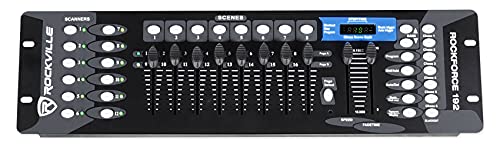
- Controls 192 channels across 12 scanners
- Includes sound activation and eight sliders
- Stores 23 banks of eight scenes
Best For: DJs and small venue lighting systems
Compact Chase Programming

- Offers 96 patchable DMX channels
- Supports 4,200 programmable steps
- Includes 15 total chase options
Best For: Compact stage and event lighting systems
Best Beginner-Friendly Pick
CO-Z 192 DMX Stage Light Controller

- 192 channels for up to 12 intelligent lights
- Controls up to 240 scenes
- Voice control and accessible control layout
Best For: Amateur DJs and smaller event lighting setups
Best Wireless Flexibility
DMX512 384-Channel Wireless Controller

- 384-channel DMX512 control
- 2.4G wireless and 3-pin wired modes
- Sound activation, MIDI, and 240 scenes
Best For: Flexible DJ, wedding, bar, and stage setups
Best High-Capacity Programming
DMX 384-Channel MIDI Controller

- Controls up to 24 intelligent lights
- Offers 240 scenes and six chases
- Includes MIDI and sound-activated control
Best For: DJs and stage operators running larger fixture setups
Best Standalone Pick – ADJ WMX1 Mk2
The ADJ WMX1 Mk2 is a practical choice among DMX controllers with joystick-style control needs, especially if you prefer a standalone console with dedicated buttons and rotary encoders. It supports up to four universes and includes four output sockets for larger lighting setups.
Best For: Users who want a compact standalone controller for multi-universe DMX systems.
Pros:
- Supports up to four DMX universes
- Includes 37 backlit silicone buttons
- Four rotary encoders provide dedicated parameter control
- Compact 2.36-pound design
Cons:
- The supplied notes do not specify a built-in joystick
- Its broad feature set may be more than basic setups require
The WMX1 Mk2 stands out for its standalone operation, tactile controls, and multi-universe capacity. It is a strong fit when output flexibility matters more than a simple entry-level layout.
Best Wireless Option – CHAUVET DJ Obey40 D-Fi 2.4
The CHAUVET DJ Obey40 D-Fi 2.4 is a rack-mountable option for shoppers comparing DMX controllers with joystick functionality and wireless operation. Its built-in D-Fi 2.4GHz transmitter sends wireless DMX signals and controls up to 12 intelligent lights with up to 16 channels each.
Best For: DJs and event users who need wireless control for multiple compatible fixtures.
Pros:
- Built-in D-Fi 2.4GHz wireless DMX transmitter
- Controls up to 12 intelligent lights
- Supports up to 16 channels per fixture
- Rack-mountable metal construction
Cons:
- Requires compatible D-Fi 2.4GHz systems for wireless operation
- The supplied notes do not specify a joystick control
- It is corded electric rather than battery powered
Choose the Obey40 D-Fi 2.4 when wireless fixture compatibility is a priority. Its 12-fixture capacity makes it more suitable for coordinated event lighting than very small systems.
Best Joystick Console – DMX512 512-Channel Controller
This DMX512 console is the clearest match for shoppers seeking DMX controllers with joystick operation. It provides 512 channels, supports up to 32 fixtures, and combines an LCD display with faders, scenes, chases, and joystick control for hands-on programming.
Best For: DJs, stages, clubs, and event operators who want an integrated console with joystick control.
Pros:
- 512 DMX channels and support for up to 32 fixtures
- Joystick and smooth buttons support hands-on operation
- Stores and runs up to 48 scenes
- Includes a console lamp, power cable, manual, and 3-pin DMX cable
Cons:
- Its 17.73-pound weight makes it less portable
- Supports up to four fixtures simultaneously according to the supplied notes
- Its larger console layout may be excessive for simple rigs
For direct joystick control and traditional console-style programming, this model is the strongest fit in the group. The LCD, scene memory, and included accessories make it ready for more involved stage and event setups.
Best Software Integration – SoundSwitch Control One
The SoundSwitch Control One is a compact choice among DMX controllers with joystick-style performance controls, though its supplied features focus on tactile pads, touch strips, and encoders rather than a dedicated joystick. It provides two DMX universe inputs and outputs and integrates with SoundSwitch software and supported DJ hardware.
Best For: DJs who want hands-on lighting control integrated with SoundSwitch and compatible Engine DJ systems.
Pros:
- Two DMX universe inputs and outputs with a Thru option
- Touch strip, encoders, and RGB performance pads provide tactile control
- Works directly with compatible Engine DJ devices without a computer
- Supports lighting effects including color, brightness, strobe, moving heads, and gobos
Cons:
- A laptop running SoundSwitch is required for PRO DJ LINK Bridge use
- The supplied notes do not list a dedicated joystick
- Its feature set depends on compatible software or DJ hardware
Control One is best viewed as a performance interface for software-driven lighting rather than a traditional standalone joystick console. Its small footprint and DJ-focused controls suit music-synced shows and live adjustments.
Versatile Scene Control – CHAUVET DJ Obey 70
The CHAUVET DJ Obey 70 is a practical choice among DMX controllers with joystick for users who need broad scene and chase programming without relying on a joystick interface. It controls up to 12 intelligent lights, with up to 32 channels per fixture and 384 DMX channels overall.
Best For: DJs, event operators, and small-to-mid-sized lighting setups that need extensive scene storage and programmable timing.
Pros:
- Controls up to 12 intelligent lights with as many as 32 channels each.
- Stores up to 240 scenes across 30 banks of eight scenes.
- Provides six chases containing up to 240 scenes, with fade and speed times programmable per step.
- Rack-mount design and a 19.01-by-7-by-2.79-inch chassis suit permanent installations.
Cons:
- It is a corded, rack-mount console rather than a compact portable controller.
- Its listed 384 channels may be more capability than needed for very small rigs.
Choose the Obey 70 when scene capacity and multi-fixture control matter more than joystick-style operation. Its extensive banks and chase programming make it a strong fit for repeatable event looks.
Accessible 192-Channel Control – Rockville ROCKFORCE 192
The Rockville ROCKFORCE 192 is a straightforward option for shoppers comparing DMX controllers with joystick, although it uses an intuitive slider-based layout instead of a joystick. It manages 192 channels across 12 scanners and adds sound activation for music-synced lighting and fog effects.
Best For: DJs, parties, concerts, and theatrical setups needing approachable control for DMX lighting and fog equipment.
Pros:
- Controls 192 channels across 12 scanners with 16 channels per scanner.
- Provides 23 banks of eight scenes for repeatable show programming.
- Includes six chases of up to 240 scenes and eight manual sliders.
- Built-in microphone enables sound-activated effects, while power-failure memory preserves settings.
Cons:
- It offers fewer channels than higher-capacity consoles such as 384-channel models.
- The 22-inch-wide, 3U rack format may require dedicated installation space.
The ROCKFORCE 192 stands out when simple access and sound-triggered operation are priorities. Its 12-scanner layout and programmable banks cover common small-venue lighting needs without adding unnecessary complexity.
Compact Chase Programming – CHAUVET DJ DESIGNER50
The CHAUVET DJ DESIGNER50 is a compact DMX console for users evaluating DMX controllers with joystick but wanting programmable chase control in a smaller unit. Its 48-channel design includes 96 patchable DMX channels, plus adjustable chase and fade times.
Best For: Compact stage and event installations that need programmable dimming and chase sequences without a higher-capacity console.
Pros:
- Provides a 24-channel DMX-512 dimming console with 96 patchable DMX channels.
- Offers 10 programmable and five non-programmable chases.
- Supports up to 4,200 programmable steps.
- Adjustable chase and fade times allow more control over transitions.
Cons:
- Its 48-channel format is less suited to larger multi-fixture systems.
- The supplied notes do not indicate joystick control, so it may not match buyers specifically requiring a joystick.
The DESIGNER50 makes the most sense for smaller rigs where chase depth and patching flexibility are more important than maximum channel count. Its compact format and large step capacity support detailed, repeatable sequences.
Best Beginner-Friendly Pick – CO-Z 192 DMX Stage Light Controller
If you are comparing DMX controllers with joystick-style channel controls, the CO-Z 192 DMX controller offers a straightforward layout for managing smaller lighting setups. Its 192 channels can control up to 12 intelligent lights with up to 16 channels each, while its scene and fixture controls support programmed show sequences.
Best For: Amateur DJs, small events, weddings, church gatherings, and users who want an accessible wired controller with voice control.
Pros:
- Controls up to 12 intelligent lights and up to 240 scenes.
- Organized layout includes light selection, scene switching, channel controls, and speed/time controls.
- Supports three-pin fixtures such as fog machines, strobes, PAR lights, and beam lights.
- Upgraded buttons and control sticks are designed for smooth operation.
Cons:
- Its 192-channel capacity is lower than the 384-channel alternatives.
- It uses a corded-electric power source and does not list wireless operation.
The CO-Z is a practical choice when ease of use matters more than maximum channel capacity. Its built-in voice control and clearly divided controls make it approachable for basic to moderately complex lighting shows.
Best Wireless Flexibility – DMX512 384-Channel Wireless Controller
For shoppers seeking DMX controllers with joystick-style controls and flexible installation options, this 384-channel console combines traditional 3-pin XLR operation with 2.4G wireless transmission. It supports up to 12 intelligent lights and provides manual, automatic, and sound-activated control modes.
Best For: DJs, weddings, bars, discos, churches, and indoor stages that may benefit from wired or wireless DMX operation.
Pros:
- Provides 384 channels for detailed control of up to 12 intelligent lights.
- Offers both 2.4G wireless and traditional 3-pin wired DMX modes.
- Includes sound activation, MIDI control, and automatic or manual operating modes.
- Stores 30 banks and 240 preset static scenes with scene editing functions.
Cons:
- The supplied details do not specify a joystick control or the wireless range.
- Its feature set may require more setup than a basic controller.
This controller stands out for venues that need installation flexibility. The wireless and wired modes, MIDI support, and scene-storage options make it adaptable for changing event layouts and programmed performances.
Best High-Capacity Programming – DMX 384-Channel MIDI Controller
This 384-channel DMX console is worth considering if you want DMX controllers with joystick-style operation for more extensive fixture programming. It controls up to 24 intelligent lights with 16 channels each and adds MIDI control, sound activation, programmable banks, and chases for live or scheduled lighting work.
Best For: DJs, clubs, theaters, parties, and stage operators managing multiple 3-pin DMX fixtures.
Pros:
- Controls up to 24 intelligent lights with 16 channels each.
- Provides 30 banks, 240 scenes, and six programmable chases.
- Supports MIDI control, music-triggered modes, and reversible DMX channels.
- Includes a power cable and LED gooseneck lamp for console operation.
Cons:
- The supplied information does not confirm wireless DMX operation.
- It is designed around 3-pin DMX compatibility, so connector requirements should be checked.
- The larger programming capacity may be more than needed for simple setups.
Choose this model when fixture count and programming depth are priorities. Its support for 24 intelligent lights, chases, MIDI, and sound-triggered operation gives experienced users more room to build complex live shows.
How We Picked the Best Dmx Controllers with Joystick
We focused on practical control, fixture compatibility, programming flexibility, and setup requirements. The selection includes standalone consoles, compact boards, wireless-capable units, MIDI-friendly controllers, and models designed for DJs, mobile entertainers, small venues, and stage productions.
We also considered channel capacity, scene and chase programming, display usability, physical controls, rack or tabletop placement, and whether a controller can grow with a lighting rig. Because joystick layouts and dedicated pan/tilt controls vary by model, verify the control scheme before buying if precise moving-head positioning is a priority.
Quick Comparison
| Best For | Look For | Typical Advantage |
|---|---|---|
| Mobile DJs | Compact layout, sound activation, and fast scene access | Quick setup and live operation |
| Moving-head rigs | Dedicated pan/tilt or joystick-style controls | More direct fixture positioning |
| Small venues | Higher channel capacity and programmable chases | Room to manage multiple fixtures |
| Wireless installations | 2.4GHz wireless DMX support | Less cable routing |
| Advanced operators | MIDI, fixture libraries, and deeper scene control | More customization and automation |
Key Buying Factors for Dmx Controllers with Joystick
Channel Capacity and Fixture Count
Channel numbers indicate how much DMX data a controller can address, but usable capacity depends on each fixture’s DMX mode. Count the channels required by your lights, then leave room for future additions. A 192-channel controller may suit a small rig, while larger or multi-mode fixtures can justify 384 or 512 channels.
Joystick and Pan/Tilt Control
A joystick or dedicated pan/tilt section is most useful with moving heads, scanners, and other motorized fixtures. Check whether the control is a true joystick, paired wheels, or shortcut buttons. Also confirm whether pan and tilt can be fine-tuned, inverted, centered, or saved into scenes.
Programming and Live Operation
Look for clearly labeled faders, scene buttons, chases, blackout controls, and an accessible display. Sound activation can simplify DJ shows, while MIDI support may help operators integrate lighting with playback or performance software. More programmable controls are valuable only if the interface remains manageable during a live event.
Connectivity and Setup
Confirm the DMX output format, wireless compatibility, MIDI connections, and power requirements. Wired DMX remains dependable for permanent or professional installations; wireless operation can speed up mobile setups but may require compatible receivers and careful attention to interference.
Who Should Buy Which Dmx Controllers with Joystick?
Choose a compact controller if you run a small DJ rig, use a limited number of fixtures, or prioritize portability. Choose a higher-channel board if you operate several fixtures or want additional programming headroom. Choose wireless-capable equipment for temporary installations where reducing cable runs matters. Choose a MIDI-friendly or more advanced controller if you synchronize lighting with music, software, or live performance equipment.
Before ordering, confirm fixture compatibility, channel requirements, connector standards, and the exact pan/tilt control method. A controller that matches your current lights and operating style will be easier to program and more useful than a larger unit with features you rarely use.