The best compact camera sliders make controlled camera movement easier without the bulk of a full studio rig. Whether you shoot with a mirrorless camera, phone, or action camera, the right slider can add polished motion to product videos, interviews, time-lapses, and short films.
This roundup compares ten portable options, including manual rails, motorized systems, foldable designs, and app- or remote-controlled sliders. Pay close attention to travel length, payload, power, and setup before choosing.
Best 10 Compact Camera Sliders Picks for 2026
Best Motorized Pick
NEEWER ER1 31.5-inch App-Controlled Slider

- App, video, and time-lapse control
- 11-pound horizontal load capacity
- Quiet motor with included NP-F750 battery
Best For: Creators needing automated camera movement and repeatable time-lapse shots
Best for Small Cameras
IFOOTAGE Shark Slider Pico Pro Mini Slider

- 15.7-inch motorized slider
- Works with phones, action cameras, and DJI Osmo Pocket
- Supports cameras up to 2.4 pounds
Best For: Mobile creators using smartphones, action cameras, or pocket cameras
Best Pocket Dolly
NEEWER SD001 Manual Camera Slider Dolly

- Pocket-sized 220-gram aluminum dolly
- Straight or circular movement
- Includes ball head and rotating phone clamp
Best For: Portable tabletop, phone, and lightweight camera shots
Best Long-Rail Option
GVM 48-inch Carbon Fiber Motorized Slider
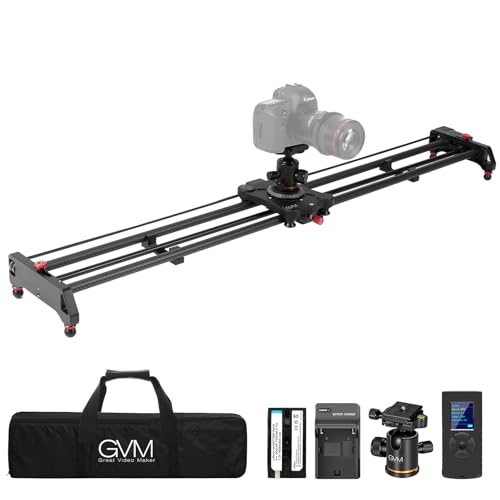
- 48-inch/120cm travel length
- Tracking, panoramic, horizontal, and time-lapse modes
- Remote control with six shutter cables
Best For: Planned shoots needing long travel and programmable camera motion
Smart Motorized Pick

- Motorized 15.8-inch slider with five shooting modes
- Works with DJI Pocket, action cameras, and phones
- Seven-hour battery and programmable motion points
Best For: Automated travel videos, time-lapses, and repeatable camera moves
Manual Travel Pick

- Foldable mechanical slider for travel
- 1.3-foot glide range from a compact body
- Supports payloads up to 3 kg
Best For: Backpack filmmakers using DSLR or mirrorless cameras
Versatile Mounting Pick
NEEWER CS1M Carbon Fiber Slider

- 16-inch rail with smooth four-bearing movement
- Includes phone and action-camera mounting accessories
- Adjustable legs support angled and uneven-surface setups
Best For: Creators using phones, action cameras, and lightweight cameras
Best Portable Motorized Pick

- 15.8-inch portable motorized slider
- 360° pan with app control
- Supports time-lapse and stop motion
Best For: Travel creators and lightweight camera setups
Best Compact Dolly Option

- Three adjustable wheels for straight or circular routes
- Remote control with three speeds
- Up to 6 hours of battery service
Best For: Portable smartphone, action-camera, and lightweight DSLR moves
Best Heavy-Duty Compact Slider

- 7kg horizontal payload
- Dual-axis motion with 360° pan
- Touchscreen and app waypoint control
Best For: Professional rigs, interviews, and complex motorized moves
Best Motorized Pick – NEEWER ER1 31.5-inch App-Controlled Slider
For creators who want automated movement without carrying a full-size rail, this NEEWER model is a versatile choice among compact camera sliders. Its 31.5-inch carbon-fiber rail supports app-controlled video and time-lapse work, while the included battery helps keep shoots mobile.
Best For: Content creators, product videos, time-lapse photography, and smooth tracking shots with compatible cameras.
Pros:
- App control with manual, video, and time-lapse modes.
- Quiet motor and included 4400mAh NP-F750 battery.
- Supports horizontal loads up to 11 pounds and 45-degree tilt shooting up to 5.5 pounds.
- Carbon-fiber construction, four roller bearings, and 1/4-inch and 3/8-inch mounting holes.
Cons:
- Remote control is not included.
- Minor shake may occur during macro photography.
- At 8.7 pounds, it is heavier than the smallest tabletop options.
The ER1 offers a strong balance of automation, payload capacity, and portability. It is better suited to serious mobile video setups than ultra-light phone-only rigs, especially when repeatable motion and time-lapse control matter.
Best for Small Cameras – IFOOTAGE Shark Slider Pico Pro Mini Slider
The IFOOTAGE Shark Slider Pico Pro is a compact camera slider built around small capture devices. Its 15.7-inch format and motorized movement make it a practical way to add smoother cinematic motion to smartphone, action-camera, and DJI Osmo Pocket footage.
Best For: Smartphone creators, action-camera users, and DJI Osmo Pocket 3/4 owners who need a lightweight motion setup.
Pros:
- Compatible with smartphones, action cameras, DJI Osmo Pocket 3/4, and cameras.
- Motorized movement helps reduce shaky handheld-looking footage.
- Compact 15.7-inch slider format for small-camera setups.
- Supports payloads up to 2.4 pounds.
Cons:
- Its 2.4-pound payload limits use with larger camera rigs.
- The shorter rail provides less travel than full-size sliders.
This is the most approachable option for mobile creators who prioritize a small rig over heavy payload capacity. It makes particular sense for phones, action cameras, and pocket gimbals rather than DSLR-style setups with substantial lenses.
Best Pocket Dolly – NEEWER SD001 Manual Camera Slider Dolly
If portability matters more than motorized repeatability, the NEEWER SD001 is a pocket-sized alternative to traditional compact camera sliders. This manual dolly can travel in straight lines or circles and includes a ball head and phone clamp for quick tabletop or floor-level shots.
Best For: Travel shooting, tabletop product videos, phones, action cameras, and lightweight mirrorless camera setups.
Pros:
- Very compact 3.9-by-3.3-by-0.8-inch design weighing about 220 grams.
- Supports linear and circular movement for sliding and panning shots.
- Soft rubber wheels move quietly across floors, tables, and sliders.
- Includes a rotating phone clamp and adjustable ball head.
Cons:
- Manual operation does not provide automated or repeatable motion.
- Not suitable for telephoto lenses.
- Phone adapter compatibility is broad, but some camera adapters are sold separately.
The SD001 is a useful choice when a full rail is inconvenient. Its small footprint and flexible movement make it well suited to quick social-media or product shots, though users wanting long travel or motorized time-lapse control should consider another model.
Best Long-Rail Option – GVM 48-inch Carbon Fiber Motorized Slider
For buyers who need more travel than most compact camera sliders provide, the GVM 48-inch rail offers a longer shooting path with motorized and manual operation. Its tracking, horizontal, 120-degree panoramic, and time-lapse modes provide flexibility for more elaborate camera moves.
Best For: Studio and professional-style video work, long tracking shots, panoramic movement, and programmed time-lapse sequences.
Pros:
- 48-inch/120cm rail provides extended travel for tracking shots.
- Supports tracking, horizontal, 120-degree panoramic, video, and time-lapse modes.
- Remote control adjusts speed, endpoints, dwell time, pauses, loops, and shot counts.
- Includes six shutter cables and an extension cable for broad camera compatibility.
Cons:
- Its 120cm length is less convenient for highly portable setups.
- The listed item weight is 5.42kg, making it substantially heavier than pocket-sized dollies.
- It is a more involved setup for simple phone or tabletop shots.
The GVM is the strongest fit when rail length and programmable movement take priority over travel convenience. It offers extensive control for demanding video and time-lapse work, but its size and weight make it better suited to planned shoots than casual handheld carry.
Smart Motorized Pick – iFootage Shark Slider PICO
For creators who want automated movement in a small package, the iFootage Shark Slider PICO is a versatile choice among compact camera sliders. Its 15.8-inch rail supports motorized video, time-lapse, stop-motion, panorama, and multi-target shots, while compatibility with DJI Pocket cameras, action cameras, and smartphones broadens its usefulness.
Best For: Creators needing programmable, quiet motion for travel videos, time-lapses, and repeatable camera moves.
Pros:
- Supports DJI Pocket 3/4 integration with USB-C and 4-axis motion control.
- Offers up to eight programmable points through the iFootage app.
- Quiet brushless motor and five shooting modes suit varied productions.
- Runs for up to seven hours and weighs about 1.9 pounds.
Cons:
- Motorized operation requires charging and app or device setup.
- Its 2.4-pound payload is more limited than some full-size sliders.
The PICO is the most feature-rich option here for automated shots, especially if you use DJI Pocket gear or smartphones. Choose it when programmable movement matters more than a purely manual, battery-free setup.
Manual Travel Pick – PROAIM Sway Portable Slider
The PROAIM Sway is a compact mechanical option for filmmakers who prefer direct control without motors or batteries. Its foldable 5.7-inch form extends to a 1.3-foot glide range and supports cameras weighing up to 3 kg, making it a practical choice among compact camera sliders for mobile shoots.
Best For: Travel filmmakers and DSLR or mirrorless users who want smooth manual slides in a backpack-friendly design.
Pros:
- Foldable construction fits backpacks and carry-on luggage.
- Mechanical design needs no batteries or motor controls.
- CNC-machined aluminum body and friction control support smooth movement.
- Accepts both 1/4-inch-20 and 3/8-inch-16 mounting threads.
Cons:
- Its 1.3-foot travel is shorter than some extended slider rails.
- It lacks motorized automation for programmed moves and time-lapses.
- It is not water resistant.
The Sway is a straightforward pick when portability and reliability matter more than automated features. Its strong payload rating and manual friction control make it well suited to compact DSLR or mirrorless kits.
Versatile Mounting Pick – NEEWER CS1M Carbon Fiber Slider
The NEEWER CS1M combines a 16-inch carbon-fiber rail with adjustable legs, a ball head, phone clamp, and action-camera mount. For shoppers comparing compact camera sliders, it offers broad mounting flexibility and smooth manual movement for cameras, phones, GoPro models, and Insta360 cameras.
Best For: Lightweight creators who use multiple camera types and need horizontal, vertical, or angled setup options.
Pros:
- Includes a 360-degree ball head, phone clamp, and action-camera adapter.
- Four precision bearings provide smooth, quiet sliding.
- Adjustable legs and a bubble level help with uneven surfaces.
- Supports horizontal loads up to 4.4 pounds and weighs about 1.3 pounds.
Cons:
- Payload drops to 2.2 pounds for 45-degree or vertical use.
- It is manual rather than motorized, so moves are not programmable.
- It is not water resistant.
The CS1M stands out for accessory coverage and camera compatibility. It is a strong all-purpose choice for creators who switch between phones, action cameras, and lightweight interchangeable-lens cameras.
Best Portable Motorized Pick – IFOOTAGE PICO
For creators seeking compact camera sliders, the IFOOTAGE PICO offers a travel-friendly 15.8-inch design with motorized linear movement and 360° panning. App control and support for time-lapse, stop motion, panorama, and multi-point shooting make it a flexible option for solo content creation.
Best For: DJI Pocket 3 users, tabletop filming, product shots, vlogging, and lightweight travel setups.
Pros:
- Compact 15.8-inch design fits easily into small studios and travel kits.
- Combines motorized sliding with 360° panning for more dynamic shots.
- Phone app control supports repeatable moves, time-lapse, and stop motion.
- Compatible with DJI Pocket 3, action cameras, smartphones, and lightweight rigs.
Cons:
- Its compact design is aimed at lightweight camera setups rather than heavy rigs.
- The supplied details do not specify a maximum payload or battery runtime.
The PICO is a practical choice when portability and creative motion matter more than a full-size rail. Its 2-axis movement and app-based controls give solo creators useful flexibility without a bulky setup.
Best Compact Dolly Option – NEEWER DL100 Motorized Dolly
The NEEWER DL100 is a compact alternative among compact camera sliders, using three adjustable wheels for straight-line or circular movement. Its wireless remote, three speed settings, and built-in rechargeable battery make it convenient for simple automated camera moves.
Best For: Smartphone, action-camera, and lightweight DSLR users who want portable dolly movement.
Pros:
- Wireless remote changes speed, direction, or pause from up to 6 meters away.
- Adjustable wheel angles support straight and circular routes.
- Built-in 1800mAh battery provides up to 6 hours of service time.
- Convertible 1/4-inch to 3/8-inch screw supports a range of cameras and adapters.
Cons:
- It is not water resistant.
- Wheel-based movement may be less suitable where a fixed rail path is required.
- Accessories such as smartphone holders and action-camera adapters are not included.
The DL100 suits creators who prioritize a small footprint and flexible floor movement. Its 6.6-pound maximum recommended load gives it useful versatility, while the wheel design is best for smooth, suitable surfaces.
Best Heavy-Duty Compact Slider – IFOOTAGE Shark Nano II 660
For compact camera sliders that can handle more substantial setups, the IFOOTAGE Shark Nano II 660 combines a 26-inch slider with dual-axis motorized control and unlimited 360° pan movement. Its 7kg horizontal payload, touchscreen and app control, and optional DJI gimbal integration make it suited to more advanced productions.
Best For: Professional filmmakers, live-streaming setups, interviews, product demonstrations, and heavier camera rigs.
Pros:
- Supports up to 7kg horizontally and 3.5kg vertically.
- Offers dual-axis motion, unlimited 360° panning, and precise 1cm movement.
- Touchscreen and smartphone app control allow waypoint programming and time-lapse management.
- Brushless motor is specified at under 20dB, supporting noise-sensitive recording.
Cons:
- DJI gimbal integration requires a separate gimbal and Nano II-RS adapter.
- Its advanced controls and heavier-duty construction may be more than casual users need.
- Powering DJI integration requires a 60W or higher power supply.
The Shark Nano II 660 is the strongest fit here for users who need compact transport without giving up payload capacity or multi-axis control. It is especially compelling for repeatable, quiet camera moves and more complex solo or professional shoots.
How We Picked the Best Compact Camera Sliders
We focused on portability, motion control, compatibility, and practical shooting flexibility. The selection includes short sliders for desks and travel, longer rails for wider moves, and motorized models suited to repeatable video or time-lapse work. We also considered camera support, mounting options, control methods, portability, and the needs of phone and action-camera users.
Because a compact slider must balance size with stability, advertised travel length is only one part of the decision. Payload capacity, rail construction, motor smoothness, and the quality of the tripod or support setup can have an equal effect on real-world results.
Quick Comparison
| Best For | Look For | Recommended Type |
|---|---|---|
| Travel and desk setups | Short travel, low weight, quick setup | Mini motorized or manual slider |
| Time-lapse and repeatable moves | Motor control, interval settings, stable power | App- or remote-controlled slider |
| Heavier mirrorless or DSLR rigs | Higher payload and rigid construction | Longer carbon-fiber motorized slider |
| Phones and action cameras | Included clamps and flexible mounts | Compact slider with phone or action-camera support |
| Simple cinematic movement | Low setup complexity and smooth manual travel | Manual mechanical slider |
Key Buying Factors for Compact Camera Sliders
Travel Length and Overall Size
A 15- to 16-inch slider is easier to pack and works well for close-up product shots, tabletop scenes, and short parallax moves. Longer models provide more dramatic lateral movement but need more room, stronger support, and a larger carrying case.
Motorized or Manual Operation
Manual sliders are usually quicker to use and can be more dependable for basic shots. Motorized models are the better choice for precise speed control, repeatable movement, automated time-lapse sequences, and unattended shooting. App control can add convenience, while a physical remote may be easier to operate on set.
Payload and Stability
Check the stated payload against the complete setup—not just the camera body. Include the lens, cage, microphone, monitor, battery, and any accessories. A slider rated for a light camera may not remain smooth with a large lens. For longer rails, use sturdy tripods or multiple support points whenever possible.
Mounts, Power, and Compatibility
Look for a standard camera screw, ball head, phone clamp, or action-camera mount that matches your equipment. Also verify battery or USB power requirements, charging options, control range, and whether the slider supports horizontal movement only or additional axis control.
Who Should Buy Which Compact Camera Sliders?
Choose a short motorized slider if portability, desk shooting, and repeatable motion matter most. These models are particularly useful for creators filming products, food, tutorials, and social content.
Choose a longer motorized carbon-fiber slider for more pronounced camera moves, larger setups, interviews, and time-lapse work. Confirm that your support system can handle the added length and weight.
Choose a manual or foldable slider if you value fast setup, quiet operation, and minimal maintenance. They are a practical fit for filmmakers who want controlled movement without carrying batteries or configuring an app.
Choose a phone- or action-camera-friendly model if you create mobile-first content. Included clamps and mounts can reduce extra purchases, but confirm that the attachment remains secure during motorized movement.