Recording unpredictable audio is easier with a field recorder that supports 32-bit float capture. This technology gives filmmakers, musicians, podcasters, and creators more flexibility when levels change suddenly.
We compare 10 strong options across compact handheld models, multitrack recorders, and professional production tools to help you choose the right balance of inputs, portability, workflow, and price.
Best 10 Field Recorder with 32 Bit Float Picks for 2026
Professional Field Capture

- 32-bit float recording with dual A/D converters
- Two locking XLR/TRS inputs
- Low-noise preamps and flexible power options
Best For: Filmmakers and recordists using external microphones
Timecode-Ready Video Audio

- 32-bit float recording with dual ADCs
- Built-in timecode generation and sync
- Dual XLR/TRS inputs plus 3.5 mm input
Best For: Videographers managing synchronized production audio
Versatile Handheld Recording

- Built-in stereo microphones and 32-bit float
- Four-track recording with two XLR/TRS inputs
- USB-C recording or streaming with SD backup
Best For: Creators recording music, podcasts, interviews, and video
Ready-to-Record Accessory Bundle
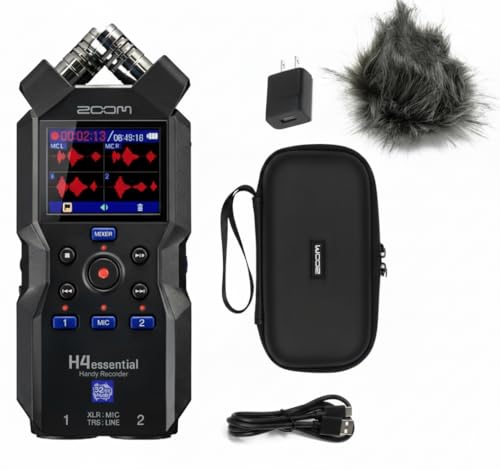
- H4essential recorder with 32-bit float capture
- Includes windscreen, case, AC adapter, and USB-C cable
- Up to 20 hours of listed battery life
Best For: Mobile creators wanting a bundled recording kit
Professional Production Pick

- 32-bit float recording with dual A/D converters
- Six XLR inputs and up to 14 tracks
- Timecode I/O for video synchronization
Best For: Filmmaking, broadcast, and multi-microphone location recording
Portable Music-Making Pick

- 32-bit float recording for clip-free capture
- Four-track recording with bouncing and undo
- Built-in effects, rhythms, and combo inputs
Best For: Songwriting, demos, and portable layered recording
Handheld Versatility Pick

- Three built-in mics with nine recording patterns
- 32-bit float/96kHz clip-free recording
- USB microphone mode with simultaneous SD backup
Best For: Interviews, podcasts, and flexible handheld field recording
Flagship Field Recorder

- 32-bit float recording with clip-free audio
- Large X/Y stereo mics and two XLR/TRS inputs
- Up to four-track, 192kHz WAV recording
Best For: Filmmakers, musicians, and advanced location recording
Everyday Content Recorder

- Compact 32-bit float stereo recording
- USB-C microphone mode for calls and streaming
- 92g design with two AAA batteries
Best For: Content creation, interviews, music practice, and portable recording
Two-Input Field Recorder

- 32-bit float, 96kHz recording
- Two locking XLR/TRS combo inputs
- Waveform display and 3.5mm I/O
Best For: Two-microphone interviews, podcasts, music, and camera setups
Professional Field Capture – Zoom F3
If you need a field recorder with 32 bit float for filmmaking, music, or demanding location work, the Zoom F3 is built around reliable, clip-resistant capture. Its dual locking inputs, low-noise preamps, and flexible power options suit setups where there may be little opportunity to adjust levels.
Best For: Run-and-gun filmmakers, professional recordists, and complex microphone rigs.
Pros:
- 32-bit float recording with dual A/D converters helps handle quiet dialogue and sudden peaks.
- Two locking XLR/TRS inputs help secure connections in mounted or larger setups.
- Ultra-low-noise preamps and battery, USB, or standalone workflows support location recording.
Cons:
- It does not include built-in stereo microphones for quick handheld recording.
- Its professional input layout may be more than casual users need.
The F3 is a focused choice when clean, dependable two-input recording matters more than built-in microphones or a broader track count.
Timecode-Ready Video Audio – TASCAM FR-AV2
The TASCAM FR-AV2 is a strong field recorder with 32 bit float for videographers who also need efficient synchronization. Along with dual ADC recording, it provides internal timecode generation and timecode input/output in a compact body.
Best For: Videographers who need no-clip recording and integrated timecode workflows.
Pros:
- 32-bit float recording and dual ADCs support fast setup and worry-free capture.
- Built-in timecode generation plus timecode in/out can simplify camera synchronization.
- Dual XLR/TRS combo inputs, a 3.5 mm input, and Ultra HDDA preamps provide flexible connections.
- Supports 48, 96, and 192 kHz recording formats.
Cons:
- Wireless monitoring requires the separately noted AK-BT2 Bluetooth adapter.
- It uses three AA batteries, which may be less convenient than simpler two-battery designs.
For production audio, the FR-AV2’s defining advantage is its timecode feature set alongside 32-bit float capture, making it especially relevant to video crews.
Versatile Handheld Recording – Zoom H4 Essential
The Zoom H4 Essential combines built-in stereo microphones, four-track recording, and 32-bit float capture in a handheld format. It is a practical field recorder with 32 bit float for creators recording music, interviews, podcasts, video audio, or live performances.
Best For: Musicians, podcasters, filmmakers, and creators who want built-in microphones plus external inputs.
Pros:
- Built-in stereo microphones provide a ready-to-record handheld option.
- Two XLR/TRS inputs accept external microphones, instruments, mixers, or soundboards.
- Four-track recording supports larger creative projects.
- USB-C connectivity enables recording or streaming to a computer, phone, or tablet while also saving to SD card.
Cons:
- Its listed digital recording time is 10 hours, so storage and session planning may matter for longer work.
- The handheld design is less specialized for rigs requiring locking XLR connections.
The H4 Essential is the most broadly adaptable option here for creators who want a single recorder that handles handheld stereo work, external gear, and USB audio duties.
Ready-to-Record Accessory Bundle – Zoom H4essential Bundle
This Zoom bundle pairs the H4essential 4-track recorder with an accessory pack, giving buyers a field recorder with 32 bit float plus a hairy windscreen, padded case, AC adapter, and USB-C cable. It is designed for worry-free recording with flexible microphone and line-level connections.
Best For: Mobile creators who want the recorder and key protection, power, and wind accessories in one package.
Pros:
- 32-bit float recording helps reduce the need for constant gain adjustments and helps prevent clipping.
- The bundle includes a hairy windscreen, padded shell case, AC adapter, and USB-C cable.
- Two XLR/TRS combo jacks and a stereo mini-jack support microphones and line-level sources.
- Listed battery life reaches up to 20 hours with lithium batteries.
Cons:
- This is a bundle built around the H4essential, so buyers paying for extras should need the included accessories.
- The supplied notes do not specify an included memory card.
If you need a more complete field kit rather than the recorder alone, this package adds practical accessories while retaining the H4essential’s flexible recording and connection options.
Professional Production Pick – Zoom F6 Field Recorder
The Zoom F6 is a powerful field recorder with 32 bit float recording for filmmakers, location sound teams, and musicians who need clip-free capture across a wide dynamic range. Its six XLR inputs, multitrack capability, and timecode I/O make it especially well suited to demanding production workflows.
Best For: Filmmaking, broadcast, location recording, and multi-microphone sessions.
Pros:
- 32-bit float recording with dual A/D converters helps capture quiet and loud sources without clipping.
- Six XLR inputs and up to 14 tracks support complex recording setups.
- Timecode I/O enables frame-accurate synchronization with video.
- Works as a standalone recorder or USB audio interface.
Cons:
- At 2.4 pounds, it is less pocketable than handheld recorders.
- Its professional input and timecode features may be more than casual users need.
The F6 is the strongest choice here when input count, synchronization, and production flexibility matter more than minimal size. Its rugged, portable design and multiple power options further support location work.
Portable Music-Making Pick – Zoom R4 Multitrack Recorder
The Zoom R4 is a compact field recorder with 32 bit float recording designed for musicians who want to capture, layer, and bounce ideas without constantly adjusting gain. Its combo inputs, built-in microphones, effects, and rhythm patterns make it a self-contained sketchpad for portable sessions.
Best For: Songwriting, demos, instrumental practice, and mobile multitrack recording.
Pros:
- 32-bit float recording helps prevent clipping while recording vocals, instruments, and ideas.
- XLR/TRS combo inputs accept microphones, instruments, and keyboards.
- Four-track recording with bouncing and undo supports layered arrangements.
- Includes more than 80 built-in rhythm patterns and works as a USB audio interface.
Cons:
- It records up to four tracks, offering less production capacity than the F6.
- Its 14-hour digital recording time is shorter than the H2 Essential’s listed capacity.
The R4 stands out as a creative, battery-powered recorder rather than a traditional location-sound unit. Choose it when built-in rhythms, bouncing, and easy portable songwriting are central to your workflow.
Handheld Versatility Pick – Zoom H2 Essential Recorder
The Zoom H2 Essential is a lightweight field recorder with 32 bit float recording that simplifies interviews, podcasts, music, and ambient sound capture. Three built-in microphones and nine selectable patterns provide flexible coverage without requiring an external microphone setup.
Best For: Interviews, podcasts, musicians, filmmakers, and stereo or surround field recording.
Pros:
- Three built-in microphones and nine patterns support varied recording perspectives.
- Records up to 32-bit float/96kHz for clip-free capture at changing volume levels.
- Can operate as a USB microphone while recording a backup to an SD card.
- Bluetooth timecode supports wireless synchronization of multiple H2 Essential units.
Cons:
- Its built-in microphone design offers less external-input flexibility than the F6 or R4.
- It uses two AA batteries, while the F6 accommodates four for its larger professional design.
The H2 Essential is the most straightforward option for creators who want a small all-in-one recorder with broad microphone coverage. Its USB microphone mode, long listed battery life, and accessibility features add practical versatility for everyday recording.
Flagship Field Recorder – Zoom H5 Studio
The Zoom H5 Studio is a strong choice if you want a field recorder with 32 bit float for filmmaking, music, and location work. Its large X/Y stereo microphones, dedicated gain knobs, two XLR/TRS inputs, and four-track recording support give you hands-on control and room to build more advanced setups.
Best For: Filmmakers, musicians, and field recordists who need flexible multitrack recording and portable operation.
Pros:
- 32-bit float recording helps provide clip-free audio with extended dynamic range.
- Large 19.4mm X/Y microphones capture detailed stereo sound.
- Dedicated gain knobs and two XLR/TRS inputs support quick, flexible setup.
- Records up to four tracks simultaneously at up to 192kHz in WAV format.
Cons:
- Its four-AA-battery power requirement is less compact than the H1 Essential’s two AAA batteries.
- The larger feature set may be more than casual voice or note recording requires.
The H5 Studio is the most capable option here for users who need onboard stereo microphones plus external inputs and multitrack flexibility. It is a practical step up for demanding location sessions.
Everyday Content Recorder – Zoom H1 Essential
The Zoom H1 Essential is a compact field recorder with 32 bit float aimed at creators who want better audio without a complex setup. Its X/Y stereo microphones, USB-C microphone mode, and lightweight 92-gram design suit videos, interviews, music practice, ambience, and everyday recording.
Best For: Content creators, podcasters, students, and musicians who want simple stereo recording and USB connectivity.
Pros:
- 32-bit float recording provides clip-free audio for changing sound levels.
- Built-in X/Y microphones capture stereo sound for video, interviews, and ambience.
- USB-C microphone mode works with computers and smartphones for calls, streaming, and voiceovers.
- Lightweight design and two AAA batteries support portable use.
Cons:
- It does not offer the H5 Studio’s XLR/TRS inputs or multitrack capability.
- The two-microphone stereo design is better suited to straightforward recording than expanded production setups.
The H1 Essential is the easiest pick for portable stereo capture and USB microphone duties. Choose it when convenience and low weight matter more than external-input flexibility.
Two-Input Field Recorder – Zoom H1 XLR
The Zoom H1 XLR is a practical field recorder with 32 bit float for users who need two external microphone or instrument connections. Its locking XLR/TRS inputs, 3.5mm stereo input and output, USB-C interface, and waveform display make it suitable for interviews, podcasts, music, and camera-based recording.
Best For: Filmmakers, podcasters, and musicians who need two-channel external input recording in a compact format.
Pros:
- 32-bit float recording supports clip-free audio capture.
- Two locking XLR/TRS combo inputs accommodate microphones, instruments, and other sources.
- OLED waveform display makes level monitoring easier at a glance.
- 3.5mm stereo input and headphone output add connection flexibility.
Cons:
- It uses two AA batteries, while the lighter H1 Essential uses two AAA batteries.
- Its 0.96-inch display is smaller than the H1 Essential’s listed screen.
- The supplied notes specify two-channel recording rather than the H5 Studio’s expanded multitrack capability.
The H1 XLR is a focused choice when external connections are the priority. It offers more input flexibility than a basic stereo recorder while keeping the setup centered on two-channel recording.
How We Picked the Best Field Recorder with 32 Bit Float
We focused on recorders that offer 32-bit float recording alongside practical features for real-world production. Our comparison considers input configuration, microphone compatibility, recording formats, portability, battery operation, monitoring, timecode support, multitrack capability, and ease of use.
We also separated simple handheld recorders from more advanced units designed for cameras, sound bags, music sessions, or multitrack projects. A recorder can be excellent for one job and unnecessarily complex for another, so the best choice depends on your workflow.
Quick Comparison
| Best For | Look For | Recommended Type |
|---|---|---|
| Solo creators and interviews | Simple controls, compact size, built-in microphones | H1 Essential or H2 Essential |
| Two external microphones | Dual XLR or XLR/TRS inputs | H1 XLR, F3, or FR-AV2 |
| Music and podcast production | Multitrack recording, effects, and overdubbing | H4 Essential or R4 |
| Professional film production | More inputs, timecode, routing, and monitoring | F6 or FR-AV2 |
| General filmmaking and field work | Flexible inputs and camera-friendly operation | H5 Studio or F3 |
Key Buying Factors for a Field Recorder with 32-Bit Float
Inputs and Microphone Support
Check how many microphones or line-level sources you need to connect at once. XLR/TRS combo inputs provide more flexibility, while a built-in stereo microphone is convenient for ambient sound, rehearsals, and quick content.
32-Bit Float Recording
32-bit float helps preserve usable audio when the incoming level is too quiet or unexpectedly loud, reducing the need to set precise recording gain beforehand. It does not eliminate microphone limitations, background noise, poor placement, or the need to monitor your recording.
Size, Power, and Mounting
Handheld models are convenient for mobile recording, while professional field recorders may be better suited to a camera rig or sound bag. Consider battery life, USB power, mounting options, screen visibility, and whether the recorder will be comfortable to carry for long sessions.
Workflow Features
Timecode can simplify multi-camera filmmaking. Multitrack recording, overdubbing, effects, and bouncing are more valuable for music and podcast production. For straightforward dialogue capture, a simpler interface may be faster and less distracting.
Who Should Buy Which Field Recorder with 32 Bit Float?
Choose the H1 Essential or H2 Essential if you want an uncomplicated handheld recorder for meetings, ambient audio, interviews, rehearsals, or social content. The H2 Essential is especially useful when you want broader stereo capture, while the H1 Essential favors simplicity and portability.
Choose the H1 XLR, F3, or FR-AV2 when external microphones are central to your work. The F3 is a compact professional option, while the FR-AV2 adds production-oriented features such as timecode. The H1 XLR is a practical two-channel choice for creators who need XLR connectivity without a larger setup.
Choose the H4 Essential or R4 for music, podcasting, and multitrack projects. These models offer more creative control than basic handheld recorders, with the R4 particularly suited to users who want a compact music-focused workstation.
Choose the H5 Studio or F6 for more demanding film, location, and multi-source recording. The F6 is the stronger fit when you need professional routing and additional input capacity, while the H5 Studio can provide a more approachable balance of flexibility and portability.