If you need a fast, standalone way to clone, erase, or dock drives, hard drive duplicators can save a lot of time and reduce setup hassles. They’re especially useful for IT teams, refurbishers, and anyone moving data between multiple HDDs or SSDs.
Below, we’ve focused on practical options for different workloads, from simple dual-bay cloners to higher-capacity multi-drive systems.
Best 10 Hard Drive Duplicators Picks for 2026
Dual-Bay Offline Cloner
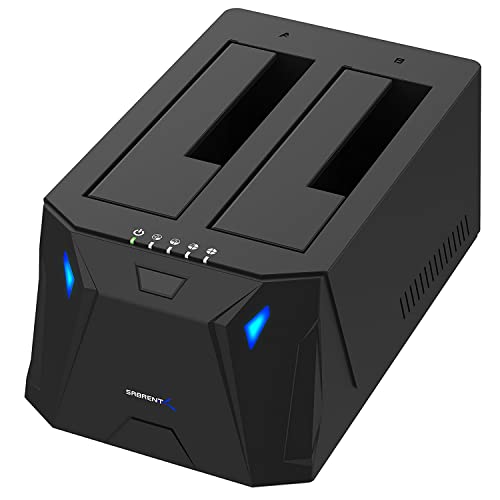
- Clones drives offline without a PC
- Works with 2.5"/3.5" SATA HDDs and SSDs
- Also functions as a USB 3.0 docking station
Best For: People who want a simple dock-and-clone setup
IT Pro Eraser & Copier
StarTech SATDUP11 Standalone Duplicator

- Offers 3 copy modes and 4 erase modes
- Supports secure erase and 3-pass overwrite
- Includes LCD navigation and copy verification
Best For: IT teams that need cloning and sanitizing in one device
Four-Bay Clone Dock

- Holds up to four SATA HDDs or SSDs
- Includes offline clone functionality
- USB 3.0 dock with trayless drive access
Best For: People who want a multi-drive dock with basic cloning
Image Library Duplicator
StarTech SATDUP11IMG Image Manager

- Manages a disk image library on one drive
- Supports 4 duplication modes
- Works with SATA HDDs and SSDs of any capacity
Best For: System builders and IT pros managing reusable disk images
Offline Clone and USB Dock
SABRENT Dual-Bay USB-C Hard Drive Docking Station & Cloner

- No-computer SATA cloning
- Dual-bay USB dock for two drives
- Supports 2.5-inch and 3.5-inch SATA HDDs/SSDs
Best For: People who want an easy offline cloner and dual-bay dock in one unit
IT-Pro Sector Copier
StarTech Dual-Bay 2.5/3.5in SATA Duplicator Dock
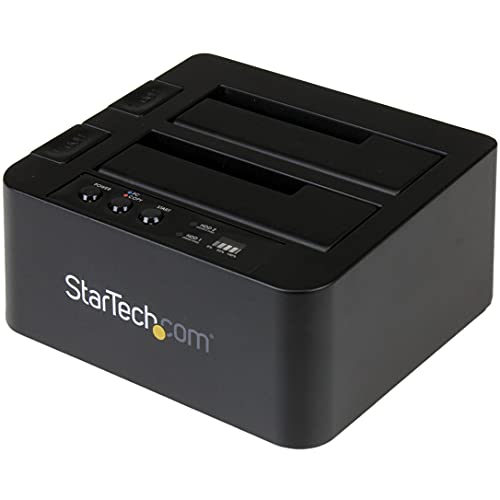
- Standalone sector-by-sector cloning
- Dual-bay dock with USB access
- Supports 2.5-inch/3.5-inch SATA drives
Best For: IT pros who need a no-PC duplicator with dock-style access
Standalone Copy and Erase Station
Systor 1:1 HDD/SSD Hard Drive Duplicator/Eraser

- Standalone cloning and erasing
- Supports 2.5-inch and 3.5-inch SATA HDDs/SSDs
- DoD 5220.22-M sanitization support
Best For: Users who need a simple copier plus secure erase function
Standalone SATA/IDE Cloning Pick
DupliM 1:1 SSD HDD SATA IDE Cloner

- Stand-alone sector-by-sector cloning
- Supports SATA, IDE, and optional adapter formats
- Sanitizes up to 2 HDDs with verify
Best For: Mixed SATA/IDE environments that need cloning and wiping without a computer
High-Capacity Multi-Drive Copier

- Copies multiple drives at once in standalone mode
- Supports 3.5-inch and 2.5-inch HDDs/SSDs
- Includes DoD 5220.22-M sanitization
Best For: IT teams that need simultaneous copying and wiping in a standalone unit
IT-Grade Docking Cloner
StarTech 4-Bay Hard Drive Duplicator

- Standalone clone, erase, and dock functions
- Supports 2.5/3.5-inch SATA drives plus IDE adapters
- Includes Quick Erase and Secure Erase modes
Best For: IT professionals needing a multifunction SATA duplicator and docking station
Dual-Bay Offline Cloner – SABRENT USB 3.0 Dual Bay Dock
If you want one of the more flexible hard drive duplicators for everyday storage work, this SABRENT dual-bay dock is a practical pick. It handles 2.5″ and 3.5″ SATA HDDs or SSDs, supports offline cloning, and doubles as a USB 3.0 dock for transfers and drive access.
Best For: Users who want a dual-bay dock that can clone drives without a computer and also serve as a simple USB storage station.
Pros:
- Supports 2.5″ and 3.5″ SATA HDDs and SSDs
- Offline cloning works without drivers or software
- USB 3.0 connection supports transfer speeds up to 5Gbps
- Supports drives up to 10TB each, with 20TB total listed capacity
Cons:
- Offline cloning is listed at up to 60Mbps, which is not especially fast
- Best suited to SATA drives rather than broader interface support
For buyers who want a simple, plug-and-play hard drive duplicator with docking functionality, this model covers the basics well. It is a straightforward option if you value convenience and compatibility over advanced duplication features.
IT Pro Eraser & Copier – StarTech SATDUP11 Standalone Duplicator
This StarTech model is built for serious hard drive duplicators and sanitizing tasks, especially when you need standalone control. It supports 2.5″ and 3.5″ SATA HDDs and SSDs, offers multiple duplication modes, and includes several erase options for drive cleanup and disposal workflows.
Best For: IT professionals who need a standalone copier and eraser with verified cloning and secure wipe options.
Pros:
- Three duplication modes, including sector-by-sector and system/file copy
- Four erase modes, including secure erase and 3-pass overwrite
- Up to 14 GB/min duplication speed
- LCD menu with copy-and-compare verification support
Cons:
- More specialized than a basic dock or consumer cloner
- Supports only two drives at a time
If your priority is controlled duplication plus proper drive sanitization, this unit stands out for its mode selection and verification tools. It is especially useful for deployment, recovery, and end-of-life drive handling.
Four-Bay Clone Dock – SABRENT DS-U3B4 4-Bay Dock
For buyers comparing hard drive duplicators that also work as multi-drive docks, this four-bay SABRENT model is a strong utility option. It supports up to four 2.5″ or 3.5″ SATA HDDs and SSDs, offers USB 3.0 connectivity, and includes an offline clone function for direct drive-to-drive copying.
Best For: Users who need a four-bay dock for drive access and occasional offline cloning.
Pros:
- Supports up to four SATA HDDs or SSDs
- Offline clone function works without a computer
- USB 3.0 host connection supports up to 5Gbps transfers
- Trayless design makes drive insertion quick and simple
Cons:
- Clone mode is a single offline function rather than a full duplicator feature set
- Designed more as a dock than a dedicated duplication appliance
This is a good fit if you want one station for drive handling, backups, and quick cloning. It is especially appealing when you value flexibility across multiple drives more than advanced copier controls.
Image Library Duplicator – StarTech SATDUP11IMG Image Manager
This StarTech duplicator is geared toward imaging workflows, making it a specialized choice among hard drive duplicators. It can clone drives, back up and restore images, and manage a disk image library on a single drive, which is useful for deployment and repeat system setup.
Best For: IT specialists and system integrators who need a standalone duplicator with image library management.
Pros:
- Built-in image library manager for backup and restore workflows
- Supports four duplication modes, including sector-by-sector
- LCD menu and LED indicators help manage drive operations
- Supports 2.5″/3.5″ SATA HDDs and SSDs, any capacity
Cons:
- More niche than a standard copier for everyday use
- Only supports one target drive at a time
If your job involves keeping reusable disk images ready for deployment, this model offers a focused workflow. It is less about bulk cloning and more about managing a portable image library with standalone hardware.
Offline Clone and USB Dock – SABRENT Dual-Bay USB-C Hard Drive Docking Station & Cloner
If you want hard drive duplicators that can also serve as a everyday USB dock, the SABRENT EC-CH2B is a straightforward choice. It clones one SATA drive to another without a computer, and it also mounts both drives over USB so you can access files from either bay when connected to a PC or Mac.
Best For: Users who want a simple offline cloner plus a dual-bay dock for 2.5-inch and 3.5-inch SATA drives.
Pros:
- Offline one-touch cloning with no computer required
- Supports both 2.5-inch and 3.5-inch SATA HDDs and SATA SSDs
- Dual-bay design lets both drives mount separately over USB
- Hot-swappable, tool-free setup with an LED for each bay
Cons:
- Does not support IDE/PATA, M.2, or NVMe drives
- Target drive must be the same size as the source or larger
- Offline cloning is limited to up to 60MBps by design
Overall, this is a practical pick if you need a compact duplicator that doubles as a dock. The included USB-C cable and plug-and-play operation make it easy to use, but buyers should confirm they are working with SATA drives only.
IT-Pro Sector Copier – StarTech Dual-Bay 2.5/3.5in SATA Duplicator Dock
For hard drive duplicators aimed at professional workflows, the StarTech SDOCK2U313R stands out for standalone sector-by-sector cloning and USB dock functionality. It copies SATA drives without a computer, and it can also be used as a USB-to-SATA adapter for quick drive access over USB.
Best For: IT professionals or advanced users who need a standalone SATA duplicator with dock-style access.
Pros:
- Standalone sector-by-sector duplication with no computer needed
- Supports 2.5-inch and 3.5-inch SATA HDDs and SSDs of any capacity
- Can also function as a USB-to-SATA dock for drive access
- Includes USB-C/A cables, universal power adapter, and 2-year warranty
Cons:
- Target drive must be equal to or larger than the source
- IDE support requires a separate adapter sold separately
- All-drive sector copying includes empty sectors, which may be slower than file-only copies
This is a strong fit if you want a duplicator built around compatibility and admin-friendly features like 4Kn and TRIM support. It is especially appealing when you need a no-PC cloning tool that also works well as a dual-bay dock.
Standalone Copy and Erase Station – Systor 1:1 HDD/SSD Hard Drive Duplicator/Eraser
If your priority is a focused hard drive duplicator that can also sanitize drives, the Systor SYS101HS-DP keeps things simple. It works without a computer or software, copies 2.5-inch and 3.5-inch SATA HDDs and SSDs, and adds an erase mode for drive disposal or reuse.
Best For: Users who need a standalone copier and eraser for SATA hard drives and SSDs.
Pros:
- No computer or software required
- Supports both 2.5-inch and 3.5-inch SATA HDDs and SSDs
- Can copy data only or a whole drive
- Includes erasure mode with DoD 5220.22-M sanitization support
Cons:
- Copy speed is up to 90MB/s, which is modest for large jobs
- Limited to SATA drives
- Single-purpose design is less flexible than dock-and-clone units
This model makes sense when duplication and secure wipe functions matter more than extras. It is a practical no-frills option for business or personal use, especially if you want a standalone unit with lifetime technical support.
Standalone SATA/IDE Cloning Pick – DupliM 1:1 SSD HDD SATA IDE Cloner
DupliM 1:1 SSD HDD SATA IDE Cloner Duplicator and Hard Drive Sanitizer Burner Cloner Stand-Alone
Check Price On AmazonIf you want a straightforward hard drive duplicators option that works without a PC, the DupliM 1:1 is built for sector-by-sector cloning and drive sanitizing in a stand-alone format. It handles 3.5-inch IDE and 3.5/2.5-inch SATA drives, and it also supports 2.5-inch IDE HDDs, mSATA SSDs, and M.2 NGFF SATA SSDs with optional adapters.
Best For: Technicians or small shops that need a no-computer duplicator for SATA and IDE drives with sanitation support.
Pros:
- Stand-alone sector-by-sector cloning, so no software or host computer is required
- Supports SATA and IDE drives, plus optional adapter support for mSATA and M.2 NGFF SATA SSDs
- Can sanitize up to 2 HDDs at once with 1-pass or 3-pass wipe options and verify
- Works with drives up to 8TB and includes U.S.-based tech support
Cons:
- mSATA and M.2 NGFF SATA support requires optional adapters sold separately
- Best suited to 3.5-inch IDE and 3.5/2.5-inch SATA drives rather than broad modern NVMe use
This model is a practical fit if your workflow still includes mixed legacy and SATA hardware, especially when cloning and sanitizing need to happen directly at the unit. Its feature set is focused and useful, but the optional adapters are important to factor into the setup.
High-Capacity Multi-Drive Copier – Systor 1:5 HDD/SSD Duplicator
The Systor 1:5 is a stand-alone choice for buyers comparing hard drive duplicators that can copy multiple drives at once while also handling sanitization. It works with 3.5-inch and 2.5-inch drives without adapters, and its stated transfer speed stays the same even as the load increases.
Best For: Users who need simultaneous multi-drive copying and wipe capability in a fully standalone unit.
Pros:
- Copies multiple HDDs or SSDs simultaneously without needing a computer
- Supports both 3.5-inch and 2.5-inch drives without an adapter
- Rated up to 90MB/s transfer speed, or 5.4GB per minute
- Includes duplication and sanitization, with DoD 5220.22-M compliant erasing
Cons:
- Listed memory storage capacity is 3TB, which may not suit larger modern drive planning
- At 26 pounds, it is a heavy unit for frequent transport
This is a strong fit when throughput and standalone operation matter more than portability. It is especially useful for IT environments that need reliable copying, full-drive wiping, and drive-format flexibility in one box.
IT-Grade Docking Cloner – StarTech 4-Bay Hard Drive Duplicator
The StarTech.com 4-bay model is a versatile hard drive duplicators option for cloning, erasing, and docking SATA drives in one standalone device. It supports sector-by-sector copying, Quick Erase, and Secure Erase, and it also includes USB and eSATA connectivity for use as a docking station when you need fast drive access.
Best For: IT professionals who want a standalone cloner, eraser, and docking station for SATA drives.
Pros:
- Performs standalone cloning and erasing of 2.5/3.5-inch SATA drives
- Also functions as a docking station for quick USB or eSATA access
- Supports Quick Erase and Secure Erase, with NIST SP 800-88 Rev 1 Purge support
- Includes IDE cable adapters for 40-pin 3.5-inch and 44-pin 2.5-inch drives
Cons:
- Target disk must be equal to or larger than the source disk
- Cloning speed is listed up to 4.2 GB/min, which may trail some faster specialized units
For teams that want a multifunction dock as much as a duplicator, this StarTech unit is a practical fit. It is best viewed as an IT tool first, with strong standalone erase and clone features backed by clear menu controls and professional support.
How We Picked These Hard Drive Duplicators
We prioritized standalone operation, broad drive support, cloning speed, bay count, and the usefulness of extra features like secure erase, image management, and docking mode. We also looked at whether each unit fits common workflows for SATA HDDs and SSDs without relying on a host computer.
Quick Comparison
For straightforward one-to-one cloning, dual-bay models are usually the easiest and most affordable. If you regularly process several drives at once, 4-bay units can improve throughput and reduce downtime. Image-capable and eraser-focused models are better for deployment or data sanitization tasks, while USB-C and USB 3.0 docks are most convenient when you want both cloning and everyday drive access.
Key Buying Factors for Hard Drive Duplicators
Drive Compatibility
Check support for 2.5-inch and 3.5-inch SATA drives, plus SSD compatibility if you plan to work with mixed media. If you still handle legacy systems, confirm whether IDE support is included.
Clone Mode and Speed
Duplication speed matters most when you copy drives often or in batches. Faster units can noticeably cut turnaround time, but real-world speed still depends on the source drive and interface.
Bay Count and Workflow
Dual-bay Hard Drive Duplicators suit one-off clones and small repair jobs. Four-bay systems are better when you need higher volume, multi-destination copying, or a more efficient bench setup.
Erase and Image Features
If you handle retired drives, look for secure erase or sanitization modes. Image management is useful when you deploy the same system image to multiple machines or want a more controlled workflow than direct disk-to-disk cloning.
Connection Type and Usability
USB 3.0, USB-C, and eSATA support can make the dock more flexible for daily use. A clear LCD and simple buttons also matter, especially if the device will be shared across a team.
Who Should Buy Which Hard Drive Duplicators?
Choose a dual-bay cloner if you want the simplest setup for occasional duplicates or drive migrations. Pick a 4-bay model if your priority is scale and you regularly manage several disks at once. For IT asset disposal, a duplicator with erase functions is the better fit. If you want one tool for both cloning and general drive access, a docking-style model is the most versatile option.
In short, the best Hard Drive Duplicators are the ones that match your drive types, volume, and workflow—not just the highest speed number on the spec sheet.