The best network audio player with hard drive can bring streaming services, stored music, and high-resolution playback together in one flexible component. The products in this roundup range from compact streamers to feature-rich players with DACs, CD drives, touchscreens, and expandable storage.
Before choosing, consider how you store music, which streaming platforms you use, the outputs your amplifier requires, and whether you want a simple source component or an all-in-one system hub.
Best 10 Network Audio Player with Hard Drive Picks for 2026
Expandable Hi-Fi Hub

- CD player and network streamer in one unit
- Dual drive bays support up to 8TB
- Supports AirPlay, DLNA, and DSD512
Best For: CD collectors building a high-resolution digital library
Versatile Touchscreen Streamer
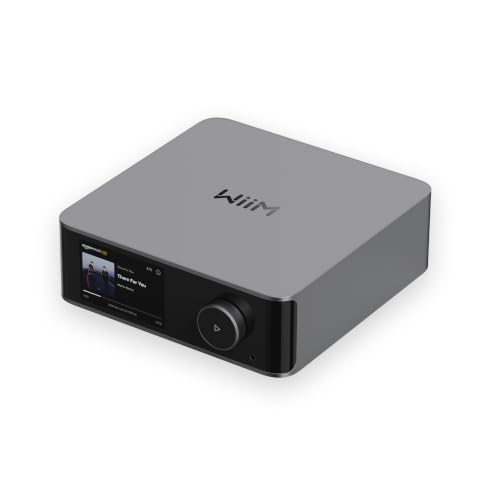
- ESS DAC with playback up to 24-bit/192kHz
- Supports NAS, DLNA, and home media servers
- Includes HDMI ARC, phono, and headphone outputs
Best For: External-library and multiroom streaming setups
Focused Stereo Network Player

- Wi-Fi and Ethernet streaming with UPnP
- Supports 24-bit/192kHz, MQA, and DSD128
- RCA, coaxial, and optical outputs
Best For: Arcam Radia stereo systems and external music libraries
Premium Multiroom Streamer

- Dual-mono ESS DACs with balanced XLR outputs
- BluOS multiroom, AirPlay 2, and HDMI eARC
- THX AAA headphone amplifier and color display
Best For: High-end multiroom systems using a NAS or digital library
Premium Streaming Choice

- SABRE Reference DAC for high-resolution stereo sound
- Streaming services, AirPlay 2, Chromecast, and Bluetooth
- HDMI eARC plus extensive digital connectivity
Best For: Hi-fi systems needing premium network streaming and TV integration
Storage-Focused Streamer

- Up to 4TB SSD expansion for local music libraries
- Android 14 with 5.5-inch touchscreen
- NAS, cloud, AirPlay, DLNA, and broad format support
Best For: Users prioritizing expandable storage and flexible music management
All-in-One Network Receiver
Yamaha R-N600A Network Receiver

- Network streaming with integrated stereo amplification
- USB playback supports high-resolution DSD and PCM
- Adds phono, optical TV, Wi-Fi, Ethernet, and MusicCast
Best For: Traditional stereo systems needing streaming and amplification together
Best Digital Transport
Fosi Audio S3 Lite Music Streamer
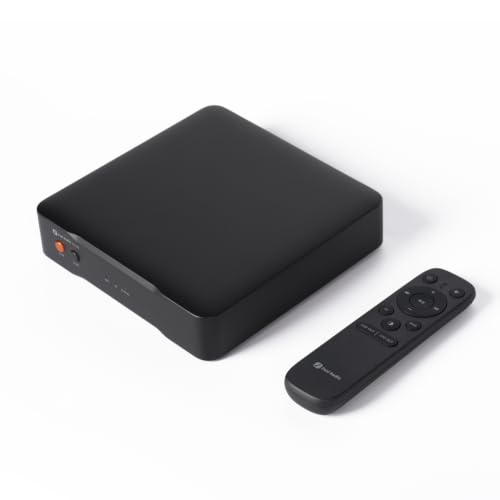
- High-resolution digital output up to 32-bit/768kHz
- Supports AirPlay 2, DLNA, Spotify, TIDAL, and Qobuz
- Compact design with no built-in DAC or storage
Best For: Adding network streaming to an existing DAC-based stereo
Best Premium All-in-One

- Combines streamer, DAC, CD player, and analog preamp
- Supports DSD512 and major lossless streaming platforms
- Includes Wi-Fi 6 and SFP fiber networking
Best For: Centralizing high-end digital and CD playback in one component
Best Built-in Storage Support
KAIBOER DMP-K8 Plus Audio Streamer

- Dual 2.5-inch SATA and M.2 bays support up to 8TB
- Combines streaming, DAC, amp, CD player, and preamp
- 7.8-inch touchscreen with Wi-Fi 6 and DSD512 support
Best For: Managing a large local music library alongside streaming services
Expandable Hi-Fi Hub – DMP-K8 Streamer and CD Player
If you want a network audio player with hard drive support and physical media playback, the Kaiboer DMP-K8 combines a CD player, high-resolution streamer, and expandable storage in one component. Its dual drive bays support up to 8TB, while DLNA, AirPlay, Spotify Connect Lossless, TIDAL Connect, and other services provide flexible access to digital music.
Best For: Audiophiles who want CD playback, high-resolution streaming, and substantial local storage in one chassis.
Pros:
- Built-in 2.5-inch SATA and M.2 bays support up to 8TB of storage.
- Combines CD playback with DLNA, AirPlay, and streaming-service support.
- Supports up to 768kHz/32-bit audio and DSD512.
- Offers USB, HDMI, and optical connectivity plus app control.
Cons:
- Does not include a headphone jack.
- Its large feature set may be more than needed for a basic streaming setup.
The DMP-K8 is the closest match here to a true network audio player with hard drive functionality. Choose it when internal expansion and CD playback matter as much as streaming performance.
Versatile Touchscreen Streamer – WiiM Ultra
The WiiM Ultra is a flexible network audio player for systems that already use a NAS, home media server, or other external music library. It provides a touchscreen, Wi-Fi 6, Ethernet, a premium ESS DAC, and extensive analog and digital connections, although it does not have an internal hard drive.
Best For: Users who want a polished streamer with broad connectivity, room correction, and support for external network storage.
Pros:
- ESS ES9038 Q2M DAC supports playback up to 24-bit/192kHz.
- Includes USB, optical, coaxial, RCA, HDMI ARC, phono, and headphone connections.
- Supports NAS, DLNA, home media servers, TIDAL Connect, Qobuz Connect, and Roon Ready operation.
- Offers multiroom playback, room correction, and independent EQ settings.
Cons:
- No internal hard drive or drive bay is listed.
- It is incompatible with AirPlay and cannot act as an AirPlay receiver.
The WiiM Ultra is a strong choice if “hard drive” means accessing music stored on a NAS rather than installing storage inside the player. Its connection panel also makes it easy to integrate into mixed analog and digital systems.
Focused Stereo Network Player – Arcam Radia ST5
The Arcam Radia ST5 is a straightforward network audio player for a dedicated stereo system. It streams over Wi-Fi or Ethernet, supports USB media playback and UPnP, and sends audio through analog RCA or digital S/PDIF. It does not include a built-in hard drive, so local storage must come from USB or a network source.
Best For: Owners of compatible Arcam amplifiers who want a clean, focused streaming source with simple stereo outputs.
Pros:
- Supports high-resolution playback up to 24-bit/192kHz, plus MQA and DSD128.
- Provides stereo RCA, coaxial, and optical outputs.
- Works over Wi-Fi or Ethernet and supports USB media playback and UPnP.
- Comms link enables coordinated control with compatible Radia amplifiers.
Cons:
- No internal hard drive or storage bay is listed.
- Its strongest system integration is with compatible ARCAM Radia amplifiers.
The ST5 is best viewed as a dedicated network source rather than a network audio player with hard drive storage. It suits buyers who prioritize uncomplicated stereo integration and already have music stored elsewhere.
Premium Multiroom Streamer – Bluesound NODE ICON
The Bluesound NODE ICON is a premium wireless network audio player designed for streaming services, personal digital libraries, and whole-home playback. It has no internal hard drive, but it can work with networked libraries and offers dual-mono DACs, balanced XLR outputs, HDMI eARC, AirPlay 2, and BluOS multiroom control.
Best For: Audiophiles who want high-end streaming, BluOS multiroom capability, balanced outputs, and a dedicated headphone amplifier.
Pros:
- Dual ESS SABRE ES9039Q2M DAC design with balanced XLR outputs.
- Supports AirPlay 2, aptX Adaptive Bluetooth, HDMI eARC, and BluOS multiroom playback.
- Includes a 5-inch color display and THX AAA headphone amplification.
- Dirac Live room correction is available as an upgrade.
Cons:
- No internal hard drive or drive bay is listed.
- Dirac Live requires an additional upgrade and calibration microphone.
The NODE ICON is a compelling alternative when network access and system-wide playback are more important than built-in storage. Pair it with a NAS or other digital library for a sophisticated, expandable listening setup.
Premium Streaming Choice – Cambridge Audio CXN100 SE
The Cambridge Audio CXN100 SE is a strong choice if you want a network audio player with hard drive connectivity through USB audio sources rather than built-in storage. It combines high-resolution streaming, broad wireless support, HDMI eARC, and a SABRE Reference DAC for a flexible hi-fi setup.
Best For: Hi-fi listeners who want premium network streaming, TV integration, and broad service compatibility.
Pros:
- ESS ES9028Q2M SABRE32 Reference DAC for detailed stereo playback.
- Built-in Spotify Connect, TIDAL Connect, Qobuz Connect, and Deezer.
- HDMI eARC, AirPlay 2, Chromecast built-in, Bluetooth, USB, coaxial, and TOSLINK connectivity.
- Roon Ready support, multi-room compatibility, and a large high-resolution color display.
Cons:
- It does not list an internal hard drive or built-in music storage.
- Operation is centered on a mobile app rather than a touchscreen interface.
The CXN100 SE is best suited to an existing amplifier-and-speaker system where sound quality and connectivity matter more than onboard storage. If your goal is a polished network audio player with hard drive access, confirm that your preferred USB or external-storage workflow is supported before buying.
Storage-Focused Streamer – HYFIOO DM100 Music Streamer
The HYFIOO DM100 is the closest match here for shoppers seeking a network audio player with hard drive expansion. Its Android 14 platform, 8GB of memory, 64GB of storage, and support for up to a 4TB SSD make it practical for large local music libraries as well as streaming.
Best For: Listeners who want expandable music storage, touchscreen control, and access to local, network, cloud, and streaming sources.
Pros:
- Supports SSD expansion up to 4TB for high-resolution music storage.
- 5.5-inch LCD touchscreen with landscape or portrait modes and adjustable brightness.
- Dual-band Wi-Fi 6, Bluetooth 5.4, NAS, cloud storage, AirPlay, and DLNA support.
- Wide format compatibility, library organization, CUE splitting, and USB optical-drive support.
Cons:
- Apps requiring Google Mobile Services are not supported.
- The SSD expansion limit is 4TB; larger expansion memory should not be used.
- Third-party app support may require more setup than a dedicated service-based streamer.
The DM100 stands out when local storage is a priority, especially for users with extensive FLAC, DSD, WAV, or other supported files. Its Android-based flexibility is useful, but buyers should account for the lack of GMS services and verify that their preferred apps work as expected.
All-in-One Network Receiver – Yamaha R-N600A Network Receiver
The Yamaha R-N600A is a network receiver rather than a standalone network audio player with hard drive storage. It is designed to power a connected hi-fi system directly, adding network streaming, USB playback, phono input, and an integrated DAC without requiring a separate amplifier.
Best For: Listeners building a traditional stereo system with streaming, vinyl, TV audio, and speaker power in one chassis.
Pros:
- ESS SABRE ES9010K2M Ultra DAC supports high-resolution playback.
- USB and network playback support DSD up to 11.2 MHz and PCM up to 384 kHz.
- Dedicated phono input for connecting a turntable.
- Optical TV input, MusicCast, Bluetooth, Ethernet, Wi-Fi, and Spotify support.
Cons:
- It does not list a built-in hard drive or expandable internal storage.
- Its receiver design may be unnecessary if you already own a separate amplifier.
- The supplied notes identify Spotify but do not list a broad range of built-in streaming services.
The R-N600A is a sensible choice for a complete stereo setup where amplification and source flexibility are more important than onboard storage. For a true network audio player with hard drive capability, look to a storage-focused streamer such as the DM100 instead.
Best Digital Transport – Fosi Audio S3 Lite Music Streamer
The Fosi Audio S3 Lite is a compact network audio player with hard drive alternatives for listeners who already have a DAC, amplifier, or local music-storage setup. It focuses on clean digital output, high-resolution wired connections, and broad streaming compatibility rather than built-in conversion or storage.
Best For: Upgrading an existing stereo with network streaming while keeping your preferred external DAC.
Pros:
- Supports high-resolution output up to 32-bit/768kHz through LAN-connected USB playback.
- Works with Google Cast, AirPlay 2, DLNA, Spotify Connect, TIDAL Connect, and Qobuz Connect.
- Includes Wi-Fi 6, Bluetooth 5.3, optical, coaxial, USB, LAN, and a 12V trigger.
- Compact design and app-based EQ make it easy to fit into desktop or home-stereo systems.
Cons:
- No built-in DAC, so an external converter or compatible digital-input component is required.
- It does not provide built-in hard-drive storage.
- USB sampling rates vary by connection, and USB and optical output cannot be used simultaneously.
The S3 Lite is best viewed as a flexible digital bridge, not a complete music library server. Its low-profile design and wide protocol support make it a practical choice for modernizing older equipment, provided your system already includes the necessary DAC and storage.
Best Premium All-in-One – EVERSOLO DMP-A8 Master Gen 2
The EVERSOLO DMP-A8 Master Gen 2 is a high-end network audio player with hard drive expansion handled externally rather than through a listed internal drive bay. It combines a streamer, DAC, CD player, and analog preamp, making it suited to systems where one central component should manage digital and physical sources.
Best For: Audiophiles seeking a feature-rich streamer, DAC, CD player, and preamp in one chassis.
Pros:
- Combines streaming, AKM-based DAC processing, CD playback, and analog preamplification.
- Supports formats including FLAC, WAV, APE, and DSD512.
- Offers Wi-Fi 6, Ethernet, SFP fiber networking, and broad service support including Spotify Connect Lossless, TIDAL Connect, and Qobuz Connect.
- Custom CD playback and ripping system adds a convenient physical-media option.
Cons:
- The supplied details do not identify an internal hard-drive bay or built-in storage capacity.
- Its substantial chassis may be more component than a simple streaming setup requires.
- The product is positioned as a premium system component and may be excessive for basic wireless playback.
The DMP-A8 Gen 2 is a versatile control center for a serious two-channel system. It does not match the brief of a player with clearly specified internal hard-drive storage, but its CD functionality, network options, DAC, and preamp reduce the need for multiple separate boxes.
Best Built-in Storage Support – KAIBOER DMP-K8 Plus Audio Streamer
The KAIBOER DMP-K8 Plus is the closest match here to a network audio player with hard drive support. Along with streaming, DAC, amplification, CD playback, and app control, it includes 2.5-inch SATA and M.2 drive bays that support up to 8TB of storage.
Best For: Building a locally stored music library with streaming, CD ripping, and large-screen control.
Pros:
- Supports dual internal drive types—2.5-inch SATA and M.2—with storage capacity up to 8TB.
- Combines streamer, DAC, amplifier, preamp, CD player, and DAP functions.
- Offers 32-bit/768kHz playback, DSD512 support, Wi-Fi 6, AirPlay, DLNA, and Spotify Connect Lossless.
- Large 7.8-inch touchscreen displays album art, lyrics, spectral analysis, and playback information.
Cons:
- Drive storage is supported but may require installing compatible drives separately.
- The supplied notes say the app connects over Wi-Fi, while the unit does not have Bluetooth functionality.
- Its many integrated features may be unnecessary for listeners who only want a basic network transport.
For shoppers prioritizing local library storage, the DMP-K8 Plus is the most directly aligned option in this roundup. Its drive-bay support, CD ripping, touchscreen, and broad streaming features make it a capable hub, though its all-in-one design requires more space and setup than a simple streamer.
How We Picked the Best Network Audio Player with Hard Drive
We compared these 10 models by looking at their storage support, network connectivity, audio format compatibility, DAC capabilities, control options, and system integration. We also considered whether each player is best suited to a traditional hi-fi system, a desktop setup, a multi-room environment, or a more complete digital music system.
Because a true built-in hard drive is not standard across this category, check each specification carefully. Some models provide internal memory, dual-drive support, USB storage access, or network-library playback rather than a factory-installed hard disk. That distinction matters if you want locally stored music available without relying on a computer or NAS.
Quick Comparison
| Best For | Look For | Notable Features |
|---|---|---|
| Simple streaming upgrade | Dedicated streamer with strong app support | Wi-Fi, AirPlay, Chromecast, and multi-room compatibility |
| Local music libraries | Storage expansion or broad network-file support | Internal memory, USB, SSD support, or NAS access |
| High-resolution playback | Advanced DAC and format support | DSD, PCM, balanced outputs, and low-noise circuitry |
| All-in-one systems | Integrated amplification, CD, or preamp functions | Fewer separate components and simpler cabling |
Key Buying Factors for a Network Audio Player with Hard Drive
Storage and Library Access
Confirm whether the player includes a hard drive, accepts an SSD, supports USB drives, or connects to a NAS. Check supported file systems, maximum drive capacity, and whether the control app can browse large libraries efficiently.
Streaming and Network Features
Look for the services you actually use, along with Wi-Fi stability, wired Ethernet, AirPlay 2, Chromecast, DLNA, Roon compatibility, or proprietary multi-room support. Ethernet is often preferable for high-bitrate files and busy home networks.
Outputs and Audio Hardware
Match the outputs to your amplifier or active speakers. Analog RCA, balanced XLR, optical, coaxial, USB, and HDMI options each serve different systems. A high-quality DAC matters most when using the player’s analog outputs; if you use an external DAC, digital output flexibility may matter more.
Usability and Long-Term Support
A responsive app, clear display, reliable firmware updates, and easy playlist management can make a bigger daily difference than headline sample-rate figures. Also check warranty coverage and the manufacturer’s history of maintaining its software platform.
Who Should Buy Which Network Audio Player with Hard Drive?
Choose a compact streamer if you already own a capable amplifier and primarily want convenient access to online services. A model with a touchscreen suits listeners who prefer direct control without reaching for a phone. Buyers with extensive local libraries should prioritize storage expansion, USB playback, or dependable NAS integration.
For a premium stereo system, consider a player with a refined DAC, balanced outputs, and strong clocking or power-supply design. If you want fewer boxes, an integrated receiver or player with amplification, CD playback, or preamp functionality may be the better value. Finally, verify the exact storage configuration before ordering: “Network Audio Player with Hard Drive” can describe a storage-ready design rather than a unit that includes an installed hard disk.