The best handheld field recorders make it easier to capture interviews, rehearsals, location sound, lectures, and live performances without carrying a full studio setup. The right model can provide cleaner audio, more reliable controls, and better input flexibility than a phone or basic voice recorder.
This roundup compares 10 portable recorders across several use cases, including casual voice recording, music production, filmmaking, podcasting, and professional field work. Pay close attention to microphone configuration, input count, recording format, storage, battery life, and how easily each device fits your workflow.
Best 10 Handheld Field Recorders Picks for 2026
Best All-Around Choice

- 32-bit float, four-track recording
- Two XLR/TRS inputs plus stereo mics
- USB-C recording with SD backup
Best For: Musicians, podcasters, filmmakers, and flexible field recording
Best for Voice Notes
EVISTR L357 Digital Voice Recorder

- 64GB storage for extensive recordings
- Voice activation with adjustable sensitivity
- WAV/MP3 recording and USB-C transfer
Best For: Lectures, meetings, interviews, and everyday voice capture
Best for Multi-Input Recording

- Six-track 32-bit float recording
- Four XLR/TRS inputs and X/Y mics
- Interchangeable capsule system
Best For: Multi-source music, video, podcast, and live-event recording
Best Adjustable-Mic Option
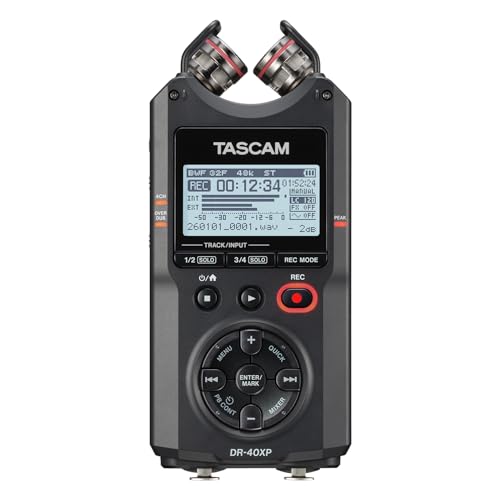
- Adjustable A-B or X-Y condenser mics
- Four-channel 32-bit float recording
- Two XLR/TRS inputs and USB-C interface
Best For: Music, video, and interviews requiring flexible mic positioning
Flagship Field Sound

- Large 19.4mm X/Y mics
- 32-bit float, clip-free recording
- Up to four tracks at 192kHz
Best For: Filmmakers and musicians needing flexible, high-resolution field recording
Everyday Content Capture

- Compact X/Y stereo recording
- 32-bit float audio
- USB-C microphone mode
Best For: Creators, podcasters, and musicians needing portable recording and USB connectivity
Long-Running Classic

- Over 20 hours on two AA batteries
- WAV up to 24-bit/96kHz
- Built-in tuner, metronome, and recording tools
Best For: Musicians and field users prioritizing battery life and onboard functions
Flexible Stereo Pick
Xvive XV1-R Portable Stereo Recorder

- 32-bit float stereo recording
- X/Y mics handle up to 130 dB SPL
- USB microphone and WAV/AAC support
Best For: Stereo recording, content creation, and USB audio
High-Headroom Pro Pick

- Up to six tracks plus stereo mix
- 32-bit float and look-ahead limiters
- Mics handle up to 140 dB SPL
Best For: Multitrack film, music, and demanding field sessions
Compact XLR Pick
Zoom H1 XLR 2-Channel Recorder

- Two XLR/TRS combo inputs
- 32-bit/96kHz recording
- SDXC support up to 1TB
Best For: Portable two-source interviews, podcasts, and music
Best All-Around Choice – Zoom H4 Essential
The Zoom H4 Essential is a versatile option for shoppers comparing handheld field recorders for music, interviews, podcasts, video audio, and live performances. Its built-in stereo microphones, two XLR/TRS inputs, four-track recording, and 32-bit float capture make it suitable for both simple and more involved setups.
Best For: Musicians, podcasters, filmmakers, and creators who need built-in mics plus external-input flexibility.
Pros:
- 32-bit float recording helps provide clip-free audio across demanding takes.
- Built-in stereo microphones and two XLR/TRS inputs support varied recording setups.
- Can record to an SD card while connecting to a phone, tablet, or computer over USB-C.
- Spoken menu guidance can make operation more accessible.
Cons:
- Requires two AA batteries.
- Its four-track design may be more capability than needed for basic voice notes.
Choose the H4 Essential if you want one recorder for field recording and creative production, with useful connectivity and a backup-to-SD workflow.
Best for Voice Notes – EVISTR L357 Digital Voice Recorder
The EVISTR L357 is a compact choice among handheld field recorders for lectures, meetings, interviews, and everyday voice capture. It combines a built-in microphone, voice activation, playback controls, and 64GB of storage in a small metal-bodied recorder.
Best For: Students, teachers, professionals, writers, and anyone recording spoken material.
Pros:
- 64GB storage can hold up to 4,660 hours at the stated 32Kbps setting.
- Voice activation can reduce silent sections and conserve storage.
- Supports WAV and MP3 recording, playback, A-B repeat, and variable playback speed.
- USB-C transfer works with Windows and Mac computers.
Cons:
- It uses a built-in microphone rather than XLR/TRS inputs for external microphones.
- Voice activation may not suit recordings where continuous room ambience is important.
For spoken-word recording and convenient file management, the L357 emphasizes simplicity, long stated battery life, and high storage capacity rather than multi-input production.
Best for Multi-Input Recording – Zoom H6 Essential
The Zoom H6 Essential is a strong fit for shoppers who need more input capacity from handheld field recorders. It offers six-track 32-bit float recording, built-in X/Y microphones, four XLR/TRS combo inputs, and interchangeable microphone capsules for adaptable music, interview, and live-event workflows.
Best For: Bands, filmmakers, podcasters, and location crews recording several sources at once.
Pros:
- Six-track 32-bit float recording helps preserve distortion-free takes.
- Four XLR/TRS inputs accommodate multiple vocals, instruments, or other sources.
- Interchangeable capsule design supports different stereo recording scenarios.
- Functions as a USB audio interface while recording a backup to SD card.
Cons:
- Requires four AAA batteries.
- At 450 g, it is heavier than the supplied H4 Essential.
- Optional capsules may be needed for expanded microphone configurations.
The H6 Essential is the better choice when input count and expansion matter more than minimal size, especially for multi-source productions.
Best Adjustable-Mic Option – TASCAM DR-40XP
The TASCAM DR-40XP is a practical choice among handheld field recorders for creators who want adjustable microphones and four-channel flexibility. Its A-B or X-Y condenser mic positions, two XLR/TRS inputs, 32-bit float recording, and USB-C interface support music, video, and interview workflows.
Best For: Musicians and location creators who want flexible stereo mic positioning with external-input support.
Pros:
- Adjustable A-B or X-Y microphones provide recording-position flexibility.
- Four-channel recording can combine the built-in mics with external inputs.
- 32-bit float recording and ultra-low-noise HDDA preamps target clean audio capture.
- USB-C provides a 2-in/2-out audio interface for computer or compatible mobile setups.
Cons:
- microSD card and batteries are not included.
- The supplied notes do not specify the battery type or runtime.
Consider the DR-40XP if adjustable stereo capture and simultaneous internal-and-external recording are central to your workflow.
Flagship Field Sound – Zoom H5 Studio
The Zoom H5 Studio is a strong choice among handheld field recorders for filmmakers, musicians, and users who need detailed audio with flexible recording options. Its large X/Y microphones, 32-bit float recording, dedicated gain controls, and up to four-track recording support make it well suited to demanding location work.
Best For: Filmmakers, musicians, and field recording setups that need clip-free audio and multi-track flexibility.
Pros:
- Large 19.4mm X/Y stereo microphones for detailed sound and wide dynamic range
- 32-bit float recording helps preserve takes in changing environments
- Dedicated gain knobs provide quick, precise level adjustments
- Records up to four tracks at up to 192kHz, with two XLR/TRS inputs
Cons:
- Uses four AA batteries, which is more than the smaller models here
- Its feature set may be more than casual users need
Choose the H5 Studio when sound quality, hands-on control, and expansion matter more than minimizing size. Battery operation and a lightweight 14.4-ounce design keep it practical for location recording.
Everyday Content Capture – Zoom H1 Essential
The Zoom H1 Essential is a compact option for handheld field recorders, offering clear stereo capture for content, interviews, music, ambience, and everyday documentation. Its 32-bit float recording and USB-C microphone mode add useful flexibility for creators working with cameras, computers, smartphones, and calls.
Best For: Content creators, podcasters, students, and musicians who want a small recorder that also works as a USB microphone.
Pros:
- X/Y stereo microphones capture voices, music, and environmental sound clearly
- 32-bit float recording supports clip-free capture
- USB-C microphone mode works for livestreams, meetings, calls, and voiceovers
- Lightweight 92-gram design and up to 10 hours of battery life support mobile use
Cons:
- Uses two AAA batteries, with shorter stated operation than the H2n
- Its stereo format is less suited to users seeking multi-track recording
The H1 Essential is a practical all-rounder when portability and simple operation are priorities. It is especially convenient for creators who want one device for portable recording and USB-connected audio.
Long-Running Classic – Zoom H2n Renewed
The renewed Zoom H2n remains a versatile pick among handheld field recorders for users who value long battery life and built-in recording tools. It records WAV up to 24-bit/96kHz or MP3 up to 320kbps and includes features such as a lo-cut filter, compressor/limiter, auto gain, pre-record, tuner, metronome, and variable-speed playback.
Best For: Musicians, students, and field users who want extensive onboard functions and long operation from standard AA batteries.
Pros:
- Offers over 20 hours of operation with two AA batteries
- Supports WAV recording up to 24-bit/96kHz and MP3 up to 320kbps
- Includes practical tools such as auto gain, pre-record, limiter, tuner, and metronome
- Provides playback and file tools including A-B repeat, markers, file dividing, and normalization
Cons:
- This is a renewed product rather than a new unit
- Its listed recording specifications do not include 32-bit float recording
- The 1.8-inch screen is smaller than the H1 Essential’s listed display
The H2n is a sensible value-oriented choice if extended battery life and hands-on utility features matter most. Consider it for rehearsals, lessons, and general recording where 24-bit/96kHz WAV is sufficient.
Flexible Stereo Pick – Xvive XV1-R Portable Stereo Recorder
The Xvive XV1-R is a compact choice among handheld field recorders for musicians, podcasters, filmmakers, and general-purpose audio capture. Its stereo X/Y microphones, 32-bit float recording, and automatic recording features make it practical when input levels may change unexpectedly.
Best For: Stereo recording, concerts, speeches, ambient sound, voice memos, and USB-based online audio.
Pros:
- 32-bit float recording helps reduce distortion from incorrect gain settings.
- X/Y microphones handle sound levels up to 130 dB SPL.
- Supports WAV recording up to 96 kHz plus space-saving AAC options.
- Works as a USB microphone with computers, iOS devices, and Android devices.
Cons:
- No headphone jack is listed for direct monitoring.
- Uses two AA batteries and has a maximum file size of 4GB before automatic splitting.
The XV1-R offers a useful balance of portability, flexible formats, and easy level management. It is especially appealing if you want a straightforward stereo recorder that can also serve as a USB microphone.
High-Headroom Pro Pick – Zoom H6 Studio Handy Recorder
The Zoom H6 Studio is a strong option for handheld field recorders when you need multiple tracks and substantial headroom. It records up to six individual tracks plus a stereo mix, while its 32-bit float workflow and look-ahead limiters are designed for demanding film, music, and location sessions.
Best For: Filmmakers, musicians, and field sessions requiring multitrack recording and high sound-pressure-level handling.
Pros:
- Records up to six individual tracks plus a stereo mix in 32-bit float.
- 19.4mm microphones handle up to 140 dB SPL.
- Supports sample rates from 44.1 to 192 kHz.
- Provides up to 15 hours of operation on four AA batteries.
Cons:
- At 1.05 pounds, it is heavier than the compact recorders in this roundup.
- The supplied details identify USB 2.0 connectivity but do not specify other included connection options.
With multitrack capacity, broad sample-rate choices, and robust level protection, the H6 Studio is built for users who need more control than a basic stereo recorder provides. Its larger size may be worthwhile for complex location setups.
Compact XLR Pick – Zoom H1 XLR 2-Channel Recorder
The Zoom H1 XLR is a compact handheld field recorder for users who want two external microphone or instrument connections without a complicated setup. It combines 32-bit/96kHz recording with two XLR/TRS combo inputs, a waveform display, and 3.5mm connectivity for interviews, podcasts, and music work.
Best For: Two-source interviews, podcasts, musicians, and portable recording with microphones or instruments.
Pros:
- Two XLR/TRS combo inputs accommodate microphones, instruments, and other sources.
- 32-bit/96kHz recording supports detailed audio capture.
- OLED waveform display provides a quick view of recording levels.
- Supports SDXC cards up to 1TB and includes 3.5mm input and headphone output.
Cons:
- Its two-channel design is less suited to larger multitrack sessions.
- Battery life is listed at up to 10 hours, shorter than the H6 Studio’s stated runtime.
The H1 XLR is a practical middle ground for creators who need professional-style inputs in a small recorder. Its waveform display and broad storage support add convenience for mobile interviews and two-source productions.
How We Picked the Best Handheld Field Recorders
We focused on recorders that offer a practical balance of audio quality, portability, controls, connectivity, and value. The selection includes compact stereo recorders for quick capture, multitrack models with XLR/TRS inputs, and newer options with 32-bit float recording for greater protection against unexpected volume changes. We also considered whether each recorder suits a distinct buyer, from students and interviewers to musicians, podcasters, and filmmakers.
Product names and specifications can vary by bundle, retailer, and regional version, so confirm included accessories, storage support, power requirements, and firmware features before ordering.
Quick Comparison
| Best For | What to Prioritize | Recommended Type |
|---|---|---|
| Lectures and meetings | Simple operation, voice activation, long battery life | Compact digital voice recorder |
| Music and rehearsals | Stereo microphones, high-quality WAV recording | Two- or four-channel handheld recorder |
| Film and interviews | XLR inputs, headphone monitoring, low-noise preamps | Recorder with professional mic inputs |
| Changing sound levels | 32-bit float recording and fast controls | Modern 32-bit float recorder |
| Mobile podcasting | USB audio capability, flexible inputs, portability | Recorder that doubles as an audio interface |
Key Buying Factors for Handheld Field Recorders
Microphones and Input Configuration
Built-in X/Y or mid-side microphones are convenient for stereo ambience, rehearsals, and location recordings. If you plan to use lavaliers, shotgun microphones, mixers, or studio microphones, choose a model with the required XLR/TRS inputs and phantom power. Count the channels you need now rather than buying solely for maximum input capacity.
Recording Format and Headroom
WAV recording preserves more editing flexibility than compressed formats. 32-bit float can be especially useful when recording unpredictable sources because it provides substantial headroom during post-production, but it does not replace good microphone placement or a quiet recording environment. AAC or MP3 support may be convenient for quick sharing.
Monitoring, Storage, and Power
A headphone output, visible level meters, and physical gain controls make it easier to catch problems while recording. Check whether the recorder uses microSD or another removable format, what card capacity it supports, and whether batteries, USB power, or both are available. For field work, carry spare batteries or a tested power bank.
Portability and Workflow
Smaller recorders are easier to keep available, while larger units generally provide more inputs and controls. USB microphone or audio-interface functionality can reduce the amount of equipment needed for computer-based podcasting and streaming.
Who Should Buy Which Handheld Field Recorders?
Choose a compact voice recorder if your priority is lectures, meetings, notes, or interviews and you want minimal setup. Choose a small stereo recorder for portable music practice, ambient sound, and quick content creation. Choose a four- or six-channel model if you record multiple microphones, instruments, or external sources. Choose a 32-bit float recorder when changing sound levels and fast, low-stress capture matter most. Filmmakers and serious podcasters should prioritize XLR inputs, monitoring, phantom power, and dependable physical controls over the smallest size.