The best portable DACs with headphone amps can make phones, laptops, and handheld gaming devices sound cleaner while providing more power for demanding headphones. The right model depends on whether you prioritize a tiny USB dongle, Bluetooth convenience, balanced output, tuning controls, or maximum driving power.
We compared these 10 options across connectivity, output formats, amplification, portability, and practical features to help you choose a compact upgrade that matches your headphones and listening habits.
Best 10 Portable Dacs with Headphone Amp Picks for 2026
Best Balanced Dongle

- Dual ESS DACs with balanced circuit design
- 4.4mm output delivers up to 241mW
- Supports PCM 384kHz and native DSD256
Best For: High-resolution USB-C listening with balanced output
Best Wireless Option

- Bluetooth supports LDAC and aptX formats
- 3.5mm and 4.4mm headphone outputs
- PC, Bluetooth, and phone operating modes
Best For: Wireless and USB listening across multiple devices
Best High-Power Model

- Up to 600mW through balanced 4.4mm
- Ten-band persistent parametric EQ
- Eco and Boost power modes
Best For: Driving demanding headphones with extensive EQ control
Best Feature-Rich Dongle
FiiO KA15 DAC and Headphone Amp

- Desktop Mode offers 560mW+560mW balanced power
- Ten-band PEQ with profile sharing and storage
- Color LCD and support for DSD256
Best For: Portable listening with detailed controls and customization
Most Versatile Wireless DAC/Amp

- Bluetooth 5.4 with LDAC and aptX Lossless
- Dual ES9069Q DACs and THX AAA 78+ amps
- 3.5mm, 4.4mm, PC, Bluetooth, and phone modes
Best For: Multi-device listeners wanting wireless and wired flexibility
Best Pocket Audiophile Dongle

- Current Mode Amplification for low-distortion playback
- 3.5mm and 4.4mm outputs with manual gain
- MFi certified with PCM 768kHz/32-bit and DSD512
Best For: Wired lossless listening across phones and computers
Best High-Power Compact Dongle

- Up to 550mW balanced output in desktop mode
- Dual CS43131 DACs and dual SGM8262 op-amps
- Compact USB-C design with 3.5mm and 4.4mm outputs
Best For: Portable setups needing extra headphone-driving power
Tube Warmth Pick
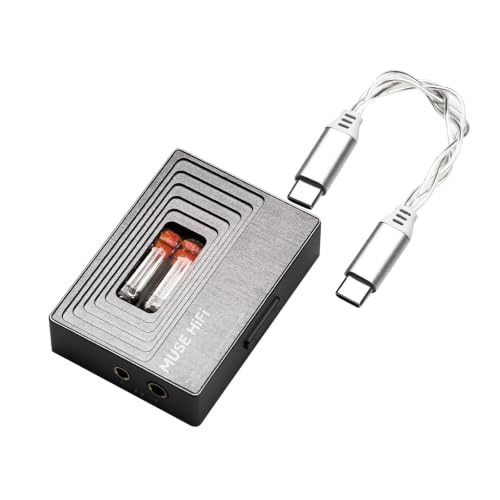
- JAN6418 tube hybrid amplification
- 460mW/480mW 3.5mm and 4.4mm output
- PCM 384kHz and DSD256 support
Best For: Listeners wanting portable power with tube-inspired warmth
DSP Tuning Pick

- App-based parametric DSP equalizer
- Dual CS43198 DAC chips
- 3.5mm and 4.4mm outputs
Best For: Listeners who want detailed EQ and volume control
Everyday Dongle Pick

- Up to 170mW per channel at 32 ohms
- 3.5mm and 4.4mm outputs
- 60-step volume control with memory
Best For: Simple USB-C listening across phones and computers
Best Balanced Dongle – iFi Go Link Max
The iFi Go Link Max is a compact choice for listeners seeking portable DACs with headphone amp functionality and both 3.5mm and balanced 4.4mm connections. Its dual-DAC design, USB-C plug-and-play setup, and support for high-resolution PCM and DSD make it well suited to phones, tablets, and other USB-C devices.
Best For: Listeners who want a small USB-C dongle with balanced output and high-resolution format support.
Pros:
- Dual ESS Sabre DACs use a balanced circuit design.
- Balanced 4.4mm output provides up to 241mW of power.
- Supports up to 32-bit/384kHz PCM and native DSD256.
- Flexible cable and included USB-A adapter improve compatibility.
Cons:
- Requires a USB-C source device and does not list wireless connectivity.
- Its 15g design is focused on portability rather than extensive onboard controls.
The Go Link Max is a straightforward pick when you want balanced wired output in a lightweight form. Dynamic Range Enhancement and THD compensation add useful processing, while the flexible cable helps reduce stress on the source device’s USB socket.
Best Wireless Option – FiiO BTR13 Bluetooth DAC/Amp
The FiiO BTR13 expands the usual portable DAC and headphone amp setup with Bluetooth, USB DAC operation, and separate PC, Bluetooth, and phone modes. It supports a broad range of wireless codecs and includes both 3.5mm unbalanced and 4.4mm balanced headphone outputs.
Best For: Users who want one compact DAC/amp for phones, computers, and Bluetooth listening.
Pros:
- Supports LDAC, aptX Adaptive, aptX HD, AAC, SBC, and other Bluetooth formats.
- Dual CS43131 DACs dedicate one converter to each stereo channel.
- Offers 3.5mm and 4.4mm headphone outputs.
- Built-in EQ options can be adjusted through FiiO’s app or web interface.
Cons:
- Bluetooth and USB DAC operation are specified up to a 96kHz sampling rate.
- It is not water resistant.
- The supplied specifications list a 3.5mm jack and 4.4mm balanced jack, but not a line-level output.
At 28.6g, the BTR13 balances portability with flexible connectivity. Its independent amplifier power system and stated 220mW+220mW balanced output make it a strong option for users who do not want to remain tethered to a USB cable.
Best High-Power Model – Protocol Max Portable DAC-Amp
The Protocol Max is aimed at listeners who need substantial amplification from portable DACs with headphone amp capabilities. It combines dual Cirrus Logic CS43198 DACs, dual SGM8262-2 amplifier chips, balanced and single-ended outputs, and a stated 600mW of balanced power.
Best For: Headphone enthusiasts who need high output power and persistent parametric EQ in a portable aluminum unit.
Pros:
- Balanced 4.4mm output is rated for up to 600mW.
- Includes both 4.4mm balanced and 3.5mm single-ended connections.
- Ten-band parametric EQ profiles can be saved directly to the device.
- Eco and Boost modes let users prioritize battery life or output performance.
Cons:
- At 110g, it is heavier than a typical lightweight dongle.
- It is not water resistant.
- Its advanced EQ setup uses a PC browser rather than an additional app.
The Protocol Max stands out for power and customization rather than minimum size. Its low 0.2-ohm impedance, dual output options, and selectable power modes make it a versatile wired companion for both sensitive IEMs and more demanding headphones.
Best Feature-Rich Dongle – FiiO KA15 DAC and Headphone Amp
The FiiO KA15 packs unusually broad functionality into a small wired DAC and headphone amplifier. Along with dual CS43198 DACs and dual SGM8262 op-amps, it offers a color display, ten-band PEQ, dynamic power management, and a desktop mode for increased balanced output.
Best For: Enthusiasts who want a compact USB dongle with a screen, advanced EQ, and high-power desktop mode.
Pros:
- Desktop Mode provides stated balanced output of 560mW+560mW.
- Ten-band PEQ supports saving, importing, exporting, and sharing EQ curves.
- 0.96-inch IPS color display provides settings and playback information.
- Supports up to 768kHz/32-bit audio and DSD256.
Cons:
- Desktop Mode is intended for greater power and may not be the most battery-conscious setting.
- It relies on USB connectivity and does not list wireless operation.
- The supplied product information does not specify separate 3.5mm and 4.4mm output power figures.
The KA15 is a strong fit for buyers who value control as much as sound hardware. Its screen and app-controlled PEQ make adjustments convenient, while intelligent power monitoring is designed to reduce unnecessary drain on the connected phone.
Most Versatile Wireless DAC/Amp – FiiO BTR17
The FiiO BTR17 is one of the most feature-rich portable dacs with headphone amp capabilities, combining Bluetooth 5.4, USB DAC operation, and smartphone tail-DAC use. Its dual ES9069Q DACs, THX AAA 78+ amplification, 3.5mm and 4.4mm outputs, and up to 650mW output make it a flexible choice for both everyday wireless listening and more demanding headphones.
Best For: Listeners who want one portable DAC/amp for Bluetooth, computer, and smartphone use.
Pros:
- Supports LDAC, aptX Adaptive, aptX Lossless, and Bluetooth 5.4.
- Offers PC, Bluetooth, and phone modes with automatic power optimization.
- Includes dual ES9069Q DACs, hardware DSD512 decoding, and full MQA decoding.
- Provides 3.5mm unbalanced and 4.4mm balanced outputs with up to 650mW power.
Cons:
- At 0.24 kg, it is less lightweight than a simple USB dongle.
- Its extensive PEQ and connection options may be more than casual listeners need.
The BTR17 stands out when flexibility and output power matter as much as portability. Desktop mode can power the unit through USB while it operates as a phone-connected tail DAC/amp, making it particularly useful across multiple listening setups.
Best Pocket Audiophile Dongle – Questyle M15i
The Questyle M15i is a compact USB DAC and headphone amplifier aimed at high-fidelity playback from phones, tablets, computers, and laptops. Its patented Current Mode Amplification, dual outputs, manual gain adjustment, and support for PCM up to 768kHz/32-bit and DSD512 give it strong credentials for lossless listening on the go.
Best For: Users seeking a lightweight wired DAC/amp with broad device compatibility and adjustable gain.
Pros:
- Patented Current Mode Amplification is designed for low distortion and fast transient response.
- Offers both 3.5mm single-ended and 4.4mm balanced outputs.
- Manual gain adjustment suits sensitive IEMs and more demanding full-sized headphones.
- MFi certified and compatible with iOS, Android, Windows, Macs, and other listed devices.
Cons:
- It is a wired USB DAC/amp rather than a Bluetooth model.
- Lightning-device users need an additional officially certified adapter.
The M15i is a focused choice for listeners who prefer a direct USB connection and want control over gain and output type. Its wide compatibility and included USB-C accessories make it convenient for modern phones and computers.
Best High-Power Compact Dongle – FiiO/JadeAudio KA13
The FiiO/JadeAudio KA13 packs a 3.5mm and 4.4mm headphone amplifier into a small USB-C dongle. With dual CS43131 DACs, dual SGM8262 op-amps, PCM support up to 384kHz/32-bit, DSD256 decoding, and a desktop mode delivering up to 550mW through the balanced output, it is a practical pick for portable power.
Best For: Headphone users who want a compact USB dongle with unusually high balanced-output power.
Pros:
- Desktop mode raises balanced output power to 550mW for low- and high-impedance headphones.
- Uses dual CS43131 DACs and dual low-noise SGM8262 op-amps.
- Provides both 3.5mm and 4.4mm headphone outputs in a compact aluminum body.
- FIIO Control app support enables adjustments for RGB lighting, filters, and SPDIF output.
Cons:
- Its USB-C dongle format does not provide Bluetooth connectivity.
- Desktop mode and its high power may be unnecessary for very efficient earphones.
The KA13 is a strong option when portability does not have to mean low output. Its small design, dual headphone connections, and desktop mode give it the versatility to serve both everyday mobile listening and more power-hungry headphones.
Tube Warmth Pick – MUSEHiFi M3 Ultra
The MUSEHiFi M3 Ultra is a distinctive choice among portable dacs with headphone amp, pairing a JAN6418 vacuum tube with an op-amp hybrid design. It supports both 3.5mm and 4.4mm headphones while offering PCM and DSD playback for compatible phones, tablets, and computers.
Best For: Listeners who want tube-inspired warmth, strong output, and flexible balanced connectivity in a portable DAC/amp.
Pros:
- Hybrid JAN6418 tube and op-amp amplification is designed for smooth vocals and rich harmonics.
- Offers up to 460mW through 3.5mm and 480mW through 4.4mm balanced output.
- Supports PCM up to 32-bit/384kHz and DSD256 through its ES9028Q2M DAC.
- Includes circuit, microphonic, and shock-absorption measures to reduce tube-related noise.
Cons:
- Tube circuitry may be less convenient for listeners who prefer a completely solid-state design.
- Its strongest output specifications are associated with particular test conditions and connections.
The M3 Ultra stands out when sound character matters as much as portability. Its tube hybrid design and dual outputs make it especially versatile for wired IEMs and headphones, though users seeking the simplest dongle may prefer a more conventional option.
DSP Tuning Pick – MOONDROP Dawn PRO 2
The MOONDROP Dawn PRO 2 combines dual CS43198 DAC chips with app-based DSP customization, making it a flexible option among portable dacs with headphone amp. Its 3.5mm and 4.4mm outputs, 100-step volume control, and aluminum housing suit users who want detailed control over their listening setup.
Best For: Headphone listeners who want customizable equalization, smooth volume adjustment, and a compact dual-output DAC/amp.
Pros:
- MOONDROP’s app supports parameterized EQ adjustments for filter type, frequency, gain, and Q value.
- Uses dual Cirrus Logic CS43198 DAC chips and three independent LDO power chips.
- Provides 4Vrms output voltage and 124 + 124mW output for many headphones.
- Aluminum alloy construction and strategically placed vents support heat dissipation.
Cons:
- Its advanced DSP features may be more involved than necessary for plug-and-play users.
- The listed maximum output is lower than some higher-powered portable amplifier designs.
The Dawn PRO 2 is a strong fit for listeners who enjoy fine-tuning their headphones rather than simply adding amplification. Its app-based EQ and refined volume control add flexibility, while the dual outputs cover common wired headphone connections.
Everyday Dongle Pick – Fosi Audio DS2
The Fosi Audio DS2 is a straightforward USB-C option among portable dacs with headphone amp, with dual CS43131 chips, physical volume buttons, and both 3.5mm and 4.4mm outputs. It works with compatible iPhones, iPads, Android devices, computers, laptops, and Macs.
Best For: Mobile and computer listeners who want an easy-to-use USB-C DAC/amp with balanced output and independent volume control.
Pros:
- Supports PCM up to 32-bit/384kHz and DSD256 playback.
- Delivers up to 170mW per channel at 32 ohms and includes 3.5mm and 4.4mm connections.
- Features 60-step volume buttons with volume memory.
- Dual CS43131 DAC chips are paired with a stated 1µV noise floor and 130dB SNR.
Cons:
- The USB-C connection may require an appropriate adapter for devices without USB-C.
- Its compact dongle format offers less output power than some larger portable DAC/amps.
The DS2 emphasizes convenience without giving up balanced connectivity or high-resolution support. It is a practical everyday upgrade for compatible mobile and computer sources, particularly for listeners who value physical volume buttons and simple operation.
How We Picked These Portable Dacs with Headphone Amp
We focused on models that combine digital-to-analog conversion and headphone amplification in a genuinely portable format. Selection criteria included USB and Bluetooth compatibility, available 3.5mm and 4.4mm outputs, rated power, supported high-resolution formats, control options, battery or bus-powered operation, and ease of use with phones and computers.
Specifications are useful, but they do not guarantee a particular sound signature. A well-matched output, low noise with sensitive IEMs, and enough headroom for your headphones generally matter more than the highest advertised sample rate.
Quick Comparison
| Type | Best For | What to Check |
|---|---|---|
| USB-C dongle | Simple phone, tablet, or laptop upgrades | Connector compatibility, power draw, and output selection |
| Bluetooth DAC/amp | Wireless listening and desktop flexibility | Codec support, battery life, latency, and wired USB mode |
| High-power portable amp | Full-size or harder-to-drive headphones | Output power, gain settings, heat, and battery requirements |
| Balanced DAC/amp | Compatible headphones and extra output power | Correct 4.4mm cable and balanced wiring; adapters may not be suitable |
Key Buying Factors for Portable Dacs with Headphone Amp
Connectivity and Device Support
USB-C is the most convenient modern connection, but iPhone users should verify cable and MFi or host compatibility. Bluetooth models are more flexible for phones and computers, while USB operation can provide the best performance and lowest latency.
Output Power and Headphone Matching
Efficient IEMs usually need little power, whereas high-impedance or low-sensitivity over-ear headphones benefit from more voltage and current. Do not choose based on wattage alone: check whether the quoted rating applies to the 3.5mm or 4.4mm output and at what impedance.
Balanced Output, Noise, and Controls
A 4.4mm balanced output can offer additional power, but it requires compatible headphones and does not automatically improve sound quality. Sensitive IEM users should also look for low background noise, useful gain settings, volume buttons, and reliable channel balance at low listening levels.
Features and Portability
Equalization, display controls, digital filters, DSD support, and multiple codecs can be valuable, but they may increase size, cost, or battery use. Check dimensions, cable strain relief, phone power consumption, and whether the device gets warm during extended use.
Who Should Buy Which Portable Dacs with Headphone Amp?
- Choose a small USB-C dongle if you want the simplest, lightest upgrade for a phone or laptop.
- Choose a Bluetooth model if you want to keep your phone in your pocket or switch easily between wireless and wired sources.
- Choose a high-power balanced model if you use demanding full-size headphones and can accept a larger device.
- Choose a feature-rich DAC/amp if PEQ, display controls, multiple outputs, or detailed customization matter as much as size.
- Choose a low-noise compact option if your main headphones are sensitive IEMs and portability is the priority.
Before buying, confirm your device connector, headphone plug, desired listening mode, and power needs. Matching those basics will usually produce a better result than paying extra for specifications you will not use.